Showing posts with label school choice. Show all posts

Monday, June 24, 2024

interesting insight from Arizona

 In a report in The New Yorker from Arizona on a violent death of a young man by a gang in a wealthy, majority white town, there's an interesting insight into what school choice and vouchers may be doing to kids: 

Several parents told me that open enrollment contributes to a sense of unrootedness in the East Valley. That feeling was compounded when, in 2022, Arizona became the first state to implement a universal school-voucher program. Students can now have their pick of strip-mall schools, online religious homeschooling programs, or “traditional academies”—charter schools that emphasize discipline and often boast Roman columns out front. The voucher program was designed to help poor children leave failing schools, but a large majority of the money has gone to wealthy families whose children were already enrolled in private education. (The program has also led to a funding crisis for the state, which currently faces a budget shortfall of more than eight hundred million dollars.) “It’s really eroded the sense of community and destabilized what was already a pretty destabilized system,” Beth Lewis, the director of Save Our Schools Arizona, a public-schools advocacy group, said. “Parents will get frustrated with something going on, rightly or wrongly, and they just say, ‘Forget it, I’m going down the street.’ ” Weinberger, a former elementary-school principal, told me, “Schools have to uphold this image to maintain their enrollment. And, because there’s so much competition, principals are encouraged to minimize issues to keep enrollment numbers up.”

Wednesday, May 15, 2024

Let's talk about these Senate budget amendments

They were due Friday, but I only got through them yesterday. Debate doesn't begin until Monday, though, so you still have time to contact your Senator's office to enlist their endorsement. As the Senate sorts their amendments by topic, you can find all the education-related ones here.

As per usual, if you're looking for earmarks, you're on your own: these are ones that impact more than one district and in K-12. Opining, as per usual, is entirely mine. 
Also there are several "let's have a foundation budget review!" amendments, which I am going to give their own blog post. 

On inflation:
Amendment 743 just straightforwardly adds the $217M (Thank you, Senator Moore!) which is the amount the jointly endorsed MASC/MASS/MTA/AFT-MA solution would cost.

Amendment 758 puts in $100M for "inflation relief," though it specifies that it would not go into base aid in future years, which rather misses the point.

The rest of these don't fix anything for this year:
Amendment 735 would establish an escrow bank, where any year where inflation was over 4.5%, the difference would be "banked" to be distributed in years when it was less.
Amendment 644 uses the calculation requested, but starts it in 2026. 
Amendment 798 uses the calculation requested, and, while it doesn't specify 2026, since it conflicts with the language the budget outlines, per Section 3, it wouldn't go into effect this year. 

Other Chapter 70 and core aid related things:
Showing his usual zest for amendment, Senator Tarr has submitted Amendments 615 for $125, 618 for $120, and 619 for $110 per pupil minimum aid. And this is your ongoing reminder that every increase makes it more likely that fewer districts will escape hold harmless during the implementation of SOA remaining, and that this funding has no relation to student or municipal need.

Amendment 666 is chapter 70 "extraordinary relief" of $18.5M, targeted only at places where the required local contribution is more than 30% of local revenue

Amendment 799 is $5M in relief "municipalities who rank in the lowest 10% of municipalities in both of the following categories: (i) total per-pupil dollar expenditure; and (ii) actual net school spending." This means it won't be the highest need districts, as those have required per pupil expenditures that are higher.

School choice:
Amendment 720 would raise the per pupil amount of a school choice student from $5000 to $7500.

Rural aid:
Amendment 631 would raise it from $15M to $17.5M

METCO:
Amendment 635 would raise it from $29.4M to $33M and would also allow funds to be carried to the following December

Charter school facilities:
Amendment 709 would raise the charter school facilities per pupil amount (which comes from a sending district's Chapter 70 aid) to $1288 from $1188

Regional transportation:
Amendments 623 would raise it to $106.5; 661 and 734 and 748 to $121.1M

Special education and circuit breaker:
Amendment 705 would phase in circuit breaker being 100% reimbursement of the "extraordinary" costs, with 75% for FY25 moving to 80% in FY26, 90% in FY27, 95% in FY28, and 100% in FY29, but would immediately put 100% into place for any children whose parents or guardians do not reside in Massachusetts or who are placed outside their hometown.

Amendment 639 would study the delivery of special education services

Vocational:
Amendment 611 would move the CTE line from $2.5M to $3.5M; 711 to $4.5M

Amendment 663 would move transportation reimbursement for out of district vocational from $1M to $2M

Amendment 751 would require a vocational admissions lottery

Amendment 752 would create vocational annexes to comprehensive high schools in cities

Amendment 755 would create a commission on such annexes

Advanced Placement:
Amendment 622 would increase the AP math and science line from $2M to $3.3M

Amendment 654 would require state colleges and universities to take an AP score of 3, 4, or 5 for credit

Early college:
Amendment 708 would take the early college line from $3M to $3.5M

Amendment 731 would create a five year strategic plan on early college in the state

Sex ed
Amendment 756 would require biannual collection of sex education in districts in the Commonwealth

Early literacy:
Amendments 687 and 780 would raise the "Literacy Launch" amount from $10M to the $30M that would match the Governor and House

Amendment 787 is the terrible literacy bill that would mandate curriculum be taken from a state list

SEL:
Amendment 640 would increase the SEL line from $6M to $8M

School to career:
Amendment 714 would increase the school to career line from $7.3M to $8.5M

After and out of school:
Amendment 665 would increase the budgeted $8.6M to $10.6M

Diversity in education:
Amendment 689 would student the impact of layoffs of this year and last on teachers of color

MSBA:
Amendment 760 adds "collaboratives" to the study of the MSBA that the Senate included in the outside section (starts on page 67)

Trusts:
Amendment 621 would increase the civics trust from $1.5M to $2.5M

Amendment 750 would increase the genocide trust from $2.25M to $3M


Monday, April 29, 2024

Two on Worcester Public Schools budget (this one on FY25)

At Thursday's Worcester School Committee meeting, we'll get our first high-level glimpse of the administration's recommended FY25 budget. That link is to the agenda; the backup for the report of the superintendent is not yet posted. 
Note of course that this means the budget is on the agenda, so if you have something to say on the budget, it could be a good time to do so. There also will be a (mandated) budget hearing before the Committee deliberates; as the preliminary budget calendar has the projected date for that conflicting with a graduation, I'd imagine it will be rescheduled?

Sunday, May 7, 2023

On the city's FY24 budget

City Manager Batista released his administration's recommended FY24 budget on Friday; you can find it here on the city website.

Maybe I missed it before, but I don't remember this jazzy graphic:

This means Worcester's at least attempting the "what are we trying to do here"
connection on budgeting, which is a good place to start.

The city, per usual (and as some other municipalities do), does again do a sort of smash up version of how funding flows to the district. We get a revenue chart on page 6: 

And yes, that means we as a city get nearly as much in state education aid as we do in property taxes, and that fully 49.5% of our funding comes from the state in one way or another.
(there's also a neat little graphic showing that our state education aid includes both ch. 70 and school choice and charter reimbursement, but if it bothers me greatly that the graphic doesn't use different sized boxes for those three things)


And we have a graphic on page 7 on overall city spending:


...but what we don't have--we will Friday!--is a representation of how much of the education spending comes from city resources, though we do get this note:
Of that total amount, $44.7M provides funding of Charter and Choice schools, leaving a Worcester Public Schools budget of $462.7M. 
Of course, that $44.7M comes nowhere near municipal coffers, moving straight out of our chapter 70 aid to the charter (mostly) and choice schools and districts.

If we did have a representation of local revenue going to the Worcester Public Schools, WPS would come between fixed costs and public safety for FY24, at $138M.

...which is of course the main reason why we in Worcester pay so much attention to the state budget, were among those who filed suit in the late 80's against the state, were among the most active and vocal of districts on the foundation budget reconsideration, and threatened to file suit against the state again just before we finally got the Student Opportunity Act. 

The McDuffy decision, the case on which the state education formula rests, held:
What emerges also is that the Commonwealth has a duty to provide an education for all its children, rich and poor, in every city and town of the Commonwealth at the public school level, and that this duty is designed not only to serve the interests of the children, but, more fundamentally, to prepare them to participate as free citizens of a free State to meet the needs and interests of a republican government, namely the Commonwealth of Massachusetts.
It is the state's duty to provide. That is how we have a standard education formula that not only calculates how much a district must be funded, given the students the district services, but one that calculates--again in a standard way across the state--a community's ability to support that. 

And thus Worcester, like not only its sibling Gateways, but like other districts with high amounts of student poverty with low ability of the local community to contribute is seeing the Student Opportunity Act come through with increases in which the state is carrying the majority of the dollar increases. This is literally what we fought over a decade for. We are majority state funded; we are supposed to be!

That really is something we should be celebrating in this budget. It's year three of a six year implementation. 

In any case, thus, the WPS section of the budget is the dollars allocated to us; it doesn't include costs the city carries that get attributed as school spending. In our case, the largest chunk of that is health insurance, but it also includes water and sewer, things like the city treasurer and purchasing department, and police liaisons. You thus can't just take page 161 and figure out all that goes into the schools.

You can, though, see from how the city attributes the dollar increase; the state said city funding for schools was required to go up by $6.1M over last year's budget as passed (you can pull that out of the state's spreadsheets). Because the City Manager last fall requested, and the Council passed, just under $1M out of free cash to hold the schools' budget harmless when the charter tuition came through as less that was originally budgeted, from our (projected) budget, that looks like $5.1M. 
That amount--$6.1M over budget as passed last year, $5.1M over actual FY23--is what is here. 
That's meeting required net school spending. 

What this doesn't include is the city capital budget, which was the topic of much discussion at our joint City Council Education and F&O meeting earlier this year, and has been part of ongoing discussion among and between the administrations. 

Thursday, March 9, 2023

a few notes on Worcester for FY24 from the Governor's budget

 The gold standard--and what you might think of as the Worcester School Committee's opening round--on this will be the report of the superintendent at next week's meeting (the 16th), when Mr. Allen will give us a preliminary look at the budget numbers. No pun intended. Ahead of that, though, a few quick notes from me:

The preliminary FY24 release from the state sets Worcester's foundation budget at $477,974,879. It's crucial to remember, though, that the foundation budget includes all of the Worcester students who attend charter schools and all of the Worcester students who choice into other districts. The charter tuition for next year is $40.7M; the choice out is $3.7M; those get subtracted from the above, while the reimbursement and the school choice in get added back in. 

IMPORTANT SIDE NOTE: the preliminary calculations were released over February break, prior to the February Board of Ed meeting. As such, the state had to make a choice on which way they'd assume the vote would go on the new charter school.
Is anyone surprised they assumed the Board would vote in favor?


That then is why our charter tuition is up from $33M to $40.7M. That also means our reimbursement--the funding that reimburses for an increase on a three year taper--is also up to $11.3M. School choice in has nearly doubled to $1M (that's 100 more kids choosing to come to Worcester, I think?).

 $477M, or rather $445M or so, once you sort out the above, is a lot of money, so a quick note on where this is coming from. Remember that Worcester is one of the largest gainers under the Student Opportunity Act, and, quite intentionally so: 77.6% of our students are low income. A third of our students are English learners. Thus those pushes within the formula to boost funding in those areas really play out in Worcester's foundation budget.

The thing about the $477M, though, is: who is going to come up with that money? The answer is another indication that the state funding formula is working as intended:

Almost exactly a quarter of the foundation budget is city funded. The vast majority of K-12 school funding in Worcester is state funded.
Thus, while the foundation budget is up $47M, the city carries only $6M of that increase; the remainder is state funded. Again, that is working just as intended: the standard measure of wealth that the state uses demonstrates the Worcester cannot carry the majority of the school budget.

If this interests you at all, tune in March 16! 

Tuesday, August 30, 2022

Learning the parts of a story through a budget update

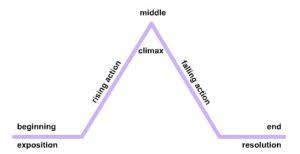
 It's undoubtably partly due to it being back to school week in Worcester, but I was reminded of teaching freshman English in reviewing this week's Worcester School Committee agenda and in particular the FY23 budget update.
Did you learn about the parts of a story in English class?

Remember this? 
Exposition, rising action, climax, falling action, resolution

We open our story with the Worcester School Committee passing an FY23 general fund budget of $417,802,152 back in June. That's the beginning.

The rising action is that Governor Baker then signed a final FY23 state budget on July 28 (yes, four weeks into the fiscal year). 

And here's the climax: that budget funds the Worcester Public Schools at $945,067 less than the budget the Worcester School Committee passed in June. 

Let's stop here for a minute at the top of our plot line and talk about why. 

Chapter 70 aid--state aid for K-12 education in Massachusetts--gets allotted by district. So you can pull up a spreadsheet that says "Worcester is getting $316,240,166 in state aid." 
But that same aid is what supports all of the funding for students from Worcester who go to charter schools, and all of the funding that accompanies students who live in Worcester but use school choice to attend a public school in another town. That gets pulled out of Worcester's state aid before it gets to the Worcester Public Schools.
The state runs an updated assessment when they put together the final state budget numbers, and that includes updated enrollment figures and assessments for both charter and school choice. Thus as Mr. Allen explains: 

Charter school tuition assessments increased by $334,788 in the final state budget, primarily due to transportation assessments for the Learning First Charter School that were not included in prior charter school tuition assessments (an increase of $876,567), offset by a decrease in the projected number of 32 charter school students totaling $541,779.

So the number of students enrolled in charter schools is actually down, but the transportation assessment (the Worcester Public Schools has to either transport or fund transportation for all Worcester students attending Worcester schools, charter, private, or parochial) for Learning First came through at the same time at $876,567...quite an increase in the assessment.

Likewise on choice, we have:

School choice tuition assessments increased by $417,217 in large part based on the final school choice assessment from the prior year, and the final FY22 school choice assessment in June was $96,969 higher than the most recent prior estimate from March—not including virtual school students. Pre-enrollment estimates from the two Commonwealth Virtual Schools for the upcoming school year increased from 149 in FY22 to 171 students in FY23.

What's interesting to me here is that the big jump is from the prior year--FY22--not the current one. 

Thus, we're almost a million dollars down in funding from the budget we passed in June. 
Not a comfortable place to be at all/in August/at any point in the year.

However, here's the falling action to the resolution:

The Acting City Manager has agreed that he will recommend that the City Council appropriate anticipated FY22 Free Cash to fully offset this change in the state budget, thus resulting in no change for the Worcester Public Schools FY23 Budget.

 (You have to admire that we get this after the finance charts in the memo).

Note that this will not happen until the city goes to settle free cash in November, thus we're living in this in between period until then. I believe this is why we have the note on the use of ESSER  funds; otherwise, we'd have to vote to cut our budget, as assurance by the executive of the use of free cash isn't enough to make the numbers reconcile. Nonetheless, much appreciation to Acting City Manager Batista for making that commitment. It's certainly a happier resolution than far too many budget memos I've had reason to blog about! 

Friday, April 17, 2020

Worcester School Committee mid-April meeting notes with lots on finance

I'm still working out how to do this both A) this go-round and B) when I'm doing it from home without a desk. I'm still taking lots of notes, but I'm finding it trickier to type. Because my notes on my blog have always been as much for me as for anyone, though, I'm going to continue to post things from the meetings, even if I have to do it later.
Should you want to take a look, the video is online here. It was, of course, again an entirely remote meeting.

Technically, we had two Worcester School Committee meetings last night: the first was the school choice hearing. This is, note, school choice in to Worcester; school choice out is simply allowed by state law. We actually don't have to have the hearing if we are allowing school choice, and last night, there wasn't a presentation or deliberation; we simply voted in favor of it.

On the regular agenda, the first item was, as I noted earlier this week, Ms. Biancheria's filing of reconsideration of the vote to waive the requirement this spring that students take the AP exam to achieve AP GPA credit. There is no deliberation prior to the vote on reconsideration, and the vote went as the vote on the item itself had gone: 5-2, Biancheria and Monfredo opposed. This, again, means that students who are currently taking an AP course can choose or not to take this spring's AP exam; their Worcester Public Schools GPA will not in any way be impacted by that decision (not taking the exam usually gives only honors level credit).

Our student representative Kwaku Nyarko asked during the section of the agenda that is theirs that we make plans to meet with our student advisory council soon, particularly given the current circumstances. The Mayor agreed, and we haven't set a date, but we'll keep you posted. 

The report of the superintendent was not something that usually happens in April: an update on the next year's budget.
The crux of the problem is this: since our February initial look at FY21, the economy has borne the impact of what UMass Dartmouth Professor Michael Goodman has called "a medically induced coma," in which we have intentionally made choices that have slowed the economy in order to bend the curve of the infections of coronavirus. That may well impact the current fiscal year; it will for certain impact next fiscal year, as was reflected in Tuesday's state economic roundtable (my liveblog is here; the MASC coverage is here). This not only raises questions around Student Opportunity Act funding; it raises questions around regular year to year funding.
I will always tell you watch Worcester Public Schools budget presentations, and this one is no exception; it starts about nine minutes into the video.

Tuesday, March 26, 2019

March Board of Education: charter funding

I was running low on battery today, so I only tweeted out my notes on this charter school funding presentation by Deputy Commissioner Jeff Wulfson, which you can watch here. As I said on Twitter tonight, it's rare that you can watch the Department actively grappling with policy quite like this, with the exception recently of accountability.
Tweets are as follows: 

Monday, March 18, 2019

Joint Committee on Ways and Means on FY20 education funding

We're at Bristol Community College (across the street from Fall River's new Durfee High project) for the Joint Committee on Ways and Means hearing on education accounts. This Committee is jointly chaired by Senator Michael Rodriguez of Westport and Representative Aaron Michelwitz of Boston. Note that generally the administration makes their pitch first, thus we'll hear early on from Lt. Governor Polito, Secretary Peyser, and the three Commissioners (early ed, K-12, and higher ed). 
Posting once we start 
Vice Chair Denise Garlick introduces Rep. Carole Fiola (of Fall River) and Sen. Jason Lewis (of Winchester, Assistant Vice-Chair), who will be co-chairing today. 
President of Bristol Community College welcoming the joint committee...two members from Fall River School Committee and one from New Bedford School Committee here today

Thursday, December 13, 2018

"Yet the stigma persists..."

 On bias among white parents:
A recent study in the journal City & Community based on survey data out of eight metropolitan areas in the U.S. suggests that residents—including, presumably, parents—frequently harbor negative associations with the term “urban” and, by extension, “inner-city” communities and institutions, such as schools. To them these words may connote scenes of educational dysfunction—rows of decrepit classrooms, for example, each stocked with an overworked teacher and a cluster of indignant teens, almost all of them poor students of color.
By contrast, the study pointed to evidence that the term “suburban” tends to elicit images of productivity and well-being among white parents. Of course, these stereotypes that white middle-class parents harbor aren’t simply about population density, but race, with “urban” standing in for predominantly black or Latino. A number of studies have shown that white parents tend to select schools with lower proportions of black students, regardless of school quality.

Tuesday, May 1, 2018

Worcester school meetings this week : UPDATED

And we have a school committee agenda...it only was posted this morning...
There are two subcommittee meetings this week (apologies for not posting earlier):

  • Finance and Operations met last night which appears to have had the auditors in, as well as covered the third quarter report, with transfers coming out of health insurance to cover balances. Note that cutting legal services in a negotiation year was not a good idea. Since WPS seems to be running a rolling agenda, we can't tell what's going to be talked about at a meeting unless there's a backup. That completely negates the reason for having a posted agenda. 
  • Teaching, Learning, and Student Supports this afternoon at 5 is set to cover Mandarin Chinese, girls ice hockey, summer programs, gifted students, and the DOJ agreement. I am told it is cancelled. 
There's also a regular Thursday meeting, which has the postponed report of the superintendent on a FY19 budget update (a week (?) ahead of the FY19 budget going out to the School Committee). 
There are a series of appointments, resignations, and retirements.
There are some recognitions.
There's a response that allowing for school choice siblings automatically to be in the same school would cause space issues. 
There will be (not posted) a response on free driver's ed.
Miss Biancheria would like a schedule of Memorial Day events by school.
Mr. O'Connell would like the district to consider participating in the Massachusetts Assistance Program for Lead in School Drinking Water.
Mr. Comparetto would like the committee to go on record in favor of S.2325, the Foundation Budget Review Commission bill.
And there are two grants for reception: the Increased Quality Summer Learning and Transition Program Grant for $45,000, which will be used for a summer rising kindergartner program at Elm Park and for 7th graders at Forest Grove; and the 21st Century Learning Centers Summer Enhancement Grant for $20,000, for a summer writing and reading program at Sullivan Middle and Burncoat Middle.

There is a 6 pm executive session for negotiations with teachers, tutors, tradesmen, parent liaisons, and plumbers and pipefitters, and two grievances. 
If it looks as though the budget update is happening, I'll try to make it. 

Sunday, April 22, 2018

Worcester School Committee meets Thursday

and there's a BUDGET update! 

Note, first, that it's the annual school choice hearing. This, remember, is school choice IN; school choice OUT of the district is required to be allowed. Generally, the administration's recommendation is "yes, where there is space."

The main agenda is here. Lots of recognitions opening the program (it could be that the National Anthem will be particularly good!).

The report of the Superintendent is an FY19 budget update; as the House budget pushed WPS Ch. 70 aid up nearly a million dollars ($981,951) AND some of the "change in low income" pothole funds would be heading for Worcester (that's $12.5M in the House) PLUS there's discussion of at least FBRC and low income allotments in the amendments...there are things to discuss. Keep your eye on the agenda to see if the backup gets posted before the meeting. Also note that setting a date for the budget hearings is on this agenda; I assume they're the June meetings, but I have yet to see the posting of the public hearing. 

There is an administrative response to the changes in math and ELA frameworks...which is one page? There should be some concern there, as one thing the state called out on the Comprehensive District Review was the lack of implementation of framework changes and of cohesion across the district.

There is a response to a query regarding expanding the 365Z Kindness Club.

The committee is requested to accept:
 - $34.50 to Tatnuck Magnet School from Yankee Candle
- $4,312.20 to Canterbury Street Magnet Computer-Based School from the meat raffle
- $2,000.00 from the Pappas Scholarship Fund to Worcester Technical High School to be awarded to a worthy football student.

And also:
- The Capital Skills grant of $464,616, which looks like it's being used for Graphic Design equipment at Worcester Tech.
- The Preschool Partnership grant of $20,000, which is being used to create a "Child Well-being Dashboard" for the community.

There are requests for recognitions.

Ms. Biancheria would like an organizational chart for when an emergency happens in the district.
She'd also like to know how many subs there are.
She'd like to know when summer work will be done on the schools.
She'd like the Administration "review the section in the Budget regarding Worcester Public Schools’ vehicles and indicate the way in which they are identified as such." I don't know what that means. It was page 175 last year, and it looks pretty clear? 

Mr. Comparetto would like the committee to support House budget amendment 246 (Great idea, but too late!).
And he'd like a report on all early childhood programs.

There are also prior fiscal year payments:
- of $10,848.00 from Additions Network.
- of $65.00 from Miniwarehousing for the rental of a unit at Burncoat High School.
- of $250.00 to Ximena Sanchez-Samper who was a presenter at a Youth and Drugs Conference.

There is an executive session for three grievances and collective bargaining with teachers, tradesmen, plumbers, tutors, and parent liaisons which is weird because the contracts are settled. I wonder what's up. 
No live blog as I have a meeting, but you can bet I'll update on budget as I see anything! 

Friday, September 29, 2017

September Board of Ed in Sum

crossposted from MASC 

The Board of Elementary and Secondary Education held their regular monthly meeting in Malden. The meeting agenda can be found here. 
Prior to the meeting, two new members of the Board were sworn in: Amanda Fernandez, who replaces Penny Noyce, and Martin West, who replaces Roland Fryer. James Morton was also sworn in for a second term. Fernandez is the founder and CEO of Latinos for Education. West is on the faculty of the Harvard Graduate School of Education. 
Chair Paul Sagan participated in the meeting remotely via video from Budapest; the meeting was chaired by Vice Chair James Morton.

Secretary DeVos at Harvard: coverage

You can read her remarks here.
The Globe, with some focus on the hundreds who protested outside, is here.
EdWeek showed up.
Max Larkin discussed her visit on WBUR this morning.
And the Chalkbeat has six takeaways.

Thursday, September 28, 2017

New Board of Ed members

As I mentioned Tuesday, there were two new members of the Board of Ed sworn in before the meeting. The Governor's press release went out later that day and says the following:
About Martin West:
Martin West is an associate professor of education at Harvard Graduate School of Education and a faculty research fellow at the National Bureau of Economic Research. He is also deputy director of the Harvard Kennedy School's Program on Education Policy and Governance and executive editor of Education Next, a journal of opinion and research on education policy. He studies the politics of K-12 education in the United States and how education policies affect student learning and non-cognitive development. In 2014-15, he worked as senior education policy advisor to the ranking member of the U.S. Senate Committee on Health, Education, Labor, and Pensions. He previously taught at Brown University and was a research fellow at the Brookings Institution, where he is now a nonresident senior fellow. He received his Ph.D. in Government and Social Policy from Harvard in 2006 and his master’s in economic and social history from Oxford University in 2000.

About Amanda Fernandez:
In 2016, Amanda Fernandez, co-founded Latinos for Education, a non-profit dedicated to developing, placing, and connecting essential Latino leadership in the education sector. She was previously a vice president of Latino Community Partnerships at Teach For America, where she engaged with the Latino community for recruitment, development and advancement of staff and alumni. She led multiple efforts to highlight the need for Latino leadership in the education sector. While at Teach For America, she launched national summits focused on professional development for Latino staff, and boosted participation from 40 people to more than 300 participants and speakers. She also led the launch of a CEO sponsored Latino Advisory Committee, which fostered leadership and community building within the Latino population at Teach for America. Earlier in her career, she worked as director of organizational consulting at The Bridgespan Group, an organization that helps nonprofit and philanthropic organizations develop strategies and build their organizations. She received her bachelor of arts’ degree from Western Illinois University and a master’s degree from Fordham University.
So what do we need to know?
West is serving out the rest of Roland Fryer's term (which goes through June of 2020). West by far has the larger online footprint. Beyond his work at Harvard, he's easiest to find as the editor of Education Next, which is on the ed-reformy end of things. You can see some of his thinking in the conversation he had this spring on the "Building Excellent Schools," a training organization for charter school leadership. For example:
“For those, like me, who think that the expansion of school choice is a promising way to improve outcomes for American students, charter schooling has proven to be politically more successful, more palatable, and able to benefit from bipartisan support,” he says, pragmatic as ever. “I think it has demonstrated that when the right conditions are in place it can really produce dramatic improvement for students who have been poorly served by traditional school districts.”
His most recent research (that's been discussed popularly) was something over the summer on students not seeing long term negative impact in being held back in school; this is of course in contrast to four decades of research that found that students are harmed by being held back. He also formed the joint research project of Boston charters and MIT and Harvard researchers on character education, funded by the Walton Foundation. You can find his appearances on CSPAN here. Among them are his testimony before the HELP Committee as they considered the revisions to the Elementary and Secondary Education Act. That largely focuses on testing and its impacts; he believes testing is efficacious, as it is reflective of long-term earning ability. Frankly, his testimony is a bit more nuanced than I expected, conceding, for example:
t some evidence suggests that heavy handed test-based accountability policies can promote rote, teacher-directed instruction and encourage schools to focus narrowly on test-preparation skills rather than ensuring that students are exposed to a curriculum rich in academic content. These tendencies may be strongest in schools with high minority and low-income populations, which typically face the strongest pressure to improve (Diamond and Spillane 2005).
and likewise:
the level at which students perform at a given point of time is a poor indicator of school quality, as student achievement is heavily influenced by factors outside of a school’s control. Measures based on the amount students learn from one year to the next can provide a more accurate gauge of schools’ contribution to student learning (Deming 2014).
...which is why he favored testing multiple times in elementary school. That's an argument, note, in favor of measurement of student growth. In the same testimony, he also argued in favor of moving much authority back to the states.
In terms of his political history, he was an advisor to Mitt Romney in his campaign for president, and he worked for Senator Lamar Alexander. He was among those who more than once said he had no interest in working in the Trump administration, however.

Fernandez, who has been appointed to a full five year term, prior to founding Latinos for Education, was the Vice-President for Diversity and Inclusiveness at Teach for America. Prior to that, she worked for Bridgespan in recruiting, which I know will raise concern in some quarters. Latinos for Education describes itself as:
Our mission is to develop, place and connect essential Latino leaders in the education sector. We are building an ecosystem of Latino advocates by infusing Latino talent into positions of influence.
We believe that Latino leaders should be at the forefront of creating an equitable education for Latino students. Latinos for Education prepares nuestra comunidad to break down barriers to educational opportunity for the next generation of Latino students.
Her other local education connection is a seat on the KIPP Massachusetts (charter) advisory board. She was the speaker at the Boston University School of Education convocation this spring, where she spoke of the importance of valuing your identity, working with passion on the struggle, and rising together.

Sunday, September 24, 2017

Secretary DeVos is coming to Cambridge

...as part of a school choice event at the Kennedy School of Government (which seems...odd?), and YES, there is a protest.
The lottery (yes, the fitness of this has been noted) for tickets for her speech can be entered here.
I can't go, but please go make some noise for me! 

Tuesday, December 13, 2016

Know where DeVos is coming from

The NY Times has an op-ed today from Katherine Stewart, which starts to get at the background from which Betsy DeVos comes.
At at 2001 gathering of conservative Christian philanthropists, she singled out education reform as a way to "advance God's kingdom." In an interview, she and her husband, Richard DeVos Jr., said that school choice would lead to "greater kingdom gain."
Edushyster called out a great deal of this in her post from late last week:
Not nearly enough has been made of DeVos’ extreme closeness to the extreme fringes of the Christian right. She and her family have spent decades and millions upon millions to help further the reach of organizations like the Family Research Council, known for its *research* into homosexuality, which, by the way, is not a civil right. While media reports have referred in passing to DeVos’s support for Christian causes, they’ve largely glossed over what these causes are and how deeply enmeshed she is in a world that views homosexuality as immoral and abhorrent. Since her position comes with some responsibilities of the civil rights variety, should we maybe be concerned about this?
Politico covered some of this last week:
During the DeVos interview, the couple talks about a trip to Israel where they learned about a geographical region, called the Shephelah, where battles were fought between the Israelites and Philistines. 
Betsy DeVos then links this topic to education. "It goes back to what I mentioned, the concept of really being active in the Shephelah of our culture — to impact our culture in ways that are not the traditional funding-the-Christian-organization route, but that really may have greater Kingdom gain in the long run by changing the way we approach things — in this case, the system of education in the country," she says.
One of the weaknesses of the American press is around religion, so this has not been a strong point of coverage. Told that DeVos is a Calvinist, many reporters won't make a connection to much of anything else. DeVos is part of the Christian Reformed church, which grew out of Dutch Calvinism. Among that which the Christian Reformed church holds is the Canons of Dort; some may know this as TULIP:

  • Total depravity
  • Unconditional election
  • Limited atonement
  • Irresistible grace
  • Perseverance of the saints  
Wikipedia's summary of this is decent if you're interested. I'll call your attention for now only to the third: the belief that only some have been chosen by God to be saved (and that there is nothing that any person can do to change this) is a troubling position for the person who is in charge of education for every child in the country to hold. Does this mean that there should be a religious test for public service? Of course not. It is, however, a relevant question as to how that applies to her fulfilling her responsibilities for all kids.

Wednesday, November 23, 2016

School choice advocate (and so much more!) Betsy DeVos is Trump's choice for Secretary of Education

So, who is she?
If you want to update your Twitter lists, you can find her account here (she was at 450 followers or so when the announcement came through).
The Chalkbeat did a "five things" that would be indicated by her appointment: her big issue is charters, vouchers, school choice: "The DeVos influence is one reason that Michigan’s charter sector is among the least regulated in the country." That gave us Detroit schools that are here, plus commentary around Michigan education like this. (Let me in general just recommend the Detroit Free Press as a resource) The DeVos family used their political donations to sway lawmakers around school choice and related efforts.
She doesn't oppose Common Core (she's on the Jeb Bush spectrum there), so that looks like another campaign point of Trump that we're taking a miss on (we were anyway, as the federal government has no oversight there, anyway, but we could have gotten someone who was going to complain about it).
They also note "Outside of education, her family gave heavily to efforts to ban same sex-marriage in Michigan." This is in keeping with the donations of the family in general, supporting groups that are against legalized abortion, LBGTQ rights, and the like. (UPDATE) The DeVos family also supports the Acton Institute, which recently gave a ringing endorsement to bringing back child labor; Peter Greene covers this well.
She's been upfront about what she sees her political contributions for; she is directly quoted:
“I know a little something about soft money, as my family is the largest single contributor of soft money to the national Republican Party,” wrote DeVos, according to Mayer. “I have decided, however, to stop taking offense at the suggestion that we are buying influence. Now I simply concede the point. They are right. We do expect some things in return. We expect to foster a conservative governing philosophy consisting of limited government and respect for traditional American values.”
There's an extensive article about the family's giving here (from March). The family is among the top funders of conservative politics in Michigan. Not only that, but they have been active in destroying the other side, as in their efforts to get so-called "right to work" legislation passed in Michigan.
The family wealth, as Politico notes, comes from Amway. Richard DeVos, her husband, is the former president of the company; his father (also named Richard) founded the company. The connections Muckety maps out are fascinating: most notably, her brother founded Blackwater, and apparently now is an advisor to the crown price of Abu Dabai.
It is worth noting from a Massachusetts perspective that vouchers are banned by the state constitution (and remember that the next time the Pioneer Institute starts talking about Know-Nothing clauses. It may have been anti-Catholic when it passed; that doesn't mean that separation of church and state should end).
More as I have it.

Monday, August 15, 2016

Worcester School Committee meetings this week

Two meetings for the Worcester School Committee this week: TLSS and the full committee.
The Teaching, Learning, and Student Supports standing committee is posted as meeting tomorrow at 5:30, but there's no agenda posted online. UPDATE: You can now find it here.
The full committee meets Thursday at 4 pm; you can find the agenda here.
There are a number of recognitions, including Al Ganem, who is now the superintendent of the Hampden-Wilbraham school district.
The report of the superintendent is the annual opening of school report (no link as yet, as the report isn't posted).
Goddard would like a voluntary school uniform (consider this your periodic reminder than any such uniform policy in the public schools must be voluntary, as students are guaranteed the right to an education).
As you may have seen in today's T&G, the nearly annual request for a report on school choice students is on the agenda. Something that appears to be being missed in the reaction thus far is the way the numbers skew older. That somewhat has to do with growing numbers of surrounding districts cutting off on school choice students; once a student has choiced in, they can stay until graduation, so in some districts, only older students who were already in would be allowed. However, it does argue that at least some of these are students who have attended the Worcester Public Schools and left. I don't think a video is going to convince those students that they've missed something.
There is a multiple part response to Miss Biancheria's inquiry on Durham, transportation, the new transportation person, and invoices, including the 23-page contract with Durham.
The administration is (again) asking that an items that the administration doesn't respond to within 24 months be automatically filed. Note that this would allow administration to kill an item they didn't want to report on by letting it age out. I'm not saying that they would; but it would be possible. 
Mr. O'Connell wants a program for gifted students, to know if the annual grant assurances document has been signed, if the guard shack at Burncoat should be removed (can they do South's, too?), to submit a grant request to MSBA for technology, and to...sign warrants?
gb #6-281 - Mr. O’Connell (August 10, 2016) To implement the provisions of the November 1995 letter of the Commissioner of Education, and the Advisory on School Governance which accompanied it, that "the school committee remains the body responsible for approving and transmitting school department expenditures to the municipal accountant for the drawing of warrants. The Department of Revenue's Division of Local Services has advised that all school department bills must be approved by the school committee. When the superintendent, or principal and superintendent, have statutory authority to incur expense, the Department of Revenue advises that the bills must be approved by them as well as by the committee."
Okay, maybe we'll come back to that one...here
Mr. Monfredo wants to thank Houghton Mifflin for a book donation, to UMass Med for a donation to Worcester Tech (which wasn't received by the school committee), a report on the summer programs, to include the Heimlich maneuver in CPR training, to participate in Constitution Day in September, and to recognize a WEC donation.
Miss Biancheria wants a report on the new bus routes.
The administration is forwarding the Substance Use, Treatment, Education and Prevention for related policy changes.
They want to file a list of items requesting reports from Ms. Colorio, Mr. Monfredo, and Mr. O'Connell.
They're requesting acceptance of a $10,000 grant for Career and Technology Education.
There are a series of prior fiscal year payments.
There also is an executive session after the meeting for deliberation around collective bargaining for bus drivers and monitors, for custodians, and for teachers.

Sunday, April 24, 2016

Worcester meetings this week

It looks like a bumper crop of school-related meetings this week:

Monday morning at 7:30, there is a meeting of the negotiations (with the superintendent-elect) committee. As those are negotiations, I'd assume they'll immediately vote to go into executive session. As we're now at six weeks and counting since the vote to appoint, one wonders what the hold-up is on the contract.

Monday night at 5, there is a Joint Education (City Council) and Finance & Operations (School Committee) meeting. It appears that the discussion is budget. 

Tuesday at noon (erg!) there is a Governance and Employees Issue meeting.  There are a few issues on that agenda: cell phones is on there, though I assume there will not be student or staff comment, given the time of day. The item on a major overhaul of WPS policy (looooong overdue) is also on there.

Also on Tuesday at 5:30 is an Accountability meeting. That has the amount of testing on the agenda. Also, the "Arrested Futures" on student arrests is on the agenda, which certainly warrants attention, as well as the October 1 student count. 

And the full committee meets Thursday.  They'll be opening with the annual school choice hearing (Remember this means school choice IN; school choice OUT is allowed, at the state level). There are a number of recognitions, both happening and requested, plus all of the above subcommittees reporting out. There is no report of the superintendent. Ms. Biancheria, interestingly, is asking that a grievance be reconsidered.
Bill Coleman, adding the School Committee to his rounds of public petitions, is asking that a portrait of the new superintendent be installed in every school. I will leave the historical and literary analogies to others, but they do leap to mind, don't they?
Mr. O'Connell is asking that the School Committee consider the Rise Act (which has passed the Senate; I assume they'd be weighing in on House action).
Mr. O'Connell is also requesting the update of a couple of policies--administration of medication to students and student activity accounts--from recent MASC updates. He's also asking that they update their substance abuse prevention policies (which MASC hasn't updated yet, as the regulations from DESE haven't been issued yet).
The audits are coming! (not attached; I'm assuming you should look for them to turn up in F&O)
Mr. Monfredo is asking that the School Committee go on record supporting the Fair Share amendment.
The School Committee is being asked to set the dates for their budget hearings: there's no backup attached; my best guess is June 2 and 16 at 4 pm.
Mr. Foley is asking that the Committee invited Treasurer Goldberg to talk about the $eedMA program of saving for college.
And there are donations! $100 from Worcester Refugee Assistance Project to Greendale Head Start; $1000 from  Worcester District Medical Society to support the CPR project; and $10,000 from Digital Credit Union  and the DCU for Kids Charitable Foundation for scholarships for graduating seniors.
Finally (but coming first) there is an executive session scheduled to reconsider the grievance (as requested by Ms. Biancheria above) and to update the committee on the superintendent-elect negotiations.
Executive session is at 6; the school choice hearing at 6:45; the regular meeting at 7.
On blogging: I won't be there for the full meeting Thursday; I plan to blog the joint meeting Monday night.