Showing posts sorted by date for query Chang-Diaz. Sort by relevance Show all posts

Tuesday, May 24, 2022

May Board of Ed: The Boston one (opening and public comment)

 The agenda is here. Livestream will be here. Looks like public comment might be something:


Wednesday, November 27, 2019

For the preservation of their rights and liberties

Governor Baker signing the Student Opportunity Act
I was there.
He really signed it.

We no longer have a 26 year old education funding formula in Massachusetts. We have one that has been updated, and updated progressively.
It actually gives more money to kids who have more needs.

Do read Senator Sonia Chang-Diaz's epic Twitter thread of thanks from yesterday:
While this was not the theme of those speaking, yesterday, to me, spoke to there being some things on which we cannot compromise. We have unjust systems, including an unjust educational system. We cannot, we must not, concede on that. Nationally, too often we hear calls for civility and compromise which come at the cost of some people's humanity. Locally, too often we hear calls for equity and justice characterized as personal attacks. We cannot indulge in that or concede to that.
It was the absolute unflinching refusal to allow a half measure that got us yesterday.
MASBO's sponsorship of MassBudget's Cutting Class back in 2011 illustrated the problem was widespread, but the injustice was particular where we have a lot of kids who are poor. The collaboration across district lines--the understanding that while it is a struggle for many, it is very much worse some places--is what built a coalition that succeeded.
We recognized an injustice and we worked to right it.
Our state constitution describes an educational system that prepares "the different orders of the people"in "the various parts of the country" with "wisdom, knowledge, as well as virtue" to continue and further our democratic (small d) governance.
Education is necessary to preserve our rights and liberties.
Yesterday, we made another step in that preservation.

Wednesday, October 23, 2019

The House deliberates the Student Opportunity Act

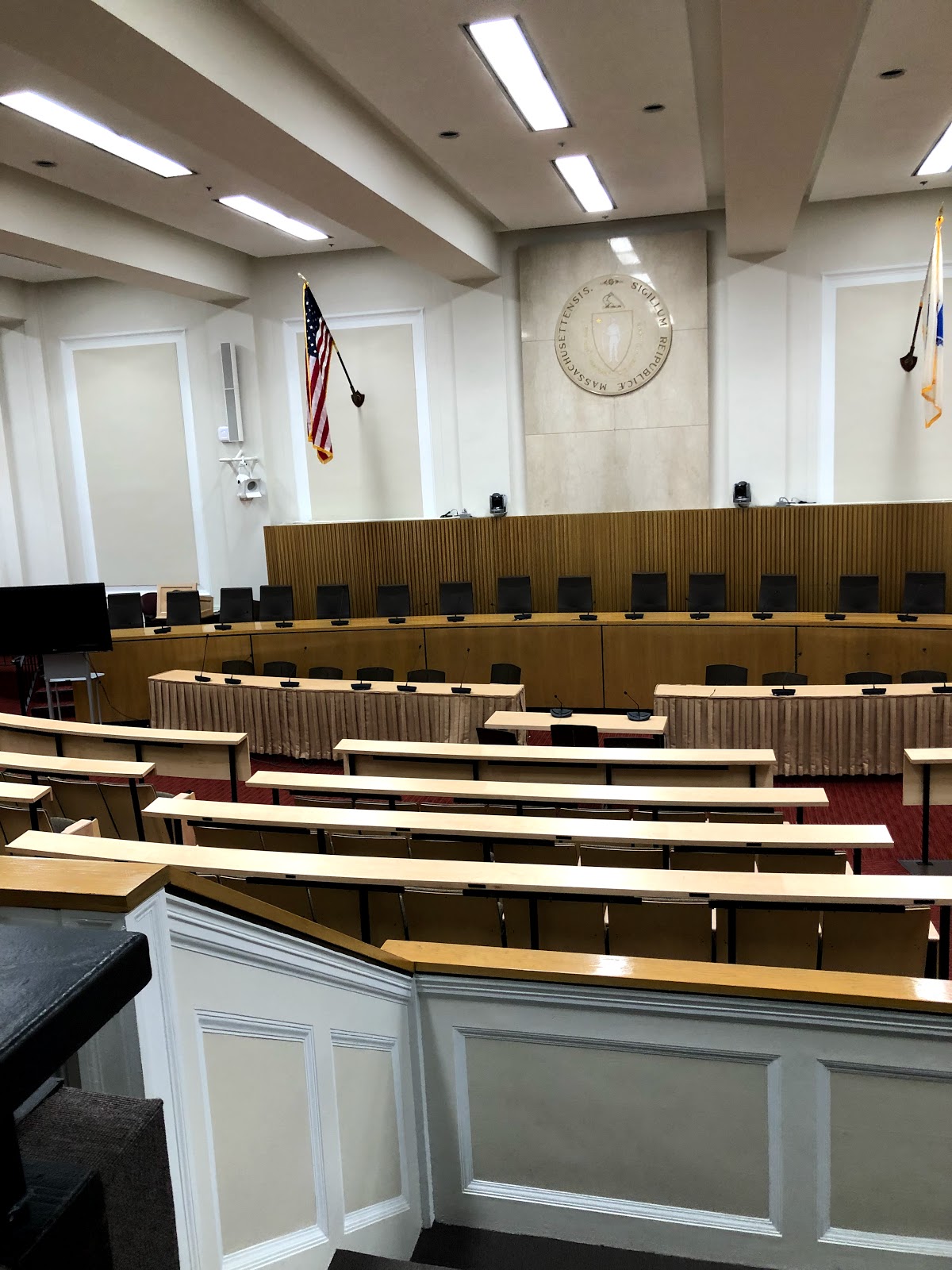
Coming to you live from the House gallery which has not been renovated and thus has not as much access to electricity, alas. I like their carpeting, though. No photos allowed.Or snacks. Or liquids other than water.

awaiting the opening of the gallery

You can watch the session here. The bill (H.4137) is here. 
I will warn you that I cannot identify most House members by sight or voice. Sorry. 
posting as we go

Thursday, October 3, 2019

Monday, May 6, 2019

"The art of the trade/ How the sausage gets made"*

Cheers to Yawu Miller for covering the discussion at Boston Foundation last week where a group of Latino organizations had invited Rep. Andy Vargas, Senator Jason Lewis, and Senator Sonia Chang-Díaz to speak about the proposed changes to education funding in Massachusetts. Notably, this got into tying up the money, which you might recall was discussed and defeated at the Foundation Budget Review Commission:
Vanessa Calderón-Rosado, a member of the Greater Boston Latino Network, asked Chang-Diaz what accountability measures she would support. Diaz pushed back, reiterating the importance of sufficient funding.
“We know money isn’t everything,” Chang-Diaz said. “But if you give a district $50 to do a $100 job, they can have the best teachers in the world and they’re still going to struggle.”
Shana Varón, who heads the Boston Collegiate Charter School and sits on the board of the Massachusetts Association of Public Charter Schools, said she would like to see more accountability measures and said she is concerned that many in Massachusetts are advocating against the state’s standardized testing regime.
Sen. Jason Lewis of Winchester noted that accountability measures are already in place, implemented as part of the 1993 Education Reform Act.
“We put very strong accountability measures in place in 1993,” said Lewis, who is Senate chair of the Joint Committee on Education. “We backed that up with tests. What we haven’t done is deliver the funds for schools to do their work.” Chang-Diaz noted that the accountability measures put in place in 1993 were enhanced in 2010.
“We have a system for more rapid intervention when we don’t see progress on the achievement gap or school performance,” she said. “The state can step in and take over a district.”
Other than the governor’s call for withholding funds and enhanced interventions, Chang-Diaz said, she hasn’t heard calls for specific additional accountability measures.
“Show me your version of what accountability is,” she said in her response to Calderón-Rosado. “Maybe we’ll agree.”
But with the clock running down on the state budget deliberations, Chang-Diaz said, legislators would have to agree on such measures on an accelerated timeline.
“I don’t want us to go another school year while we dither and talk about accountability,” she said. “Bring your proposal forward.”
I, too, am weary of vague calls for "accountability" which never appear to amount to anything more than more calls for privatization or otherwise channeling funding away from schools that actually serve all kids.
Chang-Díaz of course is entirely correct: the state got another round of accountability on the Fed's dime when the state passed the Act Relative to the Achievement Gap in order to qualify for Race to the Top funds in 2011. That law has not been revoked, even as the federal funding which was the reason for it is long gone.
Moreover, the original foundation budget was to be reviewed and updated periodically, which it was not. The state thus owes the districts this funding from the 1993 law, over and above the 2011 changes.
-------
*shamelessly borrowed from Lin-Manuel Miranda's "Room Where It Happens"

Friday, March 22, 2019

Joint Committee on Education hears the funding bills:

This is bound to be a long one! I'll be updating this all day as we go.
The hearing begins at 10 am, but the auditorum is filling fast: the MTA is here with red "Fund our Future" shirts, I've seen a few superintendents come in, Mass Parents United is here with black tee shirts, and staffers from the Senators and Reps are in and out. My view is from the top back: 

Wednesday, February 20, 2019

Leading where?

I think of the February and April vacation weeks as two of the most unequal weeks of the school calendar. While some families head off to warm beaches or ski slopes, and some school districts sponsor trips to see and experience international locations, many families struggle to ensure their kids will be fed these weeks with no free and reduced lunch. There are few weeks (all of summer is certainly another) where the gaps among all those receiving a "free and adequate" education in Massachusetts is visually so vast.

I'm thinking of this as I read this piece on Commonwealth Magazine on why we've seen a change in leadership in the Senate side of the Joint Committee on Education:
“Education reform was the reason I ran for the Legislature in the early 2000s,” she said as she walked to her office from a midday event at the State House. “As chairman of Ways and Means, we implemented the ed reform, the Foundation Budget Review Commission’s recommendations, three times in the last two sessions. Clearly it’s a top priority and it remains one.”
Asked whether she thought her appointment last week of Sen. Jason Lewis of Winchester as the Senate chair of the Education Committee (replacing Sen. Sonia Chang-Diaz of Jamaica Plain) was a key step in moving the legislation forward, Spilka said: “I believe so.”
Since what separated the House and Senate bills in the last session was that the House bill didn't include funding for English learners and poor kids, one has to wonder, at least where I sit in Worcester, what this means for the negotiating position of the Senate.

And also, this.

Sunday, January 6, 2019

Note who says what on foundation budget reform

...and speaking of which, I don't want to miss this from MassLive which got several important players on record around foundation budget reform. Note what is, and what is NOT, said:
After the speech, Education Secretary Jim Peyser said the administration’s proposals will be phased in over time and “will represent a significant new investment in our K-12 education system, while at the same time recognizing that how much we spend is ultimately not as important as how well we spend it.”  Peyser declined to say how much money the governor would invest or where that money would come from. But, he said, “There will be a funding mechanism to ensure that it’s paid for.”
So the "not as important as how we spend it" line, again, which, when we're talking about required services like health insurance and special education versus regular classroom teachers seems like...we should do both.
Also " a funding mechanism" from a Governor who promised not to raise taxes. Hmm.

Senate President Spilka's remarks from earlier in the week are cited.

It's well known that the House leadership is more conservative than the Senate's (I've heard it said that the Democratic House leadership is more conservative than the Republicans in the Senate, but I won't vouch for that; they do certainly get more done on education funding); see this, which is the only comment I've been able to find from the House Speaker:
House Speaker Robert DeLeo, D-Winthrop, said Thursday that education reform was one of the items already on his radar screen for the new session.
DeLeo said he hopes that Baker laying out his position will help move the debate forward. “I’m hopeful that maybe that might make things a little bit better, to see where it’s at, where he’s coming from on this most important subject,” DeLeo said.
...which looks a lot like the House getting cover from the Republican Governor.

And also:
Sen. Sonia Chang-Diaz, D-Boston, who chaired the Senate Education Committee last session and is leading the Senate’s efforts to update the education funding formula, said, “I’m really glad that the governor has come into the table and is elevating the issue.”

But Chang-Diaz said she would have liked to see Baker give a more complete description of the scope of the problem, and she is not happy with the level at which Baker has funded education so far. However, Chang-Diaz said she is “keeping an open mind” and is hopeful Baker will adopt the Foundation Budget Review Commission’s recommendations.
At this point, we're all waiting for the Governor's budget, due January 23.
Fund Our Future said the Governor's proposal should be rejected; as far as I can see, the Governor hasn't actually made a proposal, so I don't think there's anything to reject.
Stand for Children goes farther than the Governor did himself, and thus thanks him beyond what is deserved:
“Governor Baker made fair school funding the top priority for his administration’s second term and for that he deserves the appreciation of every parent in Massachusetts who is concerned that their children are not getting the same quality education as students in our wealthier communities,” Aloisio said in a statement.
He...didn't say that. And let's wait to see what he proposes (certainly, with due skepticism) before we get out the ticker tape. 

Wednesday, December 5, 2018

FY20 Joint Ways and Means Hearing on Revenue

About to come to you live from the Joint Ways and Means hearing on revenue, starting the process of agreeing as to how much money the state will have to budget for FY20.

Updating as we go
Rep. Sanchez gavels in, noting it's the last time he'll do this
"this exciting session...that we have by statute to decide what revenues are going to be"
there is representation from the Senate (Sen. Joan Lovely) and the Governor's office (the Secretary of Administration and Finance Michael Heffernan)
represents the kickoff of the 2020 budget
despite the $1B surplus of the previous year, "we always have to remain thoughtful as we plan for the future"
"have been able to act in a unified bipartisan choices to make hard choices"
notes that rainy day fund is above $2B, that tax revenues are above forecasts
"everywhere I look, the cranes keep going up...and not only here in Boston, but throughout the Commonwealth"

Sen. Lovely "a vital first step in the budget process"
"critical that we forecast accurately"
"must be good stewards"
"our collections grew well beyond benchmarks"
revenue this year grew $423M beyond expectations
"we must be prepared for anything...our economy has remained consistently strong"

Secretary Heffernan
"keen appreciation for the process"
looking forward to testimony today
"look forward to our continued collaboration" with Legislature
and parting words for Sanchez
"but we are just five months into the fiscal year and we must always be mindful that circumstances can change"

Christopher Harding, Commissioner of Department of Revenue
Chief Economist
General Counsel
Have distributed copies of briefing book which will also be available on their website
"exceptionally strong revenue growth in FY18"
greatest single year growth since FY11, had been exceeded only 3 times in preceding 30 years
why? preceded by two years of disappointing revenue growth
(and note that they're still getting FY18 tax filings)
S&P index rose; "jump in estimated payments...partly due to strong stock market performance" and jump in capital gains
federal tax code: impact on state revenue
"corporate tax revenue tend to be volatile"
SALT  payments from personal side encouraged (federal side)
strong Massachusetts economy throughout
"less indicative of trends than episodic factors"
financial markets much more uncertain this year than previously
"given these conditions, the more volatile sources of income cannot be depended upon"
nearly full employment, so further growth in employment may slow
slower growth nationally would at some point slow growth in Massachusetts
among longest periods of economic growth in history (will reach that in July)
"not projecting a recession to begin during fiscal year twenty" but coming
potential upside on benchmarks for next year
"should be treated with caution"
"believe some of the fiscal surplus was borrowed" from next year
"we believe that our prior FY19 benchmark remains appropriate"
based on FY19...
2% to 2.9% over FY19 forecast
range up to 3.5%; midpoint would be 3.2%
assumptions of note: tax rate down to 5%
on marijuana sales: "use with caution for budgeting purposes"
fading impact of federal tax changes, international markets, concerns about international trade
state employment rate "is impressively low" and projecting growth of less than one percent to just over
possibility of growing gains in tax revenue exists, but when those will come in "is impossible to predict"
"unclear whether state revenues will continue to be strong through the year end"

and questions
Sanchez: past two years have been completely different (from one another)
"what we can learn from that projecting from the future?"
A: significant taxes came in at the end of the year
"in some cases to prepay based on uncertainty"
"strong economy indicators, strong job growth" as we exited '18
Sanchez: assuming we hit tax rollback figures, what will be impact?
A; first rollback to 5.01% by $84M in FY19 and $175M in FY20
"and you can read that on page seven, Mr. Chairman"
(to question) sales tax exceeded expectations

Lovely: gaming tax revenue?
A: we have not looked at that, falls under the Treasurer
"have not received any proposes for changes"
to question: exceeded estate tax benchmarks "significantly"
"most volatility is estate side"
very strong revenue from marijuana sales, will continue to track that

Chang-Diaz: actual numbers versus baseline numbers
"actual is raw dollar increase"
"baseline adjusts for an administrative or legislative changes throughout the year" to do a comparison that is more accurate
Chang-Diaz: so it gives us more of an idea of what is happening in the economy rather than policy changes
Chang-Diaz: expected increase in income tax rates: why not yielding an increase in revenue?
A: "there's a model and complexity"
"not a one for one...needs to be adjusted for volatility"

Rep. Walsh: rise in GDP but expectation that employment will rise more than that
A: GDP looks at all sectors, labor side looks at just jobs

Q on online revenue
A: online registration from day one
approximately 370 registered; additional after decision
"in tens of millions right now...a nice steady growth right now"
tracking very closely who has and has not registered
"have sent them friendly reminders" of those who have not registered
do have enforceement measures

Rep. Cutler: rainy day fund
A: hard to predict when things will turn and how long they'll turn and thus how much the fund needs to be

Next up Treasurer Deb Goldberg
Goldberg wishes both Sanchez and Kulik well
Sanchez "Madame Treasurer, I'm not in a casket!"
Goldberg notes that she met Sanchez when he first ran and knocked on her door
"most of you have consistenly heard me speak of the need to replenish the rainy day fund"
here to thank you for doing so
note tax change: impact on tax exempt organizations
do not have a significant number of bonds maturing in near time
income rates had begun to increase
"navigated the markets effectively this year"
"have seen wide investor interest...and robust demand from traditional retail investors"
realistic about the challenges faced
"manage our unfunded pension obligations...on track to be funded by 2040"
"we will not turn our backs on [retirees]"
unclaimed property reversions; on track to meet total reversion estimate of $131M
"consistently returning more and more money to its rightful owners"
Lottery aid: fourth straight year topped $5B mark; $997M in net profit
Gaming landscape has shifted: lottery has adapted
increased investment in retail partners
"most efficient lottery in the United States"
pitch for online lottery
"understand that there will not be progress without partnership"
notes concerns about corner stores but not how one would deal with them
and offers to help with sports betting

And questions:
Sanchez: how to better communicate our fiscal strength and responsibility to rating agencies?
Goldberg: did a road show in NY to rating agencies when she was first elected
will recommend another one
"many states offload debt onto their counties and other state agencies we have; we do not do that, and we don't seem to get credit for that"
"they were very focused on the rainy day fund"
recommend going back down to New York and seeing them again
Sanchez: feel funding of unfunded pension liability is realistic?
Goldberg: will make recommendations again in January in response to new projections
"in good shape to whatever may come in the next couple of years"
past few years "we had major overperformance"
Sanchez: how do you come up with those projections? should we make an adjustments?
Goldberg: we use actuarial estimations, "it's a complicated data-driven process"
look at funding schedule every year

Kulik: online lottery; mentioned 11 states with online lottery presence
are there any that are a peer state (NH, Kulik says, in size and revenue, not comparable)
Goldberg: we are losing potential customers to NH
Michigan; as their sales have grown,their retailors sales have grown
which means they're creating gamblers?
Goldberg: can set up stops on their mobile phones for themselves so they only can spend so much
"patterns that you can begin to see"

Sen. deMacedo: what would you like to see happen on rainy day fund?
Goldberg: rainy day fund is important but not all they look at
was recommending a minimum of $4B
"I would recommend that we keep putting money in the rainy day fund"
"when we don't adhere to fiscal policy, it costs the state opportunity and money"
"I can't begin to tell you how many communities need new schools, and that isn't because smartboards would be nice. They need new buildings."
if we don't have good bonding, we can't borrow for it
"I think of the pipes underground" water quality is a health issue

Chang-Diaz: where the sales of lottery are happening?
Goldberg: due to commissions, we know where the sales happen, but not where the people are
"there's always the conversation of communities where it appears people would have a lot more money"

Lovely: on gaming revenue: any idea on projections?
Goldberg: we would not know anything about gaming revenues, and that is not within our department
Gaming Commission would know that; "that's not our office...do you want to move it there?'
(DoR had said Lovely should ask Treasurer)
lottery in casinos; hearing some concerns about siting
"not looking at one on one of the casino versus the lottery...we're being assaulted by multiple resources"
"if you don't innovate, you don't grow and you potentially die"
and that's it for the Treasurer

Federal Reserve Bank economist Dr. Zhao (?)
New England Public Policy center
overview of labor markets: continue to post solid job gains through October of 2018
8.8% increase over previous year (non-farm labor) for Massachusetts
by sector: construction sector posted largest year over year rate of growth (5.1% increase in the state)
outpaced nation in professional and business services, information, and other job services
measurement of unemployment (usage rate? maybe?) which takes in those underemployed as well
7.1% as a state (7.8% nationally)
labor force rate has grown continuously since 2016
only state in the region with labor force participation over that prior to the recession
last time it was this high was 2003
seniors 65 and older are part of what is driving it
tighter labor market, thus a stronger wage increase than the U.S.: 3% over prior October
2.4% increase across the U.S.
housing market: increase 6.8% nationally, 5.3% increased in Massachusetts
passed pre-recession levels
are slowing somewhat; attributed to rising interest rate
fuel and utilities increased by 4.6% over year before
top exporters reported year over year drop in Massachusetts
outlook: 2.1% over the next six months
job growth strong on average; unemployment low; house sales slowing
"economy to grow at a positive but slower rate in the near term"

Question:
Rep. Fiola: what are we exporting to China?
A: recent change? depreciation of U.S. dollars

Next is Mass Taxpayers Foundation
2.4% increase is what they are projecting
"does not include marijuana sales" or one time revenue
nor does it assume a tax rate drop
decline in capital gains is what they're projecting based on
slower employment growth projected
demographic headwinds leading to a slower growth in jobs
aging and decling workforce due to one of the lowest birthrates in the country
declining population between 16 and 64
negative impacts of opioid epidemic
initial signs of strain: pending home sales dropping, sagging auto sales, business investment (stock buyback rather than new investment), oil prices down,
tensions with China, concerns over Brexit, concern over economic downtown
increase in tax revenue of 3.6% is what they are projecting for FY20
don't recommend any revision to current fiscal year projection
"we are on borrowed time" regarding a fiscal downturn
"we certainly would like to see a higher balance in the stabilization fund"
"certainly is less than rating agencies would recommend" due to volitality of revenue sources, which would recommend 10% of state annual budget
states' ability to withstand a moderate or severe recession recently rated

to questions:
Sanchez: business confidence is down from a year ago
MTF: consistent with a lot of what we're saying
exercise is to look 18 months out; "so much easier to add a supplemental budget over the course of the year than have to take money away
Sanchez: insight "revising elements of the Grand Bargain"?
MTF: would require additional money; small businesses operate on smaller margins, and that bears watching
Rep. Malia: opioid epidemic?
MTF: economy is losing out on wages of folks who would otherwise be in the economy
companies because of absenteeism or presenteeism "has a considerable cost"


William Burke, Beacon Hill Institute
increase of 2.4% increase in tax revenue projected for FY20
current labor market in the United States is strong
250,000 jobs increased in October nationally
slowing growth over the next two years
"expected growth to slowdown in 2020" due to trade policy, other factors
"the Massachusetts outlook remains strong"
"expect growth to moderate from the current robust pace"

next testimony (I don't know who this is)
includes reductions in personal income tax rate
3.4% growth of revenue expected
"economic growth is expected to slow"
federal tax policy change: question of excess revenue in FY18 comes at expense of fiscal year '19
used estimates of FY18 without change
refunds were $446M less; payments on returns were $554M less
"seems to indicate that people indeed did move" filing from FY19 to FY18
fsical year income for businesses: consistent with corporations timing their fiscal liablity to get the lower tax rate
"there is a downside for the fiscal '19 estimate" (they were paying ahead)


Michael Goodman's testimony (UMass Dartmouth)
leads the Public Policy Center
testimony reflecting on context of time
capital gains realized in FY19; reporting well above benchmarks
"while this is very encouraging, there are a number of reasons why I think we are not going to be able to sustain this pace of growth"
aging and slow-growing population concern in keeping up with workforce; have been meeting ways in various ways
defer retirement, underused employees
domestic migration (usually unusual for us) "it may be this time is different"
crossborder commuting (NH, RI)
federal immigration laws and enforcement practices are particularly unhelpful
"our most important competitive advantages are the talents and innovative capacity of our people--our human capital"
"limited additional capacity to support growth at the current pace"
"sizable and troubling gap between the performance of the Greater Boston region and the rest of the state remains"
and even as Boston booms there is "increasing congestion on our roadways, a growing reliance on our already struggling public transit systems, and...a serious housing affordability problem"
regarding trade: "it turns out trade wars are not easy to win"
notes that new schools, which he agrees with the Treasurer we need, will need steel rebar, which now will cost 40-50% more than it would have without the trade war
thus increase cost for the Commonwealth
"growing consensus that there is a reversal of economic fortune in the offing"
running a nearly $1T annual budget deficit at the national level; lacking capacity for action if needed, let alone infrastructure investment
rainy day fund below FY07 levels
"a number of good reasons to be optimisitc about the Commonwealth's near-term economic and fiscal prospects"

Sanchez: labor force participation?
Goodman: they have stayed on and not retired
Sanchez: ethnic and racial groups: who is participating?
Goodman: that is being tracked; some recognition among employers that they need to work in the people they have
transportation and education needs
Lovely: older population staying in: want to work or have to?
Goodman: yes
Lovely: student debt; do we know what that looks like?
Goodman: does place a burden on the next generation
do millenials like roommates and not like cars or are they unable to afford them?
more the latter
"it is a significant burden and it is changing behavior"
Rep. Fiola: workforce training; really keep our eye on that
Goodman: long been a significant social problem; now an economic imperative, because we "literally cannot afford to leave anyone behind"

AND THAT IS A WRAP: ON TO FY20!

Wednesday, August 1, 2018

Ongoing failure

...the good work begun by the education reform act of 1993, and the educational progress made since, will be at risk so long as our school systems are fiscally strained by the ongoing failure to substantively reconsider the adequacy of the foundation budget.
The Foundation Budget Review Commission conclusion, 2015

And so the "ongoing failure" continues.

The best coverage this morning comes from Max Larkin of WBUR (having dedicated education reporters is GOOD!), but I'd also read Shira Schoenberg at MassLive (quickest off the mark last night!) and the combined efforts of the State House News Service reporters via The Lowell Sun.

A few things to note: the statement issued by Rep. Alice Peisch on behalf of the House conferees repeats the argument that they need to be able to tie funding to particular places:
Note the careful language: the House conferees aren't dedicated to additional funding; they're dedicated:
to ensuring that additional funding in the FY20 budget to support our ELL and low-income students is based on careful analysis that will ensure funding is directed to support the schools, classrooms and students who need it most.
It appears the belief is no, we can't trust district administration and school committees to do that; they need to be directed.
If you'd like to know, incidently, what districts with high need populations do when they receive funding to support those populations, please note what Fall River voted to do with their hurricane relief funds last night.
This misses--at this point, it's difficult to see it as anything other than intentionally--that funds for English learners and funds for low income students haven't kept pace with need. We know this. There is a hole in the services being provided to those students. Or if there isn't a hole in providing for these students--remember how this works--funding has been shifted from other areas that will then need to go back to those areas. This is why I keep tweeting out charts from districts: some holes are different!
And that's why, no, the state doesn't get to decide this, because districts have done this differently.
As I pointed out earlier this month, this was an extensive discussion at the May 2015 Foundation Budget Review Commission meeting as they wrapped up their first round of conversations; after hearing from districts, the Commission DID NOT tie additional funds to anything other than reporting. The House members are refighting a battle that they lost when districts were at the table.

Elsewhere (this is in both the Sun and WBUR), the House throws DESE under the bus:
Peisch, a Wellesley Democrat, issued a statement on behalf of the three House conferees, saying new information from the Department of Elementary and Secondary Education "complicated" negotiations and "the exceptionally complex nature of recalculating various increments to the formula as we traded proposals." 
Look, I'm there for calling DESE out when they screw up or make things unnecessarily difficult. If the House received "new information" from DESE this week, I'm going to make an educated guess that they only asked for particular calculations to be done sometime in the past few weeks, as opposed to, say, anytime in the past THREE YEARS the report has been out (or the seven since Cutting Class). Your deciding you'd like some model that hasn't been previously considered to be done now is not DESE's fault. And if the House hadn't waited until the last minute to pass a bill, "the exceptionally complex nature of recalculating various increments to the formula" would also have had more time.
In any case, none of that was news to anyone paying attention.
And it's not okay to attack bureaucrats who don't deserve it, because they can only fight back by making your life quietly miserable.

We get some insight into what broke negotiations from Senator Chang-Diaz's statement:
"House leadership rejected all our offers [and] moved the goal posts" would seem to mean that House leadership wasn't even negotiating under the bill the House passed. Not only would that not be negotiating in good faith; it wouldn't appropriately represent the interests of the House as passed in the bill. As the WBUR article puts it, the House leadership went so far as "rejecting one of its own proposals to kill the bill." 

Yikes. I'd be interested, then, in what all the House members who signed onto the full implementation budget amendment think of their leadership this morning. A quick look at the #FBRC hashtag on Twitter this morning shows a lot of constituents with strong opinions.

I don't have a witty or snappy closure this morning. This is on the House: not just on leadership, but on all those who supported leadership.

It's the "various orders of the people" who are let down by this: the poor kids, the kids learning English, and yes, kids of color. It doesn't just reflect badly on the House; it reflects badly on us all that these kids are ones we've decided can be sacrificed for political expediency.

Saturday, July 14, 2018

Take notes

As I've been following the discussion around the House bill, I had this haunting sense that this discussion--do we move forward with just sped and health insurance? do we need to do all kids?--seemed familiar.
So I checked my notes.
As I think I've said before, I started this blog lo these many years ago as a record for those who couldn't make it to Worcester meetings around school finance, as recognition that the Telegram & Gazette was never going to cover everything. And then I started going to state meetings. And here we are.
Thus, to my knowledge, no one else has notes out there that follow the discussion that was happening three years ago May about what the Foundation Budget Review Commission was going to do. The FY15 budget (passed in June 2014) had given the Commission a June 20, 2015 deadline. They had begun meeting in the fall of 2014, had held hearings over the winter, but as of May, had come to consensus only on health insurance and special education.
In order to get an extension, they had to get legislation passed by both parts of the Legislature.

My notes from that May 5, 2015 meeting are here; if you scroll down to "Chang-Diaz and Peisch offering proposals to discuss about moving forward," you'll see what I mean: Representative Peisch wanted to push ahead and get the proposals they had for those two items out there for the deadline. She argues that there is a clear interest in those two proposals, that it sends a clear message to the Legislature to come back on deadline with those two items. (I'll note that Peisch was consistent in this, as she said the same in speaking to MASBO that same month.) She doesn't talk a lot about anything else needing to be in the report.
Senator Chang-Diaz notes the concern that leaving off other recommendations lessens the urgency for them, and others argue that the report doesn't fulfill the charge of the Commission in only doing special education and health insurance, particularly given what they had heard at public hearings.
Interestingly, Commissioner Chester argues for the need for greater deliberation, 'though he says he isn't sure they'll come to consensus.
Eventually, on a motion from former Secretary Paul Reville, the Commission votes unanimously to issue an interim report in June that not only reports out special ed and health insurance, but lists the issues to be resolved, to request an extension from the Legislature, and to issue a final report by November 2015.
Which is what happened.
This was enough of a heated disputed, however, that it came up at the following meeting on June 9, 2015, when then MASC President Pat Francomano asked that the minutes be clarified to include specifically that the report would include a list of items still to be dealt with, which was not included to his satisfaction. At that meeting, there was an extensive discussion on potentially tying any new funds to specific requirements, which disturbed me enough that I wrote about it the next day. I noted elsewhere this week that this argument has also come back:

Thus while the positions of who is arguing to move ahead and who is arguing to stop have changed, the "why" has not. The urgency of the needs BEYOND those of special education and health insurance haven't, it seems, gotten any more traction than they had three years ago, when they wouldn't have made the report had it been left to Rep. Peisch. There is, of course, irony that somehow we're going to magically have the comprehensive report some think we haven't gotten in four years of work in six months, but I suppose it's easier when that work has already been done.
Additionally, much of the conversation of this past week has been the same parties making the same unsuccessful arguments that they made three years ago. Those arguing just to move on special education and health insurance, leaving out ELL and low income, and on tying districts that are owed hundreds of millions of dollars already under the current system somehow needing to prove worthliness are old, tired, wrong, and privileged.
It's a shame the House bought it.

Thursday, May 10, 2018

Senate debates "An Act Modernizing the Foundation Budget for the 21st Century"

You can find the bill (and amendments) here.
This is totally not going to start for awhile. 

2pm: Senate is now in session. I'm going to need to leave at 3:30 at the latest, so this will not be wall to wall coverage, alas.

Senator Brady (of Brockton): "we couldn't have done this without our districts, without the advocacy of our districts, we couldn't do it without our local elected officials and our citizens"
introducing local elected officials and Brockton Superintendent Kathy Smith

Senator Chang-Diaz:
who is listing cuts from district after district 
"have become year after year effort"
citation from Supt. Boone when they held hearings 
"and then there's the work that wasn't cut because we weren't able to start it"
a single counselor spread across multiple schools "despite constant demand for trauma services and recovery from the last shooting"
"face every district across our Commonwealth and it has been so for decades"
some districts considering suing the Commonwealth
districts suing "inspired the 1993 Education Reform Act"
"we act on the legacy of these reforms"
from 2002 to now, real dollar spending has fallen 7%
students "are waiting on our courage"
"a bold righteous and radically American promise" when we passed the '93 act
"all means all"
"when we say 'liberty and justice for all,' all is supposed to mean all"
made a deal with districts "expectations matched with investment"
"since then we have acted like education is a static enterprise"
"our funding formula has not grown with us"
and districts are buckling under the pressure
"it has been a quarter century since the Legislature checked in with the math that undergirds our public school system"
"we've fallen into one of the deepest achievement gaps in the country"
now reviewing FBRC findings
"were endorsed unanimously by the Commission"
"the promise of quality education...runs to the very heart of who we are as a Commonwealth"
the education section is "the only place that 'cherish' appears in the Constitution"
"ask my colleagues to think of things that they cherish in their lives
"are we cherishing public education?"

Lewis: " have worked for many, many years for this day"
and intros students from Malden High
this issue motivated him to run for public service and go into the Legislature
letter came home that his daughter's school library would be closed
asked for parents to volunteer to keep the library open
"this was a real eyeopener for me"
thanks Chang-Diaz for her leadership, thanks Jehlen
education is the hallmark of Massachusetts
"Horace Mann recognized that Massachusetts" does not have natural resources...human capital is what we tapped into
"the oldest written Constitution still in use today...it's written in there...that's how deep it goes"
in the years since 2000, the foundation budget has not kept pace
the average school in the Commonwealth is now forced to spend 120% of their foundation budget (it's 129.7%)
"what that masks is our most disadvantaged districts" can't spend over the foundation budget, while the more well-resourced districts are spending well over that
"putting tremendous financial pressure on all of our schools"
"every year, they're struggling to balance their budgets...and every year, they're told by the City Council, the finance committee, 'Nope, you'll have to cut'"
"this is exactly the opposite of what we intended in the education reform act in 1993"
"that to me is a moral failing of the Commonwealth"
first state to set up a system so that every district gets what it needs: "the same high quality education" in every district
"hope that we will once again lead the nation"

Sen. Spilka: "hard for me to sit still when we're having a debate about changing the foundation funding formula"
why she first ran
organized others to lobby and advocate
changes that were made in '06 and '07 "adequacy was the issue that eluded us in those days"
"what does it really take, what does it need to include" for each district across the state
"and it has to get updated"
"look at circumstances across the state"

Sen. Jehlen:"state budget takes another step forward...it's not enough, but it's where we ought to go"
"make that obligation transparent every year"
public hearing where all will agree on way forward
minority leader has pointed out important obligations we have made
1. Funding 2. State control/oversight 3. Charter schools
"we have increased the demands...we have raised the number of charter schools...but we have not kept the grand bargain"
"most of the aid increases...have not been targeted to the most underresourced communities"
"in 2002, we stopped meeting our obligation to fund local education adequately"
"those underresourced districts are the ones we count as most underperforming"
districts under state control are getting less than the state average increase this year "Southbridge singled out as having to reduce their staff by 30 this year"
commitment before we write our budgets
"none of the Governor's budget have met" increase in revenue
"this step is our part of keeping our part of the grand bargain"

Sen. DiDomenico: great to stand before you today on this day for children
"most important title is 'Daddy'"
Everett has to choose between library, media, things they should do
"class sizes are exploding, and they need to do more with less"
"we have to do more, and this bill does just that"

Sen. Bruce Tarr
"this day of reckoning which is long overdue"
amendment after amendment offered by minority to this end
"and then, Mr. President, we forget about one of our commitments"
"and the gap began to grow, and grow, and grow"
"something which should have been done probably in 1996 but certainly by the year 2000"
"tasked this Commission with doing a lot of work because it had been so long" since anyone had considered the foundation budget
"I would argue that this should never happen again"
"and there is still a lot of work to be done on the foundation budget"
"those need to be addressed, too" listing circuit breaker, regional transportation, charter school reimbursement
"critical that we have a process and a schedule" to address the gap that has developed
"pass the bill, send it to the House, and urge them to pass it expeditiously as well"
"I suspect that this bill receive tremendous bipartisan support, and it should"
"creates a mechanism, it creates a process, it does not create resources"
"look at the divergance between what we should be doing and we have been doing"


I had to duck out at that point, but here are a few highlights from later coverage: 
Senator Tran chose to make his maiden speech on this bill, relating his own history as an immigrant from Vietnam who went to public schools in Clinton. He said that he has lived the American dream and now can assure that others will.

A number of amendments were withdrawn, most of which will, the Senators said, be put forward as budget amendments.

The one amendment that did pass unanimously was one from Senator Bruce Tarr, the Senate Minority leader, creating a reconsideration of the foundation budget via commission every five years.

The bill passed unanimously 38-0.

UPDATE: coverage from...
MassLive
The Sun Chronicle with the spot-on observation of its bipartisan nature
RadioBoston which you have to listen to
Commonwealth Magazine which does a nice job of linking it to the "Leading the Nation" celebration also happening this week


Friday, April 27, 2018

Senate passes supplemental budget

While it is FY19 budget season, it also is FY18 supplemental budget season, when the Legislature passes a bit more money for specific programs for the current year as it becomes clear such funds are available.
A few weeks back, the House passed a supplemental budget that included $12.5M for circuit breaker funds.  Circuit breaker is an acknowledgement by the state that out-of-district special education tuition can be quite expensive; much like an actual circuit breaker flips if the circuit is overloaded, circuit breaker funding kicks in if tuition for an out-of-district special education tuition is too much. If you scroll down here, there's a good explanation from Deputy Commissioner Jeff Wulfson on how that works ('though it is from 2008, so ignore the dollar amounts). If a student's tuition is more than four times the average foundation budget per student in the state (and yes, that number pops up...basically nowhere else?), the state is committed by MGL Ch. 71B, Sec. 5A to paying 75% of that overage.
This year, tuition costs rose but the line for the circuit breaker in last year's budget hadn't. Both House and Senate have heard a lot about this from districts--in a small district, a single student can break your budget!--and so have responded.
Yesterday, the Senate passed the same $12.5M the House passed; that number thus should go to the Governor (and they have more than enough votes to override a veto, if that became necessary).

The Senate also included $4M for charter school reimbursement on an amendment proposed by Senator Chang-Diaz. That was not in the House budget, and so goes to conference committee.

I do also want to note that the Senate, whose budget comes out next month, had an extensive conversation around financial commitments to school districts, around promising something like circuit breaker, or charter reimbursement, or regional transportation, and not delivering it. It's clear that the message there is being heard (at least in the Senate) loud and clear.

A word about timing: while for teachers and students, it's a time of year that ossalates between "we'll never get there" and "nearly done," in the financial world, there's no question: this school year is nearly done. Plenty of districts cut off departmental and other spending May 1 to ensure that spending will all be through by the fiscal year's end on June 30. General funds allocated to the schools that haven't been spent by June 30 are returned to the town or city in a municipal district, where it will become part of free cash; in a regional district, some of that can go into an excess and deficiency account (and thus be held over), but even that has limits. There are exceptions, and circuit breaker is one; it can be held over to following year (and lots of districts use one year to pay the next year's tuition). In general, though, the later in the year "new" money comes into the district, the less useful it is to the district (it isn't as though anyone is hiring a new teacher in May) and the greater the likilihood that it ends up in city coffers, anyway.
This isn't to discount the importance of what the Senate did yesterday. It is to say that what they do next month is more important.

Thursday, April 5, 2018

Leading the Nation at 25 years: State House event

Here at the State House for the 25 years of Ed Reform (as told by some) event. It's like a who's who of state education: Bill Weld is here, David Driscoll is here, Bob Antonucci is here...posting as we go. 
Rep. Peisch: "to celebrate the achievement of students over the past 25 years, ...and to acknowledge that more needs to be done"

Monday, March 19, 2018

FY19 Joint Hearing on Ways and Means

Coming to you today from Peabody City Hall...the hearing begins at 10 am.
EDIT: My cleared up and probably more readable report for MASC is over here.
Opening this morning with the National Anthem and other music from the Peabody High School Chorale and welcome from Peabody Mayor Edward A. Bettencourt, who notes that the building was an opera house.

Tuesday, March 13, 2018

S. 223 is now S. 2325

Don't miss that the Foundation Budget Review Commission bill, up until now S.223, NOW HAS A NEW BILL NUMBER: S.2325:
h/t to Mike for the note! It is now in Senate Ways and Means, which has been urged to pass through with a favorable recommendation QUICKLY!

Thursday, January 25, 2018

“just plain inadequate for the job"

Yesterday was informational; this one's just from me.

What's it going to take?

We have the Constitutional commitment.

We have the legal decision.

We have the numbers.

We have the report.

And we have no action.

I'll be honest: I don't expect any better of this governor. He's made it abundantly clear that his vision of education is for the kids who look like his own experience can peaceably go on with their education, while those kids who look very different need to remain voiceless and have their educations disrupted.

I do expect better of the legislators, however.

What's it going to take?

I fully expect that the Legislature will pass an increase in regional transportation. Those districts are organized, they are loud, and, frankly, they are accustomed to being listened to.

I fully expect that the Legislature will bump the per pupil increase. Those districts--in some cases, the same districts--are likewise organized, loud, and accustomed to being listened to.

But that isn't the greatest need. It never will be.

The greatest need is in the districts that are skating along the edge of foundation funding, the ones that depend on the boost from a few more kids, the ones where the state is supposed to be ensuring that every child "rich or poor" is educated.

I don't think most of us have a good handle on just how great the disparities are. I know I didn't. It's been years since I've been in any classroom outside of Worcester, until I visited a few classrooms in a Boston suburb a few weeks ago. And the difference was breathtaking.

It isn't that those districts are spending money madly. There are things that many districts, even as they are tense around budget time, take for granted that we never, never discuss in Worcester.

Things like recent novels for elementary reading.
Things like periodicals for language study.
Things like funds to repair and restore fields.
Things like replacing the flooring that's failing rather than patching.

The list is endless, but the point is this: the budget is based on asking the question: "What can we do to ensure these kids have the best education possible?"
The cities that run on foundation can't afford to ask that question.

But as a state, we can't afford to not be asking it for them.


The title is from Senator Chang-Diaz, quoted on the Governor's education budget.


Tuesday, September 5, 2017

Joint Committee hearing on start times, recess, innovation zones

The agenda is here, 'though I don't, as yet, know in what order they'll be taking testimony.
The hearing starts at 10. Posting as we go. 
It appears they'll be taking the "zone" bills first. They are H.304 and S.279
Senator Chang-Diaz is calling the joint committee hearing to order. More on the House than the Senate side represented.
"We have a full house today; we anticipate going very long today."

Saturday, July 8, 2017

So what did the Legislature pass?

Yesterday, the House and Senate both passed a budget agreed to by conference committee. It was filed that morning, meaning, as noted by State House News reporter Katie Lannan:
Not, let's say, a triumph for public process. Among other issues, this got us a IIA report, which puts the numbers and account numbers in a spreadsheet, which included only the House numbers, not the conference committee numbers (causing some of  us not a small degree of angst!).

The budget now goes to the Governor, who has ten days to consider it and, if he wishes, to issue vetoes, which, in its turn, the Legislature can override. In other words: we're closer, but we're not done yet.

So what's in it for public education?

Chapter 70 came back at $4.746B, which is right between the House and the Senate numbers. As best as I can tell--I have yet to find the actual Chapter 70 language on this--they did this by keeping the $30/pupil minimum increase, keeping--and possibly adding to?--the insurance increase in the foundation budget, but not taking on the Senate's special education implementation of the Foundation Budget Review Committee's recommendation. Let me emphasize that on my part that is SPECULATION, again, because I haven't seen either an explanation or actual language (which should have been part of H3800). That means that most foundation budgets will be higher than both House 1 and the passed House budget, but not as high as they would have been with the Senate budget. As for state aid, the majority of districts were seeing their increase through the $30/pupil, so that doesn't change ('though do recall that the Governor's budget had set that at $20/pupil, so our foundation budget charts are not yet updated). And if anyone finds or has the actual language, please let me know; I'd be interested.

This means, of course, that two years on from the Foundation Budget Review Commission, with districts across the state repeating that we need finance reform, the only change we saw was the fragmentary one in health insurance. This isn't how one truly values public education.

Oh, and Senator Chang-Diaz was one of two votes against it.

The Department's budget is just over $14M, and continues to contain a boatload of earmarks, which I won't go into here, 'though at some point I have a whole rant on that.

METCO is $20.5M, splitting the difference between House and Senate.

Regional transportation reimbursement is $61.5M (which had been as high as $62M, so it also splits the difference).

The circuit breaker, something specified by Senator Karen Spilka as a "painful" cut, passed at $281,231,181, lower than BOTH House and Senate. Note, however, that it is $50,000 lower than what the Senate passed, which, in a budget of this size (and an account of this size) makes that more of a symbolic cut than anything.

Likewise, McKinney-Vento reimbursement was cut from both houses, being passed at just over $80M; this is an account which has never been fully funded.

Note that all of these previous three are reimbursements, meaning the district fronts the money and gets the money back from the state afterwards. There is here, then, less of a hit on the starting end, but we'll see budgets straining on by midyear.

Targeted intervention in underperforming schools passed at $7.2M, which is lower than either house had passed.

The MCAS line passed at $26.9M, also lower than either budget previously passed.

Extended learning time passed at $13.9M, lower than either.

Innovation schools split the different with a budget of $165,000; that's $150,000 with $15,000 earmarked for Pentucket Regional.

There had been no difference in the amount set aside for charter school reimbursement--an acknowledged-as-underfunded $80.5M--so that passed as previous.

Those are most of the major lines. As always, if you have questions, please let me know.