Showing posts with label minimum aid. Show all posts

Tuesday, February 24, 2026

Board of Ed for February: budget!

 "real challenge" per Martinez at federal level on funding, related to enrollment decline and other things
pay attention when things like this are said

Bill Bell on the Governor's budget

SOA implemented in full as of FY27

concern of how chapter 70 is working; increasing number of districts receiving minimum aid
Department, Commissioner, Executive Office, A&F "aren't tone deaf to the issue"
commitment to see through implementation of Student Opportunity Act; what leaders want to do after that "remains to be seen"

circuit breaker growing by $100M into next budget year

haven't received word on what the education funding levels would be for federal grants in entitlement grants
baseline is funded nationally, but allocations remain to be seen

Legislators have begun their process of budget hearings: education and local aid is March 23 in Lawrence

Hills asks if they have the resources needed to implement the goals
Martinez, in essence, says it is a start

Smidy: the capacity is very limited in the field
even with allocations and grants, a lot of schools are not going to be in a position to move forward with these initiatives if they don't have the resources to move forward

Craven: need a sense about what costs are being piled onto districts
Martinez: not only the need, but also where districts are in 
"when we use the word 'advocacy' we're using it too loosely"
nah, that's still advocacy; you just want specific advocacy
"how do we become strategic about our resources..."
this is what people say when they aren't going to give you more funding to do more things
report on local contribution coming in June 

Bell: another attempt to meet the needs of local districts and communities that exist within a capped revenue environment 

And adjourned

Sunday, July 13, 2025

On the state FY26 budget

This is of course and as always coming from me who posts on here as me  


First off, cheers to the Boston Globe (yes, you did read that right!*) for this piece which interviews a lot of the right people, who point to many of the important things on this state budget and education! Huzzah! 

The Department of Revenue did issue FINAL (because the budget is signed) cherry sheets for FY26 at the end of last week, and DESE has similarly issued FINAL chapter 70 and net school spending information. Remember, the only way that any of this is changing at this point is if the Legislature decides to overrule vetoes. If you hear anything on that one, let me know.

Let's turn then to the budget we just got. 

Sunday, December 1, 2024

When what you've heard isn't the case: busting some common misconceptions on the Student Opportunity Act


First required xkcd:

I'd like one of the major issues in education, too, but all I can do is in my little corner of the universe.


With the consensus revenue hearing on Monday, we are about to kick off the FY26 budget season here in Massachusetts, which will be the fifth of six years of implementation of the Student Opportunity Act revision.

...and yet, still I hear some of the same misconceptions and misunderstandings circulating about the SOA. 
So, as we enter that season, here's a counter to some common things I hear.

Thursday, August 22, 2024

But what did Fair Share get us?

ahem...

I hope by now you've seen that the Fair Share amendment, which taxes at 4% on every dollar over a person's first $1M in income, has far exceeded expectations. As noted back in May: 

Massachusetts has collected about $1.8 billion from a voter-approved surtax on the state’s highest earners through the first nine months of the fiscal year, the Department of Revenue said Monday in a quarterly report.

That’s more than $800 million more than what the Legislature and Gov. Maura Healey planned to spend in surtax revenue for all of fiscal year 2024, raising the possibility of a sizable pot that will land in an Education and Transportation Reserve Fund and the Education and Transportation Innovation and Capital Fund, both surtax specific accounts, once the books close.

Remember, unless you've made a million plus at least a dollar in income? You are not paying this. And if you made a million plus a dollar, you're only taxed the extra 4% on that one additional dollar.

I've seen some confusion about this, so I thought I'd clear up a few things. 

First, the above money doesn't get spent until next year; this is a reserve fund, so the funding goes in and sits until the total is determined by the state comptroller in December. It's pretty clear, though, that the state's been conservative with projections, and this is one where we do really want to spend the money that's coming.

Second, this is funding--like most in the state--that's allocated by vote of the Legislature, signed by the Governor. There isn't some sort of formula where everyone gets some of this. I've heard districts ask how they can apply, or if it's being allocated evenly...that isn't how this works at all. The Legislature decides on what, within transportation and education, they want to spend the money on, and that's where it goes.

Funding was allocated in this year's budget from last year's Fair Share collection. Again, there is a very good chance that you are not personally paying for this--these efforts are not increasing your taxes!--but we as state residents are benefiting!

  • universal free lunch - a program much in the news, due to Minnesota similarly funding meals for all students, the reimbursement to districts of the federal reimbursement rate for non-federally reimbursed meals (the wonkish explanation!), this $170M is from Fair Share funding. 
    Yes, we literally have our millionaires making sure all kids eat!
    Remember, the FY24 number is a compromise and is expected to still not be enough to fully reimburse the expense to districts
  • $74/pupil increase in minimum aid in chapter 70. I've ongoingly argued that this is not a fair, equitable, way to get aid to districts, and yet...here we are. $37M here for K-12 districts.
  • free community college is funded from the Fair Share amendment (there's several lines of public higher ed funding, in fact)
  • $110M to regional transit authorities-- aka, local bus systems
  • $60M for MBTA physical infrastructure
  • $20M for a low income reduced fare program for the MBTA
  • $7.5M for ferry services
  • $36M for safety work at the MBTA
  • $45M for municipal roadwork
  • $10M for a skilled workforce pipeline for the MBTA (those bus and train drivers don't grow on trees!)
  • $175M for child care grants (operations)
  • $15M to reduce the waitlist at early childcare and education for teen parents and homeless families
  • $5M for preschool expansion
  • $65M for increased salaries and benefits for early education and care
  • $18M for reducing the early childcare waitlist
  • expanding early college, technical, and innovation pathways at $2.5M 
  • the Literacy Launch, funding for both curriculum and professional development, which they compromised at $20M for
  • Green Energy infrastructure grants to schools for $10M
  • developing a framework for mental and behavioral health funded at $5M
This is all really good stuff! We should be proud that we fought for this money! 
I wish more people were more clear on where it is going. Please spread the word!

Tuesday, July 23, 2024

State conference committee budget on Governor Healey's desk


I'm working through updating my running spreadsheet on the FY25 budget, but the conference committee budget released last Thursday, passed Friday, and sitting on Governor Healey's desk has a few interesting wrinkles in the education accounts. 

  • In the ongoing "this is actually a terrible way to add aid to schools, but it's easy to understand" race, you might remember that the Senate had upped the House's $104 minimum per pupil increase to $110. It's usually a good bet on those that the higher number will prevail, but in this case, it did not, as the conference committee budget adopted the $104 minimum per pupil. The additional $74 per pupil that this is--remember, the Student Opportunity Act sets this at $30 per pupil--is coming from Fair Share funds. 
    And this is a really terrible and inequitable way to add school funding which is completely undercutting the entire fight over the foundation budget and passage of the Student Opportunity Act, which I will continue to scream into the void over here.

  • Free lunch for all kids is in there, but the conference committee budget took the smaller (in this case Senate) number of $170M for reimbursement on this one. We should be alarmed by this, as this doesn't fully fund the account. 
    Remember, this is now a state MANDATE; if the state doesn't fully fund it, districts are on the hook for the difference. There's been far too much dependence on supplemental budgets and "finding the money somewhere" on something as grounding as feeding kids for me on this one, so consider raising this with your legislators. You can be sure that most of them are running for re-election on it. 
    This, too, is funded from Fair Share, by the way.

  • Interestingly, the conference committee passed a higher number than either chamber for circuit breaker, by close to a million dollars; the passed account is $493,177,484. This suggests to me that they're using as up-to-date reimbursement projections as possible, which is good. 

  • Charter reimbursement was identical all the way through, at $198M, which is $33.7M. We've been assured that this fully funded; let's keep an eye on it.

  • Similarly, homeless transportation reimbursement is funded at $26.6M, which has been consistent through the process. Given how costs on this have exploded across the state, I cannot believe that this comes close to reaching need (setting aside that frequently these reimbursements don't ever get to non-regional school districts, anyway, getting stuck in municipal general funds). 
    As Salem Superintendent Zrike said before the Board of Ed in June: these are OUR kids. We need to be sure they're covered, but we also can't pretend that is magically happening somehow without funding.

  • Rural school aid came through at $16M, which is down from the Senate's $17.5M but up from the House's $7.5M. While I know this isn't the hoped-for $60M, I think it's worth noting that this is now an accepted, included account, that isn't having to be stuck in over the course of the process via amendment.
This is obviously not everything, but it's the ones I thought to flag. I will update this post when I have the spreadsheet updated, which I hope to do later today.
UPDATE: The account by account spreadsheet is still lacking a bit in commentary, but the numbers are updated.

Also, the preliminary cherry sheets are now also updated for both municipal and for regionals.

Friday, May 10, 2024

Updating FY25

 For those who find this useful: I've updated my FY25 spreadsheet with the Senate Ways and Means budget. Note that I have NOT waded through the House amendments that passed, but I do know that no large accounts were change (yes, there were earmarks). 

A few random observations:

  • The Senate keeps the $104 minimum per pupil, but puts it into the chapter 70 line itself, which means it is not coming out of Fair Share, but general fund revenue, on which the Senate differs from the House. 
  • The Senate drops the support for free lunch back down $20M to the $170M proposed by the Governor. The House thought it would cost $190M. This one worries me, as it's a mandate that is subject to appropriation, and the districts will be on the hook if the state doesn't come through with funding. Remember this has had to be backfilled with supplemental budget funds to run this year.
  • The Senate funds the Governor's much-advertised "Literacy Launch" at $10M, not the $30M she submitted and the House agreed on. That feels like it might be heading for less than $30M. 

Sunday, April 21, 2024

Recommended reading

My week went a bit sideways at the end here, so I haven't gotten around to a few things I'd intended to write on. In the meantime, here is some of what I have been reading:

Thursday, May 11, 2023

DESE shared more finance data and this is VERY EXCITING!

While I was doing my periodic check of what DESE is sharing on school finance, I discovered that DESE has added to their shared resources a compilation of Net School Spending dating back to 1993, for the state and for districts. 

How fun! 

As a reminder, there are two reasons why your required net school spending could be more than 100%:

  • your community spent less than the required net school spending the prior year. That amount then gets added to the next fiscal year.
  • your district would be receiving less state funding through chapter 70 than it received in the prior fiscal year, so the state ensures you get the same amount of aid as you received the prior year--hold harmless--and a bit more (now it is $30/pupil minimum in the SOA; it has varied by year otherwise)

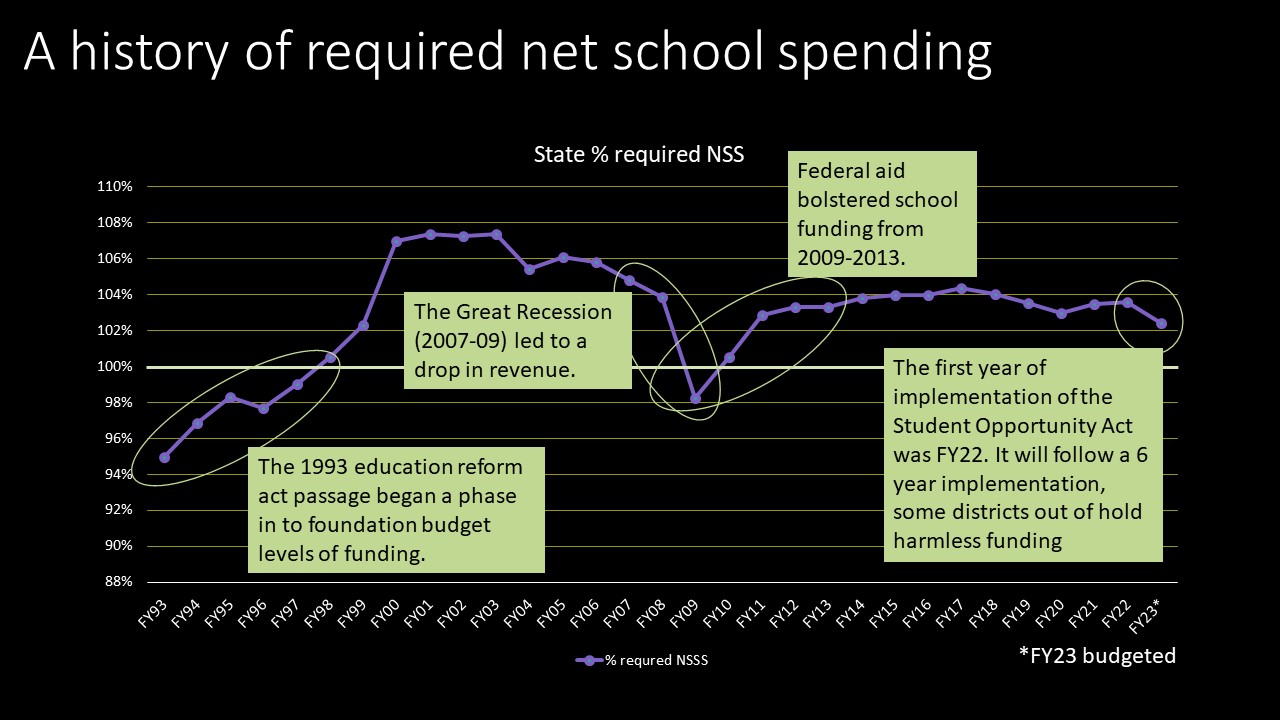
I took the statewide required net school spending back to the creation of the foundation budget in 1993 and put it in its own graph:


The first few years of education reform, the state was phasing in the foundation budget over a series of years, scaling up to requiring the 100% of the new foundation level of spending for 2000.

Over those next few years, you can see required net school spending running quickly up over the 100% of foundation due to the above. The Great Recession then socked revenue in 2007, with the federal government pushing funding out to bring school spending back up. 

What I found particularly interesting is the past handful of years, as we see SOA implementation coming in, which pulls enough districts out of hold harmless that you can actually see the state percentage begin to come back down. Those districts are getting real increases, rather than minimum increases, because the foundation budget has increased so much over these past few years. That means they're getting state funding that gets them closer to and then at their foundation budget, but those increases are foundation increases (much more significant funding) rather than minimum increases.
And that migration of districts out of hold harmless will continue will continue.

When you then look at actual spending, we of course know that for years, districts spent well in excess of required minimum spending due to districts finding that the foundation budget wasn't meeting actual needs. While the first few years here above 100%--see above--are due to districts catching up, districts then sustain above minimum, even during the Great Recession.

But look what just started happening recently!


Here's the thing: THIS IS GOOD NEWS! Remember, the foundation budget is increasing substantially. Thus that 100% represents significantly more money from BOTH state AND local sources. 

While required minimum generally required increases in local funding, in any case, we do need to remember that funding at 100% of net school spending as we continue Student Opportunity Act implementation is going to represent increases in funding--in some cases, substantial ones--for districts that were not funding way over what is required. 

Again, we're doing this, Massachusetts! 

Tuesday, May 11, 2021

A quick note on the city budget

The City of Worcester posted their FY22 budget yesterday. The three pages that cover the Worcester Public Schools start on page 150 of the PDF.

The most important things to remember about the City Council's role here is that they can only pass a bottom line budget for us--they have no oversight on internal appropriation of the school department--and they, under our city charter, cannot add funds.

Compare this from the City budget:


To this from our first FY22 presentation in January:

You might remember that the problem with getting to the $386M was revenue: this was why the district needed hold harmless enrollment funding. 
So how are we getting there? Read the final line on the second paragraph on the second page of text:

In total, the district will utilize $40 million of federal stimulus funds in FY22 to support these initiatives that align with the district’s Strategic Plan.

That would be ESSER funds. 
So, the way we're going to avoid cutting (and the way we're going to be sure that we have enough staff for the students we'll have) is by using federal funds.

What we aren't doing, I feel honor bound to note, is being funded above net school spending. The February presentation assumed the minimum required spending from the city, and it appears that is what the city is giving us.

What this means, as always, is that one needs to remember that all of the green in this chart:


...is in the blue in this chart: 


And it's most of it.

Tuesday, October 13, 2020

Comments on the local contribution study

 As you may remember, one of the several studies required by the Student Opportunity Act is one on local contributions. Comments for that study are due this week. Here is what I submitted; please do note the opening paragraph.


Let me begin by noting that my comments here reflect solely my own perspective as a single member of the Worcester School Committee, albeit one that spends a significant time on school finance. These comments do not reflect my employer, the Mass Association of School Committees, nor necessarily those of the rest of the Worcester School Committee.

I think it's of utmost importance to stress that the underlying principle of the local contribution for Massachusetts public schools—that communities that have less local wealth contribute less—is sound. This is the philosophy of the commonwealth, that the wealth the state is held in the common good, interpreted through the McDuffy case, requiring that the state's people as a greater body provide for all the children in the state through its public schooling, even when, or especially when, the local community cannot. At least philosophically, Massachusetts holds that zip code should not determine one's education. 

Friday, March 6, 2020

Joint Committee on Ways and Means FY21 hearing on FY21

coming you today from the Malden Senior Center, just down the street from the Department of Elementary and Secondary Education in downtown Malden, where the Joint Committee on Ways and Means is having their FY21 hearing on local aid and education. These "on the road" hearings are frequently chaired by the nearest rep and senator, so today we have Rep. Christine Barber and Senator Jason Lewis, as Barber reps Melrose and Somerville, and Lewis reps Malden. This hearing, like several of the others, are a bit of a set piece; they aren't open to anyone to testify. That hearing is at the State House on March 24 at 11 am. 
And this decidedly will NOT start on time; I'll start updating once it does. 

Saturday, January 25, 2020

On Governor Baker's FY21 budget proposal

I am sorry it has taken this long for me to get this into a blog post. I did tweet this out when the budget went up online on Wednesday.
The Governor's budget--House 2 in this second year of the Legislative term--is online here. You may also find useful the FY21 Chapter 70 school finance page from DESE (much more descriptive that previous years) and the cherry sheets (the net state aid calculations) for municipal and regional.
As last year, I have started an Excel spreadsheet with the accounts, the FY20 projected, and the FY21 proposed, along with any notes. Please feel free to use and share it, and let me know if there are ways it could be more useful.

It is the first year of the implementation of the Student Opportunity Act, so the first question is, was it implemented?
I think my answer on that is "mostly, but," as I said to Commonwealth Magazine when they called me this week.
  • The estimation was the 1/7th of implementation of the Student Opportunity Act would take an additional $300M in Chapter 70 aid statewide; that was hit. 
  • The new law guarantees $30/pupil minimum increases with hold harmless; that was done. 
  • House 2 does increase health insurance by the GIC three year average increase of 2.34%, rather than the inflation rate for the rest of the foundation budget, which is 1.99% (which is not great at all). 
  • The special education rate does take the 1/7th step towards the goal rate, plus 1/7th of the new enrollment counts
  • Likewise English learners category takes 1/7th step towards the goal. 
  • Low income...does not. Remember that this year, the state was directed to use the FY16 free/reduced count as a percentage to apply to this year (unless the direct certification count was higher). That added 46K kids to the count statewide, which increased the amount of dollars devoted to this category. As a result, the Governor's budget implements only 4/100ths of the goal rate. The state was directed to implement the changes in "an equitable and consistent manner" and I would argue: this isn't it.
    To give some idea of what this looks like, here are the rate charts for FY20 and FY21: 
  • This is FY20, the current year. Note the length of the bottom lines, particularly the very bottom one, relative to the three through six, which are the grade level foundation rates.

    This is FY21, the budgeted year. Note again the length of the bottom lines, the low income increments, relative to three through six. We are to be getting the bottom one equal to that in seven years. Unless not.

The danger in both state and local budgets has always been that the "new money" was going to leave those doing the allocations with the impression that they didn't need to fund other accounts (or to the same level), because schools should just pick up those activities with the new aid. This is certainly the Governor's framing of the budget. Not only are a number of accounts zeroed out--civics education, financial literacy, computer science--but several are severely cut:
  •  extended learning time (7061-9412) is cut by $10M (it's a $13.9M account cut to $3.9M).
  • likewise, the after and out of school grant is cut from $8.5M to $2.5M. 
Given the resources being made available in a single year of a seven year phase in, this is abrupt and not borne out by the resources put forward.

For those looking at other accounts, some of which also had SOA requirements: 
  • regional transportation (which we last saw getting a boost in the supplemental budget) is budgeted at $75.8M, which is where it came out of conference committee last year. That was about an 83% reimbursement level; no doubt costs of grown, and I have yet to hear projections for this year.
  • McKinney-Vento homeless transportation reimbursement is $11M, which is level funded from last year's conference committee budget. The supplemental did add another $2M to that, but unless that is re-appropriated to the schools, that goes to the general fund in municipal districts. $9M was 37%, implying that $11M was about 45%, but I would think that costs have also gone up. 
  • MassBudget projected that the circuit breaker account would have to increase by $22.5M in order to incorporate transportation, as required by the Student Opportunity Act; the account goes up by $23M. However, this means there is not space in the account for the usual growth of costs. It isn't clear that this is appropriately funded.
  • Similarly, charter reimbursement was projected by MassBudget to need to rise $29.4M in order to be at least 75% as required by the new law; the line increases by $19.4M in the Governor's budget. I am told that it is expected that once actual enrollments at charters are known this will be closer to what is needed. 
  • educational data services (7061-9200) is going from $579,786 to $1,078,231, and I have no idea why, and I cannot find any explanation of it. I can't find any explanation of anything; are they not posting any narrative this year?
  • recovery high schools were sent to study in the Student Opportunity Act, as their costs aren't being covered: last year, they were funded at $3.1M, while the Gov's budget has them at $2.6M.
  • rural schools have been added the past several years, generally on a budget amendment from Senator Adam Hinds. Thus it is a bit of a victory for it to be in the Governor's budget this year, even if it is at $1.5M, rather than the $3M that is projected for FY20.
  • (upon consideration, adding this): it does not appear the Governor is requesting additional appropriation for the Department, despite the SOA reporting requirements. Someone has to do the target calculations and review and respond to the reports; it appears that it's going to be the same stretched staff already there. 
It's always important to remember--and particularly important this year--that the Governor's budget is where the conversation starts. Get some idea of where your district is (if you haven't gotten your hands on circuit breaker projections, ask!), and go talk to your reps and senators. 

Tuesday, January 21, 2020

What do we already know will be in the budget?

Tomorrow, the Governor releases the House 2 (it's the second year of the legislative term) budget at 11 am (or so). The big education funding question is the degree to which the changes to the foundation budget outlined in the Student Opportunity Act will be implemented: will it be one-seventh of the full foundation change? Or something else?

There are, however, pieces of the Act that outline year by year changes, and so there are some things we already know:

  • the Act contains $30/pupil increase above the FY20 level (thus a hold harmless provision, as well)
  • the Act includes out-of-district transportation for special education being included in the circuit breaker at 25% (this is a four year phase in); and remember that the circuit breaker is now frozen at the FY20 level, increasing only by inflation
  • the Act includes not less than 75% reimbursement for charter reimbursement (this is a three year phase in)
Thus some of the things that are annual battles don't need to be this year, as the battle has already been waged. 
And again, if you're looking for overall phase in numbers, MassBudget is as always a good resource. 

Tuesday, June 11, 2019

Survey says...

Don't miss the results of the Suffolk University/Boston Globe poll showing that maybe Massachusetts voters are more progressive than they are credited at least on education funding:
Sixty percent of the registered voters who participated in a Suffolk University/Boston Globe poll released Tuesday said they don’t believe the state is adequately funding its K-12 schools...
It’s education, however, where voters put a heavy emphasis on change. A little more than half said they’re willing to see their own school district get less in state funding if it meant low-income districts could get more. An even greater number — 58 percent — said they’re willing to pay more in state taxes to cut down on disparities within the education system.
That’s evidence there’s a “strong appetite for redistribution,” according to the poll’s director, David Paleologos.
“I think it’s the importance of the issue and it’s due to the economy,” Paleologos said of the opinions on education funding. “People view it as a valued investment into our resources.”

Maybe the assumption that everyone has to continue to "get theirs" is not as necessary as assumed?

Thursday, September 6, 2018

On getting less money from the state (and running your numbers)

I'm always hesitant to do this, because I want to encourage local reporters to cover education issues including funding, and I'm always a bit concerned that this will come off as hammering them, when in many cases they're really trying. In a lot of cases, though, it's less the reporter than the local official(s) who are either not understanding or are willfully misrepresenting what's happening, and clarity, when it comes to education funding, is really important.
In this case from Foxborough, I think there's just more that needs to be explained. When we're talking about a print paper, I'm well aware that space is an issue; it's why this blog exists, for example. The online universe, though, allows for more room, and I would really encourage local papers to take advantage of that.
In Foxborough's case, let's first specify that their Chapter 70 aid is about 19% of their foundation budget. Their foundation budget for FY19 is $28.6M; their combined effort yield--what I'd call "what can the town afford to pay"--is $23.5M. I can't find the FY19 budget online (I hate that), but the district spent $38M in FY17, so I'll venture they're spending well over $28M for this coming year, as well.
Foxborough for FY19 is a minimum increase district; they're not seeing an increase due to changes in their enrollment and such, so they're getting $30/pupil as an increase, which is $79,680.
That isn't the only place the district gets state aid from, however, and this is where the catch comes in; the town is speaking of net aid, and they're adding in the charter reimbursement, as well.
And here's where I raise an eyebrow:
The town has received $77,940 less for fiscal year 2019 compared to last fiscal year, and assessments have increased by $29,059, according to data on the state Department of Revenue website.
“The net state aid went down by over a $100,000,” Town Manager William Keegan said. “It was unfortunate, and we didn’t anticipate this.”
The Department of Revenue report discussed is here; if you type in Foxborough, you'll see Foxborough receives $9.3M in aid this year; there's $375,815 in charter reimbursement added to the Chapter 70 aid.
Last year, though, Foxborough received $531,275 in charter reimbursement, added to their $8.8M in Chapter 70 aid. So there's a net loss.
But...they didn't anticipate this? Remember, charter reimbursement comes for CHANGES in charter enrollment (charter kids getting more kids or more expensive kids), and it's supposed to be 100% the first year, and 25% for three years after that. Now, the out years have never been funded, so please tell me Foxborough wasn't counting on that, but even so, unless their local charter schools were getting significantly more pupils, Foxborough was always going to receive less in charter reimbursement than they had the prior year.
The one thing that is a wrench in the deal is the state is only funding the first year reimbursement at what looks like 90.9%, so if Foxborough (and others) were counting on 100%, there is a difference. It's a difference of only $37,605, though.
Once Foxborough had its spreadsheet on aid and knew it would only get a minimum increase, and once it had the projections DESE shares on charter enrollment...they could have figured this out.
And this line:
He added that efforts at the state level to get reimbursed for 100 percent of charter school costs, including a bill filed by state Rep. Jay Barrows, had been unsuccessful.
...muddies the issue, as currently, districts aren't, by law, even promised reimbursement of 100% of costs, just 100% of reimbursement of changes in the enrollment. 

Remember: you're a better advocate if you can accurately represent your complaint!

Wednesday, April 11, 2018

FY19 House Ways and Means budget

Here we go!
Let's first give an acknowledgement of the Legislature making it easy to find and follow the budget deliberation; just scroll down their front page.

Clicking through the "Ways and Means budget" will get you to the House budget page. Note that Section 1A is basically a one page overview; Section 1B is revenue (where the money is coming from). The line item "what's being spent" is in Section 2; the municipal and district allocations are in Section 3, as is the language describing the allocations. The outside sections essentially are the "here are some other things we think ought to be changed while we're doing this." Most of what I'm going to describe came from Section 2, where the K-12 allocations begin at the 7010 account lines.

I appreciate this chart in the Executive Summary; clearly the House wishes to make the point that they are improving upon the Governor's proposed budget: 

Going line by line; note that all comparisons are to the Governor's budget:
  • DESE's line is up, but it's earmarks for the JFK Library ($500K) and $100K for recovery schools.
  • METCO is bumped up $1.5M. Interestingly, the House is also looking for a "detailed line item budget" as well as a report (on efficacy?), which is not language in the Governor's budget.
  • The House did blow back open the combined grant items, which means both Bay State Reading and Reading Recovery are in here as line items.
  • School to career connection activities is the same as in the Governor's budget at $3.9M.
  • There's an ELL line back, which had been merged in the Governor's budget. It's set at $2.5M.
  • Adult basic education is up $4M from the Governor's budget, bringing it to $32.5M.
  • Funding for education in the prisons and correctional institutions is the same at $7.4M.
  • Regional transportation reimbursement is up a million dollars from the Governor's budget, which brings it to $63M. From the Mass Auditor's estimates, that still leaves the account about $24M short. 
  • McKinney-Vento transportation reimbursment is up $1M to $9M (which I'm sure isn't fully funded, but is more of a recognition of responsibility than we've had before!).
  • AP Math and Science got a $300,000 increase over the Governor's budget to $2.8M.
  • The lunch line is the same as in the Governor's budget; the breakfast item is up a bit, but it's an earmark.
  • ---I want to come back to Ch. 70!---
  • To the $15M the Governor set aside for the districts taking in students from Puerto Rico and the U.S. Virgin Islands (and remember, that's round 2; there was an FY18 allocation already passed), the House--and this is a big deal!--is adding $12.5M specifically for districts that have been hit by the change in the economically disadvantaged numbers this year. You might remember hearing that they lowered the rate this year when the number of students increased. This is a filler for those districts. 
  • Circuit breaker is up $300M from $291M in the Governor's budget; as it took an additional $12.5M to get us to (we think) where it usually is from a $291M starting point this year, that's still probably underfunded, but it's closer to current reality.
  • School and district accountability office, same as the Governor's budget.
  • I can't find an allocation for the military mitigation (which the Governor's budget had at $1.3M); let me know if I'm mistaken.
  • The charter school reimbursement, which the Governor level-funded at $80.5M, the House is boosting to $90M. 
  • I hope to do more with this (because if you're into this stuff, it's kind of funny to see the battle happening in a budget line) but there's an ideological battle going on in the assessment line. The House has again cut it--the Governor had it at $32M; the House has it at $27M--and they've substantially changed the language. They've dropped the reference to the history assessment being added, which doesn't necessarily change anything, as that's referenced elsewhere in state law. They've also reworked the language to stress porfolio assessment. It doesn't overthrow the MCAS, but there are definitely some comments being made here.
  • Once again, the House includes this line for Accuplacer with a specific notation of JFYNetworks. This has got to be a larger story.
  • The targeted intervention is up $500K AND (more importantly) drops any mention of innovation zones. There's also a lot more language specifying the funds can be used for PD and supplies, provided they're tied to a plan. they want a report "describing and analyzing all intervention and targeted assistance efforts funded by this item." 
  • Extended Learning Time grant, the same at $13.9M. 
  • Recovery high schools, likewise the same at $2.4M.
  • The House budget adds $1,867,453 for "teacher preparation and certification from fees related to such services" which sounds like a story that I don't know.
  • After school grants up about $400K ($1.9M to $2.3M)
  • Safe and supportive schools is up "$200,000 shall be expended in order to leverage preexisting investments" which sounds targeted; it was $400K, now $600K.
  • Mass Academy has their $1.4M line (same as Governor's and same as usual).
  • YouthBuild, same as in the Gov's budget, at $1.7M.
  • Mass Mentoring, up from $475K to $750K.
  • The House drops the regional bonus aid allocation (which is $56,920 in the Governor's budget).
  • And same funding for sexual abuse prevention of $150,000.
Okay, let's talk about Chapter 70! It's up nearly $21M from the Governor's budget, which sounds good, but we need to know WHERE it goes, right?
And my cheers to all of you who knew to ask that! 
Here's where we scroll down to Section 3. If you REALLY scroll down, you'll get the list of towns and regions, with their municipal and chapter 70 aid. You can do a quick comparison of your own district and see if you're getting more. 
There's two main (and one smaller) reason why it's changed.
The smaller reason is that if your district contribution is "over effort," the House is reducing that 92% instead of 85%. It means those districts' required contribution comes down which (if you remember how chapter 70 aid works) means their aid goes up. 
The first bigger reason, is this: if you take a look at the language at the top of that long list of communities, you can find a part where it says, "the 'minimum aid increment' shall be equal to $30 multiplied by the district's foundation enrollment minus the foundation aid increment." There's your minimum per pupil increase. The Governor's budget had it set at $20/ pupil; the House is setting it at $30/pupil, so that's an increase for many communities.
HOWEVER, if you'll look at my post from about this time last year, it might refresh your memory that per pupil increases are not progressive ways of funding education. They have no regard to who needs it most (or at all). They are just giving everyone a cookie.
That isn't all that's going on with Chapter 70 aid, though. There is also a bunch of numbers stuck in that paragraph:

So what's that?
That's the health insurance piece of the foundation budget, by enrollment category. I think most of us aren't used to seeing just that piece by itself, but you can find it. If you downloaded the Governor's budget chapter 70 spreadsheet (and remember, we won't get a new one until the budget is finalized!), there's a "rates" sheet over to the left:
Those lines are the equivalent of those in the paragraph above, but the numbers are different! The House budget boosts the health insurance line by another 2.5% over the Governor's budget. 
Note that this doesn't do the same thing as the $30/pupil increase. This is a boost to the foundation budget itself, the amount each district is required to spend on schools. As such, it just boosts spending. For some (wealthier) districts, this will boost their required local spending; it's of course likely they were going to spend well over that already. For the needier districts, the increase in the foundation budget will translate to an increase in state aid.
And that is, legitimately, a piece of the Foundation Budget Review Commission recommendations.

I checked to make sure there wasn't FBRC language hiding in the Outside sections; alas, there is not.
I'm going to pin my hopes on amendments, which are already rolling in.
Amendments are due by Friday, April 13; debate starts Monday, April 23. 

Monday, April 2, 2018

State aid if you aren't at foundation

If you haven't already, please do go use one of your Globe articles to read today's article on state education aid in the non-foundation aid communities.
The varying increases in state aid come as the state has been stepping up its demands on local schools, which in turn requires them to spend more money.
For instance, districts have been buying textbooks, software, and other materials as they bring programs into line with new state standards for teaching English and math. Many districts also have been buying computers and upgrading their operating networks because the state is moving its standardized testing system from paper booklets to cyberspace.
All the while, school systems say they are dealing with a growing population of students experiencing anxiety, depression, and trauma — requiring a new set of services and instructional approaches — and a spate of national school shootings is prompting the need for more police officers in their schools.
Good coverage of the rock-and-hard-place choices that many districts are in.

I want to give some attention to some other pieces of the article away from the main point here.

First, I saw some questions on this:
...approximately 60 percent of school systems would receive an increase of less than 1 percent in general education aid, the review found. Two school systems under state receivership, Holyoke and Southbridge, would see aid increase by a mere 0.2 percent.
...followed by this later in the article:
Other communities, though, would make out well under the governor’s proposal, including several well-to-do ones in terms of income or property wealth.
Wellesley would increase 4.3 percent; Burlington, 5 percent; Wayland, 7 percent; and Winchester, 12.6 percent.
Those exceeding 4 percent increases also include some urban systems, such as Fitchburg, Lynn, and Fall River.
So, how come?

To start with the eye-catching ones: both Holyoke and Southbridge have lost students: Holyoke lost 274 students out of a student body that was about 6500, and Southbridge lost 73 students out of a student body of 2380. As a side note, they also both then gained students after the October count (aka, these numbers are back up again) when families evacuated from Puerto Rico and the U.S. Virgin Islands; these are among the districts that thus should be getting the additional aid both this year (too late to do anything) and next year. But it doesn't touch their foundation budgets. The inflation rate gets effectively cancelled out by the drop in enrollment.

Fitchburg, Lynn, and Fall River? All growing student bodies: Fitchburg is up 37 students (student body of 5700), boosting the foundation budget by just under $3M, of which $2.1M is state aid. Lynn is up 298 students (student body of over 16,000); Lynn's foundation budget is up $13M of which just over $10M is state aid. Fall River is up 134 students (student body of 11,600), bumping the foundation budget up by $7.7M of which $6M is state aid.
Note that all three of those districts are at or just under foundation budget spending communities. In other words, like Brockton, there is no contribution about foundation going to their schools.


Winchester is up 166 students out of a student body of about 4500. That adds about $3M to Winchester's foundation budget, just over $1M of which is coming to them as state aid, due to the capping of how much the town is required to cover of the increase. Winchester is a wealthy district; 80% of their budget is locally funded, and their municipal wealth calculation is well over their foundation budget. They were projected to spend 33% over the foundation budget last year.
Burlington, while not as eye-catching, is in a similar situation. Burlington's increase of 19 students (of a student body of 3500) bumps the foundation budget by $1.5M, of which about $320K is coming as state aid. Burlington was projected to spend 89% (no, that isn't a mistype) over foundation this year.
Wayland is up 44 students, which is huge in a student body of 2600. That bumps their foundation budget by $1.2M, of which $320K is coming from state aid. Wayland's preliminary calculation is over the cap districts are required to spend, so the state actually scales their required spending down. It won't, one suspects, matter, as Wayland was projected to spend 74% over their required spending this year.

Wellesley...is different, and it illustrates the crux of the issue with minimum aid increases. Wellesley lost a student (yes, one) last year. Due to the inflation rate and demographic shifts (more kids in high school, a few more ELL and economically disadvantaged students), Wellesley's foundation budget went up $1.5M over last year. Like Wayland, however, Wellesley's municipal contribution comes in over the required spending cap, so $374K of the increase is carried by the state. This year, Wellesley is projected to spend nearly 70% over the foundation budget.

The conversation we effectively aren't having, thus, is the one mentioned by Secretary Peyser:
Peyser also noted that Beacon Hill adjusted the formula a decade ago and that benefited some school systems in more affluent communities. The change, being implemented gradually, aims for the state to fund at least 17.5 percent of the costs of a school system’s “foundation budget,” the minimum amount a system is required to spend under the state’s formula. Previously, many affluent school systems were receiving very little state aid. 
“The state is committed to providing a minimum share of resources to all communities,” Peyser said Friday.
We keep being told there is no money to fund updating the out-of-date foundation budget. The state, however, continues to find ways to fund a required minimum amount for every district, regardless of need. That is a choice that the Governor and the Legislature is making: to fund 17.5% of the wealthy districts, and tell the poorer districts that covering their need is not possible.

Sunday, December 31, 2017

2017 Top Ten

As I think I've said before, I do this as much for me as for anybody, as I don't pay that much attention to analytics (beyond straight page views) during the year, unless something seems to blow up. Thus, without further ado...the top viewed posts for 2017:

I'll spoil the surprise and tell you that the top landing page continues to be the front page, 'though the percentage on that is down somewhat. I'll be interested in seeing if the option of getting an email each time there is a new post (see the left margin on a full screen version) will bring that down.

10. Not entirely surprising, considering how he dominated the news cycles this year, but tenth most viewed post this year was this post-inaugural post "Trump on education: myth busting". Setting the tone for much this year, the third line of that post is:
Both halves of this statement are false.
9. My post on Worcester's preliminary election was the ninth most viewed post (in part because it ended up being promoted on social media).  I'll of course be keeping a close eye on my new district councilor Matt Wally, who, along with Mayor Petty, the rest of the City Council and the School Committee are sworn in on Tuesday.

8. The December 4 post on how the federal tax bill could hurt school budgets was the eighth most viewed, and that will no doubt continue to be a topic of major concern since the terrible tax bill passed.

7. Demonstrating that there's no lack of interest in wonkish finance posts, the post from early July explaining hold harmless and minimum per pupil aid--and thus why chapter 70 could still be constitutionally cut for many communities--was the seventh most viewed. This didn't happen, and politically it's something of a third rail, but it's a good thing to understand about how many school districts are getting their increases in aid now.

6. The reason I didn't do this earlier in the week is I wanted somewhat valid results and I saw this one blowing up: the December 29th post on how the accountability system in changing in Massachusetts. Given more time, this would be higher. The weighing of that system is part of the January meeting of the Board of Education, so stay tuned.

5. My Wednesday-after-the-election post on what happened across Massachusetts in education is the fifth most viewed. One of the things I've had to adjust to in this job is how many races you end up following on election night: LOTS! The city school committees are being sworn in over the course of the next few weeks, as it happens.

4. Going back to the reset of accountability coming out of the federal education law, this April Board of Ed liveblog on the state's resetting of the accountability system was the fourth most-read. This is mainly, I believe, due to people looking for confirmation that this year was going to (for most elementary schools) be a year without levels, as it was.

3. Part of the explosion of resistance work has been passing things along on social media, which sometimes has drawbacks, which led to this post from February, taking apart one such "copy and paste" on federal education and giving specifics on what to watch, which is still true: CIVIL RIGHTS.

2. This August post about Worcester principals under the new administration--commenting that the persistent demand for a public process on principal appointments have vanished with the change in administration--was the second most read post.

1. And demonstrating that Boston can bring its size to bear even this far west, the most individually read post was "Clickbait" responding to a mess of an article from September that intimated that two dozen Boston schools were in danger of being declared underperforming this year, something all those who read number 4 knew wasn't the case.


What's up for 2018? January is going to be a lot: we've got the Governor's budget being released, a Board of Ed meeting that sets the balance in the accountability system, a new Commissioner being voted in, and (fingers crossed) Senate bill 224 on the foundation budget getting out of the Joint Committee on Education (Have you bugged anyone on that lately? Because this week, we start!).
And that, of course, is just January, but those four things will be where a lot of the state attention on schools are this year.
One thing I personally want to keep working on (spurred by my holiday reading) is a better understanding and knowledge of the history of public education in Massachusetts; you may see some of that come through on here.
No worries, though: I've gotten the message (both on and offline) that coverage and commentary from Worcester is needed and appreciated. The strategic plan is supposed to be released early next year, too, so we'll keep an eye on that, as well as Worcester's budget (below foundation no more?) and what other changes Worcester may or may not be up to.

Happy new year to you and yours, and, as I said over on Twitter earlier this week:

Thursday, March 23, 2017

Why is your district getting an increase in state aid? It probably isn't your foundation budget.

I write this well aware that isn't going to be popular. Nonetheless, more information and clarity is always, in my view, better.

Last February, I wrote a post on how the foundation budget operates and how the state's failure to reconsider it is failing districts.
The foundation budget, though, isn't why most districts get yearly increases in state aid.

Note: as always, all of the following are coming from the fantastic information available on DESE's Chapter 70 page. Bookmark it; download the spreadsheets! I'm pulling here from the FY18 one, which is based on House 1, the budget Governor Baker submitted in January. And also as always, if I totally lose you, let me know.

Less than a third of districts see increases in state aid the way that Worcester does:
  • the foundation budget goes up (due to increased enrollment or increases in categories of need or inflation) 
  • the increase is beyond the increase in the municipal assessment (in Worcester's case, they're aiming for the city to fund 28% of foundation) 
  • so the increase largely falls on the state. 
Thus for FY18, Worcester's foundation budget goes up by $9.3M, the city's assessment is only going up by $227,515, so the rest is coming in state aid.

But that combination isn't true most places.

First, lots of districts have flat or declining enrollment. Statewide, K-12 enrollment only increased by 1200 kids last year, which isn't much in a system handling nearly a million students. Skimming up the enrollment change column in the comparison of FY17 to FY18 sheet, it's mostly places like Springfield, New Bedford, Lowell, and Worcester that are seeing the big numbers (in hundreds) of student increases. Since the foundation budget is, as they say, "student driven," in that it's a by-student count, no student increases = no budget increases.
There can, of course, also be shifts in enrollment: a district could see a jump in the number of ELL students, or an increase in a vocational program. That would also increase the foundation budget, as students would shift to a higher cost category. Some of that is happening (statewide, ELL numbers continue to be up, for example), but not enough to make much of a difference in districts.

We also have a close to flat inflation rate.   An inflation rate of 1.1% isn't going to put much of a jump into a foundation budget.
And if the foundation budget doesn't grow, or doesn't grow enough to get to where the state picks up the difference, then the increase only falls on the city.

Or there isn't an increase at all.

Let's take an example.

Douglas is in southern Worcester county, right on the Connecticut/Rhode Island line. The town has its own school system (it isn't regionalized) and has 1328 students; its FY18 foundation budget is just under $13M. Through the municipal wealth formula, it's expected that Douglas can fund a bit over half of its foundation budget (52%).
But Douglas lost 77 students from last year. That means that:
  • In FY17, the foundation budget for Douglas was $13,394,370
  • In FY18, the foundation budget for Douglas is $12,885,345  
...a loss of $509,025.
Likewise, the calculation of the Chapter 70 aid fell, from $8,644,415 in FY17 to $6,121,390 for FY18.
On the summary sheet (tab 6), that looks like this:


Note that line 5 is phrased as "increase" over previous year; if it were finding the change, it would be a negative number.

And here is where we leave the realm of the foundation budget.

"Hold harmless" means your district will never get less Chapter 70 aid than you got the year before. The state, thus, will send Douglas the $8,664,415 that it got last year, rather than the $6,121,390 that it is, by the municipal wealth formula, supposed to get this year.
(It's worth noting, by the way, that it being such a difference implies that this has been happening for years; there's a lot of hold harmless and minimum increase years in that $8M!)
Note that this doesn't let the town off the hook: they still have to hit their minimum spending level, which for FY18 is $6,763,955. It does mean that what was the foundation budget isn't going to be what is spent in Douglas next year (even before we go any farther).
"Hold harmless" is not part of the foundation budget. It's what happens when the people who decide how we spend money are elected; it's hard for them to go back to Douglas, for example, and let them know they're getting less state aid than last year.
And realistically, of course, while Douglas lost 77 students from last year, their costs haven't gone down. Most districts with either losses of students or flat enrollment are still seeing costs go up by 3% or more a year.

Which brings us to the next step: the minimum per pupil increase. 
I posted on this last April after the House budget came out, as it is something that gives most advantage to the districts that need it least. It is, however, what gets most districts their increases in state aid.
The Governor's budget includes a minimum per pupil increase of $20 per student. That means if you're Worcester, and your state aid is going up by $9.3M over last year and you have about 26,000 students, you're already getting at least $20 more per pupil, so this doesn't include you. But if you're Douglas, and you're only getting what you got last year, you'll get a bump:


You're going to hear a lot about this over the next few months, again, as it's how most districts get an increase. The Legislature usually wants to increase it more (to $50/pupil or more), to ensure that their districts get an increase.
Note, though, that it isn't based on need (of district or community); it's not in any way a progressive funding system. At this point, $450M of the state's school aid is in hold harmless and minimum per pupil aid to districts, due to accumulation over time: districts that get minimum aid increases year after year see those build on one another, such that there's a real separation between the Chapter 70 aid coming out of the foundation budget and the state aid actually being received by the district. In the example of Douglas, there's a significant difference in a $13M budget between $6M in state aid and $8M.

This leads to some interesting consequences.

I tend to avoid Boston examples, because Boston is such an outlier, both in terms of size and in terms of being a high need district in a low need city: Boston is a minimum aid community, getting 17% of their foundation budget in aid because by the municipal wealth formula, they can afford to pay for the whole foundation budget locally.

The box in yellow is what the city could afford to spend; the box in green is the foundation budget.
Note of course that the foundation budget doesn't include transportation, which for Boston tops $100M a year.

I raise Boston only because hold harmless and minimum per pupil increases have real state impact when the numbers get this large:

By the FY18 calculation, Boston gets $142M in state aid; after hold harmless and minimum per pupil increases, Boston gets $217M. That's a difference of $74M.
Again, that's not to pick on Boston--the numbers are big because the system is big. It's simply the calculation writ large.

That also isn't the only consequence. A number of the poorest of the Gateway Cities--Revere, Everett, Brockton, Lynn, just for example--lost out on the change between low income and economically disadvantaged counts. The students that aren't being picked up by the ED count aren't being made up by the increase in the per pupil rate. Their foundation budgets aren't going up, or if they are, they aren't going up by enough to increase state aid. Thus most of those districts are hold harmless/minimum aid districts for FY18. 

And that's why you'll hear a lot about that in coming weeks.
And none of it is in the foundation budget.