I've been considering what to say about it since then (sorry if you've been waiting for me to post on it), and the refrain I kept coming back to is what state law says is the intent of the Legislature when it comes to school funding:
The full section reads:
It is the intention of the general court, subject to appropriation, to assure fair and adequate minimum per student funding for public schools in the commonwealth by defining a foundation budget and a standard of local funding effort applicable to every city and town in the commonwealth.
As I noted on Wednesday, Governor Healey has filed her proposed FY27 budget; as this is the second year of the legislative term, this is "House 2," as she files the bill with the House.
As always, dear readers, I post here for me and for you and in an entirely unofficial capacity.
On revenue
I think the big story here is one Sam Drysdale at State House News Service caught and covered and then...no one picked up their coverage, as best as I can tell, so it is (sigh) only behind their paywall1.
The circuit breaker is still down from the Governor, so the open question here is what they're doing with the supplemental, which does have supplemental circuit breaker funding in it. Related to this line, incidentally, is that there is word out there that the Legislature doesn't plan to take action on the supplemental budget until taking action on the FY26 budget, despite some of the funding in the supplemental budget for circuit breaker being for FY25. That's WAY too late. If the intent is for it to be for FY25, it needs to get to districts this fiscal year, which it will not if they wait until conference committee.
The Senate puts rural schools back to $16M.
The charter school reimbursement is down $14M from the House Ways and Means budget, with no clear reason as to why*. I've taken a look at some of the bigger districts on the updated preliminary cherry sheets and district by district loss in charter school reimbursement compared to the House Ways and Means budget:
$2M Worcester
$3.5M Springfield
$1.75M Lowell
$500K New Bedford
$1.5M Lawrence
$1M Fall River
$1.5M Brockton
$389K Barnstable
$478K Chelsea
$657K Everett
UPDATE: Having taken a look at the updated DESE numbers, the Senate just doesn't fully fund charter reimbursement. The account should be $215,792,970; it's $183,828,858. It's funded at 85.2% of what it should be.
I hear a lot of people talk about "deals" and "commitment" this time of year. This is not either.
___________________ *Boston's charter reimbursement is up by about $4M, but tuition is also up by $10M, which I assume is the approvals from the Board of Ed meeting earlier this spring coming through.
I'm working through updating my running spreadsheet on the FY25 budget, but the conference committee budget released last Thursday, passed Friday, and sitting on Governor Healey's desk has a few interesting wrinkles in the education accounts.
In the ongoing "this is actually a terrible way to add aid to schools, but it's easy to understand" race, you might remember that the Senate had upped the House's $104 minimum per pupil increase to $110. It's usually a good bet on those that the higher number will prevail, but in this case, it did not, as the conference committee budget adopted the $104 minimum per pupil. The additional $74 per pupil that this is--remember, the Student Opportunity Act sets this at $30 per pupil--is coming from Fair Share funds. And this is a really terrible and inequitable way to add school funding which is completely undercutting the entire fight over the foundation budget and passage of the Student Opportunity Act, which I will continue to scream into the void over here.
Free lunch for all kids is in there, but the conference committee budget took the smaller (in this case Senate) number of $170M for reimbursement on this one. We should be alarmed by this, as this doesn't fully fund the account. Remember, this is now a state MANDATE; if the state doesn't fully fund it, districts are on the hook for the difference. There's been far too much dependence on supplemental budgets and "finding the money somewhere" on something as grounding as feeding kids for me on this one, so consider raising this with your legislators. You can be sure that most of them are running for re-election on it. This, too, is funded from Fair Share, by the way.
Interestingly, the conference committee passed a higher number than either chamber for circuit breaker, by close to a million dollars; the passed account is $493,177,484. This suggests to me that they're using as up-to-date reimbursement projections as possible, which is good.
Charter reimbursement was identical all the way through, at $198M, which is $33.7M. We've been assured that this fully funded; let's keep an eye on it.
Similarly, homeless transportation reimbursement is funded at $26.6M, which has been consistent through the process. Given how costs on this have exploded across the state, I cannot believe that this comes close to reaching need (setting aside that frequently these reimbursements don't ever get to non-regional school districts, anyway, getting stuck in municipal general funds). As Salem Superintendent Zrike said before the Board of Ed in June: these are OUR kids. We need to be sure they're covered, but we also can't pretend that is magically happening somehow without funding.
Rural school aid came through at $16M, which is down from the Senate's $17.5M but up from the House's $7.5M. While I know this isn't the hoped-for $60M, I think it's worth noting that this is now an accepted, included account, that isn't having to be stuck in over the course of the process via amendment.
This is obviously not everything, but it's the ones I thought to flag. I will update this post when I have the spreadsheet updated, which I hope to do later today.
UPDATE: The account by account spreadsheet is still lacking a bit in commentary, but the numbers are updated.
Also, the preliminary cherry sheets are now also updated for both municipal and for regionals.
She did exercise her veto power on a few accounts that involve K-12 education, as follows:
Civics Education Trust fund cut by by $1M to $1.5M
$300K in earmarks in EL & Literacy programs (funded at $5,366,731)
$100K from AP math & science (thus funded at $3,292,809)
$5,601,240 from circuit breaker, which is the FY23 carryover that was in the language (thus making it $ 498,972,361)
On that last, the Governor cites the $75M in the FY23 supplemental budget, but that last is extraordinary relief. Regardless, the line is fully funded.
Bell: "our meeting schedule is always not quite where the Legislature is in their version" conference committee is working to produce a budget Driscoll signed an interim budget, provides spending authority until the general appropriation is finalized "I think we're going to have a pretty good handle on the things we're going to see" Third year of SOA: $6.7B of chapter 70 increases in circuit breaker, transportation accounts between 90-100% of need increases in early college, career and tech ed in the middle of federal spending 80% of ESSER II claimed; have until September of this year to spend a little over 30% of ESSER III; a little over billion on this to go before September of 2024 released funding for federal entitlement grants Moriarty: packet for Board had information on Reading Recovery, does legislature get that? Bell: not that I know of Tutwiler: "this is a big blip on our radar" and not letting it go
Have I mentioned that it is budget season for Worcester? Happy budget season!
Our June sessions start at 4 with budget, run until about 6, when we break for executive session, then come back at 7 for the regular session, more or less. Here's the budget session.
And remember: the budget isn't done until the final bottom lines are voted. We may review an account and come back to it, if we still have questions or something new has come up.
Because we do budget over two sessions, two weeks apart, we do have the chance to ask questions that may require reports, as they can come back in the second session. As we started Thursday, I requested the following (taken straight from my notes):
My understanding is that there are changes in recommendations from administration since the book was printed; could we have those in writing, please.
If we could please have the relative levels of vacancy in:
Teaching positions
Paraprofessional positions
Wraparound coordinator positions
School psychologist positions
School adjustment counselor positions
Custodial positions
Maintenance service positions
We have not yet received the report requested to be received prior to budget on the realignment of the social emotional learning department; could we please have that information.
We’d requested updated school-by-school budgets, as those in the book do not have all expected-as-of-now assignments; if we could please have that ahead of taking the salary accounts, please.
I’d like a report, please, on what both the intent and the perceived need is for the additional position in communications, as that is not otherwise outlined.
We have as yet not received any information regarding the efficacy of the climate and culture positions, including the deans. If we could please have that, as there is a proposed expansion.
Mayor Petty decided to take athletics out of order--Athletic Director Dave Shea wanted to make the Doherty boys' volleyball post-season game against Chelsea (they won)--and thus we took both the non-salary and the salary accounts for athletics first. Member McCullough asked if the operational budget is adequate for supplying what the athletic teams actually need, noting that it comes up often in the community, where we also see a decent amount of fundraising. Mr. Shea affirmed that it was. Member Mailman asked where we could find the streaming services the School Committee voted to add this year; it's coming from the cable access funding, which Mr. Allen noted is a special revenue fund, which we (the Committee) don't allocate by cost center. I asked how MIAA dues is calculated (it's the number of teams) and track rental ($3400). Member Johnson followed up on Member McCullough's item (sent to budget so we'll hear about it at the next meeting) asking about athletic trainers, which were not included in this year's proposed budget. On athletic salaries, Member Clancey asked what sports were being added in middle schools; Mr. Shea said the schools were polled, and the middle schools all decided on flag football for both boys and girls. Volleyball, soccer, and basketball are already played in the middle school; Forest Grove does softball, baseball, and field hockey, as well, as club sports. On that last, I tried to poke a bit at this inequity, the result of parents being able to volunteer at Forest Grove (you can see this about 24 minutes in), which is a capacity lacked by most of our middle schools, and I'm not sure that I'm all that satisfied with the answers. I also asked how middle schoolers are included in high school sports teams (grades 7 and 8 at 7-12 schools can play on the teams; grade 8 can play on an associated 9-12 lowest level team IF there aren't cuts made to get them AND we get a waiver from MIAA ahead; the district applies for the waivers as a matter of course).
On retirement, Member Mailman asked a bit about how it is put together and how those increases come about; you can find some of this on page 157 of the budget. Mr. Allen noted this account has been going up consistently at a rate higher than inflation. The state requires that the city fully fund by 2038; the city is projecting that it will be done by 2032.
On transportation, Mayor Petty opened by commenting that it has been "very successful...you proved to be correct, Mr. Allen." This account is the non-salary side, which means many of these costs are going away, leading to my question of what is going to be left here once we've moved off stop gaps. Mr. Allen said we'll be continuing to have some out-of-district contract service, even as much of that moves in house; McKinney-Vento transportation is being moved in house, and out-of-district vocational, we are doing ourselves. The "stuff" of the final line in this account is dropping as the bus leases go away. Maintenance, fuel, and technology on the buses will continue to be here. Dr. Monárrez reminded Mayor Petty of the MASBO award just received as well:
The @worcesterpublic was recognized tonight by @MASBONet with the Donald Johnson Operational & Cost Efficiency Award for the successful move to full district-operated student transportation this year! Award comes with a $2,500 student scholarship. pic.twitter.com/TRnV7BrVx4
On health insurance, Mayor Petty commented that it wasn't going up that dramatically.
On workers' comp, there were no comments or questions.
On personal services, Member Johnson asked about security guards still being included; we'd discussed that this would be discussed as part of the safety audit, which hasn't yet come back. Mr. Allen said they hoped to have an update at the next meeting; administration wants to have the report back to make a recommendation. I noted that professional development has historically been underfunded, so it is good to see it increasing. I asked what the collaboration is with UMass Med is with the North quadrant that requires payment from us; I was told that the internship for the Ch. 74 program is what is being paid for; we're also going to get further information on that. I also raised the $35,000 that we are paying WEDF for publicity and alum services; Dr. Monárrez said that this is more alum services and "ability for them to have someone to have the ability to generate the funds." I'm just weirded out by this one. Member Mailman also wanted to clarify if it was UMass Med versus the hospital back on the North pipeline.
On special education tuition, Member Mailman did some division, coming up with $35,000/student for the collaborative and $55,000 for tuition (on average). Mr. Allen noted that some programs cost more than others, that this would be the average; circuit breaker gets applied against the out-of-district costs. Ms. Seale noted that we don't, for example, have a Deaf or hard of hearing program. I asked about the lesser impact of the increase in 766 tuition on Worcester (which jumped 14% statewide this year); Mr. Allen notes that we're serving fewer students through such placements. Ms. Seale also noted that students also had aged out.
On instructional materials, in an exchange that starts here, Member Clancey reminded us that the outline of the budget was providing an expected baseline for schools, "and my question is: is $75 per pupil enough?" Dr. Monárrez offered that she'd been told by the team that it is, but looking at it, she did wonder, since we haven't done a major increase and inflation has an impact. Member Clancey asked what "behavior monitoring software" is; Ms. Azarloza said that it was the Panorama universal screener being used for social emotional surveying, saying that it drills down to which student and which social emotional competencies they are. Member Clancey asked for more information on that, leading to a back and forth on what it was that was being referenced. Member Johnson said that he had the same comment on materials, as we had talked about it, and agreed it needed to be resolved. I agreed that "behavior monitoring software" was something we needed more information on, as that sounded ominous. I also agreed that the per pupil allocation needed to be looked at. I then made a motion, acknowledging that district-operated transportation was saving us money, to move $600,000 from transportation (salaries) to instructional materials, specifically to the line A, which is the per pupil allocation, which is about $25/pupil, thus bringing the allocation to $100/pupil. Mayor Petty asked where the money would come from; Mr. Allen said it would represent savings that was realized from last year, and that there was flexibility to make the transfer. Member Mailman then asked if we had targets on funding other categories with SOA dollars; if we're 50% through. Mr. Allen said (this matters, so you're getting a block quote):
In an ideal world, we would be closing those gaps in all areas, proportionately to the complete increase in our SOA money--that'd be the ideal world--but because of ESSER and CBRF and other monies that became available through the pandemic, a lot of money has been spent on Chromebooks and instructional materials through those other funding sources, which do not get credit in those charts, so, however, when those funds run out, we'll still then have--even though we'll have all these Chromebooks and all these textbooks--there'll still be technically a gap in relation to our SOA spending in instructional supplies and materials. So with three years remaining, we will be, through purchasing Chromebooks, through additional textbooks that may come of need, and through increases in per pupil money, those are ways that I would see us over the next three years closing that gap, whether completely or not, that will kind of pan out as we get into the FY25, '26, and '27 budgets.
Member Mailman asked if asking for a three year, rest of the budget, would it be appropriate? Mr. Allen said that he thought it would be the administration's desired state as well, but if we're still adding special education positions greater than the SOA increase, still seeing employee benefits and fixed charges increasing at greater than the inflation rate, and we're still spending at foundation, then we won't get there. There need to be adjustments, but that won't happen until SOA is done and the foundation budget is being reconsidered. Mailman said as a school committee member, her confusion is how this relates to longer term. Allen said, they're agreeing; by half through SOA, we'd hope to be halfway closing the gap, but we won't be due to special education and benefits and fixed charges. Mailman asked where the biggest challenges are, if he knew offhand; instructional materials, professional development, to which Allen added operations and maintenance. Member Kamara wanted to know more about the behavioral monitoring software, as well; Mayor Petty noted that a request for a report had already been done, and reminded the Committee that nothing is done until the full budget is done. Kamara also asked about the transfer, wanted to understand "the deficit being done" through money being moved. Mr. Allen said that administration did not have any hesitation or objection to the transfer request, that it could be done with no impact on transportation services. The transfer passed unanimously.
Miscellaneous Ed OM has many things in it, including Worcester's MASC dues, which goes to pay my salary, from which I thus need to recuse myself. I asked if we had any information about Worcester Future Teachers is creating future teachers; Ms. Perez said WPS would like to see that, but we don't necessarily know that. I then asked about rental of space, and what the process is on weighing of rental spaces; some of rented spaces and some don't. I also asked about being realistic and clear on travel costs, which support professional development in some cases. Member Mailman asked why instructional technology is less than last year; Mr. Allen said it was Chromebooks coming off of lease, as presented at F&O a few months ago. Dr. Kyriazis said that the leases are being started over time so there isn't a huge single cost, with continued replenishment of supplies. Member Mailman asked about renting space; some of the space at Northeast Cutoff is the computer techs office (Nutrition, Facilities, and Transportation is also there). Mailman asked what the longer term game plan was for leases and if the city decided to sell any of our buildings, how would that be impacted. Allen said that those are the conversations that were started with the City Manager; a long term of plan for buildings, uses of space, leases of space, uses of Becker buildings, to decide if we need to continue some leases or end them. He believes we could have a more comprehensive plan over the next year for use of buildings. Mailman also asked if all vocational programs were a member of Skills USA; Allen said he'd have to check, but the increase is that the district is covering that cost for the school rather than it coming out of per pupil funding.
On unemployment compensation, Member Mailman asked about expected for this year versus projected; Allen said this is based on historical use, but that close attention would be paid in quarterly reports.
On building utilities, I said I hoped that I'd live to see line C, which is number two fuel oil, finally go away (we're down to JUST the building at Foley Stadium, now that we're no longer at St. Casimir!). I asked what "reallocating net metering costs" meant (that's part of how they balanced the budget). WPS, in addition to net metering credits from the solar arrays we have over our parking lots and on some rooftops, gets credits from the solar array at the former city landfill (you can see it from Route 146); Mr. Allen said it was a reallocation of some of those credits being referenced. I also asked if the city has yet gotten a new natural gas contract; the projected 35% change is reflective of the continued volatility of the market.
On facilities, Member Mailman noted the significant increase; Mr. Allen said it was a deliberate attempt "maybe not as much as we should have" to add money to facilities maintenance to fix the schools. Mailman asked for the connection with the capital budget; Allen said the cutoff was $150,000. Mailman said "this is a purposeful attempt to do better." Allen agreed. Mailman asked if we'd see greater detail in our upcoming F&O meetings. Allen said these funds are for not only doing the emergency repairs but do the repairs that are flagged ahead; to be proactive and do active maintenance. He said he thinks there are 6000 outstanding SchoolDude requests; they're prioritized by greatest need. Rich Ikonen, our new facilities director, was introduced by Dr. Monárrez, who noted that he'd stepped into a big task, and said that they had great confidence. I echoed the Mayor's comment that this was more money that had been budgeted in past, while still not coming close to what we know is necessary. I did ask about the $1.7M specific to schools, that it isn't going to lessen attention elsewhere; it's increasing school based requests, Allen said, without taking away. I said that measuring ourselves against foundation isn't necessarily going to be useful, as it doesn't take into account two decades of an underfunding capital and an underfunded maintenance budget does to actual need. Allen noted, as the superintendent had Tuesday, that just from 2019, what was deemed inoperable was $70M of repairs in our schools, so we'd have to clear that backlog, and then we'd need to be doing "way more preventative maintenance," but that isn't something we're going to approach in SOA. I said that it would only be of use in going back to the state. I then asked about the $1M in filters as ongoing as part of the upkeep of larger modern systems in our new buildings; Allen said upkeep of the modern systems was partially included here, but that the $1M in filters would need to be added to the general fund, as it is in ESSER this year.
and then we recessed to executive session. The budget gets picked up with salary accounts on June 15.
Lately, I feel as if all of my posts begin with an apology for being late: no different here, as the House Ways and Means budget was released Wednesday, and here it is Sunday before I get to a post on it. Apologies.
The House Ways and Means budget was released Wednesday, April 13. The account by account detail can be found in sections 2 & 3, at the end of which you can find town by town and district by district allocations for local aid, including Chapter 70. The Department of Revenue Division of Local Services have likewise updated their preliminary cherry sheets; the municipal cherry sheets are here; the regional cherry sheets are here. I have now updated my FY23 account by account spreadsheet, as well.
Let me start by highlighting a couple of things that are different than the budget proposed by Governor Baker in January, and then I'll run through the accounts.
I'm still puzzled by the Governor doubling the Executive Office of Education (that's the Secretary, not DESE) up over $4M. The House Ways and Means budget bumps it back down. Any chance someone could ask what the Governor's intent was? I mistrust that.
The House Ways and Means Committee is proposing a $15M scholarship fund for educators, half for scholarships and half for loan repayment. It would be for those pursuing public education certification in the Commonwealth in a BA or post-BA program in the state at "not more than $7500 per individual." It requires four years post graduation of working in public education in the state. It does include language prioritizing "the recruitment and retention of racial, culturally, ethnically, and linguistically diverse educators." Pros: they're paying attention the pipeline issue. They're noting that part of that is a money problem. They're paying attention to the lack of diversity in the teaching force. Cons: $7500? I say this as someone with two kids in college: $7500 isn't enough to sign up for four years of teaching. If this is going to be successful, we're going to need to do more.
Next, the Student Opportunity Act required full funding of charter reimbursement for FY23. While the Governor followed the off-by-a-year phase in of last year, putting the House 2 budget at 90% of reimbursement, the House Ways and Means budget bumps this line $24M, getting to 100% (projected) reimbursement, thus getting this piece of SOA done on schedule! This is a BIG DEAL! Good news!
You may have seen some reporting on this one: the House Ways and Means budget includes funding that is intended to fund free universal lunch for all kids for all of next year! That's amazing!
The House Ways and Means budget creates a new line item (7061-0009) of $9.6M to boost minimum per pupil increase from the SOA $30/pupil (as it was in House 2) to $60/pupil ($30 in the actual Chapter 70 line and $30 in this line). As I have noted in the past, minimum per pupil increases are not part of the foundation budget. As I have also noted in the past, they have no association with district or municipal need, as measured in the standard measurement of both in MGL Ch. 70, sec. 1. These increases bump some districts well over foundation through state funding. They also move districts JUST AS WE ARE GETTING INTO SOA farther away from making the jump out of their hold harmless into real foundation aid increases, which many districts are in the process of doing. (Here is the opinion section): I absolutely understand the difficulties and complications of minimum funding increases and limited resources; remember, I've voted eight Worcester Public Schools budgets. I balk, though, at using state resources to fund some districts over foundation without any regard to need. That is absolutely contrary to what our funding system is based on, and it's fundamentally inequitable. And you don't have to take my word for it: read the fourth item here.
On to the rest of the accounts! I'm going to take the big ones first:
Ch. 70 (7061-0008) is exactly the same as House 2...and that's fine, really, as that implemented year 2 of 6 in the Student Opportunity Act.
House Ways & Means bumps the circuit breaker account by $35M over H2 to $440M. $10.5M of that is the Department of Developmental Services for "voluntary residential placement prevention" (which I think I would need more about to understand), but that still leaves a pretty significant boost, which I assume means that there's some question as to if H2 would fund circuit breaker as it should, including the second step phase in of transportation as required by the Student Opportunity Act.
As I mentioned above, the charter school reimbursement account (7061-9010) is up $24M to $243M to cover the jump to 100% (projected) reimbursement, which would complete this piece of SOA on schedule. The House W&M budget does adopt the H2 recommended $1088 per pupil amount for facilities for charter schools.
As noted above, what is usually the breakfast account gets MAJORLY bumped by $110M to cover the cost of universal free lunch.
DESE, by the by, is actually down from last year (it's account 7010-0005) by about half a million dollars in both H2 and HW&M. I mention this because I have the radical idea that they might actually be somewhat understaffed, and there's sure as heck no way that they're going to take on running the Boston Public Schools on that same $12.5M!
Early college, which the Governor already substantially bumped from last year ($5M to $9.5M) receives a further bump to a nice round $10M.
METCO, which I think maybe the Governor's budget was doing based on reimbursement at $27.9M, gets a small bump to $28.5M.
The EL and literacy combined line, which last year was passed at $5M and the Governor has proposed for $4.6M, comes through in HW&M at $5.6M, with $600K to Reading Recovery and $440K for Bay State Reading Institute.
The Ways and Means Committee puts a marker in for the earmark line of $100K. Expect to see amendments (sigh...Have I said lately that I loathe earmarks?)
The civics education line, zeroed out by the Governor, is in for $1M, split evenly between the JEF library and the Edward M. Kennedy Institute (which I guess makes it a Kennedy institution line?).
The $250K for a financial literacy competitive grant program, zeroed out in the Governor's budget, is back.
School to career, effectively level funded at $7.5M in the Governor's budget, is boosted to $8M.
No change in the $4.8M for innovation pathways.
The English Acquisition line, at $3.5M in House 2, back up to $4.5M in House Ways and Means.
School-aged institutional education is level funded at $8.6M (that's level funded from last budget).
Career and tech ed gets a $1M boost to $3.5M.
Adult ed gets a (much needed!) $10M boost, from $50M to $60M.
Regional transportation comes through at the same $77.8M as in House 2. Remember, this is a reimbursement account, and it's on actual payments, and this is now reimbursing the year with less transportation.
Non-resident transportation isn't funded, while House 2 had $250K.
Homeless student is the same $22.9M.
AP math and science is the same $3.2M.
The school lunch line (that is just that) is the same $5.3M; the line that usually includes breakfast and summer school is the one that's boosted $110M to $115M for universal (!!).
School and district accountability is the same $1M.
Military mitigation drops $300K from House 2 (this is odd to me).
Educational data is the same, as is MCAS, and the assessment consortium isn't funded in House Ways and Means, either.
JFYNetWorks gets their line item back for $875K (and perhaps some day, someone will tell me what the pull is that they have in the Legislature, as well as what they do!).
Targeted intervention, budgeted at $17.M last year, in H2 at $10.3M, is in this budget at $15.1M.
Extended learning, now a sort of residual account for the small number of districts still getting it, was at $9.9M last year; the Governor zeroed it out in H2, and the House Ways & Means Committee puts it in here at $5.9M, specifically to districts and schools that were approved in FY22.
Recovery high schools get a $8972 increase (from $2.7M). Huh?
After and out of school stays at $10.5M.
Safe and supportive schools goes from $519K to $600K.
MassAcademy gets their $1.5M, as they did in H2.
YouthBuild goes back to the $3M it passed at last year; H2 had it at $2.4M.
Mentoring still at $1.2M
Wellness supports still at $2M
Regionalization grants are not funded here, either (which is interesting, as there are several places in the state where regionalization discussions are happening).
Sex abuse prevention still at $1.1M
RURAL AID STAYS AT $4M!
summer learning still at $1M
Hate crime/bias prevention still at $400K
The trust funds--21st century, civics project, and STEM pipeline--are all funded as in H2 ($5M, $1.5M, $1.5M, respectively).
Amendments are already rolling in. The House will take up budget deliberation on Monday, April 25. As always, if you have questions, send them along!
Governor Charlie Baker released his recommended House 2 FY23 budget on Wednesday. The full budget totals $48.5 billion. Remember, it's House 2, because it is filed as a bill with the House; it is (bill #)2 because it is the second year of the Legislative session. Last year was House 1.
I tweeted out an account by account look on Thursday and Friday. I have also put all the education accounts into this spreadsheet, which I will update over the course of the state budget process. I won't go through all of the accounts here, but I'll hit some highlights.
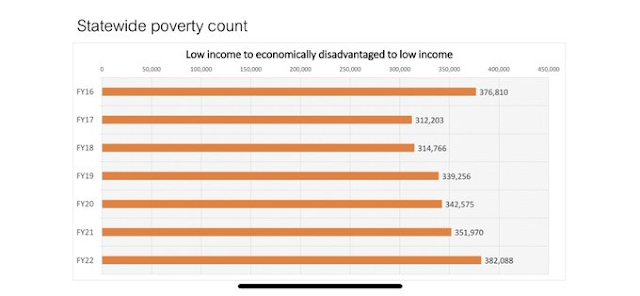
The Chapter 70 state aid recommendation is $5.9 billion, supporting a $12.8 billion foundation budget for K-12 education statewide. You'll note that this is less than half of it, which is by design; the foundation budget is designed to be funded 59% with local funds. The recommendation is a second one-sixth step towards the goal rates of the Student Opportunity Act, increased by inflation. That's in the rates for the health insurance, special education out-of-district, English learners, guidance, and low income students. This also increases the assumed in-district special education enrollment to 3.86% (4.86% for vocational), towards the goal of 4% (5% for vocational). It does again use 12 tiers for low income students. The October 1 (2021) count on which this budget is based increased the statewide low income enrollment count by 25,413 students; some of that probably is additional students who are poor, but some of that is better recognition of what already was, as I've been tracking here:
The calculation uses the 4.5% inflation rate cap of the Student Opportunity Act, as the actual inflation rate would be 5.9%, so, if that was your bet on what Baker would do, you won. The calculation uses 4.51% for inflation for health insurance, which is better than it has been. The budget holds districts harmless on funding—no district sees a drop in Chapter 70 aid alone--as well as a $30 per pupil minimum increase for districts, both of which are of course in the Student Opportunity Act.
My quick look at some districts shows some real impact on that poverty rate growth kicking in. Orange, for example, made its way out of hold harmless and into foundation aid. Mohawk Trail ate through $1M of their hold harmless this past year. We're getting there!
The circuit breaker reimbursement increases in this proposed budget from $393 million to $414 million; there's another round of the phase in of transportation reimbursement again this year as part of the implementation of the Student Opportunity Act.
Charter school reimbursement increases from $154 million to $219 million. There are three things going on here. The increases in charter school tuition stemming from the increases in the foundation budget must then be offset by reimbursement. The next step in the phase in to fully funding 100% of charter reimbursement is also in here. The state is funding the next step, which is 90%, though the actual text of the SOA says in FY23, it will be 100%. They're following the phase in by year. In outside section 40, the proposed budget adds a proposed increase to the charter school facilities per pupil increment to $1088, which then would be tied to inflation. As that funding flows through charter tuition coming from Chapter 70, it then also creates a need for reimbursement initially.
Regional transportation reimbursement, funded last year at $82 million, is proposed this year at $77 million. We sometimes forget, I think, that this is a reimbursement account; it's based on completed actual spending. Some of that drop here is reflecting the drop in transportation spending during remote learning in the year from which estimates are drawn.
Homeless student transportation funding is proposed for a substantive increase “to meet need,” from $14.4 million currently to $22.9 million for FY23, which seems wise.
METCO, funded last year at $28.5 million, is proposed in the Governor’s budget at $27.9 million.
Targeted intervention services, budgeted this current year for $17 million, is proposed to be cut this coming year to $10.3 million. Similarly, after and out of school grants, budgeted currently for $17 million, is proposed to be cut to $10.5 million. Extended learning grants, funded at $9.9 million this year, is cut to nothing. The regionalization grant to likewise cut to zero. ...all of which is rather depressing.
On the other hand, two of Baker's favorite projects, early college and vocational education, are proposed for grant increases. He proposes a substantial increase in the early college program, funded this year at $5 million, to $9.5 million. What had been the Innovation Pathways program, he renames “Career Technical Partnership Grants,” raising the funding from $600,000 to $4.8 million.
And for reasons I cannot decipher, the Executive Office of Education--that is, Secretary Peyser's office-- more than doubles from $2.3 million to $4.4 million, “to meet projected need and support new initiatives." I have no idea what that means, nor can I find anything further.
Of all of the various things to come out as part of the conference committee budget, I am most puzzled--and pretty irritated--by this:
SECTION 103: Notwithstanding any general or special law to the contrary, the comptroller shall transfer $350,000 from the General Fund to the Student Opportunity Act Investment Fund, established in section 35RRR of chapter 10 of the General Laws. Said transfer shall be made by the comptroller in accordance with a transfer schedule to be developed by the comptroller after consulting with the secretary of education, the secretary of administration and finance and the state treasurer.
That's setting aside $350M from this year's budget for the Student Opportunity Act...but not spending it. It's "in case" money.
Now, the argument that one should "save, in case" is a potent one, but the operational function of the government is primary. The government exists to do its job, which, constitutionally in Massachusetts, includes public education. And, likewise, constitutionally, that is currently underfunded until the SOA is fully funded.
Stashing $350M away in fears--I assume?--that the state won't have the funding to meet responsibilities in future years misses that we have been having headlines like this for months:
And that's without anyone touching any of the federal aid that's coming through to the state, incidentally. And these are in the months COMING OUT OF THE PANDEMIC!
It also is responding as if the state has met all of its responsibilities for this year. Mea culpa for not pointing this out before, but the Student Opportunity Act ties implementation of the circuit breaker and the charter reimbursement changes to SPECIFIC FISCAL YEARS, as so:
There was no implementation of SOA at all last year.
This year, they've implemented 25% of the transportation on the circuit breaker and 75% of the charter reimbursement; in other words, the FY21 levels. It is, though, FY22 they're funding. Despite the "no, really, we're up to date on the SOA implementation" language, we are not up to date.
As noted yesterday, one could solve one of these with the other:
This budget underfunds our education promises by $50 million.
The Student Opportunity Act committed to closing holes left by charter school tuition & in the special education circuit breaker program this year.
We have the money. But instead, this budget puts it in a trust fund.
circuit breaker relief email has gone out to districts: this fiscal year costs must be 25% over cost last year for circuit breaker
60-65 districts that file on an annual basis
hopefully by end of this month should be filed
Gov's budget: budget will go through a number of iterations through House and Senate may or may not use ESSER funds for local contribution DESE will continue to plan as if that's going to happen; guidance will be available, but not yet Still not (and won't be) sure
House 1 Ch. 70 proposal: Rob O'Donnell and Rob Hanna
slides are on DESE Ch.70 page (this set is updated as of today) updated Ch.70 formula workbook, as well, as to how ESSER II funds should be available to regional district members Ch.70 aid increases over $197.7M over FY21 1/7th implementation of SOA low income up to 185% threshold (FY16 % of low income student enrollment) assumed in district sped enrollment percentages (increased to 1/7th) inflation of 1.48% (2.78% for insurance from three year GIC average) Hold harmless for 20 districts that would have otherwise lost aid under SOA implementation local contribution reduced 100% of gap for those over target CEY of 175% of foundation or more required to contribute to 82.5% of foundation House 1 allows districts to use up to 75% of ESSER II funds for their local contribution increases Members of regional district may deem a proportional share of 75% of the regional district's ESSER II grant toward increases in required contribution charter tuition based on same foundation rates implements 100/60/40 schedule for charter reimbursement (year 1): 75% of total entitlement based on current projections: $143.5M (will be 90% in FY23, 100% in FY24) charter tuition being reduced by per pupil required local contribution that can be supported by each sending district's ESSER II award (reduction statewide of $7.5M) Charters then asked to offset with their own ESSER funding allocations of coronavirus funding $53M statewide just over $50M in funding for districts ($25 per pupil + $75 per low income pupil) two equal payments starting this month (later) No grant applications needed but for eligible expenses; only for use in FY21 (so by June); thus can go back to July 2020, must be spent by June 2021 to be put in separate account "available to school committee without further appropriation" will at least need to be reported on End of Year report; may be other reporting requirement "we're going to have all kinds of pages in the end of year report, starting in FY21" Federal CvRF next round of reporting due March 5
Transportation: Craig Delmonte: district that provides own transportation should have heard from recently how districts are reporting transportation costs on End of Year report accurate measure of claiming for costs under circuit breaker for districts that provide own transportation working on cost per ride across Commonwealth
Questions: FY21 rural aid distribution: no info as yet if my charter reimbursement is going down, what's up? Your tuition must be going down ESSER funding: available to school committee up to 75% of total amount to cover increase aid to state and local governments potentially coming in President's bill 150 districts that haven't drawn down CvRF if you're funding right at net school spending, First time in history that a grant will be counting towards NSS "you're going to spend the money, and then journal enter the money in your EOY report" ESSER II use is putting off the local funding of the increase in local contribution, which will need to be picked up the following year
I am sorry it has taken this long for me to get this into a blog post. I did tweet this out when the budget went up online on Wednesday.
The Governor's budget--House 2 in this second year of the Legislative term--is online here. You may also find useful the FY21 Chapter 70 school finance page from DESE (much more descriptive that previous years) and the cherry sheets (the net state aid calculations) for municipal and regional.
As last year, I have started an Excel spreadsheet with the accounts, the FY20 projected, and the FY21 proposed, along with any notes. Please feel free to use and share it, and let me know if there are ways it could be more useful.
It is the first year of the implementation of the Student Opportunity Act, so the first question is, was it implemented?
I think my answer on that is "mostly, but," as I said to Commonwealth Magazine when they called me this week.
The estimation was the 1/7th of implementation of the Student Opportunity Act would take an additional $300M in Chapter 70 aid statewide; that was hit.
The new law guarantees $30/pupil minimum increases with hold harmless; that was done.
House 2 does increase health insurance by the GIC three year average increase of 2.34%, rather than the inflation rate for the rest of the foundation budget, which is 1.99% (which is not great at all).
The special education rate does take the 1/7th step towards the goal rate, plus 1/7th of the new enrollment counts
Likewise English learners category takes 1/7th step towards the goal.
Low income...does not. Remember that this year, the state was directed to use the FY16 free/reduced count as a percentage to apply to this year (unless the direct certification count was higher). That added 46K kids to the count statewide, which increased the amount of dollars devoted to this category. As a result, the Governor's budget implements only 4/100ths of the goal rate. The state was directed to implement the changes in "an equitable and consistent manner" and I would argue: this isn't it. To give some idea of what this looks like, here are the rate charts for FY20 and FY21:
This is FY20, the current year. Note the length of the bottom lines, particularly the very bottom one, relative to the three through six, which are the grade level foundation rates.
This is FY21, the budgeted year. Note again the length of the bottom lines, the low income increments, relative to three through six. We are to be getting the bottom one equal to that in seven years. Unless not.
The danger in both state and local budgets has always been that the "new money" was going to leave those doing the allocations with the impression that they didn't need to fund other accounts (or to the same level), because schools should just pick up those activities with the new aid. This is certainly the Governor's framing of the budget. Not only are a number of accounts zeroed out--civics education, financial literacy, computer science--but several are severely cut:
extended learning time (7061-9412) is cut by $10M (it's a $13.9M account cut to $3.9M).
likewise, the after and out of school grant is cut from $8.5M to $2.5M.
Given the resources being made available in a single year of a seven year phase in, this is abrupt and not borne out by the resources put forward.
For those looking at other accounts, some of which also had SOA requirements:
regional transportation (which we last saw getting a boost in the supplemental budget) is budgeted at $75.8M, which is where it came out of conference committee last year. That was about an 83% reimbursement level; no doubt costs of grown, and I have yet to hear projections for this year.
McKinney-Vento homeless transportation reimbursement is $11M, which is level funded from last year's conference committee budget. The supplemental did add another $2M to that, but unless that is re-appropriated to the schools, that goes to the general fund in municipal districts. $9M was 37%, implying that $11M was about 45%, but I would think that costs have also gone up.
MassBudget projected that the circuit breaker account would have to increase by $22.5M in order to incorporate transportation, as required by the Student Opportunity Act; the account goes up by $23M. However, this means there is not space in the account for the usual growth of costs. It isn't clear that this is appropriately funded.
Similarly, charter reimbursement was projected by MassBudget to need to rise $29.4M in order to be at least 75% as required by the new law; the line increases by $19.4M in the Governor's budget. I am told that it is expected that once actual enrollments at charters are known this will be closer to what is needed.
educational data services (7061-9200) is going from
$579,786 to $1,078,231, and I have no idea why, and I cannot find any explanation of it. I can't find any explanation of anything; are they not posting any narrative this year?
recovery high schools were sent to study in the Student Opportunity Act, as their costs aren't being covered: last year, they were funded at $3.1M, while the Gov's budget has them at $2.6M.
rural schools have been added the past several years, generally on a budget amendment from Senator Adam Hinds. Thus it is a bit of a victory for it to be in the Governor's budget this year, even if it is at $1.5M, rather than the $3M that is projected for FY20.
(upon consideration, adding this): it does not appear the Governor is requesting additional appropriation for the Department, despite the SOA reporting requirements. Someone has to do the target calculations and review and respond to the reports; it appears that it's going to be the same stretched staff already there.
It's always important to remember--and particularly important this year--that the Governor's budget is where the conversation starts. Get some idea of where your district is (if you haven't gotten your hands on circuit breaker projections, ask!), and go talk to your reps and senators.
Okay, it's House 2 budget week, but still...the Governor releases his budget on Wednesday.
If you haven't already reviewed Colin Jones of MassBudget's preview of what implementation of the Student Opportunity Act should look like, please do. Numbers to note:
On Chapter 70 aid specifically, one-seventh of the new funding from the SOA reforms would have to be added to the typical annual increases. Combining this new funding with the typical increases, the Baker Administration expects $303 million per year in increased Chapter 70 aid from FY 2020 to FY 2027. This is only a rough estimate from several months ago that will be updated in the FY 2021 budget and beyond as economic conditions, student enrollment, demographics, and other factors shift. The SOA aims to add transportation costs to the circuit breaker over four years. The education committee estimated this would cost $90 million. This suggests $22.5 million in dedicated spending in this line item in FY 2021, in addition to typical funding growth for special education. The SOA also sets a goal of fully funding the charter school reimbursement program within three years. Fully funding charter reimbursements would cost roughly $75 million in FY 2020 according to current projections. This total will likely rise with the higher foundation budget as the SOA is implemented over time. This suggests addressing gap would cost $29.4 million in FY 2021 if the charter program continues at current levels and the SOA funding schedule is followed.
...but before we talk about that, let's note this nice piece from Sentate President (and former Ashland School Committee member and yes, I am always going to remind us of that) Karen Spilka:
This week, the Massachusetts Legislature passed the Student Opportunity Act unanimously. This historic vote demonstrates our commonwealth’s continuing commitment to ensure a quality public education for all our children. It also represents a deeply personal achievement for me and MetroWest, as I first ran for the Legislature 18 years ago to address what I saw as inequities in school funding in my hometown. With my two young children in public school, I first ran for school committee, and then convened the Chapter 70 Roundtable. A statewide coalition of parents, teachers, administrators, school officials, advocates and stakeholders, we sought to advocate for equity, adequacy and predictability in educational funding. the passage of the Student Opportunity Act, I am proud to say that we are finally seeing the culmination of that advocacy two decades later.
Very true, and we should note that the leadership of Senate President-emerita and former Worcester School Committee member Harriette Chandler, as well, and that list is considerably longer.
Earlier this week, I was lamenting the losses among the local press and what that meant for coverage of this school funding bill's impact locally; I am more than pleased to have been proven wrong this morning:
Front page of the Sunday Telegram has a headline that reads "Filling the blanks" over an image of a teacher leaning over a little girl with headphones looking a laptop screen
I would say there are three things happening in this article:
1. Is this really over?
This is the crux of the question over if the potential lawsuit involving Worcester will be dropped, for starters. We should note that Worcester, involved in the potential Mass Association of School Superintendents lawsuit, has not been among those represented in a currently filed lawsuit. The lawsuit that aleady exists through the Council for Fair School Finance (of which, yes, MASC is a member), is Mussotte v. Peyser, was filed in June, and involves children from Chelsea, Chicopee, Fall River, Haverhill, Lowell, Orange, and Springfield. That lawsuit has not been dropped, and I don't know anything of that decision, but the note coming from Worcester's administration that this becomes about implementation is, I think, the key.
I think we also need to remember that "they're trying" was more or less the state's (successful) defense in the Hancock case, so the hopes of a lawsuit being successful under those terms is much less certain.
Which brings us to Brian Allen's answer to "how much?":
As Worcester’s chief financial and operations officer Brian Allen pointed out, while the SOA establishes the goal-funding rates, left unsettled is at what number those rates will be phased in each year. “It appears to fully cover the gap in the foundation budget we’ve been talking about,” he said, referring to district estimates that Worcester has been underfunded by around $100 million under the current formula. But a host of variables, including the performance of the economy, means that money isn’t technically guaranteed as of the passage of the bill, he added. “Our individual yearly budget will still be subject to what the rates are phased in at (in any given year) ... there’s still going to be a level of uncertainty.”
This isn't a money bill.
My slide from my 70 on 70 presentation; this is what this becomes about.
There is no actual funding being passed by this bill. It lays out a plan SUBJECT TO APPROPRIATION of what will be done, and, as Mr. Allen notes, there isn't an actual schedule in the bill, either. There are also, as I noted back when the Governor leaked DESE spreadsheets, a lot of pieces that are still WAY up in the air: how are we changing the low income count? are we changing the municipal finance side? what are the inflation rateS (there are two now, remember)? and yes, does the economy slide or worse?
That is in ADDITION to the pieces that change year to year, anyway, with the biggest being enrollment, district by district (WHICH DESE DID NOT HAVE UNTIL OCTOBER), and what the municipal economies look like.
We don't know a lot of that. And even the part that we DO know for next year (as we'll be using the FY16 low income counts, for example) is something we know for one year.
AND we still don't know what state implementation will look like.
Thus Superintendent Jokela is right in not getting ahead of things. We need to plan, but we also need to wait.
I've now said this to school business officials, and to school committee members, and to superintendents: the most accurate numbers right now are going to be LOCALLY GENERATED.
And they're still only going to be for one year.
This is one of two areas our advocacy needs to shift to: we need year by year commitment by the Legislature and the Governor to implementation.
2. But are we going to get anything at all?
Let me note up front that this is not a Worcester question; the answer for Worcester is yes, but HEY WE NEED TO TALK ABOUT MUNICIPAL CONTRIBUTION YESTERDAY.
For many other districts, it's the question of if the state is going to be contributing more than the minimum per pupil increase, along with the fear that their local contributions are going to be increasing a great deal. On the first, there's a reason the Education Committee included charter reimbursement and the (massive) addition of out-of-district transportation to the circuit breaker (which is getting frozen at the FY20 level, plus inflation). ASK HOW MUCH THAT IS FOR YOUR DISTRICT.
On the second, let me direct you back here . This is one that you CAN with a little work mostly figure out; you just have to know how much your actual municipal contribution was for last year, versus how much was required. Rolling forward, what's the division on foundation of the target? Most of you are going to find that your local municipality(ies) are already well over minimum required.
...which brings me to what IS my main concern here: If you are a district that lives in the 5%/7% or so over, and it's a struggle every year to get there, my concern is those that would prefer to spend no more on schools are going to say "we've given you what is required; you should be fine," when perhaps you are not.
If this is your reality, the time to start having those discussions is now.
3. What do we do now?
Even given Mr. Allen (et al)'s conservative (small c) caution on implementation, we're going to see the largest increase in school funding in Massachusetts since the 1993 Education Reform Act. What are we going to do with it?
If you read this blog with regularity, you can perhaps tell that Scott caught me mid-blog post in my comments in the article. Thinking back to Ben Forman's work on how representative school committees in cities in Massachusetts are (not), we have a responsibility to be very blunt in our assessment of who is at the table and who is not, and work strenuously to counter that.
Long term, this means electoral work; for this coming budget, it means we make this as big a table in as many contexts as possible. Jack Foley, to his credit, has been absolutely unrelenting in making this point over the past several months in Worcester; if you're reading this from elsewhere, is anyone making that point in your district? If not, make it you.
That is our other round of organizing work: when the Governor's budget drops in January and we start that countdown to July 1, we need to be gathering around tables across districts to get everyone's voices heard. That isn't always going to be about the district doing it--though I would argue that the school committees have an absolute responsibility to make this their job--but about any group of any kind that cares about kids and the future to get people together to have these discussions. And for those who are in Worcester, please consider this my open invitation; I want to hear about these!
As we have those discussions, I also think we have--and here I mean as people we have--a responsibility not to get distracted by the bright and shiny. We have bedrock needs that are not being met in our districts:
Many underfunded districts have become accustomed to going without the kinds of essential, often ordinary things, like up-to-date novels or working drinking fountains, that wealthier schools “basically take for granted,” Novick said. “There’s almost an attitude shift that has to happen, to acknowledge the level of need, that this is how big the gap is,” she said.
I mean it when I say that I think that we don't even know what we don't have. We have gaps that are chasms in basic things like teaching and student supports, in building maintenance, in supplies. That's not about new programs, before meeting current needs; it's not about new buildings, before fixing the ones we have; it's not about shiny new curriculum or technology, before getting updates to what is crucial.
The work isn't over; the advocacy and organizing isn't over. Let's start NOW to shift gears towards implementation at the state and local levels.
And let's build a bigger table as we do so.
Coming to you live from the House gallery which has not been renovated and thus has not as much access to electricity, alas. I like their carpeting, though. No photos allowed.Or snacks. Or liquids other than water.
awaiting the opening of the gallery
You can watch the session here. The bill (H.4137) is here. I will warn you that I cannot identify most House members by sight or voice. Sorry. posting as we go
...which was reported out of Senate Ways and Means as S.2350, An Act Relative to Educational Opportunity for Students (AREOS?); the amendment are online here.
Note that a significant number of these, including the first ten, are from Senate Minority Leader Bruce Tarr, a prolific writer of amendments.
I'll include the numbers, but I'll cluster these by topic, as there are overlaps:
Regional Transportation reimbursement:
1 reimburses regional transportation at "not less than 85%"
2 creates a commission to study 100% reimbursement for regional school transportation
11 sets regional transportation reimbursement to 85% but takes out "subject to appropriation"
36 removes the "subject to appropriation"
43 would add any municipality over 95 square miles to transportation reimbursement; they must be using a different list than I, because I have Barnstable as the largest and it's less than 60...if you check the sponsor, you'll be shocked to find this would, it appears, apply only to the town of Plymounth, which still encompasses much of the original Plimouth Plantation.
Minimum per pupil increases:
3 increases mimimum per pupil aid to $35/pupil
4...to $40/pupil
5...to $50/pupil
6...to $100/pupil
Reviews of the foundation budget:
7 amends to review every five years (the bill proposes 10)
8 does the same but with different language
14 bumps labor representation to two
35 also sets the foundation budget review commission to every 5 years
36 requires a foundation budget adequacy study
Circuit breaker:
9 boosts circuit breaker reimbursement to 80%
10 sets the approved reimbursement threshhold to $34,345 from $45,793.
Reports:
15 requires school level reporting on mental health supports
17 makes more specific the reporting out on use of funds and specifically bars the Commissioner from decreasing them
24 requires than any new reporting be considered in light of other reporting the state already requires
31 requires sort of "workforce preparedness" reports
34 ties the district's improvement plans much more closely to declarations of underperformance
38 makes it clear that the district (not the state) is to determine what changes are necessary
39 would add "college completion" to the report the Secretary would give each year
52 adds student growth to what is being considered in the plan of how funds are used
65 requires that the report from districts including reducing disparities (rather than student achievement)
Phase in:
16 provides for the annual consensus revenue agreement on implementation that was in the Promise Act and earlier bills
25 requires phase-in be equitable but also allows for a phase-in extention to 2030
53 requires proportional phase in of the recommendations
59 requires an annual report on phase-in as well as an annual hearing
Special education:
28 bumps the low income assumption to 5% across the board
Recess:
12 mandates 100 minutes of recess a week for K-5 and forbids making it shorter
Charter schools:
19 requires that the financial impact of charter schools be considered when considering their applications
29 creates a charter school policy commission
51 deducts charter reimbursement from net school spending calculations (huh?)
60 creates a working group on charter school funding and reimbursement
61 would take any charter reimbursement not funded out of the charter school's allocation
62 includes minimum aid in the provision of Ch. 70 (so a district can be funded over foundation due to state requirements) and locks the out-of-district transportation reimbursement in as part of the full provision of the act (I don't think I entirely understand that one)
Athletics:
13 requires that each district with an athletic program have a licensed athletic trainer
Other commissions:
18 specifically DROPS "expanding use of technology to deliver instruction and enable operating efficiences" and switches " encouraging ways to reduce costs and improve educational outcomes" to "encouraging ways to improve fiscal health and educational outcomes" and "reorganizing" to "optimizing" from the recommendations to come from the rural schools study
20 creates an Unfunded Mandates Task Force
22 would have the report on Rural Schools only report out on low-income districts unless warranted by the study
23 would add an appointee of the minority leader of the House to the 21st century advisory committee
27 requires that the commission reporting out on municipal wealth specifically consider the impact of Prop 2 1/2
33 would require a study of the circuit breaker and out-of-district special education provision
63 creates a commission on debt-free higher ed
64 adds some members and some new reporting requirements to the Rural Schools Commission
66 would create a special education commission to study provision of services
MSBA:
21 prioritizes "school safety" funding in MSBA considerations
44 would further bump the MSBA funding cap to $800M
Parent engagement
26 requires that such parental engagement required by the bill specifically considers specific subgroups in doing so and report out on it
Homelessness
30 requires reimbursement of homeless student transportation, less federal reimbursements by November 20
Municipal calculation:
31 is intended as a sort of smoothing of municipal wealth calculations, requiring that in towns of less than 6000 people, the bottom and top 5% of residents be dropped from both the income and property values
Recovery high school:
40 would allow for creation of a reserve fund locally for recovery high schools
41 would add reimbursement for recovery high school transportation
42 would study the costs of sending students to a recovery high school
Early college high school:
46 would recognize early college programs for the same level of funding as vocational programs
47 would add early college to the spreadsheet at an increment above high school but below vocational (that was the Governor's plan)
Random other things:
45 requires a "school-based threat assessment team" at each secondary school that would create a threat assessment policy
48 creates an innovative health partnership
50 would add Easton to the Cambridge labor market adjuster
54 allows 71B (out of district special education) schools to apply for the grants in the bill
55 mandates that each high school student must meet with a guidance counselor at least one each year
56 would create a certification for autism services
57 would bring back a full-day K grant specifically to get it everywhere in the state
58 creates a certification bonus for districts running programs leading to vocational certification
67 would set "(a)strong institutional leadership, (b) active student engagement in their education; and (c) differentiated instruction" as what is considered in awarding 21st century grants
68 would require financial literacy instruction
69 would creating a "Learning Innovation for Tomorrow" (LIFT) fund for funding innovation in education in districts