Public comment:
Showing posts with label Keefe. Show all posts
Showing posts with label Keefe. Show all posts
Thursday, June 4, 2020


Wednesday, October 23, 2019
The House deliberates the Student Opportunity Act
Coming to you live from the House gallery which has not been renovated and thus has not as much access to electricity, alas. I like their carpeting, though. No photos allowed.Or snacks. Or liquids other than water.
You can watch the session here. The bill (H.4137) is here.
I will warn you that I cannot identify most House members by sight or voice. Sorry.
posting as we go
 |
| awaiting the opening of the gallery |
You can watch the session here. The bill (H.4137) is here.
I will warn you that I cannot identify most House members by sight or voice. Sorry.
posting as we go
Friday, March 22, 2019
Joint Committee on Education hears the funding bills:
This is bound to be a long one! I'll be updating this all day as we go.
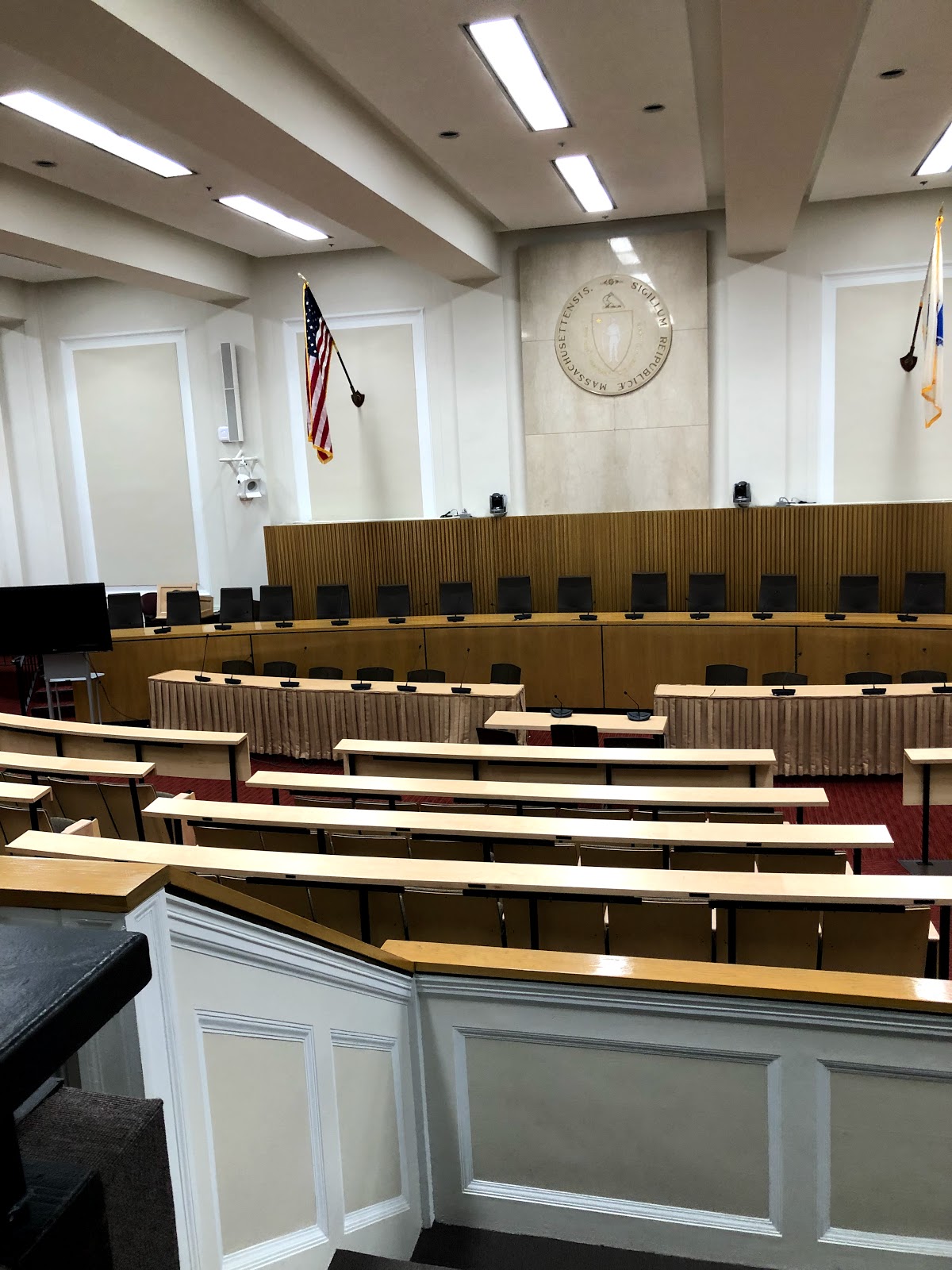
The hearing begins at 10 am, but the auditorum is filling fast: the MTA is here with red "Fund our Future" shirts, I've seen a few superintendents come in, Mass Parents United is here with black tee shirts, and staffers from the Senators and Reps are in and out. My view is from the top back:

The hearing begins at 10 am, but the auditorum is filling fast: the MTA is here with red "Fund our Future" shirts, I've seen a few superintendents come in, Mass Parents United is here with black tee shirts, and staffers from the Senators and Reps are in and out. My view is from the top back:
Wednesday, January 9, 2019
New Legislative session, new bill (this one gets wonky)
Usual disclaimer here (which lives over to the left on a full screen): this is my work, my words, my views; don't ascribe them anywhere else.
Let's start this off by noting what was in the Foundation Budget Reform Commission report (MASC summary here):
So what's the change?
Boston, in a word.
Let's back up and remember what determines the amount of state aid any district gets: every district has a foundation budget, calculating the adequate (per current law) amount is for that district to educate the students in the district (as of the prior year). The state then calculates how much of that foundation budget the local city or town(s) can afford to provide. The state fills in the rest.
Cities and towns vary widely in how much they can afford: there are districts like Holyoke and Lawrence that can barely afford single digits amount of their foundation budget. There are also districts that can fund their whole district budget will money to spare.
That includes Boston.
I've said this--lots!--before, but I'll say it again: Boston has a high-need school system in a WEALTHY city. In the current fiscal year, for example, Boston has a foundation budget of $861M; the state calculates that it can afford $100M more than that.
But every district in Massachusetts gets money, regardless of need. Every district gets--and this, too, includes Boston--gets 17.5% at least.
It's important to note that this is NOT part of the foundation budget. There is no equity issue around the wealthy districts being guaranteed state funding, regardless of need. That's a straightforward political calculation.
So what's the issue?
Charter schools in Massachusetts are funded at the level their local district is funded at. Charter school students are included in the district foundation budget; the funding of each student "follows" the student (with 100% of the tuition being reimbursed to the sending district in the first year) PLUS funding for facilities AND however much the sending district funds over foundation.
Now the charter schools don't send the district a bill; the funding for the charter schools, at whatever level, are deducted from the Chapter 70 aid of the sending district; it is netted out of the funding that is sent to the district.
The amount of that required funding is capped (that's the charter cap) at 9% or 18% (for what had been the lowest performing districts) of the foundation budget of the district, 'though if a district spends more on the local district schools, that is added on over and above that cap.
So if you are Boston, and you get 17.5% of your foundation budget in state aid and you have 18% of your foundation budget going to charter schools PLUS whatever percentage over you're spending on your district schools--in Boston, this was19.6% in FY17--yes, your state aid is dwindling, it appears.
Note, however, why this is: it is the nearly unique position of Boston to be wealthy enough to be getting the minimum amount of state funding AND have an 18% charter cap.
The bill proposed today would guarantee that, needed or not, Boston and all such districts would get their minimum state aid of their district foundation budget AFTER charter school funding is netted out.
This is not a foundation budget issue. This is not, I'd argue, even an equity issue. This is a charter funding issue. If Boston wants to reopen that can of worms, they can do that.
What about the other districts that have charter students and tuition? Let's look at Lawrence as an example, since Mayor Walsh pulled them in this morning: in FY17, Lawrence lost 10% of their foundation budget of $185M to the charter schools that receive Lawrence students. If you deduct that $18.5M from the $178M that Lawrence received in Ch. 70 aid, Lawrence received about $160M in Ch.70 aid. Assuming the district foundation budget is about $167M (that's the same 10% off the foundation; it isn't that, as it isn't exactly, but it isn't a terrible model), this bill would say that Lawrence is guaranteed $145M--their target of 87.16%--in aid. Lawrence, though, net charter tuition, already is receiving $159M in aid, though (well over their target, yes). There's no advantage to Lawrence or any other district that receives aid in excess of their target in this, unless those targets shift, which would require Lawrence to fund more of their budget.
There are districts, possibly even like Worcester, that would see a bump from this. It is not, in those high charter but high poverty districts, anything at all like the main issue at hand.
This issue shouldn't be tied to the equity issue for the districts that cannot afford to fund their district schools. And frankly, it makes me angry to see Boston arguing in any way that this is an equity issue.
Let's start this off by noting what was in the Foundation Budget Reform Commission report (MASC summary here):
- update the actual costs of health insurance
- update the special education assumption (not to actual costs)
- update the ELL provision
- update the low income provision
In also requires the creation of a data commission, and notes (but doesn't recommend) the need for preschool and the missing pieces on inflation.
Last session's Senate bill included the four sections on updating funding (the four bullets) and the data commission.
The bill being filed today--SD.101--also does that, but it has quite a bit else going on.
So what's the change?
Boston, in a word.
Let's back up and remember what determines the amount of state aid any district gets: every district has a foundation budget, calculating the adequate (per current law) amount is for that district to educate the students in the district (as of the prior year). The state then calculates how much of that foundation budget the local city or town(s) can afford to provide. The state fills in the rest.
Cities and towns vary widely in how much they can afford: there are districts like Holyoke and Lawrence that can barely afford single digits amount of their foundation budget. There are also districts that can fund their whole district budget will money to spare.
That includes Boston.
I've said this--lots!--before, but I'll say it again: Boston has a high-need school system in a WEALTHY city. In the current fiscal year, for example, Boston has a foundation budget of $861M; the state calculates that it can afford $100M more than that.
But every district in Massachusetts gets money, regardless of need. Every district gets--and this, too, includes Boston--gets 17.5% at least.
It's important to note that this is NOT part of the foundation budget. There is no equity issue around the wealthy districts being guaranteed state funding, regardless of need. That's a straightforward political calculation.
So what's the issue?
Charter schools in Massachusetts are funded at the level their local district is funded at. Charter school students are included in the district foundation budget; the funding of each student "follows" the student (with 100% of the tuition being reimbursed to the sending district in the first year) PLUS funding for facilities AND however much the sending district funds over foundation.
Now the charter schools don't send the district a bill; the funding for the charter schools, at whatever level, are deducted from the Chapter 70 aid of the sending district; it is netted out of the funding that is sent to the district.
The amount of that required funding is capped (that's the charter cap) at 9% or 18% (for what had been the lowest performing districts) of the foundation budget of the district, 'though if a district spends more on the local district schools, that is added on over and above that cap.
So if you are Boston, and you get 17.5% of your foundation budget in state aid and you have 18% of your foundation budget going to charter schools PLUS whatever percentage over you're spending on your district schools--in Boston, this was19.6% in FY17--yes, your state aid is dwindling, it appears.
Note, however, why this is: it is the nearly unique position of Boston to be wealthy enough to be getting the minimum amount of state funding AND have an 18% charter cap.
The bill proposed today would guarantee that, needed or not, Boston and all such districts would get their minimum state aid of their district foundation budget AFTER charter school funding is netted out.
This is not a foundation budget issue. This is not, I'd argue, even an equity issue. This is a charter funding issue. If Boston wants to reopen that can of worms, they can do that.
What about the other districts that have charter students and tuition? Let's look at Lawrence as an example, since Mayor Walsh pulled them in this morning: in FY17, Lawrence lost 10% of their foundation budget of $185M to the charter schools that receive Lawrence students. If you deduct that $18.5M from the $178M that Lawrence received in Ch. 70 aid, Lawrence received about $160M in Ch.70 aid. Assuming the district foundation budget is about $167M (that's the same 10% off the foundation; it isn't that, as it isn't exactly, but it isn't a terrible model), this bill would say that Lawrence is guaranteed $145M--their target of 87.16%--in aid. Lawrence, though, net charter tuition, already is receiving $159M in aid, though (well over their target, yes). There's no advantage to Lawrence or any other district that receives aid in excess of their target in this, unless those targets shift, which would require Lawrence to fund more of their budget.
There are districts, possibly even like Worcester, that would see a bump from this. It is not, in those high charter but high poverty districts, anything at all like the main issue at hand.
This issue shouldn't be tied to the equity issue for the districts that cannot afford to fund their district schools. And frankly, it makes me angry to see Boston arguing in any way that this is an equity issue.
Thursday, May 22, 2014
H 4091 passes the House
I regret to inform you that H 4091 passed the House yesterday, with the only amendment being one that allows for extracurricular activities of one set of schools to be used by students of the other (charter/public).
I am particularly saddened by the 'yes' votes of Worcester Representatives Jim O'Day, Dan Donahue, and John Mahoney, which are votes to allow the Commissioner to push "turnaround" status on our Level 3 schools (by declaring them "challenge" schools; and note that this is most of the schools in Worcester), to take up to 23% of public school budgets and send them to charters (not Worcester now, but no guarantees about later), to allow districts in receivership to use private funds for a two track teacher pay system, and to allow those districts to pass budgets without public transparency.
I can't explain it otherwise. This is an anti-public education vote.
Thank you to Rep. Keefe for her 'no' vote. The 'no' votes may have been in the minority yesterday, but they were right.
I think Rep. Denise Provost of Somerville said it best:
"this whole charter school debate would benefit from a big dose of democracy" Rep. Provost #H4091
— Tracy Novick (@TracyNovick) May 21, 2014
...because what we saw yesterday certainly wasn't.
Subscribe to:
Posts (Atom)