I am just seeing this, but for those who read or follow such things: the Office of the Inspector General has issued a report on Brockton in FY23. You can find it here.
Coverage in MassLive, Boston Globe, and The Enterprise
Showing posts with label FY23 budget. Show all posts
Showing posts with label FY23 budget. Show all posts
Wednesday, December 3, 2025
Office of the Inspector General on FY23 in Brockton


Tuesday, March 19, 2024
"Missing the point is a very fine art"
Missing the point is a very fine art; and has been carried to something like perfection by politicians and Pressmen to-day. For the point is generally a very sharp point; and is, moreover, sharp at both ends. That is to say that both parties would probably impale themselves in an uncomfortable manner if they did not manage to avoid it altogether.G.K. Chesterton "The Art of Missing the Point"

It used to be a regular feature (?) of the blog for me to argue thoroughly and at length against whatever material the Boston Globe was circulating in their education coverage. While of course the post I finally got up about early literacy was in large part on that, for the most part, I'm doing less of that. However, I did find occasion to respond at length on Twitter to the Globe's piece last week on the challenge of inflation in the FY25 state budget, and I thought it warranted fleshing out here.
Monday, December 4, 2023
FY25 Joint Consensus Revenue Hearing
hearing will be going up here (updating as we go here!)
As reporter Katie Lannan notes:
✨three fiscal years at once✨ https://t.co/TYO13qYM98
— Katie Lannan (@katielannan) December 4, 2023
Senate Ways and Means Chair Senator Rodrigues notes that the Senate is in session, subject to the call of the chair and "I need to put fiscal year '23 to bed before I start talking about FY25"
Tuesday, September 12, 2023
and there's more from Brockton
...where the assistant financial officer has now claimed whistleblower protection:
...attorney Timothy Burke has said he plans to file a whistleblower lawsuit against the city of Brockton and its school committee on [assistant financial officer Christopher] Correia’s behalf, claiming Correia sounded alarms about the district’s overspending for months.
Thursday, September 7, 2023
bits more from Brockton today
...as they had a school committee meeting last night, which had an active public comment section period, and someone noted that maybe the meeting last week wasn't as public as necessary. The district communications person has said that overspending was in transportation, special education, and payroll.
The district--I guess the school committee?--has also placed the top two financial people on administrative leave as of Friday. The mayor said this:
As the mayor and as a parent of children in city schools, Sullivan said he was shocked to learn about the FY2023 school deficit. He said he was notified of the shortfall on Aug. 8 by Petronio and Correia. The next day, Sullivan said he met with the both Petronio and Correia, the city’s chief financial officer, and the schools superintendent, Mike Thomas, who confirmed the deficit.
What I haven't yet seen is any reporting on how the deficit was possible, as the schools operate as a city department, with all spending going through the city treasurer, and departments can't overspend what they have had allocated to them (a bottom line in the city budget).
Hoping someone gets to that part soon.
Friday, September 1, 2023
Of Brockton and $14M
Let me open by noting that I know only what I have read in the press, and I wouldn't post beyond that.
The news broke yesterday that the Brockton Public Schools is faced with a $14M deficit for the FY23 fiscal year--that is, the year that ended June 30. Public school districts in Massachusetts are required to balance their books, and that fiscal year has ended. You can read Boston Globe coverage here and WBUR's here, The Brockton School Committee was in executive session for four hours yesterday for executive session reasons 1 and 2:
Pursuant to M.G.L. c. 30A, §§ 21 (1) – To discuss the reputation, character, physical condition or mental health, rather than professional competence, of an individual, or to discuss the discipline or dismissal of, or complaints or charges brought against, a public officer, employee, staff member or individual.
Pursuant to M.G.L. c. 30A, s. 21(a)(2) – To conduct strategy sessions in preparation for negotiations with nonunion personnel or to conduct collective bargaining sessions or contract negotiations with nonunion personnel.
It appears that they did not specify who in either case; note that the person spoken of in the first has the right to attend the meeting.
The same time that news broke about the deficit also came the news that their superintendent Mike Thomas is going on a medical leave, though WHDH interviewed him today, it appears. Among other things, he said:
“I’m the leader of the school district so, obviously, you can’t overspend the budget,” Superintendent Mike Thomas told 7NEWS. “But I can tell you that every dime went toward supporting kids.”
“I’m guilty of keeping too many staff members, doing what I thought was right to help kids recover from COVID and provide them the support that they needed and support our staff,” Thomas said.
This afternoon, the Brockton School Committee met in public session long enough to vote in their deputy superintendent of operations James Cobb as acting superintendent and for an independent investigation before going back into executive session.
I'm sure we're going to see lots of numbers swirling around: note that districts report their actual spending to the state in required End of Year reports that are usually due in October. Those include both district and municipal spending on behalf of the district; it also includes grant spending, which would matter as it's an ESSER year. ESSER funding comes through the state, with which districts were required to file reports on their planned spending.
Thursday, May 11, 2023
DESE shared more finance data and this is VERY EXCITING!
While I was doing my periodic check of what DESE is sharing on school finance, I discovered that DESE has added to their shared resources a compilation of Net School Spending dating back to 1993, for the state and for districts.
How fun!
As a reminder, there are two reasons why your required net school spending could be more than 100%:
- your community spent less than the required net school spending the prior year. That amount then gets added to the next fiscal year.
- your district would be receiving less state funding through chapter 70 than it received in the prior fiscal year, so the state ensures you get the same amount of aid as you received the prior year--hold harmless--and a bit more (now it is $30/pupil minimum in the SOA; it has varied by year otherwise)
I took the statewide required net school spending back to the creation of the foundation budget in 1993 and put it in its own graph:

The first few years of education reform, the state was phasing in the foundation budget over a series of years, scaling up to requiring the 100% of the new foundation level of spending for 2000.
Over those next few years, you can see required net school spending running quickly up over the 100% of foundation due to the above. The Great Recession then socked revenue in 2007, with the federal government pushing funding out to bring school spending back up.
What I found particularly interesting is the past handful of years, as we see SOA implementation coming in, which pulls enough districts out of hold harmless that you can actually see the state percentage begin to come back down. Those districts are getting real increases, rather than minimum increases, because the foundation budget has increased so much over these past few years. That means they're getting state funding that gets them closer to and then at their foundation budget, but those increases are foundation increases (much more significant funding) rather than minimum increases.
And that migration of districts out of hold harmless will continue will continue.
When you then look at actual spending, we of course know that for years, districts spent well in excess of required minimum spending due to districts finding that the foundation budget wasn't meeting actual needs. While the first few years here above 100%--see above--are due to districts catching up, districts then sustain above minimum, even during the Great Recession.
But look what just started happening recently!

Here's the thing: THIS IS GOOD NEWS! Remember, the foundation budget is increasing substantially. Thus that 100% represents significantly more money from BOTH state AND local sources.
While required minimum generally required increases in local funding, in any case, we do need to remember that funding at 100% of net school spending as we continue Student Opportunity Act implementation is going to represent increases in funding--in some cases, substantial ones--for districts that were not funding way over what is required.
Again, we're doing this, Massachusetts!
Thursday, April 27, 2023
A few quick notes from yesterday's F&O meeting
This will officially be reported out at next week's (May 4) meeting, but a few quick notes as there are some good things that we worked on! The agenda is here. The video is not yet up on the district YouTube channel, but you can find it on the district Facebook page.

We moved three items--day by day sub rate for retired educators; athletic trainers; and middle school sports--from F&O to considering with the FY24 budget. This basically is noting that we're two weeks out on the proposed budget for next year, that these proposals all are money proposals, and that we want to talk about them with the full committee when we deliberate the budget. In each case, the administration will report back on them at our second budget deliberation (June 15), along with any questions that arise during deliberation on June 1.
Important thing to remember on the WPS budget: while we will deliberate and pass it cost center by cost center, it isn't done until we officially pass the bottom line!
We took up a petition from Forest Grove 8th grade civics students on health vending machines. Due both to the non-compete language and the district's universal free breakfast and lunch, as you can see in the backup, this isn't something we can do.
Bob Walton, who is in charge of IT, led the look at streaming athletics. Due to the need to integrate with our calendar and the wish to include playoff games, we're essentially limited to a sole source which is NFHS Network. Many districts that use this pass the cost along to families. The administration recommendation for Worcester instead is that the district pay for the facility by facility costs ($4000 per site), allowing the streaming of Worcester-hosted high school games to be streamed for free (by anyone). You can see the considerations involved in the backup, but I'd note that this is in keeping with the Worcester schools ongoingly being dedicated to having an actual free public education.
Our monthly transportation update included not only the usual reports on drivers and on buses, but also a discussion of the athletic use of buses (we have 7 ready to go at 2:30 each day), free busing for field trips (377 and counting), a longer discussion of the coming application for electric school buses and the equipment to support those, and a brief look at possible late buses for high schools at some point in the future.
And also a reminder: we took over transportation, more than any other reason, to be able to dependably get students back and forth to school.
Finally, our budget update, in which we moved a million and a half dollars, continues to show position gaps, with the good news that hiring is ongoing (when the budget manager says that, it means we're paying new people). We touched a bit on paying for the new ELA curriculum (ESSER III 20% set aside), and spoke about timelines for more reporting. We also requested a report for the May 22 meeting on where the district is on foundation budget categories, so we can use that information to inform our FY24 budget deliberation, though as Mr. Allen noted: it also starts the information gathering for the next Foundation Budget Review Commission, which SOA said would happen every 5 years...so 2024?
Sunday, January 22, 2023
What happened at the mid-January Worcester School Committee meeting (with a few procedural notes)
I've been trying to write these retrospectives, both for my own tracking and to serve everyone else. Please let me know if you're finding them useful?
The agenda for the meeting is over here.
The Committee met in executive session before public session for discussions on five of the contract negotiations currently being conducted.
We also did this:
Congratulations to our Business Team for receiving the Association of Business Officers International Meritorious AGAIN! Yes they have received this award 10 years in a row!!! 😀 #excellence #allmeansall @worcesterpublic pic.twitter.com/NF4GjiaCfu
— Rachel H. Monárrez, PhD (she/her/ella) (@drrmonarrez) January 20, 2023
And because this really is that important, here's what I said about that:
Paul Matthews, the Executive Director of the Worcester Regional Research Bureau, spoke briefly on the WRRB's recent report on the evolution in School Committee governance. He also highlighted the Bureau's interactive dashboard on the new school committee districts.
From the held items, we received some additional information about the outside mental health resources coming into the district. That looks like this:


The report of the superintendent was on the multilingual department, the department that oversees language acquisition. What I think is important to remember about English learner enrollment is that it is a point in time count; students are continually moving through that status, as they test out. So while about a third of our students are English learners at any one time, what is perhaps a more useful statistic is that nearly 60% of our students speak a first language other than English. In other words, this is most of our students.
Let me also call attention to two slides from that report. First, this is the students we're talking about here:

On the students who are currently English learners, the state sets out six years for them to move into out of that status and test out. Here's how we're doing on that:

We voted acceptance for two grants: $5,950 for an arts residency grant for a street art program at Worcester Tech, and $421,326 for English learner education support.
We approved position descriptions (we approve new position descriptions; we do not approve salaries, save for the limited number of contracts under our purview) for a Physical Security Systems Administrator (the funding for this was already in the budget; this is an IT position managing school safety systems) and a WorkDay Implementation Specialist. WorkDay is the new enterprise system for the city, which will handle payroll, budget, HR functions all INTEGRATED. For something like this, WPS is just a city department (though one with both many times more employees and a larger budget than everything else combined), and we're just starting the transfer. This is looking ahead and planning for what will be a multiple year process.
If a contract will go for more than three years, that length of time has to be approved by the School Committee, so we also approved the administration seeking leases of, first, three years plus up to two three year renewals for the alternative program that currently is housed at St. Casimir's; second, of ten years, plus up to two more five year renewals for the transitions program (that's students who have special education needs that are in the 18-21 age range and are being transitioned out of the district) that is currently at the Fanning Building (in a space both too small and not suited to them).
And just to be clear: those contracts do not come back to us, as that isn't under our purview.
And just to be clear: those contracts do not come back to us, as that isn't under our purview.
We resubmitted Burncoat High School to the Mass School Building Authority. In order to get it onto Tuesday's City Council agenda--we both have to vote this--we also voted reconsideration.
Why? Under the rules of the Worcester School Committee, any member (and it is ANY member, regardless of how they voted) can file for reconsideration (think of it as "wanting to vote that again" with the assumption being voting differently) of any vote we took up to 48 business hours after the meeting. That means that any of us have until the end of the day Monday to file after every meeting. Reconsideration can only be done once on every vote.
As a result, votes of the Worcester School Committee aren't actionable until Tuesday morning. If we want something to take effect immediately, we basically tie our own hands by voting reconsideration at the meeting. We have to suspend our own rules to do that (those are "yes, I want to suspend the rules" votes) and then vote on reconsideration (thus we vote "no, I do not want to reconsider the vote we already took"). We did this on Burncoat, so it could be taken up by the City Clerk on Friday to be posted for the Council's Tuesday's agenda.
We sent an item looking at options for livestreaming of sports and other events to Finance and Operations.
The School Committee also hires legal counsel, so we authorized the hiring of Iandoli, Desai & Cronin P.C. to take care of an H-1B visa for an existing employee. Note that we are also the budgeting authority for the Worcester Public Schools; thus it is up to us to say that it is in the district's interest to allocate funds in this fashion. To me, it is simply in keeping with Worcester's long tradition as a city of immigrants.
We sent the social media policy back to Governance for further work.
We also send the out of state travel policy to Governance.
We filed four items--three from Member Kamara and one from Member Mailman--at the end of the meeting that were submitted by my colleagues; here, filed means that nothing further will be done on it. Let me talk a little bit about this, as I think that this can seem mean or like it's limiting a question if you're flipping by the video (it starts about 2:08 into the meeting)
The first item was "To explore a review of the certified nursing assistant job and salary and to
conduct review of similar CNA positions in similar school districts." Now, remember what I said above: position descriptions are ours. That part is in order. After Member Kamara asked that the item be taken "as it reads" (which just means "I have nothing more to say about this than is on the agenda"), I rose to ask that she consider amending to ask only that we consider the position description; the other items are not under our purview. She wished, however, to keep the request to consider salary in the item, so I made a motion to file, which passed.
The second and third items were taken together; they were:
The second and third items were taken together; they were:
To review the steps of accessing accommodation services for students on IEP per the Individual and disability education Act (IDEA) and the roles that administration and parent/guardians.
(that should be the Individuals with Disabilities Education Act) and:
To review the process of students needing accommodation for extra time for exams or tests.
Let me just be super clear: these are well within the realm of things School Committee members and others might want to know about. As I said at the meeting, this might be something to take up at a SPEDPAC meeting, for example.
What they aren't is under School Committee purview; these are not things on which we have any ability or legal right to take action. They also don't lead to anything about which we can take action. This thus isn't the business of the School Committee.
As our rules say, "Agenda items filed by School Committee members shall be under the purview of the Committee, focus on the business of the Committee, and should be concise and specific."(That's the beginning of Rule 25)
Something different happened with Member Mailman's item, which read, "To resume public reporting of health data and absences while COVID is still prevalent in the city." You might remember we'd been getting COVID information at every meeting; that ended, on a split vote on a motion from Vice Chair Johnson, at our December 15 meeting. However, a motion from Member Clancey, asking that the information still be shared, passed. That less than clear to us (or at least it was to me). After Dr. Monárrez explained how the information was being shared both with the committee and on the website, the motion was filed.
Next meeting on February 2!
Saturday, December 17, 2022
Sharing some mid-December updates from Dr. Monárrez
Drawn from the weekly School Committee update as well as Thursday's School Committee meeting:
First, as you may have seen on Twitter:

I could go on at length about how incredibly valuable this is to me as a member of the Worcester School Committee, and maybe at some point I will, but for now, let me put this way: I had my budget book open again this morning, six months after we passed the budget. It's a reference I use all the time, and it makes me better at my job. I'm grateful that this continues to be the standard Worcester strives for.
Second, as was discussed at Thursday's meeting, the Memorandum of Understanding between the Worcester Public Schools and the Worcester Police Department is now signed; you can find it in the backup to the agenda here. Though it is in effect immediately, Dr. Monárrez noted at the meeting that part of what will be happening now is putting together protocols for implementation with district staff.
As it was a year ago yesterday that the school safety task force report was taken up by the Worcester School Committee, I am glad to have this done. I know that it was a great deal of difficult work.
On Thursday's meeting, Dr. Monárrez reported out on the information she's gathered at this point on her listening and learning sessions (that link is to my Dropbox with a color edition of the report). Note that what we're doing at this point is gathering information for her goals as superintendent, on which the School Committee will evaluate her as required by the state, and also the beginnings of the new strategic plan. You can watch that part of the meeting starting here.
I also do want to note that there are a host of things of interest to students and families--dress code, provision of menstrual supplies, transportation, and more--that are work in subcommittees, which get reported out at our meetings. Those reports started Thursday about an hour and twenty minutes in.
as always, more as I have it!
Wednesday, November 16, 2022
A couple of notes on the WPS budget
It's been awhile since I posted anything on the WPS budget--we've been sailing along through quarter two here--but there are a few things that I haven't yet had a chance to note, so I thought I'd pull them together here.
"The School Committee has budgetary authority at the cost center level."
Of the many things I say about school finance frequently, this is one of the most frequent, in part because what "school committee authority" on budget actually means can be unclear if you haven't been around school budgeting. If you have...please know that this level of authority has explicitly been the case since the early 90's.
What does this look like? The best illustration is the quarterly budget updates that the Worcester School Committee gets, at which we also exercise our transfer authority.
Thus, in September, the Finance and Operations subcommittee received the first quarter budget report for FY23, which started in July. The fourth page gives the 30 cost centers the Worcester School Committee voted allocations to back in June and how much we adopted them for; how much of that has been spent; and what the projected balance for the end of the year is, based on what is known at this time.
Based on that last, which is described in the prior pages (good budget reports don't just have numbers!), the subcommittee, and then the full School Committee, may make transfers as recommended by the administration between those cost centers. Administration can spend within and up to the allocated amount in every one of the thirty centers, and the School Committee does not have the authority to, for example, designate a salary (save for the small number of contracts which we negotiate directly). If a cost center is projected to be more than what is allocated, the money has to be transferred, by School Committee vote, from somewhere else.
If you wonder over the course of the year where we're at on spending: this is the place to check.
And if you wonder if folks know what they're talking about school spending, remember: cost center level.
Back in September, the Worcester Regional Research Bureau published a look at the overall city budget, which I highly recommend to anyone trying to follow or figure out how it is that the city spends its money. It's also--from my corner of the universe--very useful in terms of showing what the cityside can and cannot do for schools, and does and does not do for schools.
Let me show you what I mean.

This chart is page 7 of the report, and while it's a chart we see every year in the WPS budget (this year, it's page 30), there are some things that it is useful to have someone else call attention to, like exactly how little of the overall WPS budget is local contribution: it's less than a quarter. As a reminder, this is intentional: it's a function of the foundation budget and municipal wealth calculations working precisely the way that they should be.
I'd put this in concert with the note on the full rundown on allocations on page 6:

...something which you wouldn't often know in watching Council deliberate the WPS overall allocation.
Note that this voluntary contribution over required this year was originally projected to be just over $300,000; you can find that on page 432 of this year's WPS budget. Due to the changes in the state budget described in our September budget update, the district has a commitment from soon-to-be-no-longer-Acting City Manager Batista for the $1M that our budget otherwise would have dropped, which will push this contribution up.
That's much appreciated, because otherwise we would have either had to cut the budget by $1M, or, sigh, use ESSER funds to fill the gap.
Going more deeply into the Worcester Public Schools budget, the Research Bureau not only issued a report, but gave us all a new toy to play with on the WPS budget. They've spent what's clearly a ton of time breaking down both revenue sources and spending in the Worcester Public Schools' budget from FY19 to the present. There not only are numbers: there are charts! And you can change them! You'll be able to see, for example, that the vast majority of our budget is spent on salaries, and most of that on teachers, just like every other district out there. Education is a people-centered system.
Give it a whirl, as it does a nice job of breaking down some of the internals of what exactly we're doing with our now over $500M a year.
And you don't get higher praise from WPS finance than a link straight from the budget page.
Now, all of the above is about the operating budget: that's the "running the system" part of the funding. For the major purchases--things like buildings?--you have to look at the capital budget, which the Research Bureau includes in the first report, on page 8.
First, check out where the money is coming from:

MSBA far and away is the most, and that's because, yes, we're building new schools. Much like chapter 70 state aid can't be spent on anything other than education, MSBA funding is coming to us to go straight into new buildings. The rest of the $90M is coming in through various local means.
Keep in mind, of course, that the MSBA is going JUST to those projects: it's building the new Doherty; it was building the new South; it's putting a new roof on Worcester Arts Magnet. It is project funding only, and it does not go to any other buildings.
Check out, though, what we spend our capital budget on:

Skim down, though, and look at where all of the other capital needs for 48 schools in buildings ranging in age from last year to before the Civil War.
$4M. For everything.
Now, I've been reading the city's capital budget for years, but I don't think that I've ever seen in presented in quite so stark of terms before. Something to consider as we head into the planning of another fiscal year.
Please note that I am always, always happy to field questions on our budget, and if I don't know the answer, I'll find out!
Thursday, October 27, 2022
October Board of Elementary and Secondary Education: budget update
Bell: not a whole lot more to update the Board on at this time
Continue to work with administration putting together the maintenance budget (that's a level service budget)
baseline of spending
current administration will have that work together "and available for the next administration's transition efforts"
Yes, FY24 will be prepared by a NEW governor
pretty much have fully drawn ESSER I; working on ESSER II; hovering 19-20% on districts drawing on ESSER III funds
Hills: drawn v. allocated?
Bell: we've allocated basically 100% of ESSER III funds; all districts did that awhile ago
"When I say 'drawn,' I mean they have recorded expenditures at the municipal level which entitles them to draw their reimbursement from the state; it's a reimbursement based model."
19-20% for ESSER III; 56-58% for ESSER II; ESSER I is fully drawn
Stewart: timeline on budget?
Mohammed: if there are comments or items you'd like to see highlighted after today, we'd be interested
budget committee will meet one more time before presenting at the November meeting
recognizing that a lot of our budget is earmarked already for particular purposes
Stewart: could Bell send a doc on where you are or where you need feedback, just so we know what we're talking about?
Bell: discussion with budget committee is consistent with goals discussion had with Commissioner
supporting students as they get back into school more often
once twist this year: flow through won't take place with current administration
there will also be a different timeline "as the next Governor will have until early March to file his or her recommendations for the General Court"
Sunday, October 16, 2022
Notes from the October 12 Finance and Operations meeting
You can find the agenda here; you can find the video here.
There are a few things here that are current topics of conversation, as well as some that I know we're going to be coming back to, so some notes to share:
Annual audit: When I was doing my review of the agenda ahead of this meeting, I said to a friend that the opening letter of an auditor's report is an excellent illustration of the "in this paper I will" piece of writing, though it's more "in this audit I won't"! We tend, I think, to think of the word 'audit' as meaning something very sweeping, but that isn't what this is. This is an audit that is done due to the amount of money we get from the federal government, and it very specifically tests compliance with internal controls and general acceptable accounting principles.
There were no findings for the Worcester Public Schools; that's a clean bill of health here.
Interesting point raised by Mr. Hunt: the federal COVID funding is something the federal government is, for the purpose of auditing, regarding as "high risk" meaning it needs to be looked at.
We did file a few items that either we've dealt with or we're managing in other ways: the FY22 grants; sustainable funding on technology (we have a report coming from Harvard on IT); and the two mile radius for transportation for secondary schools (the question of what we're doing with transportation is ongoing).
Provision of menstrual supplies: Dr. Deb McGovern, who heads our nursing department, will be speaking to this, but wasn't able to be with us. We did, though, take the item in order to address the related issue of bathroom access: our larger secondary schools regularly have bathrooms that are locked during the day, and are limited to a very small number of bathrooms. The explanation given has been that we lack provision for monitoring this. The request from the subcommittee is that the bathrooms get opened at the secondary schools; we're interested in supporting making that happen.
This item will be back on the November agenda for further and more specific discussion.
On transportation: You can see the drivers being trained (hang on! They're coming!), and the turnover between buses that are rented into buses that are owned.
Two things for those who use the app to know: first, if you're an Android user that had the app delete on a recent update, there is a workaround while Tyler Technology figures out how to get it back. Second, if you've had a bus that seems to have disappeared from the app, we had a discussion about the way that new buses (with geotags) are apparently being overruled by running with iPads (that also geolocate) that are supposed to forget that overnight but aren't. Tyler has never seen this before, and they're going to be coming in to work on it.
Facilities quarterly update: As a side note, I really appreciate these in keeping an eye on not only the day-to-day things, but also the larger longer term projects! Check out the pictures here!
This always opens custodial and maintenance, and this is another one where staffing continues to be an issue. This means that our custodial staff is beyond stretched as they work to cover the same number of schools (and a growing amount of square footage!) with a smaller number of people. We did have a bit of a discussion about this, as one of our strengths (this isn't just me saying this, though it's my opinion, too) is that our custodians work for the district directly, and they take a great deal of pride in "their" buildings. How we support that while also ensuring that the buildings get cleaned is an ongoing discussion. On a bit of a different note, maintenance is an evolving area, as what positions are best done by in house staff, and what specializations (think elevators, for example, but also some of the newer HVAC, possibly) are something that needs to be contracted out, even as we ensure that administration is supported in ensuring the work on the buildings gets done. We've asked, on that last, to add to this report the balance of what work is done in house versus what we're going out to contract.
Water filling stations are popular every time they come up; I shared the list of the SWIG grant (clever acronym, isn't it?) recipients earlier, which have to be done by the end of this year. Mr. Bedard noted in his report to us that using ESSER funding to add bottle filling stations elsewhere is the next step. These are not unrelated to the water testing, but in part a response to it. As with much else, there are supply chain issues here.
And speaking of ESSER and COVID: the schools are still running the equipment we have already had in buildings (both that which is internal to the HVAC systems, and the separate units that are plugged in elsewhere). There is upgrades of what we are able to do in the HVAC systems (can we upgrade filters? motors?); that scope of work has been put together and is in purchasing. There is also a round of final field work being done from Honeywell for further work; within a month or so, that work also should be out to bid. Note that this is scheduled to be funded by ESSER III funding, and we probably want to be part of the push for extensions from US DoE, only due to supply lines.
Boilers, boilers, boilers...winter is coming, and we're going to need the heat, so note the updates on Belmont Street, Chandler Magnet, City View, Goddard, and Vernon Hill on boilers (Vernon Hill's is more complicated and taking longer). Note that not all of these were planned, and that means we're making compromises on our annual $4M capital budget. Life safety, fire alarms, heat...these are the things that are always going to go first.
Mr Allen: "The bigger question is is $4M sufficient enough to maintain the age of our buildings and the number of buildings that we have."
Elm Park gym floor watchers, and Burncoat High bleacher watchers, please note the update there. Also, the WAMS new roof got its first dousing these past weeks, and what a difference a new roof makes!
On Burncoat High: Burncoat had its periodic reaccreditation review this past year, and the report (to no one's surprise) pointed out substantial physical plant issues. The review of what exactly needs to and can be done to the current building, the replacement/major renovation of which remains the first priority with the state of both the School Committee and the City Council, is currently being done and will be coming back to us. Note what Mr. Allen said: this is going to cost the city millions of dollars to keep the building open and functioning, and how this relates to the high school's reaccreditation is something of an open and evolving question.
First quarter budget report: We've gotten through the first quarter of the FY23 budget, so it is time to see where we are at and where it now looks like where we are going. First quarter is when we see the beginning of trends.
It is important for us to remember that our district budget received $945,067 less in state funding than the budget the Worcester School Committee passed in June. Acting City Manager Batista has committed to recommending this be made up through free cash when that is certified (which should be next month); just remember that this has not yet happened!
The Misc Ed OM change you'll see here is due to a call by DESE on how the insurance of our new buses gets classified: we'd thought "transportation" which is a non net school spending expense, but DESE has said that no, insurance is a net school spending expense (do not ask me to explain this). That's thus a shuffle of expense rather than anything new. The rental of buses needed while the new buses have come is an additional transportation expense.
Both in transportation and elsewhere (custodial for example) there's overtime expenses that are offsetting positions that are open.
Here and elsewhere, remember that the budget office ALWAYS plans for positions to be filled. Thus you'll see we've moved money (at the standing committee level; it isn't moved until the full committee votes the transfer this week); that's money that hasn't been spent UP TO NOW. The custodial and other positions are still open, still searching, still budgeted, and we hope to fill them.
There's two things in the budget that I want to note particularly:
On utilities, there's an illustration of EXACTLY why quarterly reports are important. The report "anticipates the increase of natural gas supply and delivery charges at approximately 20% of the FY23 budget amount." It hasn't cost us that YET, but given what is known, this is anticipated and we are planning for it. At an hour and eight minutes in , Budget Director Sara Consalvo talks through how it is that projection has been calculated. Note that she says that this is a conservative projection, and also, administration recommended that we already move money (which is unusual in the first quarter).
Discussing administration, first note that added positions usually happens during budget; the current superintendent did not, however, create the current budget, so we are making additions instead during the year. That itself is thus a function of a new administration rather than anything else.
To a larger and more telling point, though, please note Mr. Allen's point just after the hour mark: we are now in our second year of funding of the Student Opportunity Act. Whatever the Commissioner's comments, the intent of the Student Opportunity Act was to respond to specific gaps that Worcester, alongside our Gateway peers, had demonstrated again and again and again that we had*. Now we need to ensure that we are actually filling those gaps with the funding.
That includes administration. I already noted earlier this month that we underspend compared to our peers and the state average. We also, though, underspend compared to the state's calculation, spending 75% of the foundation budget and that includes city charges, which total $6.3M for FY23. That exceeds the central administration line for WPS, budgeted at $4.8M for FY23.
Really important note from Mr. Allen on other cost centers compared to foundation: Operations and Maintenance underbudgeted by $15M (58% of foundation); supplies underbudgeted by $7M (50% of foundation).
MORE ON THIS COMING FOR SECOND QUARTER!
Qustions? send them along!
*I limited myself to three links. There could be dozens. Search 'foundation budget' in the search bar if you want posts going back for about as long as this blog has been up. This is core to why I've been doing any of this for as long as I've been doing any of this.
Tuesday, September 20, 2022
September Board of Ed: budget
Bell: where we stand in September
Department works on both federal and state funding
different cycles for federal and state
actively implementing close to $7B that makes up overall allocation
supplemental budget:
$100M grant program for HVAC; support districts with higher concentrations of low income students, higher impacts of COVID, higher numbers of facilities in need of program
supplemental to other funding
second year of funding to support special education schools and programs
meet the needs our schools effectively the buyers of
ESSER I: 99% claim (ends in 10 days!)
ESSER II: 53% claim rate
ESSER III: 17% claim "not surprising...we've encouraged districts to use their older funding first"
time to start working on FY24
West: national headlines about schools not spending ESSER funding
as someone steeped in this, is your reaction that these people don't know what they're talking about?
Bell: here in Massachusetts, at the end of the day, federal funding is a minority position
school districts, municipalities have an array of funding available
"somewhat of an inaccurate headline, to be honest with you"
"I don't chuckle, but I don't think it's a fair headline."
"To me, districts are doing what they should be doing...it seems to me they're on track"
"we have no reason to believe districts aren't spending it well"
Peyser scrambles wildly to undercut this argument
asks when Legislatures might be expected to act on supplementals: this isn't Bell's job, and it's an unfair question to ask him
some of that funding is past 6/30
provision
no idea what Matt Hills just said about both things could be true, as he wasn't using his mic
Riley: wish across the country for an extension in use of funding "for five year plan"
(Actually, it's due to pandemic supply lines and hiring complications for those paying attention)
hearing that there is no willingness to do this (please note: this is contrary to what was said last week in the federal update at ASBO, where it was expected, it was just a question of when), which we have communicated to districts
Canavan looking for best practices
minutes approved
Tuesday, August 30, 2022
Learning the parts of a story through a budget update
It's undoubtably partly due to it being back to school week in Worcester, but I was reminded of teaching freshman English in reviewing this week's Worcester School Committee agenda and in particular the FY23 budget update.
Did you learn about the parts of a story in English class?
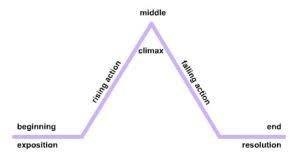
Remember this?
Exposition, rising action, climax, falling action, resolution
The rising action is that Governor Baker then signed a final FY23 state budget on July 28 (yes, four weeks into the fiscal year).
And here's the climax: that budget funds the Worcester Public Schools at $945,067 less than the budget the Worcester School Committee passed in June.
Let's stop here for a minute at the top of our plot line and talk about why.
Chapter 70 aid--state aid for K-12 education in Massachusetts--gets allotted by district. So you can pull up a spreadsheet that says "Worcester is getting $316,240,166 in state aid."
But that same aid is what supports all of the funding for students from Worcester who go to charter schools, and all of the funding that accompanies students who live in Worcester but use school choice to attend a public school in another town. That gets pulled out of Worcester's state aid before it gets to the Worcester Public Schools.
The state runs an updated assessment when they put together the final state budget numbers, and that includes updated enrollment figures and assessments for both charter and school choice. Thus as Mr. Allen explains:
Charter school tuition assessments increased by $334,788 in the final state budget, primarily due to transportation assessments for the Learning First Charter School that were not included in prior charter school tuition assessments (an increase of $876,567), offset by a decrease in the projected number of 32 charter school students totaling $541,779.
So the number of students enrolled in charter schools is actually down, but the transportation assessment (the Worcester Public Schools has to either transport or fund transportation for all Worcester students attending Worcester schools, charter, private, or parochial) for Learning First came through at the same time at $876,567...quite an increase in the assessment.
Likewise on choice, we have:
School choice tuition assessments increased by $417,217 in large part based on the final school choice assessment from the prior year, and the final FY22 school choice assessment in June was $96,969 higher than the most recent prior estimate from March—not including virtual school students. Pre-enrollment estimates from the two Commonwealth Virtual Schools for the upcoming school year increased from 149 in FY22 to 171 students in FY23.
What's interesting to me here is that the big jump is from the prior year--FY22--not the current one.
Thus, we're almost a million dollars down in funding from the budget we passed in June.
Not a comfortable place to be at all/in August/at any point in the year.
However, here's the falling action to the resolution:
The Acting City Manager has agreed that he will recommend that the City Council appropriate anticipated FY22 Free Cash to fully offset this change in the state budget, thus resulting in no change for the Worcester Public Schools FY23 Budget.
(You have to admire that we get this after the finance charts in the memo).
Note that this will not happen until the city goes to settle free cash in November, thus we're living in this in between period until then. I believe this is why we have the note on the use of ESSER funds; otherwise, we'd have to vote to cut our budget, as assurance by the executive of the use of free cash isn't enough to make the numbers reconcile. Nonetheless, much appreciation to Acting City Manager Batista for making that commitment. It's certainly a happier resolution than far too many budget memos I've had reason to blog about!
Friday, August 19, 2022
Last night at Worcester School Committee
As always, this summary is me and mine, so take with that.
We heard a report on summer learning at both the elementary and secondary school levels over the summer. In total, we had about 11% of the student population served, in programs ranging from the extended year for some students who have IEPs, to a summer camp option, to multilingual programs, to a Generation Teach program, and to an early college option. The final slide, I think, pulls together where we are going forward:

For any like me with their eyes on ESSER, I did mention last night that I'd like an update on where we are with the 20% set aside for learning loss from ESSER III.
- $500,000 for Early College Full School and Expansion Year 2 for Claremont; we also sent the early college expansion at Claremont to subcommittee, because the Committee really hasn't talked about it. The backup on this one is EXTENSIVE, so if you're interested in that, do take a look. There's a big programmatic change there for Claremont, over time.
- $85,000 for social emotional support for out of school time mental health support. I should note, by the way, that there is major work coming on mental health for students and for staff. Thus here and later on, if it seems as if we're punting a few things, it's because we know that work is going on.
- $237,021 for a Skills Capital grant for North High for the Allied Health program; check out that list of equipment on page 89!
- $311,000 for a Skills Capital grant for Worcester Tech for automotive technology; again, check out the list of equipment on page 92!
- And everybody's favorite: the $150,000 SWIG (how clever are they on the acronym?) grant for water bottle fillers. Because I have gotten some questions on this: please note that the grant program has strict outlines as to which schools can get grants, so if your school is not on this list on page 107, it isn't that you're being ignored. There has been discussion about additional efforts on this for other schools through ESSER funding, so stay tuned.
We did report out from Finance and Operations...I will try to do a separate writeup of that.you can find that here.
We got an update on COVID, which is going to continue to be part of school committee meetings this year. The state, as I think has been well covered, is offering no new guidance for this school year; the management of the district COVID response is now shifting to the Deb McGovern, the head of nursing. There are no state supplies at all. Worcester is keeping the medical waiting rooms, staffed by CNA's. However, there is no test and stay; the district will have tests which they can send home with symptomatic students, and students who are symptomatic will be sent home with instructions to isolate, but there will be no contact tracing this year.
Thus students, staff, and families will have no idea if they have been exposed at school. I will offer my opinion that people should then proceed accordingly.
We had an update on how Chromebooks will be provisioned and handled in schools this year. Last year's order of over 23,000 Chromebooks has put us in good shape for this year. Every student grades 1-12 will be assigned a specific Chromebook; if it needs repair, they'll sign out a loaner, but then get the same Chromebook back after repair. We do have spares at every school in the system now, and there's essentially a weekly cycle of schools among the IT professionals assigned.
If you haven't reviewed the latest broadband report from the Worcester Regional Research Bureau, it's what came in from the municipal broadband committee.
On Jermaine Johnson's motion, we voted to send Sue Mailman as our delegate and Laura Clancey as the alternate to the annual Delegate Assembly of the Massachusetts Association of School Committees in November.
Relatedly, we also changed our November 3 meeting to November 10 (four of us plus the superintendent will be at the Joint MASC/MASS Conference in Hyannis that week).
We then had a length discussion, which may have been a little hard to follow if you're not up on how Worcester School Committee functions: when there's a motion at a Committee meeting, for the most part, they can go two places: to one of our subcommittees, or to administration. Now, if they're on a subcommittee agenda, the chair of those subcommittees works with administration on what items end up on a meeting agenda. If it goes to administration, it pretty much is there until administration decides to bring it back.
And so they can, and they have, build up.
I filed an item for this agenda to look at all outstanding administrative items and decide if we still needed them. Some of them are just old (and never got responses). Some, though, as I said at the meeting, were a response on the Committee side to managerial inaction; if you can't get an answer or a response from administration offline--and we should be forwarding requests for information offline!--a Committee member may well file an item. We also might, in the face of administrative inaction on something that is managerial, file an item seeking action.
That isn't best practice. It isn't what's supposed to happen. When it does, something is broken; in Worcester, something has been.
So as a means of clearing the decks and moving forward with a new administration that has, clearly, every intention of being responsive (and frankly, already is), we reviewed the outstanding administrative items and we filed (which means they're gone) a LOT of them.
We voted in favor of the administration's recommendation that we increase the day-to-day sub rate from $85 to $110. Note that this also includes the following information:
The Administration intends to use the funding for up to 50 day-by-day substitutes to supplement the 70 full-time building substitute positions included in the FY23 budget, for a total of 120 available substitutes. During the last school year, the average daily absences of teachers (in positions that require a substitute) was 120.4 (with a high of 200 absent on January 6, 2022, and a low of 25 absent on August 30, 2021).
Although the FY23 Budget did not include funding for day-by-day substitutes, the cost for this year will be funded through available ESSER carry-forward funding (unexpended summer and after-school funds during FY22). It is expected that the total cost to be $990,000. The effectiveness of the additional substitutes will be discussed with building principals during the course of the year and evaluated as part of the FY24 resource allocation process.
...which, as someone who was very concerned that there was no provision for day-by-day subs in the FY23 budget, is very reassuring. We're also sending the policy on subs to Governance, as we're concerned by how often paraprofessionals are being pulled off their assigned duties to sub.
We also approved the removal of the bar on all backpacks in school except those made of clear plastic or mesh. Thus, yes, students in school may carry backpacks this year.
And finally, I am happy to say, we approved for execution the contracts of Brian Allen as Deputy Superintendent, Chief Financial Officer, Chief Operating Officer; and Marie Morse as Assistant Superintendent of Teaching & Learning. Those contracts were signed last night after we adjourned.
Monday, August 15, 2022
August Board of Elementary and Secondary Education : public comment and MCAS
This is the "one on the MCAS" though note that updating the state's accountability regs is also on today's agenda, as is a bullying regulation change, and an update on the budget. Because this was not a regularly scheduled meeting, I will not be liveblogging it all, but will catch up later.
Posting as we go once the meeting starts...jumping in mid-public testimony
Interesting: the livestream missed this, but as the first panel was being introduced, there was a member of the public yelling about "no child is safe" though it was unclear on exactly what.
Sunday, July 3, 2022
Welcome, Dr. Monárrez!
Hey, Worcester: we have a new superintendent!

Banner hanging on the front of the brick Durkin Administration Building Friday:
White banner with blue lettering says Welcome, Dr. Rachel H. Monárrez!
We're looking forward to working with you!
From Here, Anywhere...Together!
The banner is watermarked with the district seal,
and the main text is surrounded by "welcome" in the district's main languages
A new fiscal year brings new administration contracts, and Dr. Monárrez's contract officially started with us on Friday.
I appreciated that she was tweeting about it right away Friday morning: |
| Tweet from @Drrmonarrez says: Today is the day! I officially start as the superintendent of Worcester Public Schools. I am honored and thrilled to work and lead with exceptional people providing access and opportunity to the youth of Worcester. #LeadershipMatters #allmeansall #reamwork (and of course the last hashtag is a typo; remember Twitter doesn't have an edit function.) |
You can find her entry plan (in fifteen languages) on the district website.
I suspect this is going to be part of School Committee discussion at some point, so I don't want to say too much, but that it's founded on Karin Chenoweth's Districts That Succeed is quite something; I was reading it during the superintendent search, as I told Karin herself (but hadn't mentioned to Dr. Monárrez) at the time:
You’ve already captured one of the two biggest drivers in my own view of our superintendent search on page 2: “a recognition that schools live in complex ecosystem that affect them in any number of ways from finances to personnel decisions.”
— Tracy O'Connell Novick (@TracyNovick) March 26, 2022
Something we also should expect will be early on the agenda: Deputy Superintendent Sue O’Neil also retired June 30. That means leadership academic side needs to be filled. It’s entirely possible—note, this is just my reflecting history here—that the organization chart may be reworked in the process, as both Superintendent Binienda did and as Superintendent Boone did. Central offices, particularly ones the size of Worcester, can have lots of different models.
First meeting is July 21 at 4!
Saturday, July 2, 2022
On FY23, as of the start of the fiscal year
...budgets are not merely affairs of arithmetic, but in a thousand ways go to the root of the prosperity of individuals, the relation of classes, and the strength of kingdoms.
John Morely, writing in The Life of William Ewart Gladstone, Vol. 1
...which of course is just a fancier way of saying "budgets are moral documents."
This is probably the weakest year I've ever had for blogging the Worcester Public Schools budget usual warning: it's 444 pages, so that's a big document), for which you all have my abject apologies. FY23 started yesterday--yes, happy fiscal new year!--and I did want to take a look at what it is that the Worcester School Committee passed last month for this coming year.
This is a long post, but then, the budget is long, too.
Tuesday, June 28, 2022
Board of Ed for June: budget update
Bill Bell: update on working "with a business partner" on implementing pandemic relief and how working on SOA goals
ooh, there's a presentation
FY22:
$219.6M Ch. 70 increase; $28.2M circuit breaker increase
new state funding for early college, c/t ed, adult basic ed, COVID
awaiting final conference committee budget for FY23
expect to close to half a billion dollar increase in Ch. 70; $60+M circuit breaker
additional resources on impacts of education due to COVID
Simone Lynch on federal COVID relief:
$3B to administer
CARES Act expiring Sept. 30
ESSER II: expires Sept. 2023
ESSER III: expires Sept. 2024
ESSER to 399 local agenciesChart on timely of spending of the three ESSER lines pic.twitter.com/OUrqicRUGE
— Tracy O'Connell Novick (@TracyNovick) June 28, 2022
Pulled from 1200 budgets (400 LEAs times 3 ESSER grants)
summarized into categories
(note that spending can change)
Chart as pulled from district budgets on three rounds of ESSER spending as PLANNED (important note) by #MAEdu pic.twitter.com/7bMlyYQE4l
— Tracy O'Connell Novick (@TracyNovick) June 28, 2022
now a chart of percentages of districts in each category: note that DESE sent money to each district for mental health and the fed requires a set aside for unfinished learning
Fernández: where we're hearing about mental health shortages, concerns about shortages
Craven: $1.8B "still out there"
"very significant percentage" as compared to Ch. 70
Peyser: "much of it is unclaimed" but when we say "unclaimed" it means not drawn down as yet
Bell: "performance accountability" focused on
Komal Bhasin: overview of how Student Opportunity Act funds "were spent this year"
...which is an increase in Ch. 70 aid
expected to see "whole picture"
"this is rough data after districts have revised their plan amendments"
this is now divided up into what the Department called their "evidence-based program areas"
we're now going to have a discussion which is completely removed from the fact that this was a resolution to a chronic underfunding of core areas of public education which districts are now making up for
West asks about tutoring
Bhasin: "it's been really important to us" on implementation of the plan
Hills: question on how many districts "have allocated below a reasonable total" on their federal spending?
I don't understand this question
Bell: I don't think we have a true standard of where a district should be
Hills: "if you were to pick a percent with some degree of arbitrariness, are there districts that are below that percent"
Bell: would be hesitant to give one; ongoing monitoring is a function of the Department
don't think there's really an concern with districts being on pace to use the funding
on SOA; to ensure districts both fully draw but also effectively meet their requirements to spend state dollars
and Peyser cites the federal tracker online
Moriarty: hazy on the SOA plans
Bhasin: asked for updates including level of implementation
Lombos: some of our conversations about budget
would love focus on DEI in consultants and budgets
"want to be sure we are operationalizing our concern for DEI in our budgets"
Subscribe to:
Posts (Atom)