If you watched the first Worcester School Committee, you saw opening statements in which Member Binienda extemporized on publicly approved (by the prior School Committee) contracts of central administrators (as opposed to the internal changes she made as superintendent to administrative contracts not approved by School Committee, without letting anyone know) and Member Biancheria making the classic motion of the late Brian O'Connell: to cut half a million dollars from 'somewhere' in administrative spending. She did this out of order--they weren't on the administrative cost center; that will happen tonight--and she didn't have a motion on where to then move the funding.
The press, of course, obediently trotted out headlines about motions to cut administration that failed, lacking even the context of past history to tell us that this is precisely the aim: the headline, not any meaningful budgetary decision.
There is, however, a section on administrative spending that should be getting--dare we hope?--headlines, but that's in the back of the book.
This year, the city's spending on schools calculation is reported on page 377 of the budget book; I noted in my review when the budget came out that it was the first place I check, as it's where we see if the city has met net school spending requirements. Of course, the city hasn't.
Not every dollar spent on public education, Worcester or anywhere, is allocated by the school committee; there is money spent on behalf of the district by the municipality. On page 377, you can find that on in section 9:
For example, in Worcester, the school district doesn't get a water and sewer bill; the city tracks that, and reports it at the end of the year as school spending; for FY25, that is projected to be $735,399. We have talked about this before when we talk about police, which is projected for next year as $542,304.
It's the third item here, the top line, that I'd like to call your attention to. There is, in any municipal district, things that only the municipality can do. They have (unless delegated) purchasing authority, for example. As anyone who has ever received a Worcester Public Schools paycheck can attest, they send out the actual checks. You can find the list of what the city and district have agreed upon as "allowable expenditures" on pages 378 and 379 of the budget.
Notice anything about the past several years? Namely, that jump between FY23, when it was $6.6M to this current year, when it is $9M? Yeah.
Now, let me be entirely honest: when I saw this in this year's budget, I was kicking myself, as I was on the Committee last year, and I, in my study of this page, didn't catch it! Well, there's a reason for that; here's the same section in last year's budget book for FY24 (the last column is FY24, which is the second to last above):
Between last May and this May, the projection on cityside administration spending increased by $2.4M. And no one has talked about that.
Because I always have Excel open, anyway, I ran us a little chart on what this line now looks like going back to (remember, both FY24, which is the current year, and FY25, which starts in July, are projected, not actual):
And given what happened over the course of this year, one has to wonder if we can count on the $9.2M projection.
I'd suggest that someone should ask about this. Oh, and yes: even with this claimed increase, the city is still under required net school spending.
UPDATE: When this was asked during the budget deliberation:
the response is that this is due to the Workday system.
the Committee was told, in response to Member Mailman's question regarding the City Manager late in the meeting Tuesday telling the Council the city is giving the schools an additional $1.8M (the NSS budget gap for FY24). Per Mr. Allen's response: The schools are still reconciling numbers, have had additional out of district transportation costs in ...and would be looking to use it for that with some transferred to next year...full report to follow in July. There are eleven days left in the fiscal year. This is money that this Committee has not seen (and apparently had not been told of), has not voted a new bottom line to include, and has not allocated. When asked about the need to vote the money, Mr. Allen said that he'd need to check with the city auditor; it is a "transfer not an allocation" so it might not need to be. I have no idea what that means. If indeed it is to be used for out-of-district transportation, that does not count towards net school spending. I am very confused about this, including how it is that it seems the only way anyone knew is because the City Manager told the Council during a meeting.
By now, if you are the family of a Worcester Public Schools student or a staff member, you will have read the letter sent from Dr. Monárrez earlier this week regarding the FY25 budget and had a bit of a chance for it to sink in. If you haven't read it, I include the letter in full below at the end.
You may also well have seen headlines from all over the state about school budgets facing real hardships this year.
Let's first note that it is not new information that the Worcester Public Schools are facing a budget gap. As noted in the links in the superintendent's letter (blogged about here), the district has noted the $22M budget gap since the release of the Governor's budget. We knew of the issue with the inflation budget as far back as the fall.
There is a danger we run into this time of year, of the relative scope of the budget and budget issues being difficult to grasp. This isn't true exclusively of Worcester, but it is as true of Worcester as elsewhere. While, as noted, the gap is 4.4% of the WPS operating budget, that is a significant amount of money.
The conversation we've already been having regarding the School Committee clerk position reporting to the Committee should be resolved to be posted this week. Please take a look at the position description draft and see if you know anyone who would be great!
We have a public petition from a student, paralleled by an item from Member Kamara, requesting that we move to the observance of Indigenous Peoples' Day, effective this year. Kamara notes in the item that it would align with the city's Human Rights' calendar.
Dr. Monárrez is coming back to us with a draft of her goals for next year (no backup as yet).
We're being asked to send a letter endorsing the request for a federal grant for electric school buses.
I'm requesting that we acknowledge "the climate emergency in the priorities, policies, actions, and budgeting" of the district.
Member McCullough is suggesting hiring 16+ aged students in the summer for custodial work and other seasonal work.
There are a few things here that are current topics of conversation, as well as some that I know we're going to be coming back to, so some notes to share:
Annual audit: When I was doing my review of the agenda ahead of this meeting, I said to a friend that the opening letter of an auditor's report is an excellent illustration of the "in this paper I will" piece of writing, though it's more "in this audit I won't"! We tend, I think, to think of the word 'audit' as meaning something very sweeping, but that isn't what this is. This is an audit that is done due to the amount of money we get from the federal government, and it very specifically tests compliance with internal controls and general acceptable accounting principles. There were no findings for the Worcester Public Schools; that's a clean bill of health here. Interesting point raised by Mr. Hunt: the federal COVID funding is something the federal government is, for the purpose of auditing, regarding as "high risk" meaning it needs to be looked at.
We did file a few items that either we've dealt with or we're managing in other ways: the FY22 grants; sustainable funding on technology (we have a report coming from Harvard on IT); and the two mile radius for transportation for secondary schools (the question of what we're doing with transportation is ongoing).
Provision of menstrual supplies: Dr. Deb McGovern, who heads our nursing department, will be speaking to this, but wasn't able to be with us. We did, though, take the item in order to address the related issue of bathroom access: our larger secondary schools regularly have bathrooms that are locked during the day, and are limited to a very small number of bathrooms. The explanation given has been that we lack provision for monitoring this. The request from the subcommittee is that the bathrooms get opened at the secondary schools; we're interested in supporting making that happen. This item will be back on the November agenda for further and more specific discussion.
On transportation: You can see the drivers being trained (hang on! They're coming!), and the turnover between buses that are rented into buses that are owned. Two things for those who use the app to know: first, if you're an Android user that had the app delete on a recent update, there is a workaround while Tyler Technology figures out how to get it back. Second, if you've had a bus that seems to have disappeared from the app, we had a discussion about the way that new buses (with geotags) are apparently being overruled by running with iPads (that also geolocate) that are supposed to forget that overnight but aren't. Tyler has never seen this before, and they're going to be coming in to work on it.
Facilities quarterly update: As a side note, I really appreciate these in keeping an eye on not only the day-to-day things, but also the larger longer term projects! Check out the pictures here! This always opens custodial and maintenance, and this is another one where staffing continues to be an issue. This means that our custodial staff is beyond stretched as they work to cover the same number of schools (and a growing amount of square footage!) with a smaller number of people. We did have a bit of a discussion about this, as one of our strengths (this isn't just me saying this, though it's my opinion, too) is that our custodians work for the district directly, and they take a great deal of pride in "their" buildings. How we support that while also ensuring that the buildings get cleaned is an ongoing discussion. On a bit of a different note, maintenance is an evolving area, as what positions are best done by in house staff, and what specializations (think elevators, for example, but also some of the newer HVAC, possibly) are something that needs to be contracted out, even as we ensure that administration is supported in ensuring the work on the buildings gets done. We've asked, on that last, to add to this report the balance of what work is done in house versus what we're going out to contract. Water filling stations are popular every time they come up; I shared the list of the SWIG grant (clever acronym, isn't it?) recipients earlier, which have to be done by the end of this year. Mr. Bedard noted in his report to us that using ESSER funding to add bottle filling stations elsewhere is the next step. These are not unrelated to the water testing, but in part a response to it. As with much else, there are supply chain issues here. And speaking of ESSER and COVID: the schools are still running the equipment we have already had in buildings (both that which is internal to the HVAC systems, and the separate units that are plugged in elsewhere). There is upgrades of what we are able to do in the HVAC systems (can we upgrade filters? motors?); that scope of work has been put together and is in purchasing. There is also a round of final field work being done from Honeywell for further work; within a month or so, that work also should be out to bid. Note that this is scheduled to be funded by ESSER III funding, and we probably want to be part of the push for extensions from US DoE, only due to supply lines. Boilers, boilers, boilers...winter is coming, and we're going to need the heat, so note the updates on Belmont Street, Chandler Magnet, City View, Goddard, and Vernon Hill on boilers (Vernon Hill's is more complicated and taking longer). Note that not all of these were planned, and that means we're making compromises on our annual $4M capital budget. Life safety, fire alarms, heat...these are the things that are always going to go first.
Mr Allen: "The bigger question is is $4M sufficient enough to maintain the age of our buildings and the number of buildings that we have."
Elm Park gym floor watchers, and Burncoat High bleacher watchers, please note the update there. Also, the WAMS new roof got its first dousing these past weeks, and what a difference a new roof makes! On Burncoat High: Burncoat had its periodic reaccreditation review this past year, and the report (to no one's surprise) pointed out substantial physical plant issues. The review of what exactly needs to and can be done to the current building, the replacement/major renovation of which remains the first priority with the state of both the School Committee and the City Council, is currently being done and will be coming back to us. Note what Mr. Allen said: this is going to cost the city millions of dollars to keep the building open and functioning, and how this relates to the high school's reaccreditation is something of an open and evolving question.
First quarter budget report: We've gotten through the first quarter of the FY23 budget, so it is time to see where we are at and where it now looks like where we are going. First quarter is when we see the beginning of trends. It is important for us to remember that our district budget received $945,067 less in state funding than the budget the Worcester School Committee passed in June. Acting City Manager Batista has committed to recommending this be made up through free cash when that is certified (which should be next month); just remember that this has not yet happened! The Misc Ed OM change you'll see here is due to a call by DESE on how the insurance of our new buses gets classified: we'd thought "transportation" which is a non net school spending expense, but DESE has said that no, insurance is a net school spending expense (do not ask me to explain this). That's thus a shuffle of expense rather than anything new. The rental of buses needed while the new buses have come is an additional transportation expense. Both in transportation and elsewhere (custodial for example) there's overtime expenses that are offsetting positions that are open. Here and elsewhere, remember that the budget office ALWAYS plans for positions to be filled. Thus you'll see we've moved money (at the standing committee level; it isn't moved until the full committee votes the transfer this week); that's money that hasn't been spent UP TO NOW. The custodial and other positions are still open, still searching, still budgeted, and we hope to fill them.
There's two things in the budget that I want to note particularly: On utilities, there's an illustration of EXACTLY why quarterly reports are important. The report "anticipates the increase of natural gas supply and delivery charges at approximately 20% of the FY23 budget amount." It hasn't cost us that YET, but given what is known, this is anticipated and we are planning for it. At an hour and eight minutes in , Budget Director Sara Consalvo talks through how it is that projection has been calculated. Note that she says that this is a conservative projection, and also, administration recommended that we already move money (which is unusual in the first quarter).
Discussing administration, first note that added positions usually happens during budget; the current superintendent did not, however, create the current budget, so we are making additions instead during the year. That itself is thus a function of a new administration rather than anything else.
To a larger and more telling point, though, please note Mr. Allen's point just after the hour mark: we are now in our second year of funding of the Student Opportunity Act. Whatever the Commissioner's comments, the intent of the Student Opportunity Act was to respond to specific gaps that Worcester, alongside our Gateway peers, had demonstrated again and again and again that we had*. Now we need to ensure that we are actually filling those gaps with the funding. That includes administration. I already noted earlier this month that we underspend compared to our peers and the state average. We also, though, underspend compared to the state's calculation, spending 75% of the foundation budget and that includes city charges, which total $6.3M for FY23. That exceeds the central administration line for WPS, budgeted at $4.8M for FY23.
Really important note from Mr. Allen on other cost centers compared to foundation: Operations and Maintenance underbudgeted by $15M (58% of foundation); supplies underbudgeted by $7M (50% of foundation).
MORE ON THIS COMING FOR SECOND QUARTER!
Qustions? send them along!
*I limited myself to three links. There could be dozens. Search 'foundation budget' in the search bar if you want posts going back for about as long as this blog has been up. This is core to why I've been doing any of this for as long as I've been doing any of this.
Sent to the Worcester School Committee this Friday in our weekly update was a link to what district leadership read as part of their work when they met this week:
@worcesterpublic district level leaders spent time today collaborating on common language focused on working together to serve schools & our brilliant scholars. This is the team to take WPS to the next level of excellence. From here anywhere…together #allmeansallpic.twitter.com/OmZb4ix0mB
— Rachel H. Monarrez, PhD (she/her/ella) (@drrmonarrez) August 11, 2022
The piece is called "Fighting Fires in Educational Administration" by Karl E. Weick; I found a non-paywalled version here.
First, I just want to note that I appreciate getting homework from administration to keep us on the same page. This linked immediately in my mind to something Dr. Monárrez said to us in her interview regarding the role of administration:
I could write paragraphs about this, but suffice for now to say that's a frame of governance that we've needed badly.
I recommend reading the whole piece (especially if you work in/ think about organizational governance). The above, though, is also effectively proposition 4 from the article: effective firefighting occurs when people strive to manage issues rather than to solve problems. As Weick writes:
The things that come across the desk of an educational administrator can be labeled problems to be solved or as issues to be managed. When the interruption is labeled a problem, there is the expectation that people will hit it hard, that it can be solved, and that once it is solved it will stay solved. However, when an interruption is labeled an issue, once expects that it will be managed rather than solved, that it will take different forms over time, and that endurance and persistence will be needed to keep it under control.
And of course, endurance and persistence are badly needed in education, in any case!
The Worcester School Committee meets twice during the summer--once in July, once in August--with our July meeting being this Thursday. You can find the agenda online here.
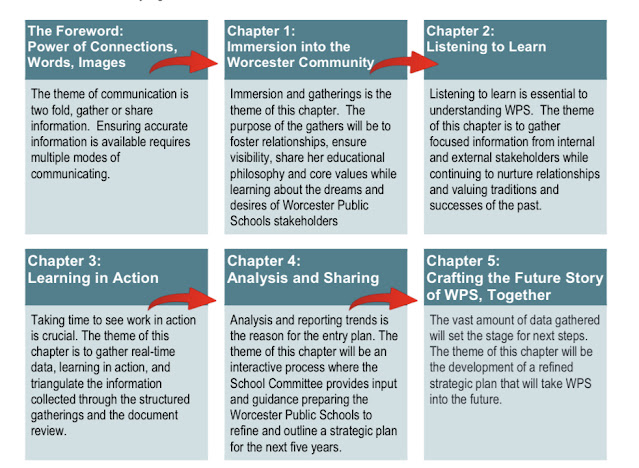
This is of course Dr. Monárrez's first meeting as superintendent, and thus the report of the superintendent is her entry plan, which is linked through the banner on the district website. It's set up with lots of listening in chapters:
That plus item gb 2-206 and following are those I think are the most important on the agenda. Dr. Monárrez proposes the following:
To consider and approve a proposed reorganization of Central Administration
positions to include the establishment of the positions of: 1.) Deputy Superintendent,
Chief Operating Officer and Chief Financial Officer; and 2.) Assistant Superintendent,
Teaching and Learning; and to approve the proposed Job Descriptions for those
positions.
The superintendent can organize her administration as she sees fit, but position descriptions are approved by the School Committee, and appointments to positions of deputy/assistant/etc superintendent PLUS business official positions are all subject to School Committee approval (and business official contracts are actually with the School Committee). Thus we also have the following recommendations:
To consider appointing Brian Allen to the position of Deputy Superintendent, Chief Operating Officer and Chief Financial Officer, subject to contract negotiations.
To consider appointing Marie Morse to the position of Assistant Superintendent, Teaching and Learning, subject to contract negotiations.
From the position descriptions, this would put all operational functions under Mr. Allen, in addition to those he already oversees, as well as day-to-day operations ("builds and leads daily operations of the district office"); Dr. Morse would be overseeing the offices having (as the title names) to do with teaching and learning (thus special education, social-emotional learning, multi-lingual).
I (of course) have to save my comments on this for Thursday, but, as I noted previously, superintendents putting together administrative reorganizations is common practice. Note that these are two longstanding Worcester Public School administrators.
Other things on the agenda:
TLSS is reporting out on a meeting that including summer school, tutoring, and sex ed.
F&O is reporting out on a meeting on transportation. Note that Vice Chair Johnson has also filed a few items on transportation regarding late buses, so expect those to be discussed.
Included in this month's donations is over $38K in donations from UMass Med; scroll to the next page to see the grants those are supporting.
Remember we held three positions pending Dr. Monárrez's taking office? They're on this agenda. (I heard that some were told the building-based subs were cut; no, they just didn't have a position description, and we held all new ones until we can find out what the new person in charge thinks.)
Member Mailman is asking that we look at childcare options for educators in geographic proximity to schools, as well as getting the city IT department out of Worcester Tech so Worcester Tech can use the space.
Member Kamara is requesting that the School Committee receive reports on "timely reports on filed racism, sexual harassment and discrimination complaints from staff and educators in the district" (an HR function) and also "To implore the administration to launch a “Positivity Campaign” during the new academic year to last all through the school year. All WPS teachers and staff to take a stance on the usage of supportive words/language to boost students’ self-awareness, gift, passion, sense of self, confidence in their education and more."
The Committee is meeting in public session first, then moving to executive session, which has two grievances and successor bargaining with two bargaining units.
So what happened at last night's Worcester School Committee meeting?
For those for whom the sound didn't work until a bit of a way in, Roger Nugent, president of the EAW, spoke first requesting that we amend an earlier authorization for sick bank use for an employee (extending it beyond days donated by one school to the larger employee pool, as some donations came from outside the school), and shared a petition from some members on "choice" around vaccinations.
We had TWO student reps at the meeting last night: Stacia Zoghbi (who's our ex officio, as she was elected by the other student reps to be our official non-voting member) and Julianna Manxhari; Stacia goes to Tech and Julianna to Doherty. They sent out a survey to their peers across the district--students, PLEASE TAKE IT!!--and plan to share the results of that with us at one of our next meetings. They've also asked for a seat on the superintendent's search committee (and it sounds to me as if they're going to get it).
The report of the superintendent was from Dr. Marco Andrade (whom I mentally refer to as "the data person") with a report that was framed from the perspective on the Office on Civil Rights (a subdivision of the U.S. Department of Education) around disparities in student data on social-emotional data, achievement information, absentee and discipline data, and post-graduate education and persistence. The report is here, starting on page 28. We have significant gaps, as was noted, and this is being referred to School and Student Performance for further discussion, because (as I said at the meeting) the data is only the start; the question is what we're going to do with it.
Reporting out were both Finance and Operations and Teaching, Learning, and Student Support standing committees. F&O had the transportation report, so we approved the new position descriptions (as budgeted for in the report, and as approved as part of the plan) for that department at the same time. And yes, we're hiring! We also had the first quarter report, and one part concerned me:
A $400K transfer from teachers to administration would raise an eyebrow, in any case, but it have it come in for the first quarter report--when we just passed the budget in June--and to have it explained as the conversation of five EL teachers to four EL administrators, particularly when we had just received a report from that department a few months back with no mention of this is simply bad process. I voted for the transfer, in part because it became clear that the administration had actually hired people ahead of the transfer, which is also bad process.
TLSS had the vocational admissions policy, and Ms. McCullough noted that the deliberation also included discussion of the recruitment of more representative applicants (as the demographics of Tech become non-representative by who applies even with the new policy), as well as some discussion of the question of interest, which will be taken up during tours. The standing committee's report was passed, which gives provisional approval. Final approval will follow a public hearing next month. Note that later in the meeting, we accepted a grant for $130K that is directed at this question of student recruitment to Tech.
We received back a report on an item I'd filed that had been bounced back and forth several times as incomplete regarding contracts that are directly with the superintendent. I'd heard concerns months ago that contracts weren't being completed, and so filed the item back in August. Eventually, the principal contracts largely were fulfilled, but there have been a number of outstanding administration contracts that were still not completed. I'll share here what we got last night:
Beyond the contracts still not renewed, there are two things here that concerned me. The first is this group of people marked "N/A" who, I was told, simply do not have contracts. There isn't parity across administration in who this is, though, and I'm concerned that this not being based on something solid could open us up to discrimination allegations. The second thing, from the far right column, is several contracts that now expire in 2026; that is, some people have recently been given five year contracts. This is itself unusual--five years for public contracts is covered for other circumstances by laws--but contracts given for five years by a superintendent who herself is leaving in seven months is particularly attention grabbing, as was my subsequent understanding that questions have been raised about extending contracts that are not yet expired. As Mayor Petty noted, there is case law around the ability of executive successor, backed by the public committee, being able to cancel extensions in such circumstances, and he told Superintendent Binienda last night that he expected any updates not already included above to come before the School Committee.
We received back an updated report from Mrs. Clancey's motion asking for information on the transfers; this was the additional elementary teachers and the additional adjustment counselors. She asked for information to be shared with the school committee about what the adjustment counselors are finding in their discussions. I was concerned to learn that the elementary teachers, who we'd specifically transferred to lower class size, largely have not been assigned to do so; only three are classroom teachers.
An additional position for the Chief Diversity Officer passed (6-1; I was the 'no' vote, as I think this office continues to be poorly defined, and I think that needs to be fixed first.)
We accepted at $12,500 grant from Mass Insight for AP teacher training.
The audits are coming to F&O! (That's all we know so far. They do every year.)
Ms. McCullough filed an item looking into playground inspection and repair, so expect to see that coming.
She also asked for a reassessment of the need for crossing guards at secondary schools.
We also had clarified, on her motion, that volunteers MAY be in schools, so long as they have provided either proof of up to date vaccination or recent negative COVID test (just like employees).
And she asked about virtual tutoring. Earlier in the meeting, Miss Biancheria questioned administration about part-time tutors who are retirees possibly being hired.
I filed an item specifically on bus 38, as I haven't gotten any response to my emails to the superintendent (who has directed that communication with Durham is hers) regarding it.
We're also going to recognize all the people who don't get recognized when you build a new school building for opening South (or at least we're going to try!).
And we're going to thank the National Guard, AA Transportation, plus WPS Transportation (per the superintendent's request) and the Lieutenant Governor (per the Mayor's request) for their work on transportation in October. Other amendments were not accepted.
And then a report I hope comes back soon:
Request administration report urgently via school level staff on student disregulation,
how it is manifesting in our schools, how staff is managing and coping with such
disregulation, and what resources and policy changes from this Committee are
necessary to better support students, families, and staff.
We next meet on the Monday the 22nd with the superintendent search firm! 5:30!
I came in about an hour into budget deliberations, just in time to hear a motion from Mr. O'Connell to cut $500,000--yes, half a million dollars--from the adminstration account.
That's this account:
That's also this account (at the top):
(and in that case, note that the majority of what is reported as central administrative spending under the foundation budget is spent by the city and credited as school spending.
This isn't fiscal prudence; this is just reckless disregard for good governance.
A motion to cut $20,000 from rentals earlier apparently passed. I don't know who made the motion, but presumably it wasn't made in connection with any real facilities planning despite this:
Miss Biancheria made a motion to cut the $85,000 for the superintendent's secretary; that seems oddly personal.
After specifically asking about the funding level for substitute secretarial coverage and receiving the answer that the account was still underbudgeted (I believe she was told it should be $150K and was $126K; I'll check), Miss Biancheria then cut $10,000 from secretarial coverage.
This, added to the $20K cut from legal last session, then came to $50K, which was added to professional development, which you will no doubt hear about this summer.
You will probably also hear of their "no" votes from Miss Biancheria and Mr. O'Connell, as the budget passed 5-2.
That's on a budget of $364,928,023; including grants, it is $420,886,178. It is a 4.9% increase over FY20.
I'm attending--as a parent!--the Multi-state Association of Bilingual Educators conference in Rhode Island today. This morning's session I'm attending is on the district's role in creating and sustaining dual language programming, being put on by Framingham Public Schools.
note that for the most part, the Legislature doesn't as yet have bill numbers for what is filed; thus everything is "SD" and "HD" until they have numbers, which is for "Senate Docket" and "House Docket." Somehow the Governor jumped the queue and already has a bill number, which is (as some have pointed out, an appropriate) H.70. (I always wonder about these things and there never seems anyone to ask, so I try to include them.) This is "An Act to Ensure Equity and Excellence in Education," which demonstrates that the Senate has better acronym writers. It has been referred to the Joint Committee on Education. It's also probably good to note that there is at least some indication that this isn't a popular bill.
The thing that is most important to know about House bill 70 is that is the product of more than one author and more than one motivation. There is a Governor Baker-oriented school funding bill with some Foundation Budget Review Commission implementation with some additional funding pieces including a draconian (literally?) funding consequence for underperforming schools, on the one hand. There is also a bill that combs through the school funding law as it currently exists and updates it to the way that we actually operate; that part comes to us, I believe, from the school finance people at DESE.
That last part is fine. We could argue over if this is really how we want to run things or if we want to make other changes, but making the actual law reflect reality on the pieces behind the calculation (not the foundation budget itself) is a reasonable thing to do.
These two pieces are intermixed, though, so disentangling the parts is necessary.
The Governor sends along a filing letter presenting his argument and his perspective on what he is doing. I don't know who wrote it--it sounds like Secretary Peyser, but that could mean nothing--but certainly expresses what I have seen of Governor Baker's view on education.
The piece that I want to wave a giant red flag on is the piece expanding the Commissioner's power, which of course has nothing to do with the foundation budget at all:
the first bit is that currently a turnaround plan created by a described stakeholder group (MGL Ch. 69, section 1J, subsection e) is issued by the superintendent: "the superintendent shall issue a final turnaround plan for the school and the plan shall be made publicly available." The union or the school committee may then appeal the plan to the Commissioner. This bill would have the superintendent submit the plan to the Commissioner and only after his approval would the plan be publicly available. This would, obviously, render moot after that any appeal to the Commissioner by school committee or union. This is a big deal.
not only the superintendent, but also the commissioner will conduct an annual review of any school deemed underperforming; this is a change from what is done right now. It's not clear how that would be possible. The kind of review done by DESE is a comprehensive, time consuming endeavor by all involved.
the actions of the commissioner if a school substantially fails to meet goals, the commissioiner can appoint an examiner, require changes, or appoint an external partner; all of these are provided in the law already, but this section puts it together.
the big issue is the funding piece of this, as the bill allows the commissioner if he "determines that the district is taking insufficient steps to implement changes to the turnaround plan" to take away the district's Ch. 70 aid at the beginning of the school year (if you were looking for evidence that whomever behind this is missing how school budgets work, there you go!) up to an amount equal to per pupil allocation times the number of students in the school--this in essence means that school's foundation budget. That funding would be set aside in a "Public School Turnaround Fund" of the state "until such time as the district implements the changes as determined by the commissioner." In turn, the district could not lower the school's funding, but could only be taking out of non "direct access to students." If we did this, Massachusetts would join the ranks of states that have made the grave error of taking away funding from underperforming schools. This builds on the myth that districts are overspending or spending ill on administration--most are not--and that services that don't directly access students don't serve them. This is, to give but one example, the reverse of what the state itself found in Southbridge, where it found the district was under-administered. We absolutely should not do this.
About the foundation budget piece:
while it keeps being said that the bill fully implements the recommendations of the Foundation Budget Review Commission, it does not in a very specific way: while the bill does implement changing the assumed in-district special education enrollment from 3.75% to 4% for regular districts, it does not shift vocational schools/districts from 4% to 5%. Those from DESE whom I have heard speak to this have argued that the needs of special education students at vocational schools were not as high as the fully population of students in special education elsewhere, thus the shift was not warranted. That wasn't the argument put forward by the Commission.
the bill does, as of FY21, boost out-of-district special education to three times the state average per pupil foundation budget
the bill does, as of FY21, tie health insurance inflation to the GIC rate annually. It resets the rate for FY20 at about a 30% increase over the actual proposed budget for FY20. Offhand, I don't think that gets us where we need to be in terms of the current gaps between spending and foundation budget allotment.
it keeps English learner as an increment, as added by the Senate this past year, and makes the increment between 27 and 33% of the base rate, progressively weighted to the higher grades (the bill uses the same numbers actually proposed in the FY20 budget). As the Foundation Budget Review Commission gave an actual dollar amount in 2015, it isn't right to make that comparison, and the progressive funding (which is the way these bills seem to be going) is a positive step.
it includes additional funding for poor students, keeping the decile ranking system and current direct certification counts, and using the same dollar amounts in the first five deciles that are used in the FY20 budget, but weighing the latter increments more heavily, with decile 10 topping out at $500 per pupil more than the FY20 budget does. What this doesn't do is break more than 50% of the base rate per pupil, however, save in high decile younger grades. It takes the smallest step possible within implementation, which recommended between 50-100%. They do also (as in the FY20) add the "high needs" category for decile 9 and 10 and 20% EL.
there is not any inclusion of a data commission. This, to me, more than anything, says that someone (DESE?) thinks that work is done; see below for more on that. It was, however, a Commission recommendation.
Note that on all of the places where it includes a dollar amount effective FY20 that is different than the actual budget for FY20, the budget is what would happen, but the bill then would become the goal rate towards which implementation was moving.
Pieces that are neither of the above:
The bill creates two trust funds, one for further regionalization encouragement and another for to stash the above money that would be taken from districts with underperforming schools at the Commissioner's discretion.
The bill requires spending reporting by foundation budget category and can require it by enrollment and by program area, which is kind of a way of wrestling with the question of if we have enough data without requiring a data commission (this is a super DESE way of handling this, by the way; they know the data exists, so they're just requiring that it get reported).
The bill creates a regionalization assistance program and creates at Regionalization Fund for grants for planning and implementation. It gives priority to rural areas (without defining them) and other districts with persistent enrollment declines.
It changes the charter funding in a couple of ways. First, it boosts the facilities component that all charters get to $938 and then indexes it to inflation (that number has been the same for quite a number of years). It shifts back to 100% for the first year, 60% for the second, 40% for the third year of what they are calling transitional assistance. Most importantly, the bill changes who gets tuition reimbursement: transitional assistance funds the difference between the current charter enrollment MINUS the highest enrollment of the previous five years, thus only districts where charter schools are actively growing will receive this funding. It also creates and codifies "supplemental charter assistance" for districts that have low Ch. 70 and high charter numbers; this year, that means $6M for Boston and two towns on Martha's Vineyard (please tell me how THAT is the highest and best use!) It also ties both these sections together to be funded at the same pace.
The bill creates a commission on rural schools to come back with trends, projections, and recommendations for rural schools in the state, and their report would be due June 30, 2020.
The wonky "we do this but it isn't written down" bits are as follows:
it spells out the components (and only the components!) being currently used in the foundation budget (in section 11). Note that this is part of what caught those who wrote the House bill (which we'll get to eventually, as well), as they used old language on preschool and "bilingual" students. This includes definitions of combined effort yield, excess effort, effort reduction, municipal revenue growth factor (in fact, it spells out how to calculate it!), minimum aid, net school spending, and so on, which in many cases were not codified. Note that this would put into the law something which was done this year, which is requiring that districts with a combined effort yield equal to or greater than 175% of its foundation budget be responsible for the full 82.5% of its foundation budget.
it eliminates a bimonthly recalculation of the ch. 70 formula so that it can work with the state budget cycle (section 12)
it gets rid of the idea of "overburden aid" which we haven't been doing in years (section 13)
it codifies net school spending as a requirement and requires the Commissioner let districts know of their minimum local contributions by March 1 (which happens now through the Governor's budget, 'though that isn't necessarily where it ends up). It also drops a 30 day waiting period on preliminary estimates, and drops an old method of calculating regional vocational funding (section 14)
it repeals an automatic reduction in local required appropriation if the final state appropriation is reduced (section 15)
it codifies taking school choice and charter tuition from a district's Chapter 70 appropriation. (section 17) Did you know this wasn't in the MGL? I didn't!
it repeals the original phase-in of the law from 1994 (section 18)
it codifies that in any year in which there isn't enough funding to do everything, foundation aid gets funded first (section 19)
And the bill states that it will go into effect July 1.
I would just note here that this should have been the first question:
what do students/parents/teachers/staff/Worcester residents think should be considered in the strategic plan?
This shouldn't be only what we are getting to after six months of private meetings.
The first one is easy: the Worcester Public Schools budget this year is about $388M.
Those numbers are now a couple of years old. Thus start with the fact that we're running the school system at something like 4/5ths of what we should be.
Quite honestly, if you don't start there, it's impossible for me to take you seriously. Funding impacts literally every single thing we do, and if you don't get that, then you don't get how school systems work.
The second starts with this piece of data, which you will rarely hear referenced in the city:
The Worcester Public Schools are a majority children of color system, and they have been for some time. This occasionally gets raised when we talk about the demographics of the staff, but otherwise rarely is mentioned. Not only is the faculty majority white: the administration is overwhelmingly so, and the upper levels of administration have gotten much more so under the current administration (this is one of those articles that one might expect to be written when looking at changes in administration; it hasn't been). The School Committee, of course, was and remains entirely white. I have no patience--nor should anyone--with the "I don't see color" line. The research on teachers working with children of color is overwhelming. This isn't just about demographic change in leadership and in the classroom; this is about recognizing and being willing to grapple with the changing demographics of the city. As has recently been said in another context: that means talking about and changing who does and does not have power.
Oh, and that strategic planning board? Stunningly white. Also, nearly all primarily English speakers, and a bunch don't live in the city. But please tell us how "diverse" it is.
What's next? I'd argue that the above is part of the explanation for the disparity in discipline in the system, as the T&G reported earlier this month. Economically disadvantaged students, students with disabilities, and students of color all are being disciplined at rates out of proportion with their enrollment in the school system. Those then are among the reasons for...
...disparities in graduation rates. Run your eye down that third column and look at the rate for ELL students, for students with disabilities, for Latino students. If you follow the link, you can look at the five year rate. The thing is, Worcester's done well at high school graduation rates; we have a lot to be pleased with. The question is how we make that more true for everyone.
Connected to several of the prior issues, but most especially the second, is the ongoing question of Worcester's selective admission programs. I've covered this more than once on the blog, most recently in March in talking about the new academy at Burncoat Middle, and at enormous length when we did the exam school report. We like to pretend that selective admission schools that admit based on test scores (or include discipline) are meritocracies. This is a lie. Rather than dealing with that, Worcester has without introspection and with little deliberation simply expanded them. That doesn't best serve Worcester's kids. Who are we serving? Where? How? And how are we deciding that?
Much of the above, you may note, leads back to the question of qui bono or who benefits. For whom do we run the Worcester Public Schools?
Take another look back at the strategic planning committee, and note the dearth of students, parents, teachers, and anyone-other-than-business-leaders-and-administration, and ask yourself: For whose benefit are we running this strategic planning committee?
I missed a few accounts, but came in just in time for Brian O'Connell's annual professed ignorance about the table of accounts (the "hidden administrators") speech. Mr. O'Connell, of course, is a school business manager.
Mr. O'Connell argues for and makes a motion to cut $150,000 from the central administration account.
I spoke from notes on Tuesday night, so this isn't word for word; some of what I said made it into the T&G. Again, the presentation from Tuesday is here.
Please note that I speak tonight only as a parent with three children in the Worcester Public Schools, 'though my perspective is informed by my work at the state level.
I think it's important first to note that Worcester is an outlier this year in having a budget that is growing as it is. While other districts are seeing staff cuts of double and triple digits, Worcester is adding double digits of teachers. The growth in the budget largely due to increased enrollment, which is also unusual. Most districts in Massachusetts have declining enrollment. We should celebrate that, but it also should make us even more active as a district in our advocacy for a revision in the state formula.
I can't help but notice that this is the second year in a row in which the central administration is growing, after several years in which it declined. I don't begrudge the growth--as the budget cites on page 396, Worcester's administration is smaller than most, and, by my calculation, in FY16 was funded at 62% of foundation--but I am concerned about the choice made in where those additions come. Early planning stages of the state's Every Student Succeeds Act planning emphasized social-emotional learning heavily, and thus many districts shifted resources in response. The final plan, however, de-emphasizes this as part of the accountability standards. This is not to suggest that social-emotional learning isn't important, but I question if a cabinet-level administrative position is the best way to do that. A budget that adds, as far as I can tell, no (or few) guidance counselors, adjustment counselors, or psychologists is not most effectively meeting the needs of students. Additions are desperately needed.
As a parent of two secondary students, I find the significant additions of secondary teachers reassuring. Additions not only in core subjects but also in the arts are heartening. I note, however, that the only addition to the Burncoat Magnet program is a single dance teacher 7-12. With the addition of the Hanover Academy to Burncoat, there already is concern in the arts magnet that they will be negatively impacted; no one has reassured them otherwise. A successful program of three decades deserves better treatment than this. Likewise, though the dual language program moves to seventh grade this year, Burncoat Middle has no additional ELL or language teachers. Those parents--and I stress, only the sixth grade parents, as no one has spoken with parents in any other grade; communication on this has been non-existent--were told that the school could only schedule those students to move as a pack. This means those students would see no differentiation of levels, thus leaving those who might otherwise head to AP or Calculus classes unable to do so. Having worked in a secondary school, I know that this is a matter of wanting to rather than being able to. I would urge the committee to take an interest in this matter and add the sections that might be necessary to give these kids access to all they are able to do.
I note that both the instructional materials account and the building maintenance account are flat funded. Likewise, though the capital repairs list is interesting, and I appreciate the City Manager's reported interest, the capital fund thus far is flat funded. While it is gratifying and important that the city continues to make investments in new buildings and windows, if we don't spend money on regular repairs to the existing buildings, we will need those new buildings that much more often. I would urge the School Committee to be outspoken in their advocacy for additional capital funding to better meet the needs of the district.
Finally, though it is found in two locations in the budget, between the schools budget and the municipal contribution, the spending on police continues to rise. This year, the district will come close to spending a million dollars on policing in our schools. I think it is important to note that, and to question the wisdom of this as a priority in funding.
Likewise, I see that the safety account is budgeted at a hundred thousand dollars this year. Having been in a number of presentations on school safety, most recently last week in one by Sandy Hook Elementary, allow me to point out: you can spend as much money as you like on cameras and buzzers and equipment. If, every time I show up outside a school and push the buzzer, I am buzzed in without any question or look, the schools are no safer than if you'd spent nothing.
Among the things I thought we might hear about in the Worcester opening of schools report was this new position:
This came out the last week of July. If you're saying "wait, I don't remember hearing anything about this when the School Committee talked about changes during the budget!" you'd be right. This new position wasn't in the budget.
It appears that what has happened is this: Al Ganem, who handled professional development (and AP courses and a bunch of other stuff) has left Worcester to be superintendent in Hampden-Wilbraham. Rather than fill that position, it appears that responsibilities were shuffled (not quite clear how) and this position was created instead (which would seem to be taking some of this responsibility off of Bertha Elena Rojas, who manages supplemental support along with ELL).
Social-emotional learning is hip right now; it is looking as though the state is going to be pushing that to the fore as a measurement for schools, so it is perhaps understandable that focus would go there. I'll say I'm a bit dubious that an administrative position was the biggest need in improving that.
As for adding the position: these salaries all would fall under the central admin budget account, so the superintendent can pay this position without having to go through the School Committee. As to if the position ought to be created without at least a notification...? Probably not best practice.
scheduled to start at 4; list of accounts is here; they should be picking up with administration; the budget itself is here, and the Table of Contents on (web) page 7 is hyperlinked to each account. Updating as we go.
DESE is coming up with post-assessment guidelines for PDPs for SBOs: being piloted today, so there is a quiz on the back of the evaluation And yes, this one is WPS's own Brian Allen
to use as a policy document, to use for information within your community, for transparency
ASBO's Meritorious Budget award process to consider within the budget document, even if not to do in full the presentation is using Poll Everywhere for those in the presentation
how important is a transparent budget to you?
when people review your budget, how clear is it to them?
is the budget solely a district administration tool (for superintendent, finance, but that's it)? Is it only for school committee (if you've been on for some time)? is it something that those who follow town finances (FinCom, selectboard) can follow? is it something that your parent groups can understand? or is it something that anybody new to your community can understand? as it happens the group is divided pretty equally in thirdsfrom extremes
transparency "is in the eyes of the beholder" with town administrators saying that they don't need all that information
Your budget is a policy statement
"it's the school committee's most important policy statement that they approve every year"
it's an accountability tool: public can hold school committee accountable for, school committee superintendent, superintendent administration
evidenced-based decision making tool: shows that "decisions based on some level of logic and equity"
record of the past: "all the decisions that have been made in the years before us" "capturing the history of your district"
builds confidence in resource allocation within the district and within the community
reductions of future actions, financial planning
signal of district preferences and priorities: "there's no money left: well, it went somewhere!"
provide solid answer to public questions about spending
shows authentic leadership: "[some] don't want to share the full information...that's the power of having the budget information" "I challenge that; being transparent is being a true leader for your community"
decentralizes budget authority: greater information shared by all
"There is strength in numbers...I have found it to be actually valuable to have your parents know your numbers...they can walk the walk, they can talk the talk."
how is your budget linked to your school improvement plan?
how can you do an improvement plan unless you identify the resources that you're going to use?
those who write the budget are "largely number crunchers"
but many who use the budget are not
people who like to see things visually, some like to see lines of numbers reconciling, some want to see words
so: use charts and graphs
use narrative
"numbers without narrative is just modeling and narrative without numbers is story telling"
"budget numbers are bound together by a coherent narrative....and I missed the rest of this part...will update if I can get it...
use infographics: SHOW IT
suggestion from group: use a dollar bill
The below swiped from WPS's FY17 budget book:
a bit of disbelief from the group on seeing WPS's 416 page FY17 budget... ASBO Meritorious Budget award requirements that could be used:
Executive Summary: a couple of pages that anyone can read
Divisional Organization Charts
Goals and Objectives: how resources will be aligned with goals district is attempting to achieve
Fiscal Policies: school committee approved policies
Budget calendar: so everyone knows what happens when
All funds budget: every dollar should be approved by school committee, all dollars included
What has changed from previous year and what are the key drivers
Budget trends and forecasts: three years actual, current, projected, and three additional projected years
Enrollment trends and forecasts: (three years prior, actual, three years projected)
Student demographics: some history, current
Tax rate and impact on community: impact on collection within municipality
Explanation of changes that are in the budget
Capital budget spending
Debt obligation and fund balances (and show it!)
Personnel: five year history and up to the current level
Staffing allocation: how are decisions about placement of staff made?
Student performance data (though what is included can be chosen)
Glossary of terms: "that we all know, that your superintendents know...but that the general public may not know"
Spreadsheets and Powerpoints are important but they shouldn't be all that's included
including this information also can be included as part of the evaluation of the SBO (and would, it is argued, be part of qualifying for exemplary status)
Superintendent of the Taunton Public Schools posting as we go
"Educational reform need not be at the expense of relationships. It is quite possible to have both."
"children suffer when people don't take time with relationships"
The link in the tweet works; the budget is here.
Here's the opening paragraph:
The Worcester Public Schools is underfunded in the current foundation budget formula in the areas of health insurance, special education, and the skipped inflation adjustment in 2010. The
district enrollment is relatively flat from the previous year causing no foundation budget growth
due to enrollment. The foundation budget inflation factor is negative for only the second time in
twenty-four years causing no increases in Chapter 70 foundation aid. The Governor’s and House
of Representative’s proposed budgets provide additional funding for a change in the definition of
low income and economically disadvantaged resulting in the total of the district’s Chapter 70 aid
increase of $3.8 million.
I think that may be the darkest opening paragraph I've read in a budget (and I've read them back into the 90's). We did know that this was coming.
For those who were laying odds, Superintendent-elect Binienda's name is on the budget.While there may as yet be no agreed-upon contract, the superintendent's salary is budgeted for $200,000. That's an increase of $6000 over Dr. Boone's final salary last year, which is interesting, given that the incoming superintendent has no experience and no terminal degree.
The following major points jumped out at me just from skimming (per my open questions):
the administrative restructuring drops three positions, due to retirements, and adds two positions: a Manager of Curriculum and Learning, to whom the curriculum liaisons will report, and a Manager of Instruction and School Leadership, to which (if I'm reading the org chart correctly) the current Quadrant Managers will be also changed, making two for elementary and one for secondary. Budgetarily, it's a bit of a savings, due to the length of service of those retiring this year
the secondary cuts came in at nine positions with, the budget says, no change in course offerings. The changes are as follows: no changes at UPCS or Forest Grove. Burncoat: up a history, down a language, up a science thus +1; Claremont: down a special ed thus -1; Doherty: down a science thus -1; North: down a history, a language, a health thus -3; South: down an English, a math, a language thus -3; Tech up a .4 language thus +.4; Burncoat Middle: down a math thus -1; Sullivan down an English, a math, a language thus -3; WEMS down a math thus -1. And that may be missing a half I missed somewhere. I haven't done the elementary; those are supposed to net out to zero change over the district, but there will be school by school changes.
Elementary class sizes will, as projected, have 72 classrooms of 26 or more students.
Dual language increases to sixth grade.
No increase in support staff
Overall, there is a drop of 4 special education teachers.
There is a cut of three preschool classes; I didn't check the school by school budgets to see where yet; I'll update once I do.
Alarmingly, Mr. Allen is projecting charter school reimbursement at 36%. Remember, that's based on the House budget, which cut the charter reimbursement from Governor Baker's budget, while not tying it in the same knots.
The IB coordinator for the planned Advanced Academy is still there.
Per pupil instructional materials is still being funded at $68/pupil with $1/pupil for recess in elementary schools.
Security guards are still being funded, and there's a 20% increase in that line item.
There's an increase of over $100,000 in the rental line item, due to the increased rental of space at the Y for Chandler Elementary, since the building plan was nixed.
While the overall regular transportation budget is only increasing by 1%, due to the capital budget from the city continuing to be level-funded, the district cannot replace district-owned school buses at the rate needed. The district thus is renting three more special education buses than last year. And, as the capital budget is again level-funded this year, expect that to go up again and again.
Health insurance is going up by 6%.
Workers' comp looks like it's probably still underfunded by about $300,000.
Facilities remains, with exception of trash, level funded, which it's been since the beginning of time...
In about the only bright spot in the budget, the school nutrition budget is going up for next year by about an overall 15%, due both to increase reimbursement and to increase participation. That would be Community Eligibility working!
AND the mysterious increase in FY16 funding? Check out the city contribution schedule on page 406 (of the online PDF): you can click to make this bigger; I've got to change the margins on postings...
The big change last year was, indeed, the police being added to the schools. From just over $400,000 in FY15 to $762,914 in FY16 and projected for $778,172 in FY17, the city-assessed cost of police in the schools has nearly doubled over the past two years. That isn't the full cost; there's still $120,000 in the Supplemental Program Salaries, as well.
This year, there's not only the continued jump in police charges, but there's also an increase of almost $100,000 in administrative charges.
As always, those aren't costs the school committee votes on; they're charges the city levies against the school department, over which the school department has no say.
Thus the "over foundation" portion of the WPS budget is coming mostly in city administration and in policing.
The City Council hears the Worcester Public Schools' budget at their May 24 meeting; the Worcester School Committee budget hearings are I believe, as they aren't posted, June 2 and June 16.
If the projected timeline holds, the Worcester Public Schools' FY17 budget should come out a week from today (here).
We got an answer, and a disappointing one, yesterday, to the question if the proposed building shift would be included in the FY17 budget: no, and because the incoming superintendent nixed it. When we heard last month that it was being dropped, I had wondered if that was budget-related; from the numbers involved, clearly not. In fact, a long term investment is being dropped in favor of an ongoing expanded expense.
This does not bode well.
Questions I have at this point:
Exactly how many of the projected 15-20 secondary teachers are going to lose their jobs, at which schools, and in which subjects? What is that going to do to the class schedules of kids next year? How many study halls are we going to have now?
Where are those 1900 elementary school students who are going to be in class sizes of 27 or more? Are they (as I would suspect) concentrated in higher-poverty, higher-need (more crowded) schools?
What does "administration reorganization" mean? Are positions--I hesitate to even suggest it as it would be outrageous--being added this year, while we fire secondary teachers and send elementary class sizes up?
Are any--any?--student support positions being added? Guidance counselors? Adjustment counselors? Given the incredible mental health needs in this district...anything?
How exactly is the cut in special education going to be managed, given the high rate of need of the WPS population?
Does the budget calculate in the $3M in health insurance changes that it appears the School Committee (? or administration?) want to negotiate with the teachers in the new contract?
What's going on with the International Baccalaureate program? I've heard rumors that there's an incoming attempt to instead retrench (which is exactly what it would be) further in AP. Will the IB position be continued next year? Will an innovation plan be put together, forwarded and approved by the School Committee, and advance to the state level? Will there be an incoming class for fall of 2017 in the proposed IB academy?
Is anyone planning for what happens when the dual language program kids hit middle school (happening the year after next)?
What rate is the city going to charge on grants this coming year? City Manager Augustus lowered the rate last year and said that would continue; has it?
Who is paying for the expanded police presence at the Worcester Public Schools? Is the city entirely covering it, or are they loading it in as a charge against net school spending?
Is there an expanded security budget? For what, exactly?
What does the capital budget look like this year? Is the proportion of funding still completely out-of-wack in balancing city and schools?
And, perhaps more largely:
is there going to be any effort to actually expand funding this year?