Showing posts with label curriculum. Show all posts

Tuesday, September 29, 2026

in search of Polaris: on last night's Board of Ed meeting

 I'd like to be able to give you some sort of meaningful summary of last night's Board of Ed meeting on the DESE strategic plan (liveblog here), but it wasn't that sort of meeting.

Polaris? This is as close as we're getting around here...

Let's walk through some main points:

Sunday, September 20, 2026

The Board of Ed meets this week

 And it is MCAS and Accountability release week.

The agenda for the Board of Ed can be found here. The MCAS data will go up on the school and district profiles at 10 AM Tuesday. As a reminder, always check the accountability data, as it's much more complex than just the testing, which will inevitably grab the headlines. 

(Yes, that's why that whole section of the website will be offline starting at 3 tomorrow.)

In addition to the release of MCAS data and accountability status, the Board has some start-of-the-year housekeeping--election of the vice chair, introduction of the new student member, the appointment of subcommittees--plus something on the literacy law implementation, which expanded the Department's authorities on determining what curricula is used, a power that had belonged to school committees in Massachusetts until now. 

There's also an update on DESE's strategic plan. In one of the ongoingly places I find the relationship between the Commissioner and Board confusing, it appears the Commissioner is simply announcing it, not presenting it for approval, despite (I'd assume?) the Board being in charge of setting of goals and overall direction. 

Sunday, August 9, 2026

AI slop: coming to a classroom near you?

Is there bad news on AI in education?
There is ALWAYS bad news on AI in education!


Chalkbeat earlier this month had a look at the AI slop on the Teachers Pay Teachers website: 

The poster depicting famous inventions by Black figures throughout history should show the invention George Crum is widely credited with: the potato chip.

Instead, the picture labeled with Crum’s name shows a firefighter in an ominous gas mask next to a stop light. There are no potato chips to be found.

But there is a typo-ridden description of Crum that reads: “Created the popular crispy snack when a customer is polated thinner fried potatees.”

For $1.99, they could also download an alphabet coloring worksheet missing the letter F. And for just $1.50, they could get a poster of U.S. presidents that uses an asteroid hurtling toward anti-slavery demonstrators to illustrate the idea that Martin Van Buren was resilient.

Tuesday, June 23, 2026

June 2026 Board of Ed: Civics

 Super weird to me that the update includes this "look this curriculum is everywhere"

civics law passed in 2018

student-led civics projects

Oddly, this presentation is from iCivics, not from DESE staff or school district people, or...this is kind of weird; 

"goal of schooling is produced informed engaged citizens"
"health of our constitutional democracy requires sustained commitment"
now speaking about the We Declare! challenge

Here's the Boston Green Academy winning video


Tuesday, May 19, 2026

Board of Ed for May: Research and evaluation

 memo is here

Craven has left; Hills now chairing

speaking on this, per the memo: Rob Curtin, Deputy Commissioner, Matt Deninger, Associate Commissioner of Planning and Research, and Kendra Winner, Research and Evaluation Coordinator

Deninger: as a former high school English teacher, it is always good to be back in a high school

Monday, September 29, 2025

Is there Monday bad news on AI?

 Of course there is Monday bad news on AI!

  • The Atlantic, not an organization known for having its eye actually on the ball when it comes to threats to childen's health, as we learned in COVID, turns its (brief) attention to the collision of teens, mental health, and AI. The piece rightly notes that leaving it to big tech to protect teens is not a complete answer, though it does not suggest another.

  • The Harvard Business Review (yes, I heard you scoff) leads its piece on AI-generated "work slop" with this: 
    A confusing contradiction is unfolding in companies embracing generative AI tools: while workers are largely following mandates to embrace the technology, few are seeing it create real value. Consider, for instance, that the number of companies with fully AI-led processes nearly doubled last year, while AI use has likewise doubled at work since 2023. Yet a recent report from the MIT Media Lab found that 95% of organizations see no measurable return on their investment in these technologies. So much activity, so much enthusiasm, so little return.

    The piece also gives us this rather cheering chart from the perspective of trust in people over the crap we're getting from AI: 


  • It appears that 30 Massachusetts school districts have taken up the "curriculum pilot" on AI put together by Massachusetts STEM Advisory Council and the Massachusetts Technology Collaborative with Project Lead the Way.
    ...and I have to wonder if any school committees publicly reviewed and approved that substantial curricular change before anyone moved forward. Hm.

Monday, June 30, 2025

Reading the Mahmoud decision

First, your periodic reminder both that I'm not a lawyer and that nothing I post here is from anyone other than me.  

Among the cases the Supreme Court handed down on Friday, closing this year's session, is Mahmoud et al. v. Taylor et al. The case was decided 6-3 on ideological lines.

This has largely been covered as "religious parents1 can opt-out of LGBTQ lessons" decision in the press, 'though I should note that The Hechinger Report did better at what this more realistically means.

I have read through the decision, which was written by Justice Alito; the concurrence, written by Justice Thomas; and the dissent, written by Justice Sotomayor. Sotomayor was joined in the dissent by Justices Kagan and Jackson. What follows are my notes and thoughts on the decision. 

Fair warning: this is bad. 

Tuesday, April 29, 2025

Board of Ed for April: educational vision including Milken award

 on the award here
boost educator morale, affirm their work and impact, sharing best practices
Jillian Levreault, Southbridge Middle School
Levreault: had an unconventional start to teaching career
"I didn't have a great school experience myself"
need and want to make a difference "to be the teacher I wish I had"
try to bring authenticity and honesty
"teaching is more than just learning content"
build self-confidence so they can and want to access content
OpenSciEd "very inquiry based"
can change their minds based on new evidence
high expectations to take academic risks
prepare ahead of classrooms
administrators who also hold themselves to high standards
"will my students have an advantage in the world because I am their teacher" is what she asks herself each day
Tutwiler notes that tomorrow is Villar's last day as Southbridge receiver as he moves to be superintendent in Connecticut
Villar thanks Secretary, says seven years have "been difficult, but the most rewarding time of my career"
break for photos and...still a break...

Thursday, November 21, 2024

Cassandra speaks: what we just got when the state passed question 2

 During my first term on the Worcester School Committee, a colleague referred to me in deliberation as "Cassandra.*" For those not up on their classics, Cassandra was the Trojan prophetess cursed by Apollo with prophetic powers that were always correct, but never believed. She of course foresaw the downfall of her home city.
I've occasionally thought of retitling this blog "Cassandra speaks" but a) I'm not always right and b) sometimes I'm believed.
However, on 2024's question 2...
As always, the following is just me.

Tuesday, November 19, 2024

November Board of Ed: vision

 Johnston: 
I cannot read these slides at all and there is no shared backup
advancing student learning
high dosage tutoring: saw in Waltham
what makes high dosage tutoring work
use and development of technology
scheduling is huge "every day, ready to go"
investment to take root

Moriarty: only one district hasn't answer in K-8 range
"sometimes 'see something say something;"
(it was charter schools he was calling out last month)

Johnston asked why they didn't answer: don't have the infrastructure "larger districts do"
and the smaller ones?

Virtual meeting the evening of December 16 (we don't know why yet)
Next regular meeting December 17 back in Everett


ADJOURNED

Monday, October 28, 2024

The Board of Ed meets tonight and tomorrow

 Note that the Board of Elementary and Secondary Education not only meets tomorrow (for their regular monthly meeting); they meet TONIGHT for the first of two of what they're calling "study sessions" on vocational admissions. That meeting is only online and starts at 5.

The regular meeting is tomorrow, starts at 9, and includes:

  1.  updates on accountability for Holyoke Public Schools, John Avery Parker (New Bedford), Van Sickle Academy (Springfield), High School of Commerce (Springfield), Oliver Middle School (Lawrence) 
  2. information on what they're calling a "Curriculum Data Dashboard" 
  3. literacy reviews in Educator Preparation and Registered Teacher Apprenticeship Program  
  4. and "Continuation of DESE's Strategy to Advance Student Learning, Including Potential New Initiatives"


(can we talk about this thing where Every Major Word Is Capitalized in Agenda Items?)

Agenda for all of that is here. Livestream will come up here.

Tuesday, May 21, 2024

May Board of Ed: Boston Public Schools

 Johnston: district reviews in 2020 and 2022
city and schools and DESE agreed to systemic improvement
now closing out second year of implementation of plan
$10M including in-kind support from the Department, spread over three years
technical assistance, consultation, programmatic reviews, facilities improvements, data audit, initial support for new positions 
Craven: over three mayors, two governors..."it's gone on"
focused on non-academic operational portions

Tuesday, April 30, 2024

Board of Ed: Safe Schools for LGBTQ

Johnston starts by remembering former Associate Commissioner John Bynoe whom he credits with some of this

what I assume was on a prior Wellesley school building

Backup on this is here

Presenting: Associate Commissioner of Student and Family Support Rachelle Engler Bennett,
Associate Commissioner of the Center for Instructional Support Erin Hashimoto-Martell,
Commission Executive Director Shaplaie Brooks
Safe Schools Program for LGBTQ Students Director, Jason Wheeler
Plus the superintendent of the Randolph Public Schools and a Boston Public Schools student

during 2021-22 year, 83.1% of LGBTQ+ students faced harassment or assault
Four strategies we know to be successful:

  • supportive educators
  • LGBTQ+ inclusive curriculum
  • inclusive and supportive policies
  • Supportive clubs
support through professional development and training
on-demand technical assistance: "are much more complicated" than they were several years ago
student leadership initiatives

schools are facing significant challenges

Hashitmoto-Martell: fostering a cultural of respect in schools
citation of examples across standards in guiding principles
reviewing materials for inclusions of those with diverse identities, backgrounds, and perspectives

Thea R Stovell, superintendent of the Randolph Public Schools
student who came out as trans recently for whom school was the only safe place
Was working with school committee to create a gender identify policy (nooo...this doesn't need a policy; gender identity is included in antidiscrimination policy, and Committees deliberating a procedure around who someone is is yikes)
Committee was concerned about notification of parents
PD on "Queer in the classroom"
finding in our schools not seeing hostility; vitriol is coming from the community
people offended about curriculum, gender neutral bathrooms
some teachers are nervous about it
request more specific guidelines from DESE around gender identity and process
A lot of searching for content: not just LGBTQ, BIPOC as well
"anything that this Board can do to push policy that makes it clearer" on process would be appreciated

Rowyn: sit here before you as a Black and queer student
"I am Black and I am gay"
Know that I cannot come out to some family members
GSA won't entirely understand your experience as Black and queer; Black Student Union won't fully appreciate your experience as being Black and queer
didn't see anyone who looked like them at GSA
"in spaces meant to be inclusive, people shouldn't have to bring a chair to a table that should already have a space for me"

Wheeler: growing limitations on resources, both LGTBQ as well as race

Stewart asks how they go to schools: Wheeler says they are invited into schools
districts leaders, teachers go to principals or superintendents; families may reach out 

Moriarty: scope and reach of training
Wheeler: preassessment sent to schools ahead of training
Moriarty: seems like demand has exploded
"as a result of the disruption in schooling" (WHAT?) and student disregulation
Wheeler: schools are doing "incredible work"
heightened level of community concern being brought forward that I don't know that our schools are always ready to respond
could use greater capacity: train trainers

Thursday, February 22, 2024

The new literacy crusade

And I mean that with all the negative baggage that carries, yes. And a periodic reminder that the only person I speak for here is me  

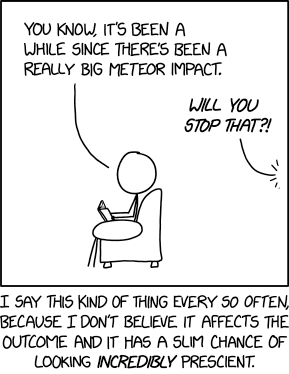
xkcd 1167, acknowledging that the world may not need more written on this

I had a friend ask me earlier this month what I knew about what Governor Healey announced in the State of the State as her administration's "Literacy Launch" and more largely about what Massachusetts is doing on literacy and public education.

If you read the linked article, you'll see that Secretary Tutwiler outlines a $30M effort from the state that seems reasonable. They're planning to fund professional development and grants for districts to purchase curriculum that more strongly supports kids learning to read. That seems fine, and it's the role of the state to support districts in this way.

Let me be clear: while teaching kids to read is not my professional background, it's demonstrable that:

  • kids need different things in order to learn to read; not every kind of instruction works with every child (kind of like everything else)

As a local side note: this is where Worcester was. It wasn't until we got a new superintendent, and the leadership that resisted getting teachers the curriculum they needed was gone, that we made a change. $7M or so in ESSER funds went to a new elementary reading curriculum; Worcester's elementary schools now have Core Knowledge for Language Arts or CKLA.

Where this becomes something else, as too often in education, is when it becomes a crusade. 

And all, we are there in spades. 

I have been struggling for weeks on how to tackle this issue on here, because it is so big, so heated, and, at ground, so breathtakingly missing the mark. Yesterday, though, I had shared with me the third of Maren Aukerman's of the University of Calgary's three part series on the Literary Research Association site "The Science of Reading and the Media" which hits the mark; you can find the first part here, and the second here.

I particularly found useful how she frames the state of coverage, which will sound familiar to any readers of the Boston Globe:

From how much of the media tells it, a war rages in the field of early literacy instruction. The story is frequently some version of a conflict narrative relying on the following problematic suppositions:

a) science has proved that there is just one way of teaching reading effectively to all kids – using a systematic, highly structured approach to teaching phonics;

b) most teachers rely instead on an approach called balanced literacy, spurred on by shoddy teacher education programs;

c) therefore, teachers incorporate very little phonics and encourage kids to guess at words;

d) balanced literacy and teacher education are thus at fault for large numbers of children not learning to read well.

The upshot? "Unfortunately, these suppositions turn out to be highly misleading."

In the first part, Professor Aukerman starts by asking if reporting is biased, using as an exemplar Dana Goldstein's piece from 2022 on Lucy Calkins. Aukerman walks us through the lack of balance, use of straw man arguments, myopic lens fetishizing phonics instruction, and logical fallacies. One could--and I would argue, we need to!-- do the same here in Massachusetts with the Globe's three part much-touted series on literacy. 

In the second part, Aukerman looks at if media is using high quality research. The lack of deep understanding and use of research across education (and I dare say, in other fields) is an ongoing issue of the current state of media, and we certainly see it here in Massachusetts. Even something so basic as the basis of the argument in their literacy series, which the Globe has based on ELA MCAS scores reveals this sloppiness, as MCAS scores do not tell us much about literacy; ELA MCAS tests much more than literacy and is not, on its own, a test of literacy. 
But more broadly, you can see this in the coverage:

By drawing mostly on vociferous advocates of one approach and bolstering their claims primarily with other journalism, journalists create an echo chamber which itself is disconnected from reading research. 

And would you guess this from reading the popular coverage?

 ...there is insufficient evidence to conclude that any single approach, including the particular systematic phonics approach often elided with “the science of reading,” is most effective.

Nearly all coverage also lacks both historical context:

 The idea that phonics can fix children’s reading ills is at least 70 years old, yet results from other large-scale phonics reforms have also yielded disappointing results, including during the Reading First era in the U.S. and as England’s recent national curriculum mandates have played out

And, I would argue, a disturbing ignorance about how curriculum works in the classroom. The Globe, for example, waved their hand and deemed "outdated" curricula that they found in their survey that districts are using. But that both a) leans on the above poor understanding of what is quality curricula and b) understands "curricula" as if it is taken from a box and inserted into children's heads without going through educators who always use a variety of resources to best meet the needs of children.

The third part of Aukerman's series brings us to where I am concerned we are in Massachusetts: the consequences. The latest Massachusetts iteration of this is the push to pass H579/S263, frighteningly favorably reported out of the Joint Committee on Education on the last available day*. This would not only add another report to the pile of reports that districts have to submit to DESE--let me know when that fixes something, eh?--but would give the Department the authority to select curriculum, with districts selecting from a list generated. As the bill reads:

each local school committee shall use programs and curricula from the lists developed by the department or an approved alternative program

This honestly makes me both so angry and so frightened about the state of education in Massachusetts that words fail me. There are much more articulate words in the actual practitioners of the letter I shared earlier this month, of the position statement of the Massachusetts Association of School Superintendents, and the four fallacies of the reading wars.

One cannot, of course, separate this out from context: this is the same "my local elected officials are not doing exactly what I want, so I am taking it to the manager" that brought us mandates over everything from COVID to other nonsense. And someone, somewhere, is going to write a great book about the economic anxiety of the white middle class and its impact on public education and lines of governance.

But in the meantime, here we are. 

So, please go read all of Aukerman's series. Share it. Email it to your legislators.  

____________________________________________________________________

*and if you think the Globe "just happened" to choose the hometown of the Senate chair of that committee for one of their articles, I have a bridge to sell you.

Saturday, January 27, 2024

Thursday, June 22, 2023

Note on the proposed new state health standards

Yesterday's Massachusetts education coverage was all about Governor Healey's announcement of proposed new health and physical education state frameworks, what we also refer to as state standards. You can find on them on next Tuesday's Board of Elementary and Secondary Education agenda. 

Because the passage of new curriculum frameworks isn't generally the kind of thing that most people pay attention to, a few notes on process:

  • In Massachusetts, under MGL Ch. 69, sec. 1E, it is the Board of Elementary and Secondary Education that sets frameworks for K-12 education in Massachusetts by curricula area. You can find them here. 

  • Infamously, the health standards have not been reviewed and updated since 1999. The Department started a process of redrafting the health frameworks back in 2018, in a process that seemed to be taking an unusually long time (so no, you can't really blame the pandemic for this one).

  • Note--and this is important!--this is not the creation or the adoption of a curriculum. This is "what a child is expected to learn" as a result, not how the child gets there.

  • There have been ongoing attempts to pass the Healthy Youth Act by the state Legislature; the act would require that curricula in Massachusetts schools be medically accurate, age appropriate, LGBTQ+ inclusive, include tools to build healthy relationships, and teach the benefits of delaying sex as well as how to prevent STIs (sexually transmitted infections) and pregnancy. It has passed the Senate four times; it never makes it to the House floor (the standing assumption is that House leadership knows some members don't want to be put on the spot about it).

  • This process, instead, leaves this under Board purview (where I, anyway, would argue it better belongs; you don't really want the Legislature sorting out what should be taught, do you?).

  • On Tuesday, the Board (and the rest of us; the meeting will be livestreamed) will receive a report on the proposed update of standards.

  • Their vote on Tuesday is on sending it out for public comment for 60 days. All proposed regulation and framework standards go through such a process.
    IF YOU WANT TO SEE THIS HAPPEN, THIS IS WHERE YOU COME IN: There will be a dedicated email address, usually as well as an online form, allowing comments to be submitted. I'll be sure and link once that exists.

  • The Department takes those comments, makes any revisions that they think are necessary in response to those comments, and brings that back to the Board for approval at a later meeting. The timeline outlined by the Commissioner says he expects them to come back later this summer (which is really cruising) or this fall.
Again, if this is important to you, yesterday's announcement is not the end, though it might be the beginning of the end. Prepare to comment on the revisions starting sometime next week. 

Saturday, April 29, 2023

On the new ELA elementary curriculum

 Among the big things that happened at Thursday’s meeting of the Worcester School Committee was the adoption of a new ELA curriculum for elementary school, as discussed at Monday's subcommittee meeting. As I have noted here before, the curriculum that our prior administration was absolutely stuck on was just what research, data, and the ongoing news of the “reading wars” was noting we should NOT be doing. 

We heard from many teachers, coaches, parents and others on this one (and for years, let me stress). 

I never taught elementary school, but as someone whose roots will always go back to my English classroom, this has been one that has struck me to my core. I thus wrote up specifically what I was going to say ahead of time. This is what I said:

As we will note later this evening, our role in curriculum approval is very high level. Broadly speaking, it is up to the Committee to determine if curricula supports our district goals and aligns with state standards.
Speaking as a former teacher, I know that teachers pour their hearts into the classroom. There are few things more disheartening than to be directed to do something that you know is actively harmful or simply not helpful to your students. I know that, having been there.
That is the position which we have placed our elementary teachers in these past years regarding ELA. Despite repeated attempts by several members of this Committee to set it straight, the previous administration was absolutely committed to a curriculum that we knew and was ongoingly reported to be, not what was needed in the classroom. 
To the teachers, principals, coaches and so forth who have fought for years for us to do better, I want to thank you for your faithfulness, and if you quietly closed the door and ensured your students had what was actually needed, good for you. 
This Committee has a responsibility to depend on the professionals who work in curriculum and work with students to give us the feedback when we make these decisions. And we owe them professional respect in doing so, and some of that has been lacking in the public process. We need to be better to our staff--our employees--than that. 

I also want to note: we are required to set aside 20% of our ESSER III spending—about $18M—for what the federal government refers to as learning loss. The funding for this curriculum not only falls into this category for reporting purposes; it also repairs what we know has been a cause of less learning for our students. This is not only an allowed, it is a strongly supported use of federal spending  

We thus will be repairing two issues from prior leadership, while giving our students and our teachers a curriculum about which we know them to be enthusiastic, which not only meets state standards but is green rated, and which will actually support students learning to read.
I support moving forward with the administration’s recommendation immediately.
I was also glad to make the motion for reconsideration that evening, allowing administration to move forward immediately with the purchase of CKLA.

Sunday, April 23, 2023

Updates from the Worcester Public Schools

 compiled in part, though not entirely, from the weekly updates, Dr. Monárrez sends the Committee

First up, ones that I've been worrying over: starting May 1

  • Richard Ikonen will be serving as Director of Facilities. He's coming from Minuteman Regional, where he was Assistant Superintendent of Operations and Facilities.

  • Ryan Hacker will be serving as Assistant Director of Facilities, focusing (I think I have this right) on capital projects. Ryan comes from UMass Med, BUT he last appeared here for his testimony during the hearing on the WCACS, as he's president of ArtsWorcester, AND he's a Burncoat High grad (yup, Burncoat!). 
I haven't met Rich as yet; I know Ryan. I'm looking forward to this.

The Auditor's office did meet with the WPS administration before vacation. That, plus our full delegation backing our call for investigations, is heartening that our concerns over OSV's management of the charter schools are being taken seriously. 

There's an executive session of the full Committee tomorrow (Monday) on negotiations with units A&B (and as it's negotiations, that's all I can say).

As I mentioned in my last post, the administration is recommending--much to the relief of many!--a new ELA curriculum for elementary students. This is of course in response to the many, many concerns from all kinds of places over the Fountas and Pinnell curriculum that the previous administration was very committed to. Major curricular changes need to go through the School Committee, so the recommendation is going to TLSS for a (virtual only) meeting tomorrow at 4:30 before coming to the full committee Thursday. This timeline has been an attempt to balance as much time for a pilot as possible, while still giving time to order materials and get them and PD to teachers before school is out.
Wit & Wisdom and Core Knowledge Language Arts are what was piloted in 21 or 22 classrooms each; page 13 of the presentation gives where. The rest of the presentation is based on feedback from the teachers and others involved in implementation. 
I won't say more on this here, as this is subject to deliberation and vote, but we'd of course welcome feedback (beyond "good bye F&P," which we've heard loud and clear!).

Finance and Operates meets this week on Wednesday at 5:30 ; you'll see that agenda tomorrow, but it will include the third quarter budget report, as well as the monthly transportation report. Also, for those who have been interested in the district streaming sports events, we'll be taking up that item as well. 

And speaking of budget: 

The budget's coming! The FY24 budget will be released on Friday, May 12 (start clicking refresh about 4, though sometimes it arrives earlier!).
There will be the statutorily required budget hearing on Wednesday, May 24 at 6; this is all of the Committee, gathered for no reason other than to hear from members of the public on the proposed budget. 
The School Committee deliberates and passes the budget, cost center by cost center, on Thursday, June 1 and Thursday, June 15. We start at 4 pm.
The one thing this doesn't include--because I don't know it yet--is the date on which the Worcester City Council hears the WPS budget. As a reminder, the Council approves only the bottom line of the Worcester Public Schools; they have no authority over cost centers. The Council also, under Plan E, cannot move funds or add funds to the budget; they can only cut. As the schools are generally funded at their statutory required level plus transportation and no more, one might argue that they cannot do that, either. 

That's what I have at this point. As always, if you have questions, send them along.

Tuesday, June 28, 2022

Board of Ed: state student advisory council report

Carris Livingstone runs through the regional councils and what each was working on in their workgroups
health and wellness workgroup:
educate students about mental and physical health resources
created a brochure including resources available to students
curricular reforms:
financial literacy student survey, research on need
history framework: need for Native American representation and Asian American history and supplemental information
college and career readiness program
much preliminary data gathering; follow up needed particularly in the curricular areas
DEI: want to diversify the Council
"have a lot of the same type of students that tend to come to our meetings"
emphasize that need diversifying the Student Advisory Council to ensure being welcoming to all types of students

regional highlights:
digital divide work: survey and a district brochure
financial literacy: focusing on online platforms
I think I missed one in here
curricular reform to increase representation
student government reform: resources including platforms to bolster leadership
mental health and wellness: social media page that outlined facts and disparities
college and career readiness: resources for receiving important information
"often there are resources; it's about students being aware"
climate change: how students can clean up their community
student representation: infographic to gain leadership skills and resources on how to make students grow
western group worked on shared resources: AP access

ongoing work on communication

Lombos asks for other feedback
Carris Livingstone speaks of greater communication between the advisory council and the Board
in a continual process throughout the year, not simply a report at the end

Thursday, May 6, 2021

My comments on tonight's vote on sex ed

more or less; I'll add links later, but you can find my sources pretty easily

 I think it important to note that we are deliberating this question now, in 2021, because a clear Open Meeting Law violation took place last term in the spring of 2019. A quorum of the Teaching, Learning, and Student Supports subcommittee deliberated on a matter under their purview—the health curriculum—outside of a posted public meeting, and the process ended.

We know this, of course, because of the public records of this deliberation.

When a public body violates the Open Meeting Law, as happened last term, and the matter goes to the Attorney General, she can impose a number of penalties, which generally are designed to make up for the lack of public process: committees can be required to revote, or they can release minutes. They can even be fined. 

No such penalties were imposed on Worcester, Mr. Chair, as the matter was never reported to the Attorney General. 

But even if it were, nothing can make up for the consequences of the members of this public body denying students of the Worcester Public Schools two years of comprehensive health education. We do not know, Mr. Chair, how many of our students were harmed by not having what can in fact be life-saving information. 

I don’t want to let this evening pass without noting where the responsibility for this lies.

We cannot make up for that lost time, but we can ensure no more time is lost.

In terms of process, I want to thank you, Mr. Chair, for not letting up on this, as well as Ms. McCullough for ensuring that there was a public process with clear evaluation and parameters with public comment. 

I have noticed that there has been some confusion during, so let me observe: the Committee asked for our staff to conduct a curriculum review. I appreciate the work our health department staff, as well as that of the HOPE Coalition and the Department of Public Health, in a thorough, professional curriculum review as requested.
Both “conflict of interest” and “ethics violations” are legal terms of art, which have specific definitions; the vote this evening is neither.
I’d also note that curricular materials usually are protected by copyright, and thus aren’t available, in my experience, via a public records request. The curriculum we are actually discussing, however, is entirely publicly available. 

Regarding public comment, I do think it incumbent to note that some of what we received, particularly at the last meeting, was no less than hate speech, and in some cases directed at our students. That may be legal in this public forum, but it is unacceptable. It has been also been quite clear how much motivation is based on fear and concern over loss of control rather than care for our students. It was, in many ways, a potent illustration of just why we need the comprehensive curriculum before us this evening. 

All of our students, all of our staff, all of the members of the Worcester community deserve to have their human dignity and bodily integrity valued and respected. 

Our trans students and community members are valued, as they are, for who they are.

All members of the LGBTQIA community deserve respect, justice, and equity. 

All of us here have taken an oath to the Massachusetts Constitution, which lays out in its very first lines a recognition that the purpose of democratic government is “to furnish the individuals who compose it with the power of enjoying in safety and tranquility their natural rights, and the blessings of life.” 

To shirk our work this evening is to shirk our oath of office. 

Yes, Mr. Chair, Massachusetts General Law says parents may choose not to have their children take such coursework as that under discussion. 

However, those under the impression that students who do not receive comprehensive sex education in school will not have any exposure to sex are badly mistaken; they’ll simply be subject to whatever turns up on a Google search.

To the question of whose job this is, allow me to cite two quotations:

Parents/caregivers are the primary sexuality educators of their children. 
School districts and community-based organizations should function 
as partners with parents/caregivers in providing sexuality education. 
Together, these institutions have the responsibility to provide young 
people with honest, age-appropriate sexuality education.

And:

We need to have sex education for children. The ideal is to start from home, with the parents. It is not always possible because there are so many differentsituations in families, and because they do not know how to do it. And so the school makes up for this, because otherwise it will remain a void thatwill then be filled by any ideology.

The first quote, Mr. Chair, is the first principle of the curriculum being considered tonight from the teacher’s manual of Rights, Respect, and Responsibility.

The second, Mr. Chair, is from a translation from an interview in 2019 with Pope Francis,.

It is not a scandal for public schools to teach comprehensive sex education. It is, in fact, a responsibility we have, and it is one that we here in Worcester have been shirking for far too long. Sex education is covered in the Massachusetts state frameworks for health education—long overdue for updating—and are anticipated by the state laws—thus the ability for parents to choose to have their children not participate. The list of which districts have comprehensive sex education, have had comprehensive sex education, and continue to have comprehensive sex education is lengthy, and ironically includes many of the districts from which we had callers over the past weeks. They would deny our students something students in their own communities already have.

It is also not something that can be or should be isolated to high school or even middle school. We received painful personal testimony from callers who noted their own experiences of sexual assault at young ages. One out of every NINE girls and one out of every 53 boys is a victim of childhood sexual abuse. That means on average at least one girl in every one of our classrooms and several boys in every one of our schools have been victims of childhood sexual abuse. 93% of those reporting such abuse know the perpetrator, and in fully of third of reported cases, the perpetrator is a member of the victim’s family. 

Again, Mr. Chair, we as a district have a responsibility to our students; this clearly cannot be left only to family. While sexual assault is never the victim’s fault, having conversations about bodily autonomy as developmentally appropriate make it that much more likely those who need it will get help by the mandated reporters under our employ.

As one of our callers noted last week, an adult deciding that they are uncomfortable with something does not make it developmentally inappropriate. Child development is a field of study; we educate children in line with that, not in line with various degrees of adult discomfort. Best practice on teaching children about health in all fields is that one does so gradually and consistently over time starting, yes, when they are young. 

And this remains true, Mr. Chair, regardless of the culture or even the religion of the families. We could do a world tour and find the need for sex ed in any country that does not have it. We could easily start with my own cultural heritage, where a country run as very close to a theocracy for much of a century is still uncovering decades of sex abuse in religious schools, not to mention the horrific legacy of the Magdalene laundries. Don’t tell a great-granddaughter of Ireland that religion and culture should be allowed to block comprehensive sex education. 

We are instructed, after all, to remove the log from our own eye before attempted to remove the speck of sawdust in another’s.

Likewise, a parent saying that they could never teach something to their child does not mean that no one ever should. Many could never teach basic principles of mathematics or of science; students still need to know them. I know we have many gifted health teachers in the Worcester Public Schools. 

I will also echo that we have at least a few that have no business teaching health, which is why we must have a single curriculum that is implemented with strict fidelity. We would not have someone who insisted the Earth is flat teaching geography; we must not have health educators that deny basic scientific principles of the field. 

And make no mistake: this is a scientific field of study. It is thus infuriating, Mr. Chair, to hear the vast array of misinformation and outright lies that have been conveyed in this discussion, including by leadership that should know better, and which has a responsibility to tell the truth to people under their care. It is deeply troubling to me how much of the testimony comes from fear and a perceived loss of control. Yet we are told that it is the truth that sets us free.

The reason that we have such solid research on the need for comprehensive sex education is that the U.S. federal government ran the equivalent of a large scale experiment from 1998 to 2016 on the youth of the country by funding abstinence only until marriage education under Title V, Section 510. Review after review after review (compiled by both Mathematica and by Guttmacher) of such programs in the states that accepted the funding over those years came to the same conclusion: there was no evidence that such programs increased the rates of sexual abstinence, and students had similar numbers of partners and rates of unprotected sex as students without any access to any sort of sex ed at all. 

The only positive--and I meant that in a statistical sense--correlation from a 2019 review in Reuters was that students in such programs in politically conservative districts had a teen birth rate that went up. 

Those involved in studies of children’s health concluded that such programs were unethical because of the actual outcomes of the programs. To persist to giving incomplete information when it has been shown to do actual harm is unethical. 

So to those who asked why it was we have the rates we do of teen pregnancy in the country, there’s your answer. 

To those who have raised the issue of birth rates in other cities with comprehensive sex education: the test is impact. Those cities had rates significantly higher than ours to begin with; it is, at least in part, their use of a comprehensive sex education curriculum that pushed those rates down. Facile comparisons that simply note which city is higher than which without accounting for those other factors tell us little. 

As a number of the callers endorsing such programs also, a review of their associated sites show,  discourage COVID restrictions, question vaccinations for COVID for young people, and take other perspectives contrary to public health, I would suggest we should not take their advice on public health matters.

Meanwhile, as has been widely noted, and is easily Googleable, and has been demonstrated over and again by actual peer reviewed scientific research conducted by legitimate research organizations, comprehensive sex education, like the program before us tonight, is actually effective. We have known this for decades at this point. It is past time we acted on it.

In my consideration of this important matter, Mr. Chair, I have continued to come back to an image from my own high school years. Created by ACT-UP New York, it was three stark lines printed under a pink triangle.

SILENCE

=

DEATH

Because of the activism of ACT-UP and others, as well as the work of researchers, the death sentence at that time due to AIDS is no longer the fate of those who are HIV positive who have access to treatment.

 But the silence that meant death, and the fear and in some cases the bigotry motivating that silence remains with us still. To remain silent when we have the rates of STDs among our students that we do—to remain silent when we know the huge rates of suicide and other harms to trans youth when they are not supported by family or community—to remain silent when our children lack for basic education that would give them, we know, healthier and happier lives—to remain silent under such circumstances is, Mr. Chair, death.

I will support the recommendations of the subcommittee as amended.