Showing posts with label Baker. Show all posts

Tuesday, March 12, 2024

Four years ago today...

 This was what I posted on Facebook:


Worcester, for what it's worth, was only calling for the single day left in the week; we'd call two weeks over the weekend, part of the weekend when literally every single district in Massachusetts (I vividly remember downloading the full list and opening a spreadsheet to track them) called school off before Governor Baker did a damn thing about it.

Am I still angry about that? Yes. And his lack of leadership--and I have some words about the outgoing Commissioner, too, at some point--and meeting the needs of schools during the pandemic would only continue from there. 

More as I have time, but I didn't want the day to pass without noting it. 

Sunday, January 8, 2023

"There shall be in the department a board of elementary and secondary education..."

With the inauguration of the new governor have come a number of questions of what authority the Governor has over K-12 school governance in Massachusetts. 

This involves the interaction of three sets of players: the Secretary of Education; the Board of Elementary and Secondary Education; and the Commissioner of Education

The Secretary of Education is a cabinet member of the Governor. They are appointed by the Governor, and serve at the pleasure of the Governor. They oversee an Executive Office of Education, which is not the governance system of the state.
By virtue of that appointment by the Governor, they have a voting seat on three Boards:

  • The Board of Early Education
  • The Board of Elementary and Secondary Education
  • The Board of Higher Education
Governor Healey has appointed Dr. Patrick Tutwiler as Secretary of Education; this position was held by James Peyser under Governor Baker.

The Board of Elementary and Secondary Education was created by MGL Ch. 15, sec. 1E, the Board consists of eleven voting members as follows: 

    1. The Secretary of Education: As above, this is Dr. Tutwiler. His term is entirely up to the Governor, but he can serve as long as Governor Healey is Governor.

    2. The Chair of the Statewide Student Advisory Council--This student member is the only elected member of the Board of Elementary and Secondary Education, as the chair is elected by their peers on the Council. They are elected in June and serve for one year. This seat is currently held by Eric Plankey, who is a senior at Westford Academy (which is the public high school in Westford). Eric's  term ends in June.

    3. A member whose term is coterminous with the Governor. That seat was held by Tricia Canavan of South Hadley; as such, this is a seat which Governor Healey now can fill with a person of her choice.

The term of all other seats is for five years, with a single renewal of an additional five years allowed.

    4. A labor representative, selected by the Governor from a list put forward by the State Labor Council, AFL-CIO. This seat is currently held by Darlene Lombos of Boston, who is the executive secretary-treasurer of the Greater Boston Labor Council. Darlene was appointed in June of 2020; as such her term should run through June of 2025, though she could be reappointed to a second five year term at that time if Governor Healey wishes.

    5. A "representative of business or industry selected by the governor with a demonstrated commitment to education." This seat is held by Katherine Craven of Brookline, who is Chief Administrative Officer of Babson College. She was appointed in August of 2014, and had her term renewed by Governor Baker; as such, her term expires in August of 2024.

    Important note: Though Craven currently serves as Chair, the Governor appoints the Chair, so  Governor Healey may appoint a different chair from among the members if she wishes.

    6. A "representative of parents of school children" selected by the Governor from a list of three put    forward by the Massachusetts Parent Teacher Association. This seat is held by Mary Ann Stewart, formerly a member of the Lexington School Committee, who was appointed in August of 2014; she was reappointed (or was she?) by Governor Baker, and thus her term expires August 2024.

The remainder of the five seats are non-specific, though the law specifies: 
No appointive member of said board shall be employed by or receive regular compensation from the department of education, or from any school system, public or independent, in the commonwealth, or serve as a member of any school committee.

 and not more than two can work for the state.
Currently, they are: 

    7. Matt Hills, Vice-Chair (elected to that position by his colleagues for the year), formerly a member of the Newton School Committee, is a Managing Director at LLM Capital Partners. He was appointed to the Board in March 2019--despite it not saying that on the Board page--thus his term should be up in March of 2024, though Governor Healey could reappoint him for a second term at that time. 

    8. Farzana Mohamed, also of Newton, was just appointed by Governor Baker this past July; as such    her term runs through July 2027, though she could be reappointed for a second term.

    9. Michael Moriarty, a former member of the Holyoke School Committee (prior to receivership), is the Executive Director of the OneHolyoke Community Development Corporation. He was appointed to the Board in September of 2015, and was reappointed by Governor Baker; as such, his term ends September of 2025.

    10. Paymon Rouhanifard of Brookline, is the former superintendent of the Camden, NJ schools under state control; he current runs Propel America. He was appointed in September 2019, and thus his term ends in September 2024, though he could be reappointed for a second term.

    11. Martin West of Newton, is a profession of education at Harvard Graduate School of Education. He was appointed in September 2017; as such, his term ended September 2022, unless he has been appointed for a second term.

Now there's something weird going on with appointment dates; the "official" website of terms of office, I am told, is here. Setting aside that the secretary of the Board (the Commissioner) is still somehow Jeff Wulfson (who was serving as interim five years ago), and the student member is two years of out date, the terms of office are strangely off, as follows:

  • Lombos was only appointed in 2020; her appointment should run through 2025. The website has 2023, but the law has no three year terms.
  • Craven's is correct.
  • Peyser's blank (serves with Baker) is correct.
  • Stewart was appointed in 2014, thus her first term did, as noted here, expire in 2019. She has continued to serve, though, so her term of service should run, one assumes, through the second five years, expiring in 2024. This is assuming that she was reappointed. 
  • Moriarty's is correct.
  • Canavan's blank (coterminous with Governor) is correct.
  • West was appointed in 2017; as such, his first term have should run through 2022, unless he was reappointed. The site has it as 2025, but there are no eight year terms.
  • Mohamed's is correct.
  • Hills was appointed in 2019; as such, his first term ends in 2024. The site has it as 2027.
  • Rouhanifard's is correct.
The law is quite clear on five years, allowed to be renewed once. The only exception is if someone is appointed to fill a partial term vacancy of less than three years. If the argument is that Hills, for example, first filled Sagan's additional year, that still only gets him to 2025, not to 2027. 
I don't like what looks like fudging here, and I hope that the state's former top lawyer, now running the show, straightens this little mess out.

It is, however, the Board, who you will note do NOT answer directly to whomever is currently the Governor, that appoints the Commissioner of Elementary and Secondary Education, who is the executive of the Department of Elementary and Secondary Education, which oversees K-12 education in Massachusetts.
Currently, the Commissioner is Jeffrey Riley, former receiver of Lawrence, who was appointed Commissioner in 2018. He can serve as long as the Board wishes him to do so. He has no direct reporting line to the Governor.
Think of the relationship of the Board to the Commissioner as paralleling the School Committee to the Superintendent, with the Secretary simply serving as a voting member. 

Sunday, January 1, 2023

The most read of 2022

 What a year!

Photo UP at the Durkin Administration Building this summer

In the classic manner, we do this from ten to one, remembering that the actual number one remains the face of the blog. Many of you simply wander by from time to time to see what's new. I appreciate that!

10. "We pauperize education": A letter to my delegation (from January): "Schools should be the last thing to close!" we were told over and over, yet no one did anything to create the circumstances that would make that possible. Here's my letter to the delegation (one of several I sent) regarding that.

9. Vernon Hill School (a post from 2015): This one feels a bit like cheating, because I know what drove the traffic for this. Someone on one of the Worcester community Facebook pages asked a question about Vernon Hill (which is the former Providence Street Junior High), and the photos I have in this post responded to some of the question, so I posted a link.
This does remind me, though, that I need to be more faithful about posting photos of buildings when I have them, as they're appreciated!

8. A post on Sonia Chang-Díaz (from December): The loss of Sonia in the Senate (even as her successor is great!) is something I know I will keenly feel, as will many. This is the post which doesn't do her justice, but is my best attempt. 

7. Who are those guys? A bit about the Board of Elementary and Secondary Education (a post from 2017, which probably needs updating): With the change of Governor, there have been many under the impression that we'd a) get a new Commissioner (no);  and/or b) get an entirely new Board of Ed (no). I shared this link at least once to try to straighten some of that out. I should probably update it with new names, though. Maybe once we see what else happens after Thursday...

6. A legal opinion regarding health authorities in the Worcester Public Schools (from February): One of the ongoing questions of the pandemic has been who has the authority to do what (and also who does not). In particular around schools, what the authority of the school committee versus the board of health led to a few clashes. Worcester didn't have a clash so much as a sequencing question, but I posted the legal opinion of the city solicitor to clarify.

5. SCOTUS did what? (from June): It's been an alarming year in Supreme Court decisions, and education has not escaped unscathed. This is post is on the Carson v. Makin decision, requiring Maine to fund tuition to religious schools as well as secular ones. This is due to the very particular conditions of Maine education, but it has opened the doors to vouchers effectively being required to be used similarly in states where there are vouchers. 

4. What happens next in the WPS superintendent search? (from April) Posted the night the finalists were announced (at 9:32 pm), this post was designed to ensure everyone knew exactly what was happening next.

3. Remarks on Dr. Rachel Monárrez, next superintendent of the Worcester Public Schools (from April) Posted the night we voted on the next superintendent, this post is my remarks reflecting to my colleagues on my visit to San Bernardino City Unified School District. It was also a recommendation of action (which is what we did!).

2. Finalists for the Superintendent of the Worcester Public Schools (from April): Because I knew that people weren't going to be able to listen fast enough! This simply replicates the text that was shared with the School Committee the evening it was announced. 

1. Let's talk about this charter school application for Worcester (from November): My personal subtitle for this one is "what I did over my Thanksgiving break" but it was worth it, as it caught the attention needed, and that snowballed into the work that got the community mobilized. Fingers crossed we made our case strongly enough.

What's up for this year? I have fallen away from posting about what happens at Worcester School Committee meetings, which is probably something I need to get back to. Local coverage continues to fall off, and that means that the narrative of what is and isn't happening there from those who don't attend or watch meetings is often off course. There is only so much I can do, but I should do more of what I can.

Also: Ongoing work of new superintendent! New Governor and new Secretary! And a fall election under Worcester's new system.

Happy new year, and thanks as always for reading! 

Tuesday, December 20, 2022

Board of Ed for December: opening comments

 The agenda is here. The livestream is here. 
This is the final Board of Ed meeting of the Baker administration, and thus the final meeting for Secretary Peyser.

updating as we go

Let me say up front: I'm not here for nice words about Baker or Peyser and public education. You'll have to go find that somewhere else. If you fought off privatization efforts (remember Baker's question 2 ad?) and got the SOA signed, cheers. We made it.

Public comment: 
gifted and talented education
MCAS very inept at identifying where students are
Aversion to acceleration in this state
"I see a structural policy failure in this Department in this topic"

sophomore at Revere High School who participated in the Biggest Winner Math Challenge
"in those kids I could see a pleasure in seeking more knowledge"
"I could see the changes in the students that came" in every passing week
changed her perspective on school
teachers put in school "to help and guide me"
sophomore at Easton High School
was in Brockton gifted and talented program
Biggest Winner Math Challenge provides opportunity for those without such a program
helped learn teaching and leadership skills
sophomore at Brockton High
use math in the real world; changed the way I viewed math
worked in the video series
junior at Foxborough Regional Charter School
took over parts of the schedule after the first week 
making connections through humor
junior at Philips Academy Andover
strong interest in STEM; team leader of the Biggest Winner Math challenge
worked collaboratively to make things more engaging for the students 
sophomore at Revere High, who serves on Board of Ed's gifted and talented council
starts by recognizing Eric Plankey, student member of the Board
in then team leader in Biggest Winner Math challenge
was empowered to take on leadership roles in community
"discovered an interest in teaching I didn't know I had"
"teens need to have the opportunity to work for more programs that work for them"
Shashoy Bailey, chemistry teacher at Discovery High School in Springfield
instructor in Biggest Winner Math challenge
emigration from Jamaica
Attended school in Springfield and chose to go back to Springfield to teach
often one of the only or only Black student in classes in engineering program
systematic lack of access to resources for Black and brown children
need more programs that schools can easily access and provide for their students
seen development in program over time

Senator Nick Collins
speaking for concerns about school safety in Boston
which is not the correct place to raise at all
flagging school safety concerns to the state board (?)
likens medal detectors to library check outs
raises Sandy Hook Elementary
"I appreciate the role this Board has been playing the city of Boston"
has little confidence in Boston School Committee

Max Page, president, Mass Teachers Association
congratulations to all of us for having passed the Fair Share Amendment 

call for lifting "artificially low" inflation cap in the Student Opportunity Act
Right to strike
retirement 
end high stakes testing and receivership
poses some questions to pose to the Southbridge receiver
"how much evidence do we need" of the catastrophe of this experiment?

Hills: Commissioner's assessment subcommittee
set out a structure; and he's talking about a memo that we do not have
"student achievement how we weigh our success or failure as a Board" weighed at fifty percent
Moriarty on pandemic recovery and literacy, because he has this hobbyhorse committee that isn't under purview
"good meaningful robust discussions"

Craven turns it to Peyser
Peyser who is home sick; he's been on the Board for eighteen years
and his list of things they did that I don't think are the things are important at all
welcomes Pat Tutwiler

Commissioner: Boston Public Schools latest
equity analysis for transformational schools as compared to non
literacy focus: getting some traction
transportation: still concerned
concerned about bathroom renovations: "timelines blown early in the process"
"still have ongoing leadership challenges"
"I guess I'm disappointed that we've had elected officials come to the chamber numerous times" and it feels like balls are being dropped
early indications that Superintendent Skipper will be excellent
safety audit coming
Craven: bullying and special education
Riley: special education concerns; bullying
Hills: transportation: why did people think it positive in June?
how do you go from over 30 people interested to one bidder?

vo-tech admissions: policies being reviewed
following up with some districts that may still be impeding equitable admissions
Moriarty: what is being done to expand programs?

Riley opines off the cuff that he disagrees with the MTA prioritizing the right to strike

list of grants in learning loss, and now they're talking about a grant that I don't know what the conversation is about

Saturday, November 26, 2022

Let's talk about this charter school application for Worcester

The Department of Elementary and Secondary Education this year is considering a single application for a new charter school, and it's in Worcester. You can find the application online thanks to the MTA (not on DESE, as would, you know, actually make sense); the notification the Department gives is that the application is in, and they'll be holding a hearing, as required by MGL Ch. 71, sec. 89(h) here in Worcester:

4:00–6:00 p.m. on Friday, December 9 

the Hebert Auditorium, Surprenant Building, Quinsigamond Community College

You can also email your comments to charterschools@doe.mass.edu by January 4.

First, an overview of charter schools in Massachusetts, in case this is a new conversation for you:

Now, if you're brand new to charter schools entirely, let me recommend this piece from John Oliver from 2016, keeping in mind that a) it's from six years ago and b) it's a national look:


One thing that often is touted in Massachusetts is that all charter schools under MGL Ch. 71, sec. 89, are chartered by the state: applications go to the Commissioner for consideration, who then recommends (or doesn't) charters to the Board of Ed, who then awards (or doesn't) the charter. A parallel process is followed for renewals. While this means we have dodged some of what has happened in other states, let me note that Massachusetts isn't immune to some of the issues other states have seen; the ongoing issues, dating back at least a decade, of Mystic Valley Charter (up for renewal in February, incidentally) is probably the extreme, but please note that Worcester did have a charter that collapsed in October (!) of 2013 for exactly the financial reasons the Worcester Public Schools said in public testimony were going to happen when the state first considered it in 2010. (Search "Spirit of Knowledge" in the sidebar if you'd like the whole history of that.) 
The part that will always stay with me about that experience is attending a meeting in the Mayor's office with parents of students at Spirit of Knowledge who were begging the Worcester School Committee to do something, anything, to improve their children's experiences, and being entirely powerless, as charter schools answer only to the Board of Ed. My testimony before the Board of Ed on that experience is here; I also testified before the Joint Committee on Education in 2015 about that experience, calling for local authorization, if funding that impacts local districts is being used.

And that is how charter schools are funded in Massachusetts: the foundation budget amount of each student that attends the charter school PLUS $1088 for facilities (increased due to the Student Opportunity Act) PLUS any amount over foundation that the district spends (calculated as a percentage) comes straight the Chapter 70 state aid of the district in which the student lives. If you like playing with spreadsheets, you can download the projected FY23 district by district amounts here.
That spreadsheet also includes the calculation of what is most often misunderstood about charter school tuition: there is a transition amount. When a student, for example, leaves a district school for a charter school, for the first year, 100% of the amount of state aid being transferred comes also as reimbursement to the district; this tapers to 25% for the following three years. This was fully funded for the first time ever this past year (also thanks to the Student Opportunity Act). Note that it is the INCREASE, not the ongoing cost, that is reimbursed, and only for the transition.
The argument has been that this gives the district time to make the adjustments needed to their budget due to the loss of that individual student. Given a moment of thought, however, the inapplicability of this argument becomes clear: a district doesn't lose an entire third grade class, and so can cut a teacher to save that cost. A district loses a few students here and there across grade spans, and generally there is no "savings" at all.
And a charter school in a town or city is granted by the state district-funded transportation for all in-town or city students at the same status as the district's own. Thus the charter's existence itself increases a district cost, with no benefit to district students. You can see how much this costs on a per pupil basis on this spreadsheet; for Worcester last year, it was $2771 per student, or $5.7M.

Also, possibly a discussion for another time, I continue to wonder about the constitutionality of charter schools at all in Massachusetts, given the outlines of the dismissal in 2016 of Doe v. Peyser; in particular, as I quoted in that earlier blog post: 
The education clause "obligates the Commonwealth to educate all its children." [McDuffV. 415 Mass. at 617]. This obligation does not mean that Plaintiffs have the constitutional right to choose a particular flavor of education, whether it be a trade school, a sports academy, an arts school, or a charter school. Even if the court were to deny the instant motion, thereby allowing substantial discovery to follow, Plaintiffs' action will always be addressed to the question of whether the Commonwealth is obliged to provide more of one flavor of education than another. This decision - how to allocate public education choices amongst the multitude of possible types - is best left to those elected to make those choices to be carried out by those educated and experienced to do so.

A bit about where we are with the state process:

As noted on the MTA's Policy Minute, initially there had been three applications for new charters in Massachusetts. That link also covers the proposed expansion of current charter schools. Two things that could maybe be relevant here:

  • the Pioneer Valley Chinese Immersion group was not invited to apply for their proposed central Mass twin school (My personal opinion is that could be due to their continually turning up at Board of Ed meetings to try to get them to overrule the Commissioner on pretty basic stuff around their enrollment, but that's based on nothing other than attending Board of Ed meetings).

  • Old Sturbridge Village Charter, which is the same administrative oversight proposing the new school in Worcester, was not moved forward for their proposed expansion into high school. 
Expansions and additions are governed by the state law on charter school spending: up to 9% of a district's required spending can be pulled out by charter schools, with up to 18% being pulled out of the lowest 10% of districts. This is the charter school "cap" which the state overwhelmingly voted to retain by rejecting question 2 in 2016. 
Because I will share this map any chance I have to: a look at exactly how unpopular lifting the charter cap was, courtesy of WBUR

Much like everything else, this list lowest 10% list, which is based on MCAS scores, was impacted by the pandemic, and so it has been frozen for 2021, 2022, and 2023 with the ratings of based on 2018 and 2019 MCAS scores.
And yes, Worcester is on that list, just. We had moved off the lowest performing list (download them and check!) for a number of years, but the 2020 list dropped us back into that group. This was never discussed at the district level; the previous administration never really did much sharing of the state accountability information, let actual reacting to it.
And that is the group that is now frozen.
We would have space under the charter cap, in any case, as 9% of Worcester net school spending does not go to charter schools, thankfully.

What's the deal with Old Sturbridge Village and charter schools?

The charter being proposed in Worcester essentially is a sibling to the Old Sturbridge Village Charter School in Sturbridge, which opened in 2017, after being rejected the previous year. It has 320 students in grades K-8. For FY22, it pulled $4.8M out of the districts of Brimfield, Brookfield, Holland, Monson, North Brookfield, Palmer, Southbridge, Spencer-East Brookfield, Sturbridge, Tantasqua, Wales, and Webster, though $1.8M of that came from Southbridge alone, where close to half the student body comes from. Southbridge is one of the three districts deemed chronically underperforming by the state. It has been under state receivership since 2016.
The dates being the same as when OSV first applied to open a charter school is in no way a coincidence. The state law is constructed such that this sapping of resources of the districts that are often only minimally funded and most need every dollar to do better is incentivized under the argument of giving families, essentially, an escape hatch, as the state has thrown up its hands (at least until recently) around actually doing its job in ensuring the constitutional requirement for a fully-funded education for each student is met.
As a side note, there is no evidence that state takeover of school districts in Massachusetts has been effective. 

It's also not a coincidence that it's Old Sturbridge Village that has been, I believe, the first and only museum to take advantage of the provision that allows for a charter to be filed jointly by (MGL Ch. 71, sec. 89(d)) "a college, university, museum or other similar non-profit entity," given who the President and CEO of OSV--who also serves as Executive Director of OSV Charter and who also is proposed to serve as Executive Director of the Worcester expansion--has been since 2007: Jim Donahue. 
Donahue, as this profile in Worcester Business Journal from 2011 notes, came on as OSV's President at at time when it wasn't entirely clear that OSV was going to make it. That changed under Donahue. Donahue's background, though, is not from the museum world: he's a charter school director.
Donahue was the director of Highlander Charter School in Providence, Rhode Island. Donahue also recently ran for City Council in Cranston, RI (there were three seats open and he came in fourth), as well as serving as co-chair of Allen Fung's campaign for the Second Congressional district in Congress (both men are Republicans; Fung lost to Magaziner).

In both the case of OSV Charter and the proposed Worcester school, Donahue serves as Executive Director under a management agreement with Old Sturbridge Village; he is appointed to that position by the OSV board. The proposed management agreement for the Worcester school, which is 28 pages long and is included starting on page 278 of the application, looks to these non-lawyer eyes like it is pretty difficult for the charter school to ever get out of; look at what "termination" spells out, starting on page 297.
The agreement states that OSV will be responsible for:

  • Providing general business operations
  • Providing leadership and management support to School Leaders as necessary to achieve goals as outlined in the Accountability Plan and mission and vision of the Charter;
  • Preparing entitlement grant applications and reporting;
  •  Recruiting School Leaders, teachers, and other administrators; using best practices for attracting a qualified, talented and diverse faculty and staff, and ensuring compliance with the provisions of MGL c. 71, §38G;
  • Training and coaching of the School Leaders by the Executive Director;
  • Preparing the evaluation of the Principal for the Board’s review and approval;
  • Preparing a budget and monthly financial statements for the Board’s review and approval;
  • Providing payroll and accounting services;
  • Assisting with the selection of an independent auditor to be retained by the Board;
  • Coordinating and implementing contracts with prior Board approval, consistent with the School’s policies and procedures;
  • Preparing selection of benefits plans for Board approval for employees of the School governed by the Board;
  • Assisting with the maintenance of human resource files for employees of the School to the extent permitted under State and federal law;
  • Facilitating the purchase and procurement of all required School materials, equipment and services consistent with the School’s Fiscal Policies and Procedures and in accordance with all applicable Massachusetts statutes and regulations. An employee of OSV will be designated as procurement officer and such person will attain a Massachusetts Certified Public Purchasing Official (MCPPO) certification. OSV will ensure that at least one School employee will attain the MCPPO certification;
  • Assisting School Leaders with the preparation of drafts of required government reports, including, but not limited to the annual report of the School for review and final approval by the Board;
  • Administration of transportation services contract for students
  • Facilitating student recruitment through community based outreach, parent information sessions, direct mail, social media, and person to person conversation. Facilitating fundraising through the identification and submission of grants proposals;
  • Providing marketing and advocacy for the School under the direction of the Board;
  • Administration and oversight of food services for students;
  • Oversight of procurement of custodial, supplies and equipment for leased school facilities;
  • Providing resources to support School goals related to Diversity, Equity, Inclusion and Access (DEIA); and
  • Information technology support for staff and students including but not limited to; network and communications and set-up and support for all staff and student computer devices
All of that is spelled out in greater detail in the pages that follow in the management agreement. 
There are two things to note on this: the first is that the oversight of the school remains pretty firmly under OSV: the Executive Director is to provide "training and coaching" of the principal; the principal's evaluation is to be prepared by OSV. The second is that all of the finance and operations functions are done by OSV; from the minutes of the current school, one can infer that this will be led by Tina Krasnecky, Vice President of Finance and Human Resources. 
The opening discussion outlines the relationship as follows (p. 83):
Because the accountability of the Management Organization is essential to the foundation of this partnership, and because the responsibilities of the Principal are critical to the success of WCACPS, the Board of Trustees will delegate to the Management Organization the authority and responsibility, consistent with state law, to make recommendations for recruiting, hiring, evaluating and terminating the Principal. Actions regarding the Principal must be approved by the Board. The Management Organization will provide the leadership of the Executive Director who is responsible in assisting the Board in holding the Principal accountable for managing the school’s day-to-day operations and will hold them accountable for meeting established goals that ensure the success of WCACPS.
For all of this, the school will pay OSV $12,500 per month until June of next year, and then 7% of all tuition payments once the school is operational. As the budget projects tuition being $3.3M for the first year, rising to $6.7M in year five of operation, that's a fee of $233,955 rising to $470,531 over the term of the charter.
(The budget starts on page 236. Don't worry; we'll get there.)

Now this made me curious as to how this has been working for the current school at Old Sturbridge Village. As the school doesn't post their budget online, the state doesn't publish spending broken out by account code for charter schools (which would only do us so much good, anyway), and the school doesn't include an annual budget or financial statements in their minutes on their website, this is not clear. Old Sturbridge Village also doesn't make this clear in their 990 filing (page 9 is revenue).
However, if you look at the pretty vague financial statement on page 28 of the FY 22 Old Sturbridge Village annual report, you can find a line for contracted services: 

That isn't a line that appears in the OSV Annual Report prior to the opening of the charter school. Is that $464,816 all coming from the management agreement? We can't tell without filing public document requests (with the school; the museum isn't subject to public document laws), but 7% of the $4.8M the school gets in tuition would be $336,906, so if its agreement is similar to that of the proposed school, at least most of that is chapter 70 aid, funding the museum.
Additionally, the rental line is also at least in part from the school. The modular classrooms that OSV has along the edge of their parking lot are charged rent by the museum. In the April minutes of the charter Board, we find the cost has been $323,952 (page 4), but the total cost will increase in FY23 to $687,362 (page 7), because OSV plans to rent the Oliver Wright Tavern and the Village Conference Center to the school next year for the middle school. 
...which means that OSV has been getting $650K from the school, rising to nearly a million dollars next year. 
To that, then, they'd be adding another $233K next year, rising to $460K the year after, largely for providing the financial bookkeeping, along with Donahue's executive coaching, to the Worcester school. 
While that isn't the make or break for a $12M a year institution, I imagine it doesn't hurt.
For this, by the way, Donahue makes $242,626 as of the last filing (page 7 of the 990) from Old Sturbridge Village; as best as I can tell, this is the only payment to him, as the management agreement, at least of the proposed school, makes no additional allocation. 

How does the budget work for the proposed charter school?

The proposed budget for the charter school starts on page 236 of the application, but let's start not with spending, but with revenue.
Let's start with what they're spending now:
Old Sturbridge Village is currently leasing a building in Worcester that the founding team is using as a base for our outreach efforts in the Worcester community. This is funded by a private donor that we believe will also continue to generously give to WCACPS. If a charter is granted, the WCACPS Board will have the option to assume this lease from OSV.
This is the former You, Inc. building at Holy Family Parish on Hamilton Street. 

In this planning year, their budget is $750,000, of which $500,000 is half of a million dollar planning grant that they would expect to receive from DESE if the charter were awarded; the other $250,000 (p. 87) is "a private foundation grant of $250,000" which they haven't yet received:
The applicant group has applied to a private foundation for a $1,000,000 grant to fund the start-up of WCACPS. The funder expects to make a decision on this request at its Board meeting in November 2022. Based on conversations between Jim Donahue and the foundation we are confident of receiving at least $500,000 which would be disbursed during the pre-operational period ($250,000) and the remainder in Year 1 and 2 to help fund building improvements, the purchase of a bus and other start-up costs
In other words, they're already spending money that they don't have. As the lease of the building is being carried by Old Sturbridge Village at this time--and gosh, I'd sure have some questions there if I were an OSV Trustee!--this is clearly OSV making a gamble on the finances here with ultimately there being a reward to that risk.
And note that the early years of operation likewise are dependent on this funding source to make the books balance.

There's also, throughout the application (this is from p. 96): 
The foundation discussed above is also exploring the creation of a philanthropic ecosystem through which they will make grants to the Expedition Institutions of central MA to support their development of programs in partnership with the Worcester Cultural Academy.

The crux of the program for the proposed school is the museums, but they don't have funding for this part of the program. And where is the funding for that going to come from? The Worcester donation ecosystem is not that large, and the non-profits--museums included--depend on that pool of funds in order to keep things going. Unless this somehow expands the funding involved, one could easily hurt the very institutions cited.

The allocation is WILD. First up, remember much of what we might call administrative overhead is being done through the management contract with OSV. For the first year of operation, that's budgeted at $233,955.
To that, the plan adds an administration of a principal, a vice-principal, for a total of $261,581.
As the full budget for the first year of operation is $4,090,017, they've budgeted 12% of their budget for administration.
While some of that is due to the size of the school, because the management agreement is a percentage of the tuition, that drops but only to 10% of the total budget in year five. 

Looking through the rest of the education salaries, they appear to have 10 classroom teachers, 3 English learner teachers, the science enrichment teacher, the wellness teacher, and the learning expedition coordinator, and possibly the math time math coach (?) all coming out of the lines totaling $888,080; for student support, a full time adjustment counselor, plus full time nurse, plus half time psychologist, half time OT, half time PT, if that's all "student support services" (because I can't figure out where else it would go?) totals $156,000.
And there are four paraprofessionals in a line budgeted at $133,620.

The salary line for custodial is $70,000 for TWO custodians. 

There's just not enough money in here for salaries, in any case, but in this current state of affairs, I just don't see how this gets staffed.

What exactly is the program being proposed for Worcester?

My quip to my homeschooling friends when OSV charter opened was that this was homeschooler bait: send your children to school at the Village! They can wear bonnets and milk cows and feed chickens and learn to make shoes! And of course, there are plenty of photos of that, though that is not the bulk of the experience at that school.

In the Worcester case, there is a significant amount of attention to a two hour block once a week for students for what the application refers to as "Learning Expeditionary Field Study." (Schedules start on page 228 of the application.)There are several mentions of the "short drive" to OSV (from the proposed school location on Hamilton Street, it's a 40 minute drive), and ongoing references to proposed partnerships with Worcester museums.
This is another place where it gets interesting: one can, of course, bring students to museums all one likes. There is, though, no evidence, that any actual partnerships with Worcester institutions, which the applications refers to as "Expedition Institutions" in fact exist. The application says, for example:
We anticipate that this type of relationship can be replicated at other Central Massachusetts cultural institutions such as the EcoTarium, Worcester Art Museum (WAM), Hanover Theatre and Conservatory for the Performing Arts, and more, in addition to the partnership with Old Sturbridge Village. The founding group is continuing to forge relationships and find potential opportunities within Central Massachusetts that fits our criteria for partnerships
As much as the names of Worcester institutions are featuring prominently in some of the advertising of the school, it is not Worcester museums proposing this charter, nor should one read into their names being used any support of it, as much as the application and surrounding documents lead in that direction. The only actual thing we know is that there have been initial meetings.

The proposed Worcester charter, like the one in Sturbridge, essentially would contract out their curriculum to EL Education, for which they would pay $75,000 a year for the first three years, then $40,000 a year thereafter. It seems clear from the application introduction that this is based off a visit Jim Donahue had with Ron Berger (who now is an executive at EL Education) when Berger was teaching in Shutesbury. Knowing that, the passive voice here is...a choice:
With that in mind, it was no surprise that EL Education was recommended to the museum as a school-design partner for OSACPS.
Surely someone did the actually recommending?

They plan to use iReady math, which is fairly common. 
Concerningly, their assessment grid also says that they also plan to use Fountas & Pinnell for grades 3-8, which WPS just managed to extricate itself from and has been widely noted to not follow what is known about what works in reading instruction.

What about the students?

This, of course, should really be the crux of the matter. Who is this school designed to serve? 
And that's actually a really good question. 

The school application is coming in as a "proven provider": the argument here is Jim Donahue (and those coming over from OSV Charter--about half the proposed Board is from there--have experience in running a charter school and so that gives the school a leg up.

But take a look at who OSV Charter has as students: 
OSV Charter: 4.1% African America; 0.3% Asian; 17.8% Hispanic; 0% Native American; 76.3% White;
0.3% Native Hawaiian, Pacific Islander; 1.3% Multi-Race, Non-Hispanic
Worcester Public Schools: 16.9% African American; 6% Asian; 44.7% Hispanic; 0.2% Native American;
27.9% White; 0% Native Hawaiian, Pacific Islander; 4.3% Multi-Race, Non-Hispanic

Very much not the same, and you'll see something similar in comparing selected populations:
Here's OSV Charter:

OSV Charter: First language not English, 5.3%; English language learner, 3.8%; Low income 43.8%;
Students with disabilities 19.7%; High needs, 55.6%


Worcester Public Schools: First language not English, 58.9%; English language learner, 28.3%;
Low-income 74.3%; Students with disabilities, 21.1%; High needs, 84.1%

Thus in addition to being a much whiter and a much wealthier student population, the student body there has very few students who are learning English, and very few students whose first language isn't English. Not only is their percentage of both well below Worcester's; it's even below the state average (which is really saying something). 
In fact, they serve so few English learners, that their results for such students are not reported because there are so few students.

We literally cannot see how they do with their (less than 20) English learner students.
And as a side note: they're also nowhere near Southbridge Public Schools' demographics, either.

This, of course, speaks to lack of experience with students who are multilingual learners. While there is a section of the application (p. 60ff) designed to address English learners specifically, it opens in part:
This model is an ideal school environment for ELLs, which the leadership team has already established through OSACPS, that will enable them to overcome language barriers.
...which isn't something one can see from the student body actually being served in Sturbridge.  They don't have the experience to know that at all.
There is a heavy dependence on supplemental materials and differentiated instruction. There is not a great deal of evidence of understanding and experience of the actual needs of multilingual learners (who are not referred to as that, incidentally) in a school whose advocates envision it serving a student population that's between one- and two-thirds students who are learning English.

The application also speaks of the students in ways that strike me as worrying: the school has "a unique opportunity to serve children who fit a typically urban profile" (p. 27) in a section set aside to describe the student population served. That section instead pinballs from the proposed Board members to MCAS scores, to student demographics, to the housing authority, to rates of mental health issues, of which the section says: 
WCACPS would create a pathway for better outcomes when it comes to mental health and wellbeing for students by connecting them to cultural institutions, social services, and community organizations in the city and beyond at an early age.

And yes, the article cited does briefly review a few pieces relating mental health and museums, but this is a concerning focus when not presented in connection to further supports for students, which in this section, it is not.

There is of course much more one could say; the application is over 300 pages long, and the arguments on which it depends are larger than that. One could compare MCAS scores, but current MCAS scores are not even being used for accountability purposes, so there's not a great deal of use there. 

What we can say is this: we have a charter proposed that is not integrated to the Worcester community, that does not have the experience needed to serve our kids, that is predicated on a curricular model that is off-the-shelf, that uses a model to teach reading that is problematic, that legally binds the education to a non-profit oversight financially and administratively, and that will pull millions of dollars out of the local school district, just when the state has finally implemented the reform that would appropriately fund the district to the level constitutionally required.

We need to say no. 

Let me also note the following for Worcester residents: there are petitions going around in support of this expansion coming directly from the proposed Board. First, please don't sign or share them; second, please push back on the narrative accompanying them.
Oh, and a note on the opening of the application, which I found irritating.

Tuesday, July 26, 2022

New Board of Ed members incoming

 ...and thus the reason for the postponed meeting!
You might remember that the Board of Ed postponed their decision regarding the MCAS graduation requirement--the competency determination--from their June meeting to a July meeting (which doesn't usually happen). Such a meeting had been posted for Monday, and then cancelled. 
Today, State House News Service discovered what had happened:

The Department of Elementary and Secondary Education sent notice Friday afternoon that the board was to hold a special meeting Monday at 9 a.m. to discuss, among other topics, changes to the district and school accountability system for 2022. A little after 8 p.m. Friday, the department sent an updated notice saying Monday's meeting would be rescheduled without providing an explanation for the change. A DESE official subsequently informed the News Service that the terms for two board members -- Vice Chair James Morton and Amanda Fernández -- expired June 30 and that the appointment of their replacements was being finalized. 

To answer some of the usual questions:

  • Yes, this is Governor Baker's appointment: the Governor appoints members to the Board of Ed.
  •  Yes, these members of the Board will serve after Governor Baker's term is done. Board of Ed members' terms are intentionally, by state law, non-coterminous with the Governor's term (with the exception of the Secretary, and the position of the Board Chair). 
  • No, these aren't particular seats: the parent, labor, business seats are all already occupied. 

Saturday, February 5, 2022

A preliminary look at Worcester for FY23

On Thursday evening, Mr. Allen gave the Worcester School Committee (and us all) our first look at the Worcester Public Schools FY23 (next year's) budget. 


This information is from the Governor's budget (House 2) that came out last week; my write-up on that is here. 

Remember, as a foundation budget funded district, Worcester's budget is particularly enrollment-driven. So, as the T&G reflected today, much of our conversation was about student enrollment: 
Overall, the student enrollment in WPS has looked like this for the past few years: 

But--and this, I think, is being missed a bit in some of the discussion from those who didn't delve into the details--where those drops are coming from matters quite a bit:
It isn't high school.

The big drops are in Head Start and in elementary school. 
Clearly Head Start is a conversation that needs to happen.
In the past, we've been able to track what our kindergarten will look like in five years by tracking the birth rate; about 80% of the births in Worcester were in kindergarten five years later. That hasn't worked for the past two years, as above, and it's an open question as to if we're now hitting a new norm or if this is still an aberration.
Where are those changes? 
Here's the elementary rundown.

and the secondary schools.

Now, as Mr. Allen noted, this is not only a Worcester issue. But what's interesting is that the obvious places for students to turn up? They haven't.
what we do need to ask about is families moving and families homeschooling
The foundation budget is enrollment and inflation driven. Here's inflation:

So, then what does that look like for us? 
As I said in the meeting, this breakdown is something that most districts don't get. Knowing WHY we get the aid we do is really important.
The inflation is an $18 increase; the enrollment change is a $2.5M decrease. 
Those are what would be the usual enrollment + inflation changes that happen from one year to the next. 
The second part is SOA: the final shift in low income count (direct certification +) is another $1.8M and the increases within the sections for SOA are $13.2M. 

Remember that the foundation budget isn't only WPS, so we have to get down to "just us."
Now that's a great deal of money, and an increase of nearly $30M seems like a big jump, right?
But here's the deal: Remember that some of last year, and ensuring we didn't do pandemic-era layoffs and service cuts was in using ESSER funding anticipating increases this year. 
That bill is now due: 
And then there is inflation of our budget:
Yikes.

We do get a note here from Mr. Allen on the inflation rate:

What then are we going to be talking about in the upcoming budget season?
And remember this starts the discussion: 


Saturday, January 29, 2022

On Governor Baker's FY23 budget (a statewide look)

Governor Charlie Baker released his recommended House 2 FY23 budget on Wednesday. The full budget totals $48.5 billion.
Remember, it's House 2, because it is filed as a bill with the House; it is (bill #)2 because it is the second year of the Legislative session. Last year was House 1.

I tweeted out an account by account look on Thursday and Friday. I have also put all the education accounts into this spreadsheet, which I will update over the course of the state budget process. I won't go through all of the accounts here, but I'll hit some highlights.

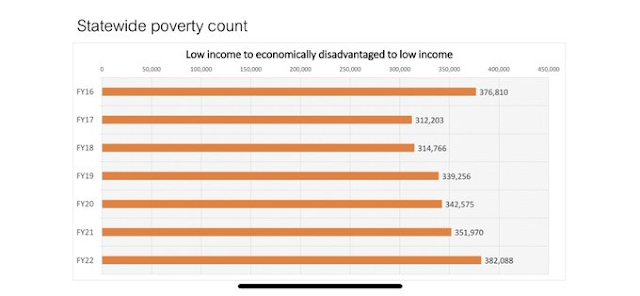
The Chapter 70 state aid recommendation is $5.9 billion, supporting a $12.8 billion foundation budget for K-12 education statewide. You'll note that this is less than half of it, which is by design; the foundation budget is designed to be funded 59% with local funds. The recommendation is a second one-sixth step towards the goal rates of the Student Opportunity Act, increased by inflation. That's in  the rates for the health insurance, special education out-of-district, English learners, guidance, and low income students. This also increases the assumed in-district special education enrollment to 3.86% (4.86% for vocational), towards the goal of 4% (5% for vocational). It does again use 12 tiers for low income students. The October 1 (2021) count on which this budget is based increased the statewide low income enrollment count by 25,413 students; some of that probably is additional students who are poor, but some of that is better recognition of what already was, as I've been tracking here: 


The calculation uses the 4.5% inflation rate cap of the Student Opportunity Act, as the actual inflation rate would be 5.9%, so, if that was your bet on what Baker would do, you won. The calculation uses 4.51% for inflation for health insurance, which is better than it has been. The budget holds districts harmless on funding—no district sees a drop in Chapter 70 aid alone--as well as a $30 per pupil minimum increase for districts, both of which are of course in the Student Opportunity Act. 

My quick look at some districts shows some real impact on that poverty rate growth kicking in. Orange, for example, made its way out of hold harmless and into foundation aid. Mohawk Trail ate through $1M of their hold harmless this past year. We're getting there!

The circuit breaker reimbursement increases in this proposed budget from $393 million to $414 million; there's another round of the phase in of transportation reimbursement again this year as part of the implementation of the Student Opportunity Act. 

Charter school reimbursement increases from $154 million to $219 million. There are three things going on here. The increases in charter school tuition stemming from the increases in the foundation budget must then be offset by reimbursement. The next step in the phase in to fully funding 100% of charter reimbursement is also in here. The state is funding the next step, which is 90%, though the actual text of the SOA says in FY23, it will be 100%. They're following the phase in by year. In outside section 40, the proposed budget adds a proposed increase to the charter school facilities per pupil increment to $1088, which then would be tied to inflation. As that funding flows through charter tuition coming from Chapter 70, it then also creates a need for reimbursement initially.

Regional transportation reimbursement, funded last year at $82 million, is proposed this year at $77 million. We sometimes forget, I think, that this is a reimbursement account; it's based on completed actual spending. Some of that drop here is reflecting the drop in transportation spending during remote learning in the year from which estimates are drawn. 

Homeless student transportation funding is proposed for a substantive increase “to meet need,” from $14.4 million currently to $22.9 million for FY23, which seems wise.

METCO, funded last year at $28.5 million, is proposed in the Governor’s budget at $27.9 million.

Targeted intervention services, budgeted this current year for $17 million, is proposed to be cut this coming year to $10.3 million. Similarly, after and out of school grants, budgeted currently for $17 million, is proposed to be cut to $10.5 million. Extended learning grants, funded at $9.9 million this year, is cut to nothing. The regionalization grant to likewise cut to zero.
...all of which is rather depressing. 

On the other hand, two of Baker's favorite projects, early college and vocational education, are proposed for grant increases. He proposes a substantial increase in the early college program, funded this year at $5 million, to $9.5 million. What had been the Innovation Pathways program, he renames “Career Technical Partnership Grants,” raising the funding from $600,000 to $4.8 million. 

And for reasons I cannot decipher, the Executive Office of Education--that is, Secretary Peyser's office-- more than doubles from $2.3 million to $4.4 million, “to meet projected need and support new initiatives." I have no idea what that means, nor can I find anything further.  


Monday, January 17, 2022

"We pauperize education": a letter to my delegation


“The richest nation on Earth has never allocated enough resources to build sufficient schools, to compensate adequately its teachers, and to surround them with the prestige our work justifies. We squander funds on highways, on the frenetic pursuit of recreation, on the overabundance of overkill armament, but we pauperize education." Dr. Martin Luther King, Jr. Speech to the United Federation of Teachers on receiving the John Dewey Award, March 1964

 To the members of the Worcester and Massachusetts delegations,

In the past week, thousands of students across the country, largely in urban districts including here in Worcester, walked out of their schools in protest of unsafe learning conditions. 
And those, of course, are just those who walked out, not all of those who feel this way. 

We have heard, over and over during this pandemic, that schools should be "the last things to close." That statement, however, continues to live in isolation, as there has not been a real policy in the United States or in Massachusetts that made other things the first to close. Thus schools have simply been ordered--and it is ordered, at this point--to open, without regard to what has been noted throughout the pandemic of the close tie with community spread and the intimate relationship schools have with all aspects of their community. There has been no community effort, let alone a state or national effort, to create the conditions and provide the resources in which schools can safety function in buildings during a pandemic. 

Likewise throughout the pandemic, there has been a significant lack of effort to close the gaping wound of racial health inequities which have continued through this time. Instead, the argument has been that children of color and in poverty most needed to be back in school buildings. This was well addressed this past week by Dr. Michelle Holmes, who in The Prospect wrote: 

It is curious to me that Leonhardt, Strain, Oster, and Bloomberg, none of whom are known as racial justice leaders, all now cite the disproportionate academic and social suffering of Black and Latino or low-income children as top reasons for in-person schooling, despite such disparities having been present historically. Nowhere in their arguments do they cite voices of color sharing their viewpoint. Also not evident are the voices of older people and those at high risk of exposure in their jobs.

As Dr. Tressie McMillan Cottom noted in her New York Times column this week: 

How we got here is a story about parents engaging with schools as consumers who want to extract the most school resources for their children. Mothers are the ones societally tasked with doing that extraction. A good mom gets the best learning plan, best teacher, best school, best activities and all-around “best” school experience for her kid. And a mom with the privilege of race and class gets to define the terms of what counts as best. 

This week alone, I heard firsthand of: 

  • a promising young elementary teacher who had to quit her job, as her young children kept having their childcare close due to COVID infections;
  • a number of combined elementary school classrooms, due to teachers and students being out due either to illness or to quarantine; 
  • students coming to school with known symptoms in order to be tested, as their families have no access to testing; 
  • students who didn't have a first or second shot because parents have not had the opportunity to get their children to a site, due to work obligations;
  • staff who are still deceived as to the nature of the vaccine; 
Students continue to be concerned that they will miss work if they miss school. Teachers are torn between attempting to continue to cover skills and material and leaving myriad children who are absent well behind. Administrators open every day scrambling to ensure that students are at least supervised during the course of their day. Parents are continuing to send students to school because the national message has been that the 'pandemic is over,' and thus there is no provision for them to stay home with sick or isolating or quarantining children. Everyone in district leadership knows we don't have enough bus drivers, or school nutrition staff, or nurses, on an average day, and that we are dangerously burning out those we have. 

I know of no one in my city, state, or country who has the sort of easy access to testing that guidance assumes: at home tests are hard to find and not cheap; PCR tests require taking time during the workday to stand in line. Neither of these is achievable for many. 
I know of far too many people who are not vaccinated, some of whom are are staff, many of whom are our students. I am exhausted by those who have cars and flexible time and access to health care and speak English as their first language who say that there is no excuse. When you are juggling three jobs in a country that pays little mind to your language or your health, when you don't have a car and have unstable housing and access to food, then perhaps we can discuss who has 'an excuse' at this time. 
Omicron has made it necessary to upgrade masks for those in spaces with limited circulation and other people (that would be schools), which has set off a mad scramble for parents who can afford to upgrading masks for kids, a handful of districts making their own arrangements, and yet another illustration of health and safety coming back to resources. 
And we simply cannot run schools without people. 

It is the responsibility of both the state and the federal government to provide for the health of its inhabitants. This is absolutely part of promoting the general welfare, as the U.S. Constitution provides, and the Massachusetts Constitution is even more explicit in the commitment: government is: 
to furnish the individuals who compose it with the power of enjoying in safety and tranquility their natural rights, and the blessings of life:

When we are continuing to so poorly fighting a pandemic that has taken the lives of 850,000 Americans, nearly 21,000 of them in Massachusetts, I would assert that we who take an oath to uphold and defend these documents are not doing our jobs.  

While I have perhaps grown accustomed to the lack of care for such issues by the state's executive branch, I confess that I have been puzzled to see what seems a similar attitude by the year-old federal administration. Justin Feldman's analysis of the Biden administration's response to the pandemic, posted last week, gave some much needed perspective. This, together with Daniel Boguslaw's piece in The Prospect looking at the leadership appointed at the federal level, well frames the lacks we have faced as a country. 

The argument has been "districts have plenty of money" due to the three rounds of ESSER funding. I would never wish to be seen as ungrateful, but it is the case that the rounds of federal funding don't provide anything close to the needs. As Jess Gartner of Allovue, among others, has been at pains to note, the total of ESSER funding represents about a 6% supplement to all K-12 spending over the life of the grants:

And even with money, there are things that the over three hundred districts of Massachusetts should not be having to sort out individually.

  • Everyone needs tests, and not just four from the federal government or two for teachers coming back from the state. If we are to base our actions on real knowledge, then anyone needs to be able to test as needed. We know this can be done, as its being done in other countries. The kinds of testing that require staffing--whether that's the public PCR testing or the schools pool testing--cannot be left to current staffing level. More support and access is badly needed.
  • Everyone in buildings needs masks, and they need good masks to protect against omicron. We cannot simply push this cost off to families of staff and students as well. There is no excuse for the back and forth about testing of masks given teachers, and we apparently could have been making them locally, to boot.  
  • The discussion around ventilation has demonstrated an enormous amount of ignorance of school buildings from those who should know better. I would suggest, however, that the state and federal government's substantial buying power could appropriately be applied to portable air filters for any school that doesn't have a system that runs MERV 13 filters already (which I am guessing, given what I know of local buildings, would be nearly anything not built or renovated in the past five years or so). Among other things, that would keep staff and students warmer in a Massachusetts January.
  • The inflexibility around local conditions that leaves superintendents negotiating safety measures with the Commissioner is a massive state overreach, as I have noted in the past, and it should be called out as such. It is simply not safe to have a single arbiter of school safety who has incredibly limited district level experience making the call for every district in the state. 
  • We cannot run schools without staff. We cannot run schools with sick staff. If the federal and state government mean to keep kids in school buildings, then they must live out what we have known from the early days of the pandemic and CLOSE THINGS THAT ARE NOT SCHOOLS. That means, please note, supporting those people who are impacted by closing other things. There is no reason and no virtue in pursuing a 'normalcy' that continues to kill people, do lasting harm to student health, and does not, in the end, actually keep schools open. 
As I said about this pandemic early on, if you had asked me to guess how Massachusetts would do at responding to a pandemic, I would not have dreamed that it would look like this. As a lifelong resident, as a parent, as an elected official, I believe it when I say that we are "a Commonwealth." We are not, now, acting like one. 
Both Massachusetts and the United States can and must be better than this.
Thank you, as always for your attention to this matter.
Tracy O'Connell Novick
Worcester School Committee