I'm under the weather, so this one is coming to you remotely...
The agenda is here; the livestream is here.
DESE has extended the embargo of assessment and accountability results until 11 AM today.
I'm under the weather, so this one is coming to you remotely...
The agenda is here; the livestream is here.
DESE has extended the embargo of assessment and accountability results until 11 AM today.
As I noted on Wednesday, Governor Healey has filed her proposed FY27 budget; as this is the second year of the legislative term, this is "House 2," as she files the bill with the House.
As per usual, I'm keeping a running "account-by-account" for K-12 over here. This year, I honestly started by downloading this page from the state website and then playing with it; you might also find that useful.
As always, dear readers, I post here for me and for you and in an entirely unofficial capacity.
I think the big story here is one Sam Drysdale at State House News Service caught and covered and then...no one picked up their coverage, as best as I can tell, so it is (sigh) only behind their paywall1.

Governor Charlie Baker released his recommended House 2 FY23 budget on Wednesday. The full budget totals $48.5 billion.
Remember, it's House 2, because it is filed as a bill with the House; it is (bill #)2 because it is the second year of the Legislative session. Last year was House 1.
I tweeted out an account by account look on Thursday and Friday. I have also put all the education accounts into this spreadsheet, which I will update over the course of the state budget process. I won't go through all of the accounts here, but I'll hit some highlights.
The Chapter 70 state aid recommendation is $5.9 billion, supporting a $12.8 billion foundation budget for K-12 education statewide. You'll note that this is less than half of it, which is by design; the foundation budget is designed to be funded 59% with local funds. The recommendation is a second one-sixth step towards the goal rates of the Student Opportunity Act, increased by inflation. That's in the rates for the health insurance, special education out-of-district, English learners, guidance, and low income students. This also increases the assumed in-district special education enrollment to 3.86% (4.86% for vocational), towards the goal of 4% (5% for vocational). It does again use 12 tiers for low income students. The October 1 (2021) count on which this budget is based increased the statewide low income enrollment count by 25,413 students; some of that probably is additional students who are poor, but some of that is better recognition of what already was, as I've been tracking here:
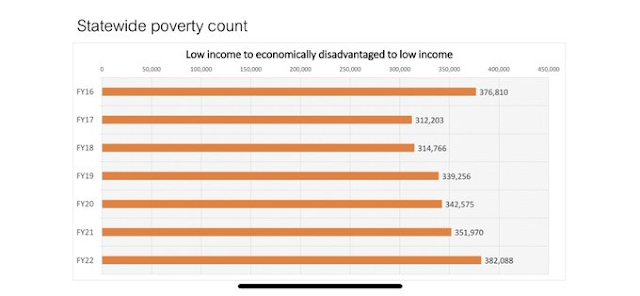
My quick look at some districts shows some real impact on that poverty rate growth kicking in. Orange, for example, made its way out of hold harmless and into foundation aid. Mohawk Trail ate through $1M of their hold harmless this past year. We're getting there!
The circuit breaker reimbursement increases in this proposed budget from $393 million to $414 million; there's another round of the phase in of transportation reimbursement again this year as part of the implementation of the Student Opportunity Act.
Charter school reimbursement increases from $154 million to $219 million. There are three things going on here. The increases in charter school tuition stemming from the increases in the foundation budget must then be offset by reimbursement. The next step in the phase in to fully funding 100% of charter reimbursement is also in here. The state is funding the next step, which is 90%, though the actual text of the SOA says in FY23, it will be 100%. They're following the phase in by year. In outside section 40, the proposed budget adds a proposed increase to the charter school facilities per pupil increment to $1088, which then would be tied to inflation. As that funding flows through charter tuition coming from Chapter 70, it then also creates a need for reimbursement initially.
Regional transportation reimbursement, funded last year at $82 million, is proposed this year at $77 million. We sometimes forget, I think, that this is a reimbursement account; it's based on completed actual spending. Some of that drop here is reflecting the drop in transportation spending during remote learning in the year from which estimates are drawn.
Homeless student transportation funding is proposed for a substantive increase “to meet need,” from $14.4 million currently to $22.9 million for FY23, which seems wise.
METCO, funded last year at $28.5 million, is proposed in the Governor’s budget at $27.9 million.
Targeted intervention services, budgeted this current year for $17 million, is proposed to be cut this coming year to $10.3 million. Similarly, after and out of school grants, budgeted currently for $17 million, is proposed to be cut to $10.5 million. Extended learning grants, funded at $9.9 million this year, is cut to nothing. The regionalization grant to likewise cut to zero.
...all of which is rather depressing.
On the other hand, two of Baker's favorite projects, early college and vocational education, are proposed for grant increases. He proposes a substantial increase in the early college program, funded this year at $5 million, to $9.5 million. What had been the Innovation Pathways program, he renames “Career Technical Partnership Grants,” raising the funding from $600,000 to $4.8 million.
And for reasons I cannot decipher, the Executive Office of Education--that is, Secretary Peyser's office-- more than doubles from $2.3 million to $4.4 million, “to meet projected need and support new initiatives." I have no idea what that means, nor can I find anything further.

Section 3B. The department of elementary and secondary education shall make available to school districts a form to certify family income level for the purpose of calculating low-income enrollment. A school district may choose to have its low-income enrollment established through collection of the forms or through a direct certification system established by the executive office of health and human services, which may include the virtual gateway system.What does that mean? It means that districts can choose to use direct certification (as we do now) OR that districts could use a form to certify family income. Essentially, it allows districts to choose how they count poor kids.
Section 16 shall apply in fiscal year 2020. The department of elementary and secondary education shall provide school districts with the family income certification form described in section 3B of chapter 70 of the General Laws within a reasonable time prior to the low-income enrollment count process for the purposes of calculating chapter 70 aid in fiscal year 2020....so this isn't for this year but goes into effect next fiscal year (so the state would have to work on this during the coming year).
Not, let's say, a triumph for public process. Among other issues, this got us a IIA report, which puts the numbers and account numbers in a spreadsheet, which included only the House numbers, not the conference committee numbers (causing some of us not a small degree of angst!).7 hours and 56 minutes from release to enactment. #mapoli https://t.co/5JOFwHQzcS— Katie Lannan (@katielannan) July 7, 2017
Education
I am passionate about improving the quality of our public schools. Accountability and high standards are paramount. I support choice through charter schools, as well as the MCAS exam as a graduation requirement. I have worked to ensure that all children have access to a quality education. I am a strong advocate for the METCO program, which provides lower income students with broader educational opportunities.

