The Board today is meeting at Hudson High School, the school of student member Isabella Chamberlain. The agenda is here; the livestream will go up here.
 |
| chalking outside of Hudson High School today |
There is a good chance this will start late.
The Board today is meeting at Hudson High School, the school of student member Isabella Chamberlain. The agenda is here; the livestream will go up here.
|
| chalking outside of Hudson High School today |
There is a good chance this will start late.
The Board of Ed has their regular April meeting today beginning at 9 AM. The agenda is here; the livestream will come up on their channel over here.
 |
| flowers in downtown Boston yesterday |
Today is the first meeting at which the new Secretary, Steve Zrike, will be present in that capacity. As a reminder, Zrike was Salem superintendent, though most of his appearances at the Board of Ed previously were in his prior-to-that position as Holyoke receiver. As an offhand observation, today is the eleventh anniversary of the Board voting the Holyoke Public Schools into receivership; I don't know if there's a balance to that or not.
Also as a reminder, the Secretary is a single member and a single vote on the Board of Elementary and Secondary Education (as well as the two other education boards, Early Ed and Care, and Higher Ed), serving at the pleasure of the Governor, who appoints him*
I will update this post as we go
 |
| ahem... |
I hope by now you've seen that the Fair Share amendment, which taxes at 4% on every dollar over a person's first $1M in income, has far exceeded expectations. As noted back in May:
Massachusetts has collected about $1.8 billion from a voter-approved surtax on the state’s highest earners through the first nine months of the fiscal year, the Department of Revenue said Monday in a quarterly report.
That’s more than $800 million more than what the Legislature and Gov. Maura Healey planned to spend in surtax revenue for all of fiscal year 2024, raising the possibility of a sizable pot that will land in an Education and Transportation Reserve Fund and the Education and Transportation Innovation and Capital Fund, both surtax specific accounts, once the books close.
Remember, unless you've made a million plus at least a dollar in income? You are not paying this. And if you made a million plus a dollar, you're only taxed the extra 4% on that one additional dollar.
I've seen some confusion about this, so I thought I'd clear up a few things.
First, the above money doesn't get spent until next year; this is a reserve fund, so the funding goes in and sits until the total is determined by the state comptroller in December. It's pretty clear, though, that the state's been conservative with projections, and this is one where we do really want to spend the money that's coming.
Second, this is funding--like most in the state--that's allocated by vote of the Legislature, signed by the Governor. There isn't some sort of formula where everyone gets some of this. I've heard districts ask how they can apply, or if it's being allocated evenly...that isn't how this works at all. The Legislature decides on what, within transportation and education, they want to spend the money on, and that's where it goes.
Funding was allocated in this year's budget from last year's Fair Share collection. Again, there is a very good chance that you are not personally paying for this--these efforts are not increasing your taxes!--but we as state residents are benefiting!
Johnston: educational vision and how it relates to early college and literacy launch
For those who might not want six and a half hours worth of liveblogging. Note the video of the hearing is here. Crossposted from MASC
Last night was a LOT, and with two members having commitments as parents and it being the mayoral holiday rounds, we ran part of the Committee with just a quorum, which is unusual!

That's why, oh committee watchers, I was chairing; in the absence of both the chair and the vice-chair, the senior member chairs (and then hands off sequentially, which is why Molly McCullough chaired when I was speaking).
Also, it appears the T&G is going to do a terrible job covering this meeting, so I guess it's up to us again.

On Thursday the 7th, we had our first meeting of the school year. You can find the agenda here; the video is posted over here.
Headlining the night (I'd say) was the Superintendent's opening of school report. While the slides start on page 55 of the agenda, as above, I recommend watching that section if it is of interest; it starts about an hour and 7 minutes into the meeting. Note that the statistics there on staff hiring are related to the introduction of new assistant principals and others that happened earlier in the meeting.
Because I know we've already had our first run-in with exposure this school year in my family, so I assume we're not alone, here's the current COVID protocols:

Transportation Department Recognized for Successful Move to In-House Operations
— Worcester Schools (@worcesterpublic) September 8, 2023
The Worcester School Committee recognized the Transportation Dept. for receiving a state award at Thursday's meeting; WPS is receiving a national award this fall.
Read more: https://t.co/RGoKoLMIhx pic.twitter.com/qXnodB6qpS
There'll be another one of these, this time national, in November!
there is a backup here
established in 2018/19 school year
now 48 designated programs; 58 high schools
projecting 8200 students across the state
early college students succeed in college at a higher rate despite earlier academic levels
they're now listing the new ones which is a lot but mind-numbing to listen to
grants from DESE using ESSER funds
...what we aren't getting: any data on outcomes. or intakes
There are zero statistics being offered of who is in these programs, what the demographics are, and what is happening to the students who graduate from them.
But we're expanding like topsy.
Canavan: ESSER going away: any plans?
A:Yes; notes legislature has been generous (but those are also grants)
West: what are the cost?
A; five year cycle grant
plus $180/credit (which we know isn't enough)
Have estimated $1000 a year for students
Moriarty: outcomes, look forward when work is done
think first or second cohort have had a chance to earn a bachelor
A; third year of college for first cohort
Moriarty: impact on families
A: looking ahead, data to analyze
Moriarty: talk about onramping
A: students go through MCAP (?), provide tutoring for students
"My College and Career Academic Plan"
Rouhanifard: how many whole school models?
A: Five?
also larger high schools may have both two and four year partners
Rouhanifard: what does a typical day look like?
A: autonomy in making it work for the high school
Scheduling is a major stepping stone
built-in time for transportation is a requirement
huge variency
academic supports built into college coursework over course of week
Moriarty: thinks of his work on this "as happy time"
"Good stuff without the bad stuff"
"complex but sort of simple"
"it's almost inspiring...the way government is supposed to be working"
Craven asks Tutwiler for thoughts: "We go as far and as wide as we can"

Governor Healey's proposed FY24 state budget--known as "House 1," as it is the first year of the Legislative session--was released last Wednesday. As has become my custom, I'll be tracking the state budget education accounts in a spreadsheet which I am sharing here.
House 1 fulfills this year's obligation regarding implementation of the Student Opportunity Act. That is, should the chapter 70 proposal pass as written, the state will be 3/6th of the way to the targets in the SOA (plus inflation) as passed in 2019. Chapter 70 is budgeted at $6.5 billion for FY24.
Naturally--because math!--this means we have the highest amount of chapter 70 aid in history!
A few things to note on Chapter 70:

I'm coming back here after a bit of this to say: we are not operating from a common understanding of what gifted and talented even is, and this presentation is a very clear demonstration of that. It's all over the place.
Riley: maximize potential for all of our students
Department is hiring for this, but he suggests that this should perhaps be part of a larger conversation about meeting the needs of all students
and now the Lawrence High School theater troupe is performing
Regina Robinson, Deputy Commissioner presenting
"centering equity"
whose voice is heard, who's going to benefit, who is going to be most burdened
Thomas Zorich, center for strategic initiatives
will be turning to school level presenters
continuum K-12
Stacey Ciprich, Abbott Lawrence Academy
Lawrence High School had 6 separate high schools when entered receivership
receivership changed that model
Abbott is is an accelerated studies program
priority: rigorous academic instruction, robust enrichment, partnership with families
Cambre Santos-Tavares: now a Spanish teacher, graduate of Abbott in its first year
graduated with a year and a half of college credit
tools for being successful in life
junior class vice president Maya Salazar
wanted to be challenged while still doing things like theater
build really close relationships with teachers; teachers not interrupted
talent in our school
"has made me believe in myself in many ways"
students are required to do 25 hours of community service by the time they graduate; and must participate in at least one sport or extracurricular
early college partnership with Merrimack College
put students in a college-level biology class "when they had never even been in a high school biology class"
Ciara Sem, junior at Abbott, speaking about early college
preparing us for the future in keeping up with pace and balancing requirements
"have learned so much and have done so much"
MCAS and AP results
Craven says this is a great example of how receivership works and that the Lawrence School Committee never would have created this
Q on admission: a committee that considers admissions
entrance exam, essay, short answers, recommendations from middle schools
average of about 1 in 3 admissions (250 to 300 applications a year for a class of 100)
Research Questions:
What are current practices and policies
What is known about academic practices
looking at available data: "MCAS is not an assessment of gifted students"
biggest dropoff is between third and fourth grade
top 10 or so percent over fifth and sixth
West notes that the norm is that not all would stay, in any case (good point!)
Hills: percentage of students at end point? (to West who agrees)
"excellence gap" is differences between subgroups performing at the highest levels
Massachusetts has some of the highest excellence gaps for low income students
Social emotional well being of advanced and gifted students via survey
Black and Hispanic students reported less positive school climates, less support
students with disabilities reported less positive climates, lower engagement, less support
which I would think is universally true
and now we have a remote presentation from Center for Talent Development
"implementation of evidence-based practices"
"a continuum of services"
Talent development happens over time and student needs vary
each child receives "a challenging and enriching education"
we now have a crosswalk that these out of state remote presenters have created of the Massachusetts MTSS model with their "continuum of services" model
This is a mesmerizing waste of time of a presentation.
some students we don't know are gifted until they have things that make them interested
Eric Plankey sees overlap with student interest in vocational educational: students with high interest are those who should be getting in
Moriarty: MTSS, early literacy; concept can transfer to gifted and talented
Stewart: family engagement
so all of that took two hours. Then they took a half hour plus break. Then they came back.
Then they did this for another hour. I do not have the will to summarize another hour here.
@worcesterpublic educators are displaying their talents tonight 6-9 pm. Come by and be amazed. #educatorsrock #talent pic.twitter.com/CSWbiI91kE
— Rachel H. Monarrez, PhD (she/her/ella) (@drrmonarrez) November 11, 2022
Are you following Dr. Monárrez on Twitter?
from the weekly updates to the School Committee:
Riley: "while the Department historically has been one of compliance, enforcing mandates, both federal and state" has argued since his arrival "that we at DESE need to play a more supportive role with our districts"
think the goals reflect that thinking (presentation here)
also think the Department needs to decide "if we're going to continue to be a kind of counting and a mirror organization or are we willing to jump in and support our districts"
wait, how are those two different things?
Strongly recommending move towards support
four themes:
• Provide Supports to Accelerate Student Learning
"this is shifting away somewhat from that compliance role"
early literacy, acceleration academies, deeper learning, early college, IEPs and English learners
• Build a Diverse and Culturally Responsive Workforce
"research proven to be effective for children"
• Cultivate Safe and Healthy Learning Environments
mental health "students came back from the pandemic often disregulated, often with challenges"
that includes mental health, food, housing
• Align DESE Supports to a Shared Academic Vision of Deeper Learning
"a vision for where we're going with this Department"
Peyser: "this are ambitious goals, and these are the right ones"
balance essential "with areas of improvement"
would suggest--"I was going to say 'add,' but I don't want to add to an already long list"--is early college (which Riley just said under student learning)
would add career pathways
strengthening career pathways
"think of that in point four of the first point"
"the 25 percent growth...ambitious...would include innovation pathways and the after dark vocational programs"
existing programs are already growing as well
h/t to Secretary Peyser for demonstrating up to the end here that the Baker administration has been only early college and very specific aspects of vocational
Riley: were talking about students in high school being disengaged prior to the pandemic
"this idea that students are ready to do more...resonates with me"
Peyser: early college, strengthening Department's capacity to manage it
"don't want to lose sight of something that's really something internal"
Stewart: visioning exercise
really looking forward to having them share their vision
strategic plan: data being collected educator preparation programs
look at everything being proposed here: has to be "sauce that pulls everything together...and that's family engagement"
just want to see more of that
Riley: going to be talking about that on Friday
Mohammed: curious: how will you know over the course of the year where you are?
What kind of targets do you have?
"is there some kind of dashboard" that provides where you are
Riley: most of these goals are measurable
we can find a way to distill those and capture those for this Board to understand
West: thoughtful document, appreciated foregrounding accelerated student learning
sometimes you have an overarching goal with others in service of it
didn't see included anything on the changes in the competency determination process
"hope that's on your radar screen as well"
Riley: can expect we will adhere to the regulations as we begin to roll this out
important to hear from districts themselves in how it is rolled out
Lombos: glad to see diverse and culturally responsive workforce
interested in how we get to tried and true data-proven ways for students of color to improve
culturally responsive and inclusive curriculum is another way
Riley: focus on data to serve all our students better; "see what is most impactful"
"prior to five years ago, we didn't understand that there was a relationship between teachers of color and student performance and we're probably the only state that's focusing on this right now"
that is entirely not true, but it is troubling that he would think that; does he pay so little attention to what other states are doing?
These are the "kinds of data nuggets that we're looking to recover"
Canavan: what are the levers we could pull or push to have the greatest results?
had seen data that was even more granular than (what was just presented)
wonder as we highly these bullet points "to really really push on absenteeism"
really effectively move the needle on
how is the state going to move the needle on that?
Riley: for the first time, many families have children who were chronically absent "through no fault of their own"
"this is something...we're going to keep pushing out to parents and out to the public"
"kids that for whatever reason were caught up in COVID protocols missed more days of school"
(some of them got caught in COVID? itself?)
Canavan: "I had a kid who missed ten days of schools, because at that time the protocol was staying home for ten days...you could get super unlucky and be exposed multiple times, but is the lack of luck...anecdotally there seems to have been a shift in attitudes about attendance...COVID itself has been a huge driver of absence, but COVID has also been a driver in people getting used to not being in school as much"
Hills: was struck by the comprehensive nature of the goals in the memo when I read it
liked the comprehensive nature of what you were trying to do
set some expectations as part of a final document for a year from now what this Board should expect to see
resource conversations with the Governor and the Legislature
"Set our expectations given what we're seeing"
Riley: state ed departments move at "a more ponderous pace"
saying we need to move "more urgently...also be able to pivot if need be"
Three quick notes on Tuesday's Worcester School Committee Standing Committee on Teaching, Learning, and Student Supports meeting which is at 5:30:

The Board of Ed meets at 9; the agenda is online here.
There's been much online discussion of the Commissioner notifying Boston that he's doing another review. This has been--again, online--been seen as a step toward state receivership (which I am much less sure is accurate), so expect to see public testimony on that. However, NOTHING ABOUT BOSTON IS ON THE AGENDA TODAY.
updating as we go
Craven: gratitude to National Guard, MEMA, and Other Partners (first item on the agenda)
speaks about Springfield "a great shining example" of the state cooperating with districts
"knowing that we've turned the corner" on the pandemic (what?)
Reilly: board has asked for a meeting to update on Boston (Two year anniversary)
Cassellius has made significant progress: MassCore, bathroom upgrades
concern about special education, English learners, on time bus arrival data, graduation data
"not on the agenda today" but later this spring
meeting with superintendents later this week
Peyser: eight new early college programs
up to fifty statewide
STEM summit on April 28; online, in person, mostly the morning
supplemental budget: note $140M to Ch. 766 special ed schools to support workforce to maintain capacity and staff
Craven: haven't had a joint meeting with Higher Ed in two years; want to have one before the end of the fiscal year
Public comment:
Mayor Michelle Wu: notes her position as both the Mayor and as BPS mom
thanks to partnership
see DESE's review as progress we've made as well as places for follow-up
lifting up young people across state and city
"I have seen firsthand dedication and commitment to achievement"
commitment of our families and educators
have seen places where we fall short
"we must do better"
tomorrow Boston School Committee takes up budget
pushing for a "whole of government approach"
notes work of city in "what ends up showing up in our schools and classrooms"
excited to work on search for superintendent
"It is with all of this in mind that I firmly oppose receivership"
would be counterproductive
Councilor Julia Mejia
"good morning, everyone: y'all ready for this?"
humbling to be back as chair of education, as have come as a parent in the past
conversation is as much person as it is professional
stood alongside parents in Holyoke opposing receivership "and we all know the outcome of this"
"every single time that we advocated for dollars we were met with opposition"
receivership "is the wrong move"
has voted to place three districts in receivership
Southbridge and Holyoke worst and second worst performing
Lawrence, following an uptick, is now in the lowest ten percent
wrong time when 77% of voters are seeking an elected school committee
"that kind of thinking lacks innovation and intentionality"
show what is possible "when we lean into discomfort"
"let's all take responsibility and accountability around this"
Marcela Sliney speaking about her son who has dyslexia
asks for help for students across the state
Lisa Guisbond on update on accountability
call on you to stop the harm caused by your current inaccurate rating system
Vice-chair of the Lawrence School Committee Jonathan Guzman
here to oppose putting another district into receivership
strip rights of own elected body that support the needs of the people
"why do you still think that takeovers are saving...when you've been in control of the Lawrence Public Schools for ten years"
all have made a commitment to be anti-racist, but to do so must first show some respect for communities of color
current back in bottom 6% of districts
invest in teachers year after year, can get a job in a community with higher pay and better working conditions
Students passed from grade to grade with attainment; standards lowered
Greater Commonwealth Virtual School Board member Jennifer Reynolds on renewal recommendation
Salah Khelfaoui, executive director
"do our best to offer" students what they need
students who in some cases choose to go back to their schools
Patrick Lattuca, superintendent of TEC Academy also speaking on renewal
Jessica Tang, BTU President
educators and families on the ground are increasingly concerned about discussion about receivership
upends teachers' plans to have this second audit
further frightens families and staff
"receivership cannot and should not be part of any BESE conversation" if your goal is to support the Boston Public Schools
citing experiences of those who have experienced school-based receivership
parent is now giving testimony
notes inaccessibility of meetings of the Board
Packets sharing data on why receivership isn't the answer
Samantha Laney: fifth grade teacher
now teaches in Boston, did teach in Lawrence under receivership
"keeping high needs students out keeps test scores up"
says she had no business being in Lawrence as a young white teacher who was new
turnaround DESE seeks doesn't work
notes vote of Boston for elected school committee
"will we not allow Boston to suffer the same fate as our sisters in Lawrence"
Secretary Peyser is allowed to then give a small lecture responding to public comment
Riley notes this is not on the agenda
Craven pushes him to give timelines and such; Riley continues to note that this is not on the agenda
Lombos wants to know about timeline; Riley says he doesn't have it in front of him.
Governor Charlie Baker released his recommended House 2 FY23 budget on Wednesday. The full budget totals $48.5 billion.
Remember, it's House 2, because it is filed as a bill with the House; it is (bill #)2 because it is the second year of the Legislative session. Last year was House 1.
I tweeted out an account by account look on Thursday and Friday. I have also put all the education accounts into this spreadsheet, which I will update over the course of the state budget process. I won't go through all of the accounts here, but I'll hit some highlights.
The Chapter 70 state aid recommendation is $5.9 billion, supporting a $12.8 billion foundation budget for K-12 education statewide. You'll note that this is less than half of it, which is by design; the foundation budget is designed to be funded 59% with local funds. The recommendation is a second one-sixth step towards the goal rates of the Student Opportunity Act, increased by inflation. That's in the rates for the health insurance, special education out-of-district, English learners, guidance, and low income students. This also increases the assumed in-district special education enrollment to 3.86% (4.86% for vocational), towards the goal of 4% (5% for vocational). It does again use 12 tiers for low income students. The October 1 (2021) count on which this budget is based increased the statewide low income enrollment count by 25,413 students; some of that probably is additional students who are poor, but some of that is better recognition of what already was, as I've been tracking here:
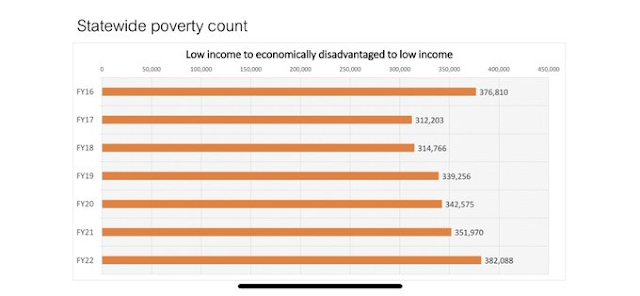
My quick look at some districts shows some real impact on that poverty rate growth kicking in. Orange, for example, made its way out of hold harmless and into foundation aid. Mohawk Trail ate through $1M of their hold harmless this past year. We're getting there!
The circuit breaker reimbursement increases in this proposed budget from $393 million to $414 million; there's another round of the phase in of transportation reimbursement again this year as part of the implementation of the Student Opportunity Act.
Charter school reimbursement increases from $154 million to $219 million. There are three things going on here. The increases in charter school tuition stemming from the increases in the foundation budget must then be offset by reimbursement. The next step in the phase in to fully funding 100% of charter reimbursement is also in here. The state is funding the next step, which is 90%, though the actual text of the SOA says in FY23, it will be 100%. They're following the phase in by year. In outside section 40, the proposed budget adds a proposed increase to the charter school facilities per pupil increment to $1088, which then would be tied to inflation. As that funding flows through charter tuition coming from Chapter 70, it then also creates a need for reimbursement initially.
Regional transportation reimbursement, funded last year at $82 million, is proposed this year at $77 million. We sometimes forget, I think, that this is a reimbursement account; it's based on completed actual spending. Some of that drop here is reflecting the drop in transportation spending during remote learning in the year from which estimates are drawn.
Homeless student transportation funding is proposed for a substantive increase “to meet need,” from $14.4 million currently to $22.9 million for FY23, which seems wise.
METCO, funded last year at $28.5 million, is proposed in the Governor’s budget at $27.9 million.
Targeted intervention services, budgeted this current year for $17 million, is proposed to be cut this coming year to $10.3 million. Similarly, after and out of school grants, budgeted currently for $17 million, is proposed to be cut to $10.5 million. Extended learning grants, funded at $9.9 million this year, is cut to nothing. The regionalization grant to likewise cut to zero.
...all of which is rather depressing.
On the other hand, two of Baker's favorite projects, early college and vocational education, are proposed for grant increases. He proposes a substantial increase in the early college program, funded this year at $5 million, to $9.5 million. What had been the Innovation Pathways program, he renames “Career Technical Partnership Grants,” raising the funding from $600,000 to $4.8 million.
And for reasons I cannot decipher, the Executive Office of Education--that is, Secretary Peyser's office-- more than doubles from $2.3 million to $4.4 million, “to meet projected need and support new initiatives." I have no idea what that means, nor can I find anything further.
Today's Board of Ed meeting, coming to us (change of venue) from 1 Ashburton Place, starts at 9:30 am. The agenda is here. The livestream will be here.
really choppy connection here today...missing large parts of what people are saying...after five restarts, we just jumped to what I assume is current in the meeting with a woman talking about a universal remote learning option during public comment
Commenter says her daughter's just been approved for home and hospital
school ventilation and distancing not possible everyone
children under 12 need time to be vaccinated
was so excited about children going back to school after last year being remote
watched as rates rose, safety protocols made optional
"We aren't asking for forever; we're just asking for remote options until vaccines are widely available for children under 12"
"asking for ability to keep our children safe"
"all students have to be alive to be learning"
Commenter speaking about "normal childhood" being denied children
mitigation "no longer necessary"
policy must be made on "costs versus benefits"
encourage looking at data in other countries (erm, wow. Hospitalization rates in the UK right now?)
Commenter on MCAS
"they are who they are and ready to learn what they need to learn next"
"system is not adapting to where the kids are and what they need to learn"
Better information about where students are achieving; adaptive assessments can do that; the current MCAS can't
Moriarty asking for information about ventilation systems across the districts
Riley: ESSER dollars, district responsibility to set up
another welcome to the new student member Eleni Carris Livingston of Wellesley
Peyser talking early college and STEM week
election of Board Vice Chair: nomination of James Morton (again)
elected unanimously
Riley on reopening: round of thanks for reopening
now doing multiple rounds of COVID data
He...really just spoke of requiring masks as a "difficult decision"
I'm also just going to note that so far I think all of these charts go up at the end
vaccines varied across the state; Chelsea singled out for having 81% of 16-19 year olds vaccinated
"we think the best place for kids is at school"
testing program
looking at needs of kids who have medical needs
kids qualified for home and hospital can be remote; individual remote bundles for remote students via virtual schools
National Guard help kids get to school "especially our special needs students"
173 drivers ready for service; currently in eight districts, more to come
test and stay program
"as one of the first penguins out of the gate" on test and stay
"with local control we were undermined by a few factors" on going back at three feet last year
he just listed mental health and suicide, as well as what I assume is a reference to MCAS scores as a result of districts being remote
WE HAVE HAD A FREAKING PANDEMIC
MCAS in sum: Drops all over the Commonwealth, so not an opening of new gaps
Rouhanifard: high rates of vaccinations in state, mask not hill to die on
argues that we don't need to vaccine children to lift restrictions
Livingstone: distress and difficulties that adults in children's lives are having
encourage social and emotional supports for staff and families
resources to support faculty
Stewart: families and students and schools "a time to heal"
Has to be something that happens that's different
can't assume we go back to "some kind of normal"
She cites Neema Avashia's piece
Morton: effecting Black and brown children differently
"while I want to be optimistic, I want to be cautious"
want to know how Black and brown children and communities
"we during public comment heard two different stories, and that concerns me, that we're hearing two different stories"
our low income communities and our Black and brown communities are not
Moriaty: high needs special needs students and families "fell into a hole"
how much provision of compensatory services for those who have turned 22 since March 2020
The agenda is here. The livestream will come up here. Updating as we go
we appear to be coming in partway through some public testimony which seems to be a parent arguing that her school building should be open
"We simply have to change our mindset when it comes to risk tolerance."
Next on music in schools: Foxborough parent
music programs provide much for students: "why they come to school each day"
not an even playing field: sports are resuming, so music should be able to practice inside, too
Superintendent Lynch of Whittier Tech
ongoing engaging collaboration with the Department "to work together to increase the access to all students"
increasing access for ALL students
awareness gap among students: would welcome chance to present data of parent and student survey
Charter school: association speaking in support
spells out what charter schools have been doing: food, wifi, financial support
Education Law Task Force
supports conditional renewal on UP Academy given history
recommend language should be parallel to that of Roxbury Prep
"exclusionary disciplinary policies" of concern
ask also that the education be improved by an independent authority doing the review called for
Boston Green Academy speakers (up for renewal and report on probation; it's a Horace Mann)
invested heavily in improving areas of concern
improved academic performance in strategic plan
ask that the Commissioner's recommendation be approved
Have resolved all concerns from previous reports
"share the Department's desire" for continued improvement
Chair's report from Craven:
Early College joint committee (with Higher Ed) met
a convert to this
pathways for becoming an educator
allowing new districts to come in this year
Peyser: seeing early college succeeding at scale so far
collaborative work with Early Ed: strengthening remote learning and ongoing collaboration during the summer and beyond
Commissioner will speak on reopening
(a)The commissioner shall establish statewide targets for addressing persistent disparities in achievement among student subgroups in the aggregate and within subcategories, including, but not limited to, subject matter and relevant grade levels. The targets shall include annual benchmarks on the progress expected to be achieved in the aggregate and by subcategory.The sequence thus is supposed to be:
(b) Each district shall establish targets for addressing persistent disparities in achievement among student subgroups consistent with the targets established by the department. Each district shall develop an evidence-based 3-year plan to meet its targets. Each district’s plan shall be developed by the superintendent in consultation with the school committee and shall consider input and recommendations from parents and other relevant community stakeholders, including but not limited to, special education and English learner parent advisory councils, school improvement councils and educators in the school district.
1. Intentionally focus on student subgroups who are not achieving at the same high levels as their peers;The plan descriptions also focus on "doing a few things well" and "focus on implementation."
2. Adopt, deepen or continue specific evidence-based programs to close opportunity and achievement gaps for student subgroups and allocate resources to support these programs;
3. Monitor success in reducing disparities in achievement among student subgroups over three years with a small number of metrics and targets; and
4. Engage families, particularly those families representing student subgroups most in need of support, about how best to meet their students’ needs.
a historic opportunity for Massachusetts to propel our state to become a national leader, not just in overall achievement, but for all children in the Commonwealth....because if we aren't beating New Jersey, where are we?
We also encourage districts, to the extent possible, to allocate other new or existing resources to evidence-based programs, sufficient to significantly improve student outcomes and close achievement gaps over time.Did...you miss the entire prior discussion? What "other new or existing resources"? The ENTIRE reason we are doing this is these districts DO NOT HAVE ANY OTHER RESOURCES and they haven't had enough from the state for years!
During my listening and learning tour over the last year, I often heard from the field about individuals who are or could be great teachers but have been unable to pass the MTEL. As is true for most educator license tests in other states, overall pass rates on MTEL vary based on race and ethnicity, causing concern that MTEL requirements may discourage qualified educators of color from entering the profession. At the same time, we have an ongoing commitment to ensure that teachers know the content they are being asked to teach and have the deep knowledge they need to foster deeper learning for our students.

