Showing posts with label FBRC. Show all posts

Tuesday, September 29, 2026

Bittersweet, indeed

 From today's Globe: 

“It feels a little bittersweet,” said Anthony Clough, a policy analyst at the left-leaning Massachusetts Budget and Policy Center. “How are we supposed to celebrate the culmination of this really progressive law when it hasn’t really panned out for anybody in the way we thought it would.”

 There is, of course, too much "but why aren't the test scores higher" here, but, as so often, Andrew O'Leary nails it:

“It was a long overdue I-O-U,” said New Bedford Superintendent Andrew O’Leary. “Those of us who worked in urban districts for a long time had seen the result of the fiscal inequities. It was constant budget crises and constant compromises.”

Friday, September 18, 2026

the first appointees to the Foundation Budget Review Commission

 While some of the Commission is set by the legislation, some are appointed. Governor Healey today announced her picks: 

 Governor Maura Healey has appointed Kristen Smidy and Amy O’Leary to the Foundation Budget Review Commission. 

Smidy is the former superintendent of the Gateway Regional School District and currently serves on the Board of Ed; O'Leary is the  Executive Director of Strategies for Children. Both are from western Mass, which the Governor notes in her press release. 

Monday, May 26, 2025

Senate passes a DESE funding commission

So this is in interesting one! 

The Senate budget passed at the end of last week includes amendment 665 proposed by Senator Lewis which funds (at $200K) a DESE study to report back by June 2026, which is, fascinatingly, largely contribution side in what it proposes to study. I'll include the full language below, but the list is:

  • target local contribution*
  • local contribution as it impacts other local services
  • the 59/41 split (that's the local/state split)
  • wealth and income as the measurements of ability to contribution
  • the 82.5% cap on the required contribution towards foundation
  • minimum aid
  • proposition 2 1/2 (that's sec. 21C of chapter 59)
  • other ways of measuring ability to contribute
Plus also: 
  • changes to local required contribution caps possibly by establishing tiers
  • change to statewide target local contribution
  • declining enrollment as impacting target contributions
  • rural and regional district challenges
  • what it would look like if changes were phased in over years
The Department under this would be required to hold no fewer than four hearings across the state and to post a draft of the report before finalizing it.

What's particularly genius about this is it doesn't have one of those exhaustive lists of every group and their brother appointing someone, which quickly creates a cast of thousands and frequently means the names, rather than the geeks** who get it, are at the table. 
It would also be reporting back, of course, just as the final fiscal year of SOA phase in is starting, giving the state then the budget season to be ready to start the next phase of funding reform (right?).

It of course is not in the House budget, so this goes to conference committee.

Monday, April 14, 2025

The Speaker says 'no' on education formula review this year

 From State House News Service from last week (which no one appears to have picked up, so this is behind a paywall; I assure you this is the whole education funding section): 

No Chapter 70 Reform In The House This Year

Though Mariano promised that the House Ways and Means budget proposal will continue funding free school meals for all public school students and commit to fully funding the Student Opportunity Act, he told reporters that reform of the school funding formula is off the table.

Superintendents, school committee members and public school students have made their case at budget hearings for the state to overhaul the Chapter 70 funding formula for public schools, saying that small- to mid-sized districts are facing a financial crisis resulting in teacher layoffs, program cuts and even school closures.

Asked after the chamber event if the House would consider changes to the formula this year — something that Senate President Karen Spilka has signaled an interest in — Mariano said no.

"No. Too much uncertainty," he said, shaking his head.

He did say the House plans to continue funding Commonwealth Cares for Children early education and child care grants, a $475 million program that began with federal dollars during COVID-19 and the state has since taken on.

Overall, Mariano said the House would spend "more than a billion dollars" on the EEC sector. Gov. Maura Healey recommended $1.8 billion in state support for early childhood education in her fiscal year 2026 budget, a 20% increase from fiscal 2025.

Mariano said the House plans to take up legislation aimed to bolster access to early college programming for Bay State students, and voiced his support for three-year college degrees. The Board of Higher Education is considering regulations to allow students to achieve their bachelor's degree with less than the typically-mandated 120-credits.

"I was pleased to see that the Board of Higher Education moved to consider adopting this innovative approach. A reduced bachelor's degree would be especially beneficial to non-traditional students, and it will allow graduates to enter the workforce sooner and with less debt. This is the kind of fresh idea we need in education right now," he said during his speech to business leaders.

 "Too much uncertainty" includes "whatever we do is going to cost more," of course.

Monday, March 24, 2025

Joint Committee on Ways and Means hearing on education and local aid


sign from Amherst Regional

Coming to you live today from the Joint Committee on Ways and Means hearing at UMass Amherst. A number of the surrounding districts are here--Quabbin Regional brought a bus; Amherst Regional walked over--and I just hope someone told all these people that they don't take public testimony. If you're here and need power, by the way, I have a power strip at one of the outlets, so come over if you need it.

I'll post as we go. Note that they have us in what is the airplane hanger of an auditorium on the first floor of the Campus Center, so I can barely see the committee members; I'm making no promises on being able to identify speakers.

They'll start with intros then have the Secretary with the three Commissioners.

Wednesday, January 8, 2025

“I still believe in hope*


From my notebook
From last April 

Okay, so clearly my New Year's Day post on the state senate potentially taking up school funding came from a place of skepticism.

But Senator Jo Comerford is clearly so excited and happy on her Instagram post from the same day that I feel like a heel for only that take, so let's try for the optimism that is the thing one needs to keep on trying in this field of education. Our kids, after all, deserve better.

Monday, March 25, 2024

A few notes from the Worcester School Committee legislative breakfast

 I promise I'll go back and post on last Thursday's Worcester School Committee, but before we get too far away or lose the impact, I did want to share a few notes from Friday's Worcester School Committee legislative breakfast, As it was a posted public meeting--it had to be, as the School Committee was discussing the budget, which is under their purview--I attended and took a few notes.

The presentation at the breakfast was largely (though not exactly) the preliminary budget presentation the School Committee heard from Deputy Superintendent Brian Allen in February after the release of the Governor's budget; my highlights of that are here. You may remember that the upshot of that is: 


If you're at all looking at headlines across the state, you will have caught that the picture has only gotten more grave since then (there are so many articles I could link to there that I don't know where to start). As shared at the breakfast by Mr. Allen, last week MASC/MASS/MTA/AFT-MA sent a joint letter of advocacy on inflation to the state legislature. 

Friday, December 8, 2023

What happened at the December 7 Worcester School Committee meeting

 Last night was a LOT, and with two members having commitments as parents and it being the mayoral holiday rounds, we ran part of the Committee with just a quorum, which is unusual! 


That's why, oh committee watchers, I was chairing; in the absence of both the chair and the vice-chair, the senior member chairs (and then hands off sequentially, which is why Molly McCullough chaired when I was speaking). 

Also, it appears the T&G is going to do a terrible job covering this meeting, so I guess it's up to us again.

Note that the agenda is over here.

Thursday, May 11, 2023

DESE shared more finance data and this is VERY EXCITING!

While I was doing my periodic check of what DESE is sharing on school finance, I discovered that DESE has added to their shared resources a compilation of Net School Spending dating back to 1993, for the state and for districts. 

How fun! 

As a reminder, there are two reasons why your required net school spending could be more than 100%:

  • your community spent less than the required net school spending the prior year. That amount then gets added to the next fiscal year.
  • your district would be receiving less state funding through chapter 70 than it received in the prior fiscal year, so the state ensures you get the same amount of aid as you received the prior year--hold harmless--and a bit more (now it is $30/pupil minimum in the SOA; it has varied by year otherwise)

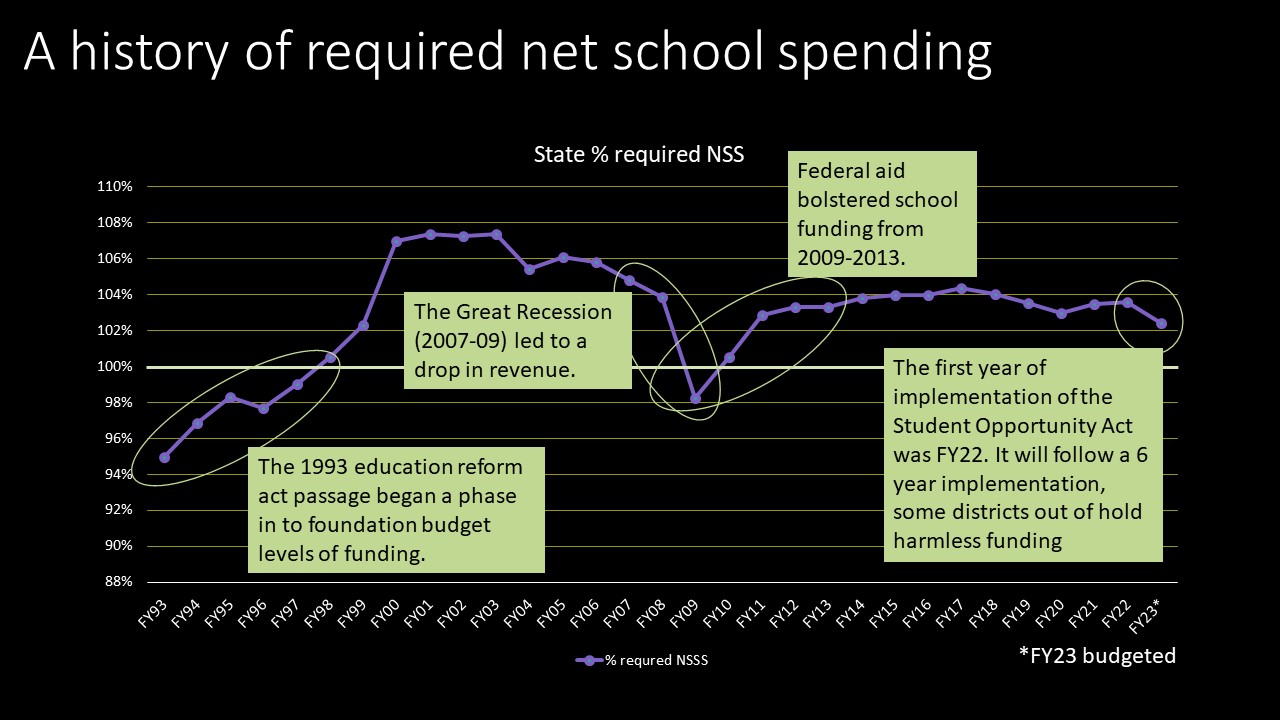
I took the statewide required net school spending back to the creation of the foundation budget in 1993 and put it in its own graph:


The first few years of education reform, the state was phasing in the foundation budget over a series of years, scaling up to requiring the 100% of the new foundation level of spending for 2000.

Over those next few years, you can see required net school spending running quickly up over the 100% of foundation due to the above. The Great Recession then socked revenue in 2007, with the federal government pushing funding out to bring school spending back up. 

What I found particularly interesting is the past handful of years, as we see SOA implementation coming in, which pulls enough districts out of hold harmless that you can actually see the state percentage begin to come back down. Those districts are getting real increases, rather than minimum increases, because the foundation budget has increased so much over these past few years. That means they're getting state funding that gets them closer to and then at their foundation budget, but those increases are foundation increases (much more significant funding) rather than minimum increases.
And that migration of districts out of hold harmless will continue will continue.

When you then look at actual spending, we of course know that for years, districts spent well in excess of required minimum spending due to districts finding that the foundation budget wasn't meeting actual needs. While the first few years here above 100%--see above--are due to districts catching up, districts then sustain above minimum, even during the Great Recession.

But look what just started happening recently!


Here's the thing: THIS IS GOOD NEWS! Remember, the foundation budget is increasing substantially. Thus that 100% represents significantly more money from BOTH state AND local sources. 

While required minimum generally required increases in local funding, in any case, we do need to remember that funding at 100% of net school spending as we continue Student Opportunity Act implementation is going to represent increases in funding--in some cases, substantial ones--for districts that were not funding way over what is required. 

Again, we're doing this, Massachusetts! 

Monday, April 24, 2017

Worcester school meetings this week

Two meetings for Worcester schools this week:

The subcommittee of Teaching, Learning, and Student Supports meets today at 5:30. On the agenda is a review on AP programs (not the scores, if you look at the backup); a discussion of the possible $20-$30,000 per year funding of Worcester Tech membership in SkillsUSA; a report on last year's summer programs; yet one more report on wifi (citing actual science); a report on "day-to-day PEAK-like instruction" in WPS elementary schools (in response to a request that the PEAK gifted program be re-established); and a discussion of citywide wrestling.

The full school committee meets Thursday; you can find the agenda here. After recognitions, there is a report on the Worcester HEARS initiative. There are citizen petitions requesting public hearings on the FY18 budget (required by state law) and on standardized testing.
There is a report back on elementary summer programming (18 days, four hours a day, at nine schools); there is a note regarding the decreased funding available this year. The committee is being asked to approve the innovation plan for the Goddard school (the link isn't to the plan, but to a summary; the full plan isn't posted).  Administration is asking that dates be set for FY18 budget hearings (really, budget sessions, unless they change this to take public comment).
Among the recognitions being filed this week is year four of ASBO recognizing the Worcester Public Schools' budget with its Meritorious Budget Award.
Mr. O'Connell wants to request funding for the science AP exams from the state; to submit nominations for awards to MASC; to possibly file items with MASC for its annual Delegate Assembly; and to pass an FBRC petition.
Ms. McCullough requests that the No Live Lice policy be reviewed.
There's another round of schools receiving grants for Breakfast in the Classroom from the EoS foundation.
The committee is being asked to accept a donation from Scholastic to Woodland Academy, and from Andy's Attic to South High for marketing.
Mayor Petty has filed a plan on PCB cleaning (still no money mentioned).
Miss Biancheria wants an inventory of playground equipment.

There is also an executive session scheduled: PCB's, negotiations with the teachers (still), and a grievance from an HVAC worker.

No liveblog; I have a presentation on Thursday. 

Tuesday, September 6, 2016

A few Worcester notes

A few things from this past week...

CPPAC, the Citywide Parent Planning and Advisory Council, is meeting September 14 at 7 at Chandler Magnet. As is customary, the superintendent will be at this meeting.

Class size made the T&G this weekend, with Scott O'Connell quoting my tweet from last Monday. It's worth noting that (as Melissa Brady pointed out) this is both a secondary and elementary issue, and it has yet to make it into anything that has been discussed at School Committee. When I spoke with Deb Daigle from WGBH about this over the weekend, I pointed out that (you guessed it!) Worcester is at least 660 teachers short under the failure of the state to reconsider the foundation budget. This isn't just a Worcester issue, and it isn't going to go away until the state fixes the formula.

Did you catch the contradiction between the implementation of the cell phone policy and the intent? At least some of the schools are emphasizing the draconian crackdown consequences under the revised cell phone policy, whereas the technological intent was in the article from earlier in the week: "is allowing high school students to have greater access to their smartphones during the school day this upcoming year," in other words, a Bring Your Own Device policy. How much the fearful response to the cell phones of kids is out of step with other districts is illustrated by this blog post on in-school use of social media by students by the Assistant Superintendent of Burlington, though the examples are myriad. These are the kids that our kids are going to "compete" with (that's what we're supposed to worry about, right?) once they've left the Worcester Public Schools. It's a shame that the policy implementation is so far out of step with best practice. Instead, it appears, the School Committee is going to spend time of the discredited conspiracy theory of the dangers of wifi.

Scheduled Know Your School Nights have been posted on the district calendar.

And while this post from me went up before I heard the suggestion about how Worcester should pay for summer school: yes, it's entirely relevant.

Monday, December 15, 2014

Foundation Budget Review Commission hearing at Somerset-Berkeley HighSchool

And Somerset-Berkeley High School, which is brand new, is GORGEOUS. We're still awaiting most of the commission, as apparently the traffic coming down from Boston was difficult.
People are being asked to sign up at the door if they wish to speak.
Rep. Alice Peisch "charged with reviewing the way that foundation bdugets are calculated and suggest changes to that calculation"
specificially seeking testimony meeting one or more of the charges of the committee:

  • educational programs and services necessary to achieve the Commonwealth's educational goals
  • Components & assumptions used in the calculation of the foundation budget
  • Measures to ensure that resources are effectively utilized
  • Models of efficient and effective allocation

written testimony is accepted
Peisch
"very interested in hearing from members of the public who live or work in this area"

first up Superintendent from Carver: citing the balance of the amount the state funds versus how much the town funds
cutting "to the marrow"
does not allow for the costs of special education: "we've brought back children from out of district placement, and we're still unable to release that burden"
"implore you to find a way to keep the schools open in Carver"
on the edge of 35 children in the classroom

speaker from Fall River
78% low income
needs are diverse, complex
"Fall River are not receiving"
"has not kept pace with the actual costs" of health care and special ed
no support for "critical" wraparound supports
Foundation budget gap is "over $25 million"
$16.5M diverted to health care; $6.6M to special ed
kindergarten classes too big
Fall River teachers have lowest average adjusted teacher salary among urban schools
"impertative that our educators receive the necessary resources"
Increase and provide a low income allocation
include full day preschool in the foundation budget
allocate funding for expanding the school day
assumptions of each of the foundation budget catagories, multiplied out by the number of students Fall River has
"diversion of $16M towards health care, and diversion of special education funds"
MBAE rep "overall looking at the overall approach to education...versus actual innovations to how education is delivered"
response: if you addressed some of the fixed costs, "imagine what we could do if we had that $25 million"
praise for illustration of how much the gap is; question as to how much is being covered by circuit breaker
rep from DESE: has Fall River made changes the state pushed in health care? short answer is yes

City administrator from Fall River: "have some huge challenges"
from municipal side "doing our best" to provide with education
best case scenerio is $2M a year
"by and large, when you consider that we had to increase education spending by $6M, we clearly are on a path that's unsustainable"
have rebuilt 3 of our 4 middle schools
"and yet, we can't really take credit for those...there are often times things a community is doing that don't factor in to direct or indirect school spending"
saw transportation increase by over $3M, mostly special ed
"trying to encourage our children to walk to school...and yet, school crossing guards are not an eligible net school spending request"
annual student population: a lot of movement after October 1
"have gone out a number of times to restructure our health insurance...BlueCross matched GIC savings"
going out again on a competive bid
"how far above foundation is Fall River?"
for FY15 at foundation; but FY14, $3.2M under foundation (thus the careover)
struggle with not full funding of McKinney-Vento, struggle that not all Medicaid has been achieved
question: if there were no deficit, would the amounts be adequate? it sounds as if he wants to know just about the gaps in special education and health insurance
"there's no doubt in my mind, they are in need of additional funding"
"It would go a long way"

Taunton: one of the lowest per pupil in the state
57% low income
class size around 30
need for assistant principals in large elementary schools
fulfill state mandates
"you have failed to fulfill the promise of the 1993 Ed Reform Act"
Taunton superintendent Julie Hackett: Gateway city, cites education level of parents
"experiencing sifnificatn demographic shifts"
ELL students in a low wealth district have different needs than those in a high wealth district
"perform very well compared to our urban counterparts"
headline in recent paper was "tight budget, right results"
"only six other school systems have less administration costs than Taunton"
"I want to make it clear that we've done a lot"
closed five schools, consolidated two schools, relocated sixth grade
added guidance and safety through federal grants
bringing special ed back
all day kindergarten increased chapter 70
"operations and efficiency award"
"consider an additional supplement for free and reduced lunch, increase supplement for ELL"
"increase accountability for chapter 70 funds"
same Q from MBAE:
"a complete redesign is necessary...I'd be content with more of a tweak"

Middleboro faculty member: right now the town is using half of the funds for its schools
"we are doing the best we can"
"amazing people in town, amazing employees"
"if we had more money...we'd be able to do even better"
don't have funding for PARCC and Common Core
don't have common planning time
infrastructure and technology
need to see more funding to be successful
"look at the mandates in changing education and look at the funding for those changes we have"

Superintendent Lynch of Somerset-Berkeley
speaks of small size of Berkeley (regionalized in 2009)
Berkeley passed two overrides to fund regionalization and education
"increased number of school choice students" : using funds for technology and to fund five teachers
lists number of teachers and programs cut over past few years
"running out of band-aids"
"I ask you to remember the small towns around the state"
in answer to MBAE question: needs full adjustment
"whole structure...needs to be looked at"
have increase number of seats of school choice as K enrollment has gone down

Robert Baldwin superintendent for Fairhaven
"more and more dollars must be diverted"
health insurance and special ed together nearly $2M "or 23% of our actual spending"
"gradual gap widening"
18.1% statewide for FY15
gap between the communities that can make up the difference by funding over foundation
"truly a financial tipping point"
"in order to make their budget balance, towns look at their biggest expenditure: their schools"
yet schools' gap continues to widen
"what is apportioned by the town
"spending is clearly connected to school performance"
"closing the achievement gap and the funding gap are one and the same"
"as the funding gap continues to grow, so will the achievement gap"
"we collectively cannot wait one more day"
Peisch: does the gap factor in circuit breaker?
Baldwin: "we are to provide the least restrictive environment...it does not qualify" (as it isn't as expensive)

Brockton business manager: much of what has been said by Fall River and Taunton
"many, many ELL"
"we find that the ones that we receive are the ones that are most expensive"
students come in all year long
"we're not complaining about the students; we're very good at teaching them"
coming in third or fourth grade, by high school, achieving as well
1/3 of students received Adams scholarship
83% low income
15,000 to 17,000 students
"to carry that continual growth of students year to year...has put quite a strain on our system"
Q: is there a date? "I would love April 1...anything would help"
Q: is the city spending under foundation budget? a bit of an off the topic question: how do you achieve these results if you're not funded even at foundation?
eliminated a lot of positions
"I can balance class sizes easily; we bring class sizes to 34"
"basically, we overwork our staff"
225 students net coming in after October 1
1400 students changed
McKinney-Vento "is a general fund receipt and goes to the city" (not the school; city doesn't share)

President of Attleboro teachers' union
6200 students
"a plea, a plea for a formula that works for everyone...a number that superintendents can count on...that cities and towns can count on"
list of things that districts are asked to fund...without funding
"and these are unexpected gaps"
"make changes or redesign the formula, whatever is needed"
Q: how could this be more transparent?
when this ($155,00 change; they were expecting more) last year happened, we asked and were told "the numbers hadn't changed"
Q: did your enrollment fall? No.
someone just pulled open the spreadsheet and found that there was a change in enrollment
argument is that it was unexpected which it shouldn't have been; enrollment is known by fall of the previous year, inflation by the previous year, as well
Chang-Diaz: what factors has Attleboro used to predict?
Doesn't think that the superintendent would be able to answer either
"we've had four business managers in the past few years..."
Tom Gosnell "complexity has significantly decreased...historically, it is significantly easier to understand"

Jim Hawkins: MTA, retired teacher from Attleboro

Fall River teacher: "not one person said that their salaries" were the priority
"a good week for me is when I don't read my former students' names in the police log or the obituary column"
students who have special needs are not being serviced...falling further and further behind
two alternative middle school programs, at least three alternative high schools
"our resources need to be expanded and our formula need to be changed"
"there seems to be plenty of money for Common Core training and materials"
"leaving our youngest children behind"

Superintendent Lincoln Lynch, Walpole
students we receive back from vocational schools or private schools
high needs need to be adjusted
"seeing a trend of students who are moving into Massachusetts" due to our interpretation of special ed law
cites multiple cases of students moving out of state and coming back due to services provided
difficult to explain formula to town meeting
"perhaps we should think of different formula for urban, for rural...even if it's a multiplier, like wages"
significant amount of mandates from DESE, in addition to minimal state aid
need to have time and funds to implement what already have
"a lot of efficiencies, saved funds on transportation, but loss of circuit breaker"
this last in response to same circuit breaker Q; the commission is flummoxed that circuit breaker isn't somehow making a difference; looks like they need a breakdown on how special ed budgets are being spent


Ron Clark, Carver: "this formula is very complicated, but the goal is very simple: that every child in the state should have access to a quality education"
needs to take socio-economic factors of towns into account
citing cranberry juice prices
wealthier towns arguing that they pay a lot in taxes, but "I don't think that's where you start applying 'fairness'"

Whitman-Hason School District testimony
regionalization presented as financial saving
2001, chapter 70 was 68% of foundation budget
rely on chapter 70 and regional transportation for funding
after 2001, these percentages declined
local contributions have not increased enough to make up the loss of chapter 70
"over time, programs have disappeared, class sizes have grown...and unfunded and overfunded mandates have continued"
"while regionalization has helped for the first decade..." it doesn't anymore
growing percent of free and reduced lunch students
concern with students in the middle
ranks in the bottom 2% of per pupil expenditures
formula "has become obselete and has now become inadequate"
"realistic support for regional school districts and cost effective regional collaboratives"

Allen Crowley, Board of Selectman Middleboro
"we get just under matching contribution for chapter 70"
"I don't understand how this formula works; I try"
citing increases in foundation budgets and chapter 70 levels (which by themselves don't mean anything!)
"would appreciate your taking a look at it"

Bob Montero, superintendent in Swansey
"most of the areas I'd like to discuss have been discussed by my colleagues"
meeting the needs that our students have on the budgets that we have
"we're pretty lucky in that the community supports our budget"
low income students increasing, increasing needs
in the last 16 months, 60 homeless students coming into the community
"just that number alone, just the transportation, affected our budget $130,000"
"I know that there has been some movement in the House in terms of McKinney-Vento...we need to look at it"
ELL services go to the unfunded mandates, required to have our staff trained
"put on our plate, but we're not seeing the funding"
"needs in technology...we are a district that chose to go PARCC. We think we're ready for that, but it's drained our resources"
Q: you talked about low income population has doubled, and you're far from a Gateway community; explain Title I funds
"increase in Title I funds has been a little bit...draining in some ways for the services we have to provide, with the homeless students in particular"
argument that the Title I goes 'into the general pot' of funding I think...but that isn't quite right

former finance committee member from Lakeville
would like them to look at how much a town is worth
"on the property value side, do the appraised values get used, or do the assessed values get used?"
because the appraised values aren't how much the town gets from the property
which is why they don't use that. They thought of that.
Peisch: points out that this is not under their purview; they are ONLY looking at the foundation budget, not the community wealth model
answer that comes back is "it tracks pretty close to assessed"

Carver School Committee chair: "I wanted to make the town a better place, and the school system a better place"
tight budget when he joined 15 years ago "and every year it has gotten worse and worse"
"we're always going to do a little bit more next year when there's more money"
kids need a little more help; please keep them in mind

HEARING CLOSED: four or five more to come
meeting over the next six months
always willing to take additional testimony via email or letter
All can be sent to Jennie.Williamson@mahouse.gov