and this is Rob Curtin
released for the first time district and school staff attendance data
Showing posts with label Curtin. Show all posts
Showing posts with label Curtin. Show all posts
Tuesday, November 18, 2025
Board of Ed for November: staff attendance data


Tuesday, September 30, 2025
Board of Elementary and Secondary Education: accountability and assessment
Martinez: results are mixed
no student group across the Commonwealth that is above pre-pandemic levels
"we always meet children where they're at"
foundational goal: regardless of what people's opinions are of where we were in 2019
"here in our Commonwealth, I seem advantages, I see alignment, I haven't seen in other parts of the country"
At the end it's about us coming together
"I'm fine having critical friends...there are no shortcuts in this work"
"the data will speak for itself"
 |
| this sheep has nothing to do with it, but I thought we might need a sheep to get through this |
Tuesday, May 20, 2025
May Board of Ed: competency determination
Tutwiler: thank Curtin for him and his team for preparation of conversation; "your work is greatly appreciated"

May Board of Ed: vocational admission
Tutwiler: never been about casting aspersions on career-tech leaders or educators
 |
| Methuen High School auditorium |
"has been about advancing values that reflect that every student" warrants a chance to pursue access
recommending one minor change to the middle school access, and three substantive changes to the weighted lottery
heard "loud and clear" the demand for more seats
Tuesday, February 25, 2025
February Board of Ed: competency determination
and we're going out of order to competency determination
Tuesday, January 28, 2025
Monday, October 28, 2024
Special meeting of the Board of Ed: voke admissions (part I)
The agenda is here; the livestream is going to go up here.
Meeting opened by Vice Chair Hills (with an amazing amount of noise behind him)
Johnston opens by saying it will be looking at the impact of the last engineering change
quotes “Every system is perfectly designed to get the result that it does.” (W. Edwards Deming)
Tonight's agenda:

Tuesday, January 23, 2024
Tuesday, September 19, 2023
September Board of Ed: MCAS results
Riley: achievement slide caused by the pandemic appears to be over
"either maintained or increased number of students meeting or exceeding"
"need to continue on the momentum"
accountability : "today's data will not include any exiting or entering underperforming status": coming in the coming weeks
66 schools of schools of recognition
Curtin: "the embargo on the results is lifted"
"achievement slide since 2019 has halted and recovery is fully underway"
Science remain relatively unchanged
"positive momentum" towards recovery
one caution is grade 3 "has not increased"; results are flat
they were in preK or K during height of pandemic
statewide results can mask school and district results
all grades in ELA either held or gained ground over last year
compared to 2019, still have ground to make up; on average 10% points off 2019
grade 10 flat from last year
by race and ethnicity relatively unchanged with overall results; Black students 1% off of 2022, 4% compared to 2019; Hispanic students just about back to 2019 level
"math represents a similar but better story"
really large increases of +3 (grade 4) +5 (grade 5); flat results in grade 10
by race and ethnicity; "more in the two range across the board" increases across the board
compared to 2019, distance to be made up
in math in grade 10, greater than in ELA
science, relatively stable, slight decreases "caused by rounding"
cannot compare grade 10 to 2019 as implemented new science test in 2022
5% increase in grade 10 Asian students compared to 2022
accountability system running in full for first time since 2019
all schools receiving overall accountability classification, plus student group percentiles
criterion referenced percentage towards targets
no designations on underperforming or chronically underperforming exit/entrance today
of 1832 schools, 226 receiving "insufficient data"
remaining 1607: 1331 "not requiring assistance or intervention" 83%
275 "requiring assistance or intervention" 17%
also normative indicators 1-99 within grade groupings
points assigned on progress towards each accountability indicators
over 60% of 50 or higher making either substantial progress towards targets or meeting or exceeding targets
September Board of Ed: historical overview of MCAS
Craven: asked for overview prior to release of scores, will have Hills
Curtin: "nothing I say today should be construed as myself or the Department as taking any position on any proposed ballot question"
McDuffy v. Secretary
Tuesday, January 24, 2023
Board of Ed: Student Opportunity Act reporting -> goal setting
which is one of my personal irritants, because of how the Commissioner has chosen to do it, so...
we should also perhaps note that this presentation has 98 slides
Tuesday, January 3, 2023
Board of Ed: Special meeting on goal setting
This is the presentation that was bumped from the last meeting because the one on gifted and talented went on and on and on.
Agenda is here; livestream will be here.
Craven notes that this is a discussion only item.
Riley "how we can set ambitious yet attainable targets"
learning recovery
Curtin: introduces Erica Gonzales as Associate Commissioner for Data and Accountability
target setting process for accountability as well as for SOA
having to do this for two reasons:
- ESEA: set targets for both state and for schools
- SOA: "for addressing persistent disparities"; for state and districts
Thus for state, for districts, for schools, and for all the subgroups therein
Target setting has been happening for many years; public document
pandemic has created new challenges, outside the usual norms of what we would do
"so that everyone understands what our intentions are"
between districts, schools, subgroups have to set between 60-70,000 targets annually
but challenges due to pandemic
did not see huge swings in graduation rates; and this is true of the majority
not so of student achievement; "we have never seen variance like this"

it's the variance within the levels that is such an outlier, from 2019-22
had schools that also didn't lose ground
have to come up with a system that fits all
schools that lost extreme amounts, some of that lost small amounts, and some that made gains
how to have schools recover and then go beyond
process that both provides for that and provides for going beyond where schools were in 2019
two paths:
path to recovery: each district, school, subgroup will have a full 'recovery target'
Acknowledging what has happened over the course of the pandemic
asking them to recover back to where they were in 2019 before moving beyond there
the amount of decline requires thinking differently depending on where schools are starting from
amount of that decline will determine the group's 'time to recovery' quartile
those in the bottom quartile will have more time than those in higher quartiles
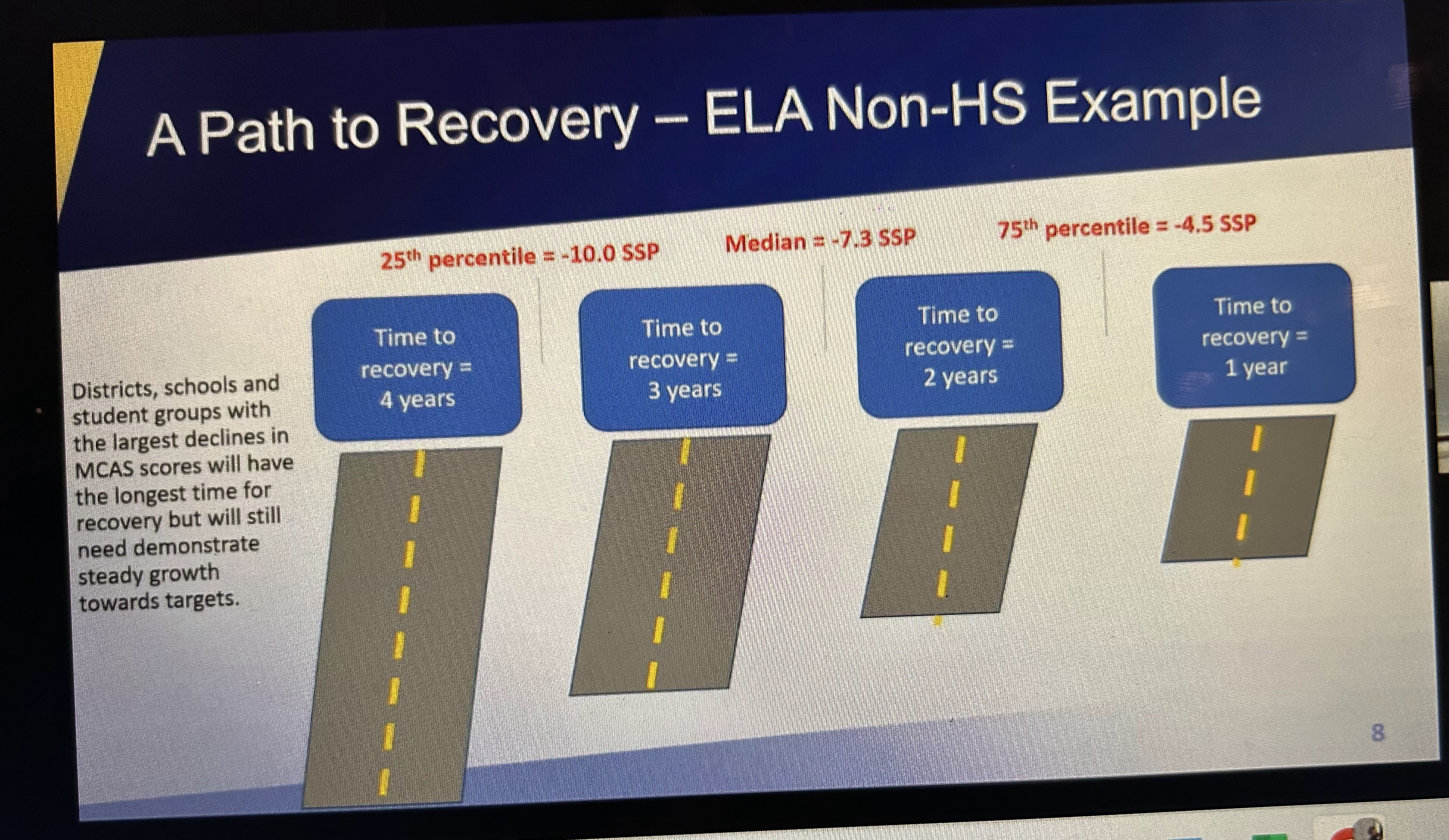
must show "care to where schools are"
simply saying that schools need to get back to where they were in 2019 "simply doesn't work"
"want to note that this is a rigorous requirement of schools"
this is a bigger expectation than what would have been set under prior system
"a fair and careful approach"
make sure those that didn't have as much of a loss over past years would have goals at least as rigorous
also important to think how to move forward: to accommodate different combinations
once a district, school, subgroup recovers, then need a path forward
Those will focus on closing achievement gap; those furthest behind; particular attention need to be paid to those groups
"very complicated process, where you have schools that are in multiple places"
but we "have to develop a process that meets our schools where they are"
every year, schools would be moving from the path to recovery to the path forward
Canavan: asks if any reflection of usual underperforming
Curtin: "kind of a mix"
largest loss "by no means just a list of our historically lowest performing schools"
Canavan: do we have a forecast on when these paths will converge?
"I have some real concerns for our kids who have been most impacted"
Curtin: "I think it's important that we recognize that those that are furthest behind, getting back to recovery is very much progress."
"We need to meet our schools where they are right now."
"We have kids coming up into our tested grades right now who likewise were impacted by the pandemic."
"Yes, they would have a long runway, but I think it's really important to acknowledge what kind of progress that would be"
Canavan: "the phrase that was in my head was 'separate but equal'" though don't want to liken to Jim Crow South
"I'm concerned about the equity impacts"
"I think that we have to do better"
ESSER funding, SOA funding
"should we be looking at wildly different strategies"
"I know we have tensions here on local control"
"wonder if SOA plans are a lever to require" tutoring, extended day
"you have my full support"
West: nothing magical about where we were in 2019; why go back to that
would be working to ensure that the targets that are set would be more ambitious than those set under the previous system
compared to what the targets would have been if we'd simply continued
Curtin: in year one, guarantee they'd be at least as rigorous as the previous system; for bottom distribution, much more rigorous
"Any time you draw a line" one side gets one treatment, the other another
at some point, we had to draw some lines
a function of us having to develop a methodology here
Hills: "I want to give you a reaction"
"at the end of the day, our success or failure as a Board will be largely a function of how we're moving the needle on student achievement"
I think this is incorrect FWIW
getting to 2019 "nothing to write home about"
"But there's a whole lot of money that's pouring in"
Money will stop soon from the federal government and stop increasing from state "and we won't have even gotten to the achievement gap"
"this is not a matter of beating up on districts or anything like that...districts have to figure out how to do it"
and that's it in a nutshell
"They also have to get us to a point where we have to be happy to get to that point"
if others on the Board, maybe you need to come back to us
this isn't under their purview, FWIW
Curtin notes that it isn't the lowest performing districts that had the largest loses (again, because he already said that)
Hills is now feeling himself to ask that question again
Curtin answers it again
"I think that the assumption that schools aren't going to start on that path forward until four years from now" is incorrect
"I wouldn't want to leave the impression with you that 25% of our schools is what's going to happen each year"
Again notes that the historically lowest performing
Plankey: think that clarification of timeline is useful
"almost expecting linear recovery"
"we keep talking about how unprecedent these drops in achievement are...when we have these...is it possible that these drops might take exponentially longer" to recover?
Curtin: yes, developing a system within the unknown
Plankey: really the question we want to ask is what does this mean our job is and what support we need to give districts
Curtin: developing this with assistance folks, working in coordination
"very much trying to think about the quantitative side of things"
Plankey: think the combination would be helpful
Mohamed: creates a health care analogy which is creating the No Child Left Behind act
"what does this say to this family or concerned parent about what our expectation is for those students"
"we seem to think will fall further and further behind"
"I wonder what other states and doing what other countries are doing and particularly all this funding that we have available"
"how should we be signaling"
Curtin: have gotten feedback already from council
Those that have lost the most believe that these targets are ambitious
"I believe we really need to be careful...it's a little like No Child Left Behind was: everybody is going to be proficient"
recognizes the complication of the conversation
Moriarty: 2019, last logical thing
"I didn't find much about 2019 to be acceptable"
rather than thinking about how long the runaway is, think like triage
"much more urgent intervention, guardrails" from the state needed due to those losses
to do what?
Time to recovery shouldn't be measured in reaching its next point, how much more do we have to do to reach that next step
"with good triage, we're looking a lot under the hood"
scores "never answer the questions so much as tell us the next questions to ask"
building stronger systems, what made some schools better withstanding than others
Stewart: would apply to both SOA and ESEA?
Curtin: yes
Stewart: other indicators besides the achievement scoring
really being clear about privilege and bias
Curtin: very much thinking about the questions that...who? has asked us
try to eliminate those biases as much as we could
districts are free to supplement SOA indicators set by DESE with their own
Stewart: missing data on real information around attendance and absence
I don't understand what this data is actually telling us
"if you had to touch base with families on some of this stuff, I don't know how it's going to feel surmountable at all"
Curtin: certainly can supplement around assistance efforts
discussed with advisory committee prior to coming to the Board
important to note that there are a lot of different indicators in the accountability system that made pandemic related decisions
illustration of how we have shown flexibility in the past
Peyser: to Craven saying this is "absolutely" his last meeting
"I don't know; there's always tomorrow"
Target really has two purposes: setting relevant targets; also used for accountability system
sometimes those are in conflict
two or three years sounds like an awfully long time to get back to where you need to go
we know that this is the actual children who have to do the work to get there, right? Like this isn't a thing DONE to kids?
he riffs on some sort of two year categorization, and I'm sure I'm not the only one thinking that he is not going to be on the Board in 48 hours
oh, that was targets for individual students. We can add that to the 70,000 that DESE already has to create
And he wants more ambitious targets for 3 and 4 grade reading performance
West notes interest in supports for districts and asks about path forward
Curtin: yes, going back to 2019 methodology but would increase rigor within methodology
past performance of like schools was past practice, but would choose a point in the continuum that is more rigorous than that used in the previous methodology
Stewart notes national state boards of education is taking up this topic in March
Craven asks about talking about this at the next meeting "on your impressions of what the Board has said"
Curtin said "we have to let districts know what their targets are so there is a bit of a time crunch"
happy to work with Commissioner on following up on comments
Tuesday, November 15, 2022
Notes from the November Board of Ed: post secondary workforce
Curtin: a demonstration of a report we recently released
"we release a lot of data...about every Thursday night, we're releasing something"
wage report was required by the Student Opportunity Act
have reporting on post-secondary enrollment for some time
wage earning and the combination of the two, basically
report was made public on October 27
National Student Clearinghouse through a data match twice a year
primary matching done through school, name, date of birth
only 97.4% of U.S. institutions, no international ones
directory matching will never be perfect
students under FERPA have the right to opt out of information sharing
data comes back anonymized
wage earnings: only have information for MA businesses that contribute to unemployment insurance
no federal (no post office, no military), no self-employed
wage data only includes those not found in postsecondary education: "only counted" each in one place
"you could think about it different ways"
for public information only; no current plans for formal or informal accountability purposes
will be updated annually
"new stuff for us" will learn from this
wage gaps between and among different groups exists
earnings increase over time and vary within industry field
note: small N size in some district and student groups "something to be careful about"
large percentage of MA high school graduates are employed in MA many years after graduation
he's now talking through the report that he's showing them, which one can't really recreate and I can't find the report...
Stewart: what next?
Curtin: stopped at district level; interested in school level
look at ways to display the data (and gives kudos to those who put it together)
West: wage outcomes a little unstable and hard to learn from until late twenties
"bunch of ways we have to be smart in how we use this information"
"opportunity to broaden accountability" of secondary schools
think that's something we should be considering as a Board
cross-agency resource
Louisiana and Texas I know have incorporated their post-secondary into their high school accountability system
West: right now high school accountability is based almost exclusively on tenth grade MCAS
Curtin: our system right now ends at graduation
"there are other factors" besides 10th grade MCAS, "but it does end at graduation"
there are states that look at post-secondary factors, including enrollment, others take it a step farther and include remediation
West: others look at seamless enrollment, enrolling the next year
important to do it based on growth, taking into account where students are when they enter high school
Thursday, October 27, 2022
October Board of Elementary and Secondary Education: MCAS and NAEP
And the presentation is posted here
and if you're watching the video, this starts about 29 minutes in
Curtin: notes the public release of MCAS and accountability data last month, NAEP results released for the country
Monday, August 15, 2022
August Board of Elementary and Secondary Education : public comment and MCAS
This is the "one on the MCAS" though note that updating the state's accountability regs is also on today's agenda, as is a bullying regulation change, and an update on the budget. Because this was not a regularly scheduled meeting, I will not be liveblogging it all, but will catch up later.
Posting as we go once the meeting starts...jumping in mid-public testimony
Interesting: the livestream missed this, but as the first panel was being introduced, there was a member of the public yelling about "no child is safe" though it was unclear on exactly what.
Tuesday, May 24, 2022
Tuesday, September 21, 2021
September Board of Ed: MCAS
Rob Curtin:
districts had several more weeks to give test
shortened grade 3-8 assessment and took one session instead of two
Grade 10 the same
remote administration option
call out for districts and assessment staff for their flexibility in this
Board has modified competency determination of classes of '20-'23
over a million assessments, 85% in person, 99% received a valid result
1% did not; some small number of classrooms being reviewed and grade 8 remote science was not able to be scored due to a contractor error
participation remained strong across; all at 90% or higher (save 89% at math grade 10); younger grades 97% in gr.3-5 in both subjects
Typically in 97% in grade 8 and under; 95% grade 10, so a dip, but still strong
Someone asked if there were higher pockets of non participation
Moriarty: 89% in math grade 10: harbinger of dropping out?Curtin: not as yet, provide ample opportunity for students to take the test to meet the competency determination
stacked bars of achievement; vertically within each grade an achievement level; horizontally comparing across grades
Blue bar of achievement in 2019: orange above the blue line in grades 3-8 is the drop in students meeting or exceeding expectations compared to 2019
2021 grade 10 OUTPERFORMED 2019 in ELA (so no orange over the bar!)
West asks if test was shorter, confirms it was not in grade 10
Curtin: do have "tale of two subjects" as we look at math
Decreases in ELA for sure, "to a more significant degree in math"
concern with amount of red "not meeting expectations"
grade 10 did experience a decrease in math as compared to ELA
science drop more consistent with ELA than math
15% drop in meeting or exceeding expectations in grades 3-8
grade 10 7%
West: comfort in comparison?
Curtin: "what gives me comfort is numbers"
speaks of the numbers of tests given and results
and I missed a section here...augh
Curtin: looking at achievement gap
math change in achievement gap: "actually have a little bit of a narrowing"
"all in all, we end up with certainly declining results" but while we might have feared increasing achievement gaps, that isn't what happened (that last is totally paraphrase)
Riley says he sees recovery as a several year project
Morton: what is social emotional impact on students and on schools
"if we could get such data, that would be helpful"
Riley: "I don't think there is such data."
Morton: "then maybe there should be"
Morton: should focus on alternative assessments, "I'd like us to be sure that we're spending the same amount of resources on alternative assessments"
and then an alarm sounded and the floor? building? was ordered to be evacuated via an automated voice
Hills: wanted to make a comment "there's no perfect place on the agenda to make it"
Haven't looked at individual assessments,
MOU and work that DESE wants to be able to do in Boston
"systemic and systematic and structural problems" in Boston Public Schools
"more skeptical now than I was a year and a half ago"
Don't know how you're going to address deep and wide options "without considering all options including receivership"
"beginning to feel complicit"
"not another day that goes by without another Boston Globe article that...amps my skepticism up a notch"
"I just want to raise this issue publicly, not just privately"
Riley notes it is "not on the agenda today" but hears concerns and notes "there is a process"
Tuesday, February 25, 2020
Board of Ed: accountability for the coming year
in essence, this is adding another year: it will be based on three years rather than two
the backup is here
beginning discussion of a change in system for 2020
Curtin: process for revision
two part process with regard to this: regulation which outlines general framework
plus a systems document with more technical information
possibility each year of revising regulation (which requires regulatory amendment process) OR changing the systems document (which does not)
this is the third year of the system
recommendation is to make minimal changes to the system: incorporate a third year of data
(so it will simply add 2020, without dropping earlier years)
this year it was 40/60 (prior year, current year)
Recommendation for 2020 is:
20% 2018
30% 2019
50% 2020
will be sent out for public comment March/April
vote in May
West: want to learn more before making bigger changes
question is how much weight to put on each year
with more years "there's less riding on the current year"
"districts can get further behind the eight ball"
Curtin: we've never had a system that had three years of data (we had four when it went)
"interested in what the public comment comes back as"
will be taken to accountability advisory commission in March
will take the comments from public and AAAC
"we have lived by the mantra that the most recent year should count the most"
there's no vote required, but it will be sent out after the meeting, it was said...
Thursday, October 17, 2019
Worcester School Committee periodic liveblog
On the agenda tonight is the state presenting on accountability and discipline, but there are also a good number of people presumably in reaction (of various kinds) to the student suspended at Forest Grove.
Petty: work together, and we can do better
"my understanding is the data has gone in a good direction...we have a pretty good school system"
Associate Commissioner of Accountability Rob Curtin
and the presentation just was shared with me and I have shared it here
who leads with his time at Clark
"all that I am presenting for you tonight" is under my purview
notes that he is also in charge of Comprehensive District Reviews, which was done in Worcester in 2017 and was never heard from again
"for the betterment of you all, I did not make this an 100 slide presentation"
"there's a lot of different ways to slice this data"
"that will allow you ask more questions of our office to provide you with information or to ask those questions of the superintendent as well"
will show most recent data that we have
data certified as of July, accountability data in September
all publicly available save the discipline data, not yet released
"won't see any comparison with state" as yet as it hasn't yet become public
"there are more MCAS slides as on other topics...the reason for that is we have a lot of different tests...it's a little difficult to fit it all on one slide"
next gen MCAS grades 3-8 look kinda flat over three years

"in the top half of partially meeting expectations"
"almost a meaningful difference in terms of improvement" in ELA
"more sort of neutral" in math over the three years
how does Worcester compare to other urban districts?
higher than a point, green
"the news is quite positive" for African-American students compared to the urban districts
"some really good news there"
"I would generall portray this as a difference between subjects" however
ELA "primarily overall" positive
"whereas in math Worcester does not compare as well" to urban districts across the Commonwealth
how have things changed over three years?
"meeting or exceeding...have increased" ELA and math
"where we'd like to see more movement" in not meeting expectations
ELA 1 in 5 not meeting
math between 1 in 4 and 1 in 5
the top has increased from the middle, not increase from the bottom
some really good news and some areas of concern:
grade 3 ELA: has increased by six over three years
no movement in 7th grade ELA
"across both subjects there are pockets of good news and places to ask questions"
"particularly good news is sixth grade math"
"data are made to lead to questions"
achievement gap has widened in both ELA and math but for different reasons between subjects
gap has widened in ELA because the top group has done exceptionally well
gap has widened in math because BOTH the top group has done well AND the others have fallen
science: "here is where there is certainly room for improvement"
 grade 8: more than 1 in 4 not meeting expectations on the science test
first year in grade 10: right on par in ELA, in math "again the results are slightly lower"
"questions and room for improvement"
"achievement is important, but growth is important, too"
"our growth statistics are done compared to their academic peers"

 "across the board...for the most part...the growth numbers are on the lower side of typical or the low growth category"
this is not good...growth should be where we're good
"a lot more low growth across the board in subgroups...compared to their academic peers...across the Commonwealth"
"MCAS are the primary driver in our accountability system"
BUT THERE IS MORE as any of you who follow this know: new system
44 schools included in the accountability system
31 schools not requiring assistance or intervention
13 require assistance or intervention: 10 because they are in the lowest 10% in the state; 3 due to a subgroup or more
"there's always going to be a lowest 10%"
the three "had one of the lowest performing subgroups in the state"
"on the extreme positive side" two schools of recognition: West Tatnuck and Belmont Street
"very interesting trend among the schools in Worcester"
 there are 10 schools in the lowest ten percent: there is a range of schools across the district,
a range of performance across the district
er, I fear this may be as a result of our not having particularly integrated elementary schools
17 had a higher percentile in 2018 than in 2017
"in addition to thinking about schools...we also do the same for subgroups"
"a real range of performance among your subgroups across the district"
"there are six schools where the Hispanic students in that school are among the lowest performing in the state...but eight schools in which the Hispanic students in which they're the highest performing subgroups in the state"
"a real testiment ot what's happening"
"a core component is how the school is doing compared to itself"
3/4 of schools either are making substantial progress towards their progress or meeting targets in 2019
 though I am going to observe that the number of schools that MET progress fell 2019 versus 2018
disciplinary data:
"please, there's a lot of different questions we could have answered here"
"I understand there is a clamoring for additional information, and I'd be happy to answer those questions either with the district or on behalf of the district"
discipline: in school, out of school, emergency removal
at highest level, it is lower than it has been at any point over the past five years
gaps among students being disciplined by race and ethnicity
still over 1000 Hispanic students being disciplined in the 2019
"certainly improvement, while still concentrating on high numbers of students who are being disciplined across the district"
lower numbers than in 2018 by subgroup
"you have improvement from 2018 but there are still major difference that exist between groups even between the types of discipline"
 the 1.4% of students who had an emergency removal, a decrease from 1.8% from 2018
"represents a very high percentage compared to the rest of the state"
0.2% for the state in 2018
someone just said "Daaaamn"
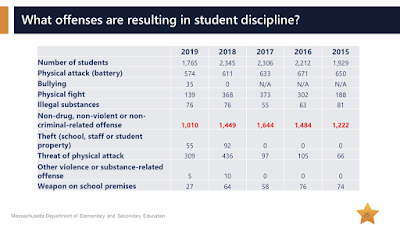
chart now shows numbers sorted out on why students are being suspended
"while my main goal here is to present the facts to you without a whole lot of conjecture"
the number of non-criminal non-violent non-drug reasons
most of them are "some sort of...violating school rules" and such
"but it seems to me that there's at least room for examinating a very high number of non-violent non-criminal non-drug offenses in Worcester"
interrupted here by applause
"and whether or not there's other forms that don't involve removing a student from instruction"
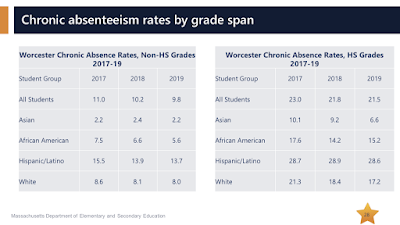
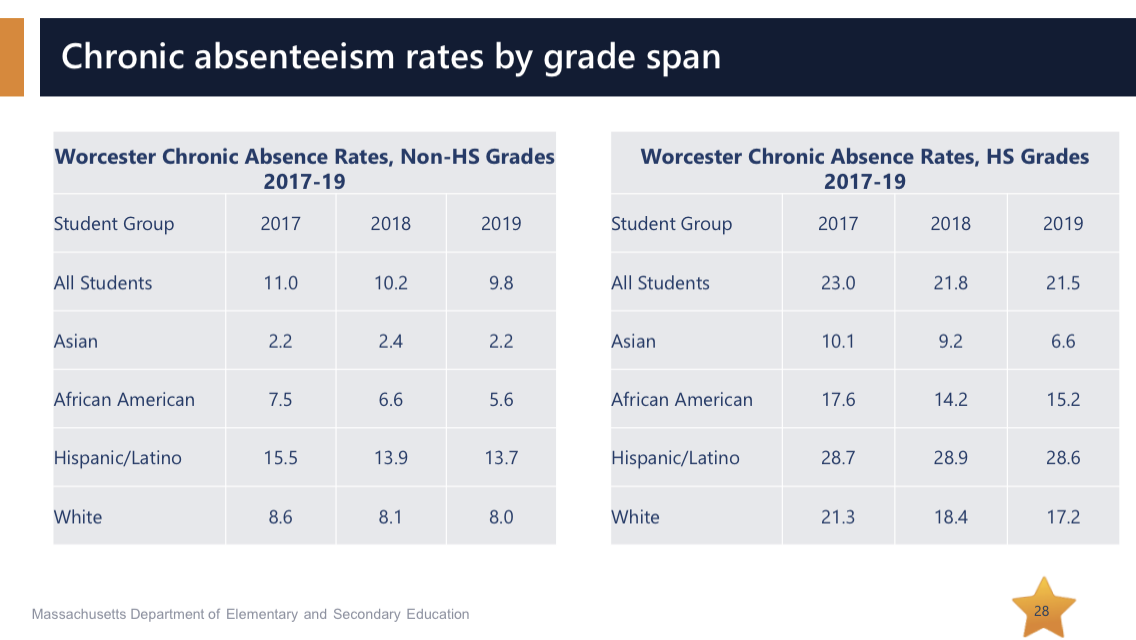
real interesting story on chronic absenteeism
missing at least 10% of their days
just under 15% of students were missing at least 10% of their days in a given school year
"students missed less instructional time than other urban districts across the Commonwealth"
the numbers are actually improving
"quite high but lower than other urban districts across the Commonwealth"
"less than 10% of students in elementary school are missing 10% of their days" and those numbers have come down
"and you've seen dramatic improvement across the races"
"but you have a very different story in high school"
while the numbers have come down
"you have more than 1 in 5 students" missing 10% of their days
"attention can be really focused on the high school"
"My mantra is if we can make it public, we should make it public"
"if there are additional information...my email is there"
Petty: non-drug non-violent non-criminal offenses "we should really dig into"
asks for comparison with urban districts
"look at programs later on"
"have this on a semi-annual...have this again and invite you back!"
things we're doing well but we "can't ignore those things that we have to improve"
Petty: not sure how to do, maybe have a special meeting
Foley: this really warrants much more discussion at future meetings
"you can cross-tabulate a lot of this on the website"
"would love to see breakdown by poverty and is that an overriding factor"
"seeing a movement of a cohort" through "is a trend sometimes"
"students with disability, their performance is very very low"
"challenges we're still facing"
Curtin: something to be investigated here and what's happening among different subgroups among different schools
Foley: "we need to have a conversation about emergency removals...what constitutes an emergency removal, why are we so much higher than the rest of the state"
"I don't know what is occuring to cause the removal of a student from school"
"large number of non-drug non-violent offenses...how can work as a district to keep more of those students in school"
"we have to find a way to keep those students in school"
to applause
The superintendent is referencing a change in the law...there was no change in the law
high rates in October and in May and she's...inventing reasons why?
Superintendent's Advisory Council is making welcoming school books, she says
every school is planning an additional event in October to make school more welcoming
"and we had a tremendous decrease from '16-17"
Foley: "there's a difference between the way Worcester is applying the protocols than other districts across the state"
Binienda: "we have repeated school violations..and that tends to be a catchbasin...so this year, we're being more specific" about the reason for the suspensions
so like cutting class and then they're suspended for that
sorry Monfredo spoke there and he wanted to know about poverty and homelessness and then he was pleased by ELA scores but not in math
Comparetto: see two school systems here
look at implementing alternative practices in discipline
McCullough: one of the things I'd like to see is consistency across the district
"it's been a concern of mine...so we're not seeing disparities across the district"
see students removed from the environment but not the school
"and work towards that goal"
"perhaps part of the strategic plan is to hold policy forum" and perhaps get additional data from the state
Biancheria: why are schools recognized as a school of recognition?
both were for high growth
and I think she just suggested we should teach to the test for science
Petty "have a meeting to really dissect" the non-drug non-violent non-criminal offenses
"maybe we can get a report on that"
Binienda "really feel that was an excellent report on progress"
"with that I want to thank my staff that's here"
thank the School Committee
student rep: asks why there are fewer subgroups than schools (essentially why every school doesn't have them)
Curtin: not enough students in tested grades
asks about seventh grade: follows it down
"I'd hestitate to comment on specific grades"
asks why detentions aren't included
Curtin: first, we don't collect it
"we also don't think of it as a loss of instruction"
"I tend to focus my remarks around the instructional loss"
Petty: work together, and we can do better
"my understanding is the data has gone in a good direction...we have a pretty good school system"
Associate Commissioner of Accountability Rob Curtin
and the presentation just was shared with me and I have shared it here
who leads with his time at Clark
"all that I am presenting for you tonight" is under my purview
notes that he is also in charge of Comprehensive District Reviews, which was done in Worcester in 2017 and was never heard from again
"for the betterment of you all, I did not make this an 100 slide presentation"
"there's a lot of different ways to slice this data"
"that will allow you ask more questions of our office to provide you with information or to ask those questions of the superintendent as well"
will show most recent data that we have
data certified as of July, accountability data in September
all publicly available save the discipline data, not yet released
"won't see any comparison with state" as yet as it hasn't yet become public
"there are more MCAS slides as on other topics...the reason for that is we have a lot of different tests...it's a little difficult to fit it all on one slide"
next gen MCAS grades 3-8 look kinda flat over three years

"in the top half of partially meeting expectations"
"almost a meaningful difference in terms of improvement" in ELA
"more sort of neutral" in math over the three years
how does Worcester compare to other urban districts?
higher than a point, green
"the news is quite positive" for African-American students compared to the urban districts
"some really good news there"
"I would generall portray this as a difference between subjects" however
ELA "primarily overall" positive
"whereas in math Worcester does not compare as well" to urban districts across the Commonwealth
how have things changed over three years?
"meeting or exceeding...have increased" ELA and math
"where we'd like to see more movement" in not meeting expectations
ELA 1 in 5 not meeting
math between 1 in 4 and 1 in 5
the top has increased from the middle, not increase from the bottom
some really good news and some areas of concern:
grade 3 ELA: has increased by six over three years
no movement in 7th grade ELA
"across both subjects there are pockets of good news and places to ask questions"
"particularly good news is sixth grade math"
"data are made to lead to questions"
achievement gap has widened in both ELA and math but for different reasons between subjects
gap has widened in ELA because the top group has done exceptionally well
gap has widened in math because BOTH the top group has done well AND the others have fallen
science: "here is where there is certainly room for improvement"

first year in grade 10: right on par in ELA, in math "again the results are slightly lower"
"questions and room for improvement"
"achievement is important, but growth is important, too"
"our growth statistics are done compared to their academic peers"


this is not good...growth should be where we're good
"a lot more low growth across the board in subgroups...compared to their academic peers...across the Commonwealth"
"MCAS are the primary driver in our accountability system"
BUT THERE IS MORE as any of you who follow this know: new system
44 schools included in the accountability system
31 schools not requiring assistance or intervention
13 require assistance or intervention: 10 because they are in the lowest 10% in the state; 3 due to a subgroup or more
"there's always going to be a lowest 10%"
the three "had one of the lowest performing subgroups in the state"
"on the extreme positive side" two schools of recognition: West Tatnuck and Belmont Street
"very interesting trend among the schools in Worcester"

a range of performance across the district
er, I fear this may be as a result of our not having particularly integrated elementary schools
17 had a higher percentile in 2018 than in 2017
"in addition to thinking about schools...we also do the same for subgroups"
"a real range of performance among your subgroups across the district"
"there are six schools where the Hispanic students in that school are among the lowest performing in the state...but eight schools in which the Hispanic students in which they're the highest performing subgroups in the state"
"a real testiment ot what's happening"
"a core component is how the school is doing compared to itself"
3/4 of schools either are making substantial progress towards their progress or meeting targets in 2019

disciplinary data:
"please, there's a lot of different questions we could have answered here"
"I understand there is a clamoring for additional information, and I'd be happy to answer those questions either with the district or on behalf of the district"
discipline: in school, out of school, emergency removal
at highest level, it is lower than it has been at any point over the past five years
gaps among students being disciplined by race and ethnicity
— Tracy O'Connell Novick (@TracyNovick) October 17, 2019"those are still significant numbers, and I am sure there are still discussions to be had" about the rates
still over 1000 Hispanic students being disciplined in the 2019
"certainly improvement, while still concentrating on high numbers of students who are being disciplined across the district"
lower numbers than in 2018 by subgroup
"you have improvement from 2018 but there are still major difference that exist between groups even between the types of discipline"

"represents a very high percentage compared to the rest of the state"
0.2% for the state in 2018
someone just said "Daaaamn"
chart now shows numbers sorted out on why students are being suspended
"while my main goal here is to present the facts to you without a whole lot of conjecture"
the number of non-criminal non-violent non-drug reasons
most of them are "some sort of...violating school rules" and such
"but it seems to me that there's at least room for examinating a very high number of non-violent non-criminal non-drug offenses in Worcester"
interrupted here by applause
"and whether or not there's other forms that don't involve removing a student from instruction"
real interesting story on chronic absenteeism
missing at least 10% of their days
just under 15% of students were missing at least 10% of their days in a given school year
"students missed less instructional time than other urban districts across the Commonwealth"
the numbers are actually improving
"quite high but lower than other urban districts across the Commonwealth"
"less than 10% of students in elementary school are missing 10% of their days" and those numbers have come down
"and you've seen dramatic improvement across the races"
"but you have a very different story in high school"
while the numbers have come down
"you have more than 1 in 5 students" missing 10% of their days
"attention can be really focused on the high school"
"My mantra is if we can make it public, we should make it public"
"if there are additional information...my email is there"
Petty: non-drug non-violent non-criminal offenses "we should really dig into"
asks for comparison with urban districts
"look at programs later on"
"have this on a semi-annual...have this again and invite you back!"
things we're doing well but we "can't ignore those things that we have to improve"
Petty: not sure how to do, maybe have a special meeting
Foley: this really warrants much more discussion at future meetings
"you can cross-tabulate a lot of this on the website"
"would love to see breakdown by poverty and is that an overriding factor"
"seeing a movement of a cohort" through "is a trend sometimes"
"students with disability, their performance is very very low"
"challenges we're still facing"
Curtin: something to be investigated here and what's happening among different subgroups among different schools
Foley: "we need to have a conversation about emergency removals...what constitutes an emergency removal, why are we so much higher than the rest of the state"
"I don't know what is occuring to cause the removal of a student from school"
"large number of non-drug non-violent offenses...how can work as a district to keep more of those students in school"
"we have to find a way to keep those students in school"
to applause
The superintendent is referencing a change in the law...there was no change in the law
high rates in October and in May and she's...inventing reasons why?
Superintendent's Advisory Council is making welcoming school books, she says
every school is planning an additional event in October to make school more welcoming
"and we had a tremendous decrease from '16-17"
Foley: "there's a difference between the way Worcester is applying the protocols than other districts across the state"
Binienda: "we have repeated school violations..and that tends to be a catchbasin...so this year, we're being more specific" about the reason for the suspensions
so like cutting class and then they're suspended for that
sorry Monfredo spoke there and he wanted to know about poverty and homelessness and then he was pleased by ELA scores but not in math
Comparetto: see two school systems here
look at implementing alternative practices in discipline
McCullough: one of the things I'd like to see is consistency across the district
"it's been a concern of mine...so we're not seeing disparities across the district"
see students removed from the environment but not the school
"and work towards that goal"
"perhaps part of the strategic plan is to hold policy forum" and perhaps get additional data from the state
Biancheria: why are schools recognized as a school of recognition?
both were for high growth
and I think she just suggested we should teach to the test for science
Petty "have a meeting to really dissect" the non-drug non-violent non-criminal offenses
"maybe we can get a report on that"
Binienda "really feel that was an excellent report on progress"
"with that I want to thank my staff that's here"
thank the School Committee
student rep: asks why there are fewer subgroups than schools (essentially why every school doesn't have them)
Curtin: not enough students in tested grades
asks about seventh grade: follows it down
"I'd hestitate to comment on specific grades"
asks why detentions aren't included
Curtin: first, we don't collect it
"we also don't think of it as a loss of instruction"
"I tend to focus my remarks around the instructional loss"
Tuesday, March 26, 2019
March Board of Ed: accountability system potentional changes
back up is here; more usefully, the presentation is here.
Johnston:
any changes to overall changes require public comment and a Board vote
Curtin:
(balance is in) making changes that we think may be beneficial versus gaining consistency in results
recommendation is for minimal changes for 2019 for this reason
2nd year of data, 2nd year of consistency for greater understanding, plus adding grade 10 this year
would like to see a year of 10th grade before "major changes"
(including things like the weighting of achievement versus growth)
Proposed changes
- Calculation of participation rate: change to combined subgroup level (rather than separately by each subgroup by each test); "increases n size" ...much fairer way to do it; will cut down schools identified by at least a third; participation data still reported; this is about "applying a consequence" or not; science, as it's only take twice, is over represented
- progress towards targets: "meeting targets" "partially meeting targets" move to three "meeting targets" "partially meeting targets" "not meeting targets" plus call out improvement in "partially meeting targets"; should be a name change if progress is made but target not met
- use of two years of data: build up using multiple years of data; weighting to come
- add to advanced coursework "needs to be a living document" adding Project lead the Way among others
DEPARTMENT to seek public comment April or May; vote in June
Subscribe to:
Posts (Atom)