no questions on this which passes
Showing posts with label student discipline. Show all posts
Showing posts with label student discipline. Show all posts
Tuesday, September 19, 2023


Tuesday, June 27, 2023
Saturday, October 15, 2022
Supports coming for Worcester schools

Let me start by saying that this is not even close to a complete post! I'm trying to pull together a few different strings of things here.
- You may have seen the reporting that the Worcester Public Schools are looking for outside counseling services at 15 schools. Clearly, someone is keeping an eye on the city's bid list, which is smart! Here's the one in question. This, of course, is part of the much larger work that's now going on in the district in both meeting and working to more comprehensively and sustainably meet student mental health needs; you might have read Dr. Marie Morse talking about that in Worcester Business Journal. There's going to be long-term planning rolling forward, too.
Some of that also is in the reworking of administration positions we discussed at our last Worcester School Committee meeting. That link goes to the reworked org chart; in that, you'll see (towards the right) that the (new, to be filled) Positive Youth Development position is over both (current) social-emotional learning and nursing under the (new, to be filled) Chief Academic Support Officer.
All of this is first of all acknowledging that this is work that the district needs to be doing. That itself is a refreshing change, as you might remember we spent all of last year having that reality denied by district leadership, even as students, staff, and parents noted the need. If we're going to do this right--and that's something that current leadership, thank goodness, is committed to--that means both that it isn't just internal work--thus the bid--but coordinating with outside work. It also means actually coordinating internal work, and that, frankly, just hasn't been happening. At some point I need to write a whole thing on why we need good administrators and how things fall apart without them...oh for world enough and time. - Also at our last meeting, we approved two position descriptions: one for a Dean of Students, one for School Culture and Climate Assistant. The School Committee, remember, approves new position descriptions; we only hire directly a handful of people.
These positions are a) pilots; b) not uncommon in other districts; c) school personnel (they're assigned to a school and in a school building).
As we moved to no longer have police in the secondary schools, one concern raised was "what are you going to do now that the police are out of the buildings?" The reflection was that, in some cases, the school resource officers might have had interactions with students during the school day that would now be removed, and that some of those interactions were contributing to a positive climate. I'm not going to argue about this here; I know what the data says overall about this, and also, Worcester's experience has varied on this widely. This is part of the response to that concern.
The Dean position is an assistant principal level position. This also fills in a gap from my perspective that dates back to 2011: when we pushed teacher evaluation into something much more time-consuming, we took some of the time away from assistant principals, and I don't think that we did much to fill the spaces that left. Having a position that specifically is designated for student interaction at the school level is something I'm interested in seeing tried out. This pilot is at North High.
The School Climate and Culture Assistants are staff that are in the hallways, in the lunchroom, around students; they're paraprofessional level positions. For the pilot, we're adding five of these: three at North, two at Sullivan Middle. Again, those are positions that are directly working with students. - For those who have been ongoingly concerned about things like student discipline and restorative justice practices--you can't just drop those things in!--I also want to note how the Positive Youth Development position is described:The ideal candidate will demonstrate knowledge of • Positive Behavioral Intervention and Supports • Trauma-Informed Practices • Restorative Practices and Restorative Justice • Educational Neuroscience
The position quite specifically is focusing on this question, which also means it isn't simply being added as "a thing to do," but is specifically somebody's job.
And since we've already voted the above, let me add this: the work that goes on in classrooms has always needed structural support to go well. The crush around schools right now makes that even more important. This is the kind of attention to that which allows teachers to actually connect with students and gives students the support and the environment to learn.
It's very much a work in progress, but it IS a work in progress, which itself is progress!
It's very much a work in progress, but it IS a work in progress, which itself is progress!
Tuesday, August 16, 2022
A note on WPS student discipline
Passing along from Dr. Monárrez's weekly update to School Committee members the following:
As we develop a long-term strategy for addressing student discipline processes, long-term suspension and incorporating a restorative approach to student discipline, we will be shifting student discipline oversight to the Assistant Superintendent, Teaching and Learning division. For the immediate all long term suspension hearings will be conducted by our retired quadrant manager, Dr. Mary Montaque. This is a short term action until additional quadrant managers are hired. Then quadrant managers will take on the role of working with schools to ensure restorative approaches are being utilized before long-term suspension is recommended. This model will stay in place while I complete my entry plan and we finalize the strategic planning process.
The School Safety officer, which had led long-term suspension, will be focusing on building safety and emergency management.
Saturday, February 1, 2020
of office referrals
When I sit in a session like yesterday's at Worcester's North High on student discipline, I think about Kurt.
His name wasn't actually Kurt, and, usual round of disclaimers:
His name wasn't actually Kurt, and, usual round of disclaimers:
I taught in a well-resourced district.
This was twenty years ago.
An anecdote isn't the singular of data.
I taught English, mostly freshmen and sophomores. Kurt was in one of my midday sophomore classes. He played defense on the football team, which mattered, because, during the season, you had to have a passing grade in each core subject in order to play each Friday.
I don't remember what day of the week it was, but it was well after football season. It was into the part of the year where we'd all settled in, the course changes had long been made, and this was where we were for the duration.
And that day, for whatever reason, he just couldn't settle in. As I was trying to get through the work of the class, he kept pushing back and not doing it and getting in the way of others doing it.
And I spoke to him and I spoke to him and I spoke to him, and eventually he snapped.
I can still remember him getting up out of his seat, outraged with me, and yelling back at me.
I can still remember him getting up out of his seat, outraged with me, and yelling back at me.
I sent him to the office.
My classroom was next to one of the sets of swinging fire doors that all schools have, and as he left, and went through the doors, he hit the window of the door hard enough that it shattered.
His hand went through it.
And so he came to the office, furious and bleeding, and he went to the hospital.
And I sat down at my desk that afternoon and filled out the office referral form.
And he was suspended for a few--two? three?--days for the damage to school property.
While he was gone, the assistant principal came to my classroom during my prep period with the referral, and he asked me to talk him through it. This didn't always happen, but, after all, this one had ended with stitches and a broken door.
And so we sat and talked through it.
My assistant principal--and as teachers know, you need the secretary and the custodian to like you, but an assistant principal can make or break you--never questioned my judgment and he never argued with me. What he did do was make me think about how it could have gone differently.
Kurt had, clearly, been having a rough day before he got to me. I had even seen it in how he carried himself as he came in. This, like so much of what happens in school, wasn't about me or my class at all.
Was there a point at which a choice that I, the adult in the room, made could have meant that Kurt didn't end up in the hospital that afternoon?
In retrospect, there were several.
In retrospect, there were several.
When Kurt came back to school, he came by my room and apologized before school. There are many ways I messed up as a teacher over that part of my life, but in this case, I didn't: I apologized to him, as well.
None of this is to absolve a fifteen year old from breaking a door or even from being disruptive in class.
Schools are not just about English and math and history, though; they're about becoming people.
As a teacher, I had the luxury of time with someone wiser than me who wasn't accusatory but who asked what happened in terms of what the adults, the ones who have the most agency, can do.
To that question, we need to add: what resources are needed to create institutions that support, rather than hurt, the young people in them?
Thursday, November 21, 2019
Worcester Strategic Plan update
You can now find it online here.
If you remember, the framework for the strategic plan is:

If you remember, the framework for the strategic plan is:
- culture of innovation
- academic excellence
- welcoming schools
- investing in education
- technology and innovation
Note, first, that most of this presentation isn't new: it's the July presentation with a few "new" items that are sprinkled in. I'd argue that if you are truly going to give quarterly updates on the strategic plan, you need to gauge what has happened over the quarter, not simply continue to add to the same presentation and make it longer.
If you scroll through the presentation, though, the examples don't actually match the goals.
They're lists. They're stuff. But they're helter-skelter, not linked to the benchmarks or the themes. There isn't a report of actual progress towards the culture of innovation (read through and tell me what is innovative!), academic excellence (EXCELLENCE), welcoming schools (the creation of "welcoming books" as the foundational item on what should be a presentation of school climate), investing in education (the Student Opportunity Act didn't make the presentation, though it was mentioned; someone please be sure the superintendent knows that the Governor didn't sign it as yet), and technology (that is accessible and used?) and innovation.
They're lists. They're stuff. But they're helter-skelter, not linked to the benchmarks or the themes. There isn't a report of actual progress towards the culture of innovation (read through and tell me what is innovative!), academic excellence (EXCELLENCE), welcoming schools (the creation of "welcoming books" as the foundational item on what should be a presentation of school climate), investing in education (the Student Opportunity Act didn't make the presentation, though it was mentioned; someone please be sure the superintendent knows that the Governor didn't sign it as yet), and technology (that is accessible and used?) and innovation.
And the benchmarks aren't connected to any report: there are percentages, but there is no data backing it up. It isn't attached to anything (50% of site councils are operating and representative? based on what? 8% of new hires are "diverse"? How?).
And the presentation on lack of disciplinary data is simply incorrect: the superintendent stated that they were waiting for data from the state but the STATE GETS THE INFORMATION FROM THE DISTRICT!
And it's this:

Thursday, November 7, 2019
Worcester School Committee meets tonight: who's fooling who?
And I know, I know, I'm sorry...I will say that most of the agenda is items that have been postponed from prior meetings, so this isn't going to go through everything, either.
The report of the superintendent is the quick survey of every department that has been on several agendas and keeps being postponed.
The real meat of the meeting, however, and what would be gathering much attention were the community not still in election mode is an updated update on the 14 points the School Committee passed back with the Superintendent's contract.
In sum? There's nineteen pages here, but there's not a lot of content.
Thus the subtitle of the blog post
1.The call is for a "clear and transparent process" for presenting data going back seven years.
The response is to note that the state's report doesn't include yet-to-be released data from other districts--"hey look at them" is not a good plan here--and that they'll get to it when it is.
We don't need to wait on the state to release other districts' data to get ours up.
2. The call is to re-engage with the "Suspension in Worcester: a Continuing Conversation" report from City Lab at WSU.
The response is that the memorandum of understanding with WSU is still being reviewed.
This doesn't answer the re-engagement with the report content.
3. The call is for comprehensive training for all staff, including the Worcester School Committee,
on "understanding cultural differences, unconscious bias, understanding racial disparities, and trauma informed care, including Ch. 222.
The response is four pages of professional development of which, of the above, only trauma informed care is mentioned at all.
4. The call is for a comprehensive legal review of the district's implementation of Ch. 222, with a report back on the changes in policy and procedure that are necessary.
The response is a dismissal that it has been done and the district is in compliance.
There has been no evidence offered of any such review, and the data makes it clear that the district is not doing well with this issue. There has been no report and no proposed changes in district policy or procedure.
5. The call is for maintainance of a English Learner Parent Advisory Council which includes community partners.
The response is that there is one with some discussion of what has been done so far.
The important point here? This is an ADVISORY council; they exist to ADVISE the district on the English Learner community.
6-9 are coming in January
10. The call is for the disciplinary practices to not be funneled through a single process.
The response is that they aren't.
My sense is that this is one where the phrasing of the query is the issue.
11. The call is for the hiring of a Chief Diversity Officer.
The response is that there is one.
I will note here that there was and is continues to be community observation that limiting the scope of this position to Human Resources makes it of extremely limited utility, and is counter both to the motivation of the community call and the way in which the position exists in other districts (where it most often is an assistant superintendency).
12. The call is for work with the colleges on focused recruitment and retention of a diverse teaching force.
The response is on the Worcester Teacher Pipeline initiative.
If we continue to ignore retention, all we get is high turnover, which isn't fair to anyone.
13. The call is for a semi-annual report on the English Learner deparment, including compliance with best practices and federal guidelines.
The response is to push the report onto page 11 and following of the printing material here: not to have it be a report of the superintendent, not to have it be a formal discussion, but to bury a list of items, a host of which are a repeat of the PD items above, within this written report.
For a district in which one in three children is currently an English Learner, this is both irresponsible and dismissive.
14. The call is to work to implement the report of the Mayor's Commission.
The response is that the initial report is out but has not been finalized.
The initial report is not included here.
The report of the superintendent is the quick survey of every department that has been on several agendas and keeps being postponed.
The real meat of the meeting, however, and what would be gathering much attention were the community not still in election mode is an updated update on the 14 points the School Committee passed back with the Superintendent's contract.
In sum? There's nineteen pages here, but there's not a lot of content.
Thus the subtitle of the blog post
1.The call is for a "clear and transparent process" for presenting data going back seven years.
The response is to note that the state's report doesn't include yet-to-be released data from other districts--"hey look at them" is not a good plan here--and that they'll get to it when it is.
We don't need to wait on the state to release other districts' data to get ours up.
2. The call is to re-engage with the "Suspension in Worcester: a Continuing Conversation" report from City Lab at WSU.
The response is that the memorandum of understanding with WSU is still being reviewed.
This doesn't answer the re-engagement with the report content.
3. The call is for comprehensive training for all staff, including the Worcester School Committee,
on "understanding cultural differences, unconscious bias, understanding racial disparities, and trauma informed care, including Ch. 222.
The response is four pages of professional development of which, of the above, only trauma informed care is mentioned at all.
This is a clear attempt to snow the Committee under with lots of information (even bet we hear "clearly there is a lot of work going on" said tonight), distracting from the administration's refusal to work on institutional bias at all.If I'm not actively anti-racist, anti-all-oppression, then I'm not trauma-informed.
— Paul Gorski (@pgorski) November 9, 2019
4. The call is for a comprehensive legal review of the district's implementation of Ch. 222, with a report back on the changes in policy and procedure that are necessary.
The response is a dismissal that it has been done and the district is in compliance.
There has been no evidence offered of any such review, and the data makes it clear that the district is not doing well with this issue. There has been no report and no proposed changes in district policy or procedure.
5. The call is for maintainance of a English Learner Parent Advisory Council which includes community partners.
The response is that there is one with some discussion of what has been done so far.
The important point here? This is an ADVISORY council; they exist to ADVISE the district on the English Learner community.
6-9 are coming in January
10. The call is for the disciplinary practices to not be funneled through a single process.
The response is that they aren't.
My sense is that this is one where the phrasing of the query is the issue.
11. The call is for the hiring of a Chief Diversity Officer.
The response is that there is one.
I will note here that there was and is continues to be community observation that limiting the scope of this position to Human Resources makes it of extremely limited utility, and is counter both to the motivation of the community call and the way in which the position exists in other districts (where it most often is an assistant superintendency).
12. The call is for work with the colleges on focused recruitment and retention of a diverse teaching force.
The response is on the Worcester Teacher Pipeline initiative.
If we continue to ignore retention, all we get is high turnover, which isn't fair to anyone.
13. The call is for a semi-annual report on the English Learner deparment, including compliance with best practices and federal guidelines.
The response is to push the report onto page 11 and following of the printing material here: not to have it be a report of the superintendent, not to have it be a formal discussion, but to bury a list of items, a host of which are a repeat of the PD items above, within this written report.
For a district in which one in three children is currently an English Learner, this is both irresponsible and dismissive.
14. The call is to work to implement the report of the Mayor's Commission.
The response is that the initial report is out but has not been finalized.
The initial report is not included here.
Thursday, October 17, 2019
Worcester School Committee periodic liveblog
On the agenda tonight is the state presenting on accountability and discipline, but there are also a good number of people presumably in reaction (of various kinds) to the student suspended at Forest Grove.
Petty: work together, and we can do better
"my understanding is the data has gone in a good direction...we have a pretty good school system"
Associate Commissioner of Accountability Rob Curtin
and the presentation just was shared with me and I have shared it here
who leads with his time at Clark
"all that I am presenting for you tonight" is under my purview
notes that he is also in charge of Comprehensive District Reviews, which was done in Worcester in 2017 and was never heard from again
"for the betterment of you all, I did not make this an 100 slide presentation"
"there's a lot of different ways to slice this data"
"that will allow you ask more questions of our office to provide you with information or to ask those questions of the superintendent as well"
will show most recent data that we have
data certified as of July, accountability data in September
all publicly available save the discipline data, not yet released
"won't see any comparison with state" as yet as it hasn't yet become public
"there are more MCAS slides as on other topics...the reason for that is we have a lot of different tests...it's a little difficult to fit it all on one slide"
next gen MCAS grades 3-8 look kinda flat over three years

"in the top half of partially meeting expectations"
"almost a meaningful difference in terms of improvement" in ELA
"more sort of neutral" in math over the three years
how does Worcester compare to other urban districts?
higher than a point, green
"the news is quite positive" for African-American students compared to the urban districts
"some really good news there"
"I would generall portray this as a difference between subjects" however
ELA "primarily overall" positive
"whereas in math Worcester does not compare as well" to urban districts across the Commonwealth
how have things changed over three years?
"meeting or exceeding...have increased" ELA and math
"where we'd like to see more movement" in not meeting expectations
ELA 1 in 5 not meeting
math between 1 in 4 and 1 in 5
the top has increased from the middle, not increase from the bottom
some really good news and some areas of concern:
grade 3 ELA: has increased by six over three years
no movement in 7th grade ELA
"across both subjects there are pockets of good news and places to ask questions"
"particularly good news is sixth grade math"
"data are made to lead to questions"
achievement gap has widened in both ELA and math but for different reasons between subjects
gap has widened in ELA because the top group has done exceptionally well
gap has widened in math because BOTH the top group has done well AND the others have fallen
science: "here is where there is certainly room for improvement"
 grade 8: more than 1 in 4 not meeting expectations on the science test
first year in grade 10: right on par in ELA, in math "again the results are slightly lower"
"questions and room for improvement"
"achievement is important, but growth is important, too"
"our growth statistics are done compared to their academic peers"

 "across the board...for the most part...the growth numbers are on the lower side of typical or the low growth category"
this is not good...growth should be where we're good
"a lot more low growth across the board in subgroups...compared to their academic peers...across the Commonwealth"
"MCAS are the primary driver in our accountability system"
BUT THERE IS MORE as any of you who follow this know: new system
44 schools included in the accountability system
31 schools not requiring assistance or intervention
13 require assistance or intervention: 10 because they are in the lowest 10% in the state; 3 due to a subgroup or more
"there's always going to be a lowest 10%"
the three "had one of the lowest performing subgroups in the state"
"on the extreme positive side" two schools of recognition: West Tatnuck and Belmont Street
"very interesting trend among the schools in Worcester"
 there are 10 schools in the lowest ten percent: there is a range of schools across the district,
a range of performance across the district
er, I fear this may be as a result of our not having particularly integrated elementary schools
17 had a higher percentile in 2018 than in 2017
"in addition to thinking about schools...we also do the same for subgroups"
"a real range of performance among your subgroups across the district"
"there are six schools where the Hispanic students in that school are among the lowest performing in the state...but eight schools in which the Hispanic students in which they're the highest performing subgroups in the state"
"a real testiment ot what's happening"
"a core component is how the school is doing compared to itself"
3/4 of schools either are making substantial progress towards their progress or meeting targets in 2019
 though I am going to observe that the number of schools that MET progress fell 2019 versus 2018
disciplinary data:
"please, there's a lot of different questions we could have answered here"
"I understand there is a clamoring for additional information, and I'd be happy to answer those questions either with the district or on behalf of the district"
discipline: in school, out of school, emergency removal
at highest level, it is lower than it has been at any point over the past five years
gaps among students being disciplined by race and ethnicity
still over 1000 Hispanic students being disciplined in the 2019
"certainly improvement, while still concentrating on high numbers of students who are being disciplined across the district"
lower numbers than in 2018 by subgroup
"you have improvement from 2018 but there are still major difference that exist between groups even between the types of discipline"
 the 1.4% of students who had an emergency removal, a decrease from 1.8% from 2018
"represents a very high percentage compared to the rest of the state"
0.2% for the state in 2018
someone just said "Daaaamn"
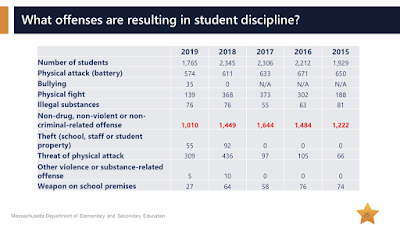
chart now shows numbers sorted out on why students are being suspended
"while my main goal here is to present the facts to you without a whole lot of conjecture"
the number of non-criminal non-violent non-drug reasons
most of them are "some sort of...violating school rules" and such
"but it seems to me that there's at least room for examinating a very high number of non-violent non-criminal non-drug offenses in Worcester"
interrupted here by applause
"and whether or not there's other forms that don't involve removing a student from instruction"
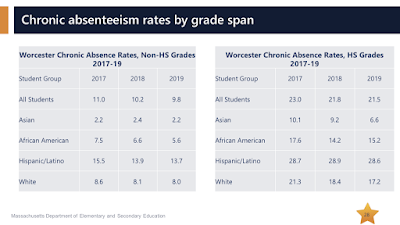
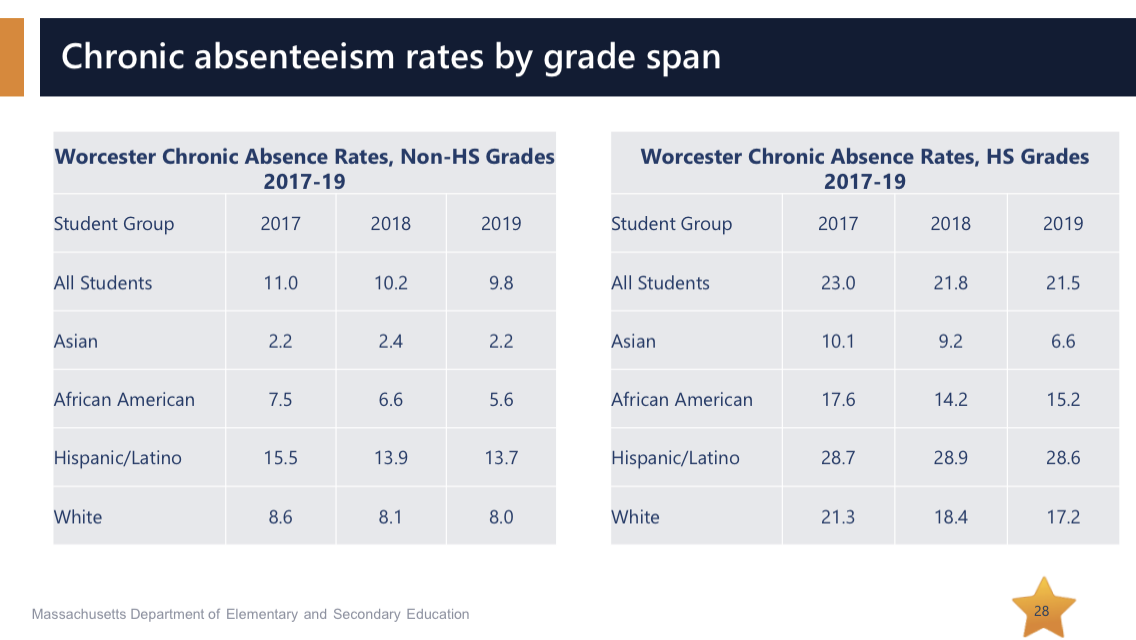
real interesting story on chronic absenteeism
missing at least 10% of their days
just under 15% of students were missing at least 10% of their days in a given school year
"students missed less instructional time than other urban districts across the Commonwealth"
the numbers are actually improving
"quite high but lower than other urban districts across the Commonwealth"
"less than 10% of students in elementary school are missing 10% of their days" and those numbers have come down
"and you've seen dramatic improvement across the races"
"but you have a very different story in high school"
while the numbers have come down
"you have more than 1 in 5 students" missing 10% of their days
"attention can be really focused on the high school"
"My mantra is if we can make it public, we should make it public"
"if there are additional information...my email is there"
Petty: non-drug non-violent non-criminal offenses "we should really dig into"
asks for comparison with urban districts
"look at programs later on"
"have this on a semi-annual...have this again and invite you back!"
things we're doing well but we "can't ignore those things that we have to improve"
Petty: not sure how to do, maybe have a special meeting
Foley: this really warrants much more discussion at future meetings
"you can cross-tabulate a lot of this on the website"
"would love to see breakdown by poverty and is that an overriding factor"
"seeing a movement of a cohort" through "is a trend sometimes"
"students with disability, their performance is very very low"
"challenges we're still facing"
Curtin: something to be investigated here and what's happening among different subgroups among different schools
Foley: "we need to have a conversation about emergency removals...what constitutes an emergency removal, why are we so much higher than the rest of the state"
"I don't know what is occuring to cause the removal of a student from school"
"large number of non-drug non-violent offenses...how can work as a district to keep more of those students in school"
"we have to find a way to keep those students in school"
to applause
The superintendent is referencing a change in the law...there was no change in the law
high rates in October and in May and she's...inventing reasons why?
Superintendent's Advisory Council is making welcoming school books, she says
every school is planning an additional event in October to make school more welcoming
"and we had a tremendous decrease from '16-17"
Foley: "there's a difference between the way Worcester is applying the protocols than other districts across the state"
Binienda: "we have repeated school violations..and that tends to be a catchbasin...so this year, we're being more specific" about the reason for the suspensions
so like cutting class and then they're suspended for that
sorry Monfredo spoke there and he wanted to know about poverty and homelessness and then he was pleased by ELA scores but not in math
Comparetto: see two school systems here
look at implementing alternative practices in discipline
McCullough: one of the things I'd like to see is consistency across the district
"it's been a concern of mine...so we're not seeing disparities across the district"
see students removed from the environment but not the school
"and work towards that goal"
"perhaps part of the strategic plan is to hold policy forum" and perhaps get additional data from the state
Biancheria: why are schools recognized as a school of recognition?
both were for high growth
and I think she just suggested we should teach to the test for science
Petty "have a meeting to really dissect" the non-drug non-violent non-criminal offenses
"maybe we can get a report on that"
Binienda "really feel that was an excellent report on progress"
"with that I want to thank my staff that's here"
thank the School Committee
student rep: asks why there are fewer subgroups than schools (essentially why every school doesn't have them)
Curtin: not enough students in tested grades
asks about seventh grade: follows it down
"I'd hestitate to comment on specific grades"
asks why detentions aren't included
Curtin: first, we don't collect it
"we also don't think of it as a loss of instruction"
"I tend to focus my remarks around the instructional loss"
Petty: work together, and we can do better
"my understanding is the data has gone in a good direction...we have a pretty good school system"
Associate Commissioner of Accountability Rob Curtin
and the presentation just was shared with me and I have shared it here
who leads with his time at Clark
"all that I am presenting for you tonight" is under my purview
notes that he is also in charge of Comprehensive District Reviews, which was done in Worcester in 2017 and was never heard from again
"for the betterment of you all, I did not make this an 100 slide presentation"
"there's a lot of different ways to slice this data"
"that will allow you ask more questions of our office to provide you with information or to ask those questions of the superintendent as well"
will show most recent data that we have
data certified as of July, accountability data in September
all publicly available save the discipline data, not yet released
"won't see any comparison with state" as yet as it hasn't yet become public
"there are more MCAS slides as on other topics...the reason for that is we have a lot of different tests...it's a little difficult to fit it all on one slide"
next gen MCAS grades 3-8 look kinda flat over three years

"in the top half of partially meeting expectations"
"almost a meaningful difference in terms of improvement" in ELA
"more sort of neutral" in math over the three years
how does Worcester compare to other urban districts?
higher than a point, green
"the news is quite positive" for African-American students compared to the urban districts
"some really good news there"
"I would generall portray this as a difference between subjects" however
ELA "primarily overall" positive
"whereas in math Worcester does not compare as well" to urban districts across the Commonwealth
how have things changed over three years?
"meeting or exceeding...have increased" ELA and math
"where we'd like to see more movement" in not meeting expectations
ELA 1 in 5 not meeting
math between 1 in 4 and 1 in 5
the top has increased from the middle, not increase from the bottom
some really good news and some areas of concern:
grade 3 ELA: has increased by six over three years
no movement in 7th grade ELA
"across both subjects there are pockets of good news and places to ask questions"
"particularly good news is sixth grade math"
"data are made to lead to questions"
achievement gap has widened in both ELA and math but for different reasons between subjects
gap has widened in ELA because the top group has done exceptionally well
gap has widened in math because BOTH the top group has done well AND the others have fallen
science: "here is where there is certainly room for improvement"

first year in grade 10: right on par in ELA, in math "again the results are slightly lower"
"questions and room for improvement"
"achievement is important, but growth is important, too"
"our growth statistics are done compared to their academic peers"


this is not good...growth should be where we're good
"a lot more low growth across the board in subgroups...compared to their academic peers...across the Commonwealth"
"MCAS are the primary driver in our accountability system"
BUT THERE IS MORE as any of you who follow this know: new system
44 schools included in the accountability system
31 schools not requiring assistance or intervention
13 require assistance or intervention: 10 because they are in the lowest 10% in the state; 3 due to a subgroup or more
"there's always going to be a lowest 10%"
the three "had one of the lowest performing subgroups in the state"
"on the extreme positive side" two schools of recognition: West Tatnuck and Belmont Street
"very interesting trend among the schools in Worcester"

a range of performance across the district
er, I fear this may be as a result of our not having particularly integrated elementary schools
17 had a higher percentile in 2018 than in 2017
"in addition to thinking about schools...we also do the same for subgroups"
"a real range of performance among your subgroups across the district"
"there are six schools where the Hispanic students in that school are among the lowest performing in the state...but eight schools in which the Hispanic students in which they're the highest performing subgroups in the state"
"a real testiment ot what's happening"
"a core component is how the school is doing compared to itself"
3/4 of schools either are making substantial progress towards their progress or meeting targets in 2019

disciplinary data:
"please, there's a lot of different questions we could have answered here"
"I understand there is a clamoring for additional information, and I'd be happy to answer those questions either with the district or on behalf of the district"
discipline: in school, out of school, emergency removal
at highest level, it is lower than it has been at any point over the past five years
gaps among students being disciplined by race and ethnicity
— Tracy O'Connell Novick (@TracyNovick) October 17, 2019"those are still significant numbers, and I am sure there are still discussions to be had" about the rates
still over 1000 Hispanic students being disciplined in the 2019
"certainly improvement, while still concentrating on high numbers of students who are being disciplined across the district"
lower numbers than in 2018 by subgroup
"you have improvement from 2018 but there are still major difference that exist between groups even between the types of discipline"

"represents a very high percentage compared to the rest of the state"
0.2% for the state in 2018
someone just said "Daaaamn"
chart now shows numbers sorted out on why students are being suspended
"while my main goal here is to present the facts to you without a whole lot of conjecture"
the number of non-criminal non-violent non-drug reasons
most of them are "some sort of...violating school rules" and such
"but it seems to me that there's at least room for examinating a very high number of non-violent non-criminal non-drug offenses in Worcester"
interrupted here by applause
"and whether or not there's other forms that don't involve removing a student from instruction"
real interesting story on chronic absenteeism
missing at least 10% of their days
just under 15% of students were missing at least 10% of their days in a given school year
"students missed less instructional time than other urban districts across the Commonwealth"
the numbers are actually improving
"quite high but lower than other urban districts across the Commonwealth"
"less than 10% of students in elementary school are missing 10% of their days" and those numbers have come down
"and you've seen dramatic improvement across the races"
"but you have a very different story in high school"
while the numbers have come down
"you have more than 1 in 5 students" missing 10% of their days
"attention can be really focused on the high school"
"My mantra is if we can make it public, we should make it public"
"if there are additional information...my email is there"
Petty: non-drug non-violent non-criminal offenses "we should really dig into"
asks for comparison with urban districts
"look at programs later on"
"have this on a semi-annual...have this again and invite you back!"
things we're doing well but we "can't ignore those things that we have to improve"
Petty: not sure how to do, maybe have a special meeting
Foley: this really warrants much more discussion at future meetings
"you can cross-tabulate a lot of this on the website"
"would love to see breakdown by poverty and is that an overriding factor"
"seeing a movement of a cohort" through "is a trend sometimes"
"students with disability, their performance is very very low"
"challenges we're still facing"
Curtin: something to be investigated here and what's happening among different subgroups among different schools
Foley: "we need to have a conversation about emergency removals...what constitutes an emergency removal, why are we so much higher than the rest of the state"
"I don't know what is occuring to cause the removal of a student from school"
"large number of non-drug non-violent offenses...how can work as a district to keep more of those students in school"
"we have to find a way to keep those students in school"
to applause
The superintendent is referencing a change in the law...there was no change in the law
high rates in October and in May and she's...inventing reasons why?
Superintendent's Advisory Council is making welcoming school books, she says
every school is planning an additional event in October to make school more welcoming
"and we had a tremendous decrease from '16-17"
Foley: "there's a difference between the way Worcester is applying the protocols than other districts across the state"
Binienda: "we have repeated school violations..and that tends to be a catchbasin...so this year, we're being more specific" about the reason for the suspensions
so like cutting class and then they're suspended for that
sorry Monfredo spoke there and he wanted to know about poverty and homelessness and then he was pleased by ELA scores but not in math
Comparetto: see two school systems here
look at implementing alternative practices in discipline
McCullough: one of the things I'd like to see is consistency across the district
"it's been a concern of mine...so we're not seeing disparities across the district"
see students removed from the environment but not the school
"and work towards that goal"
"perhaps part of the strategic plan is to hold policy forum" and perhaps get additional data from the state
Biancheria: why are schools recognized as a school of recognition?
both were for high growth
and I think she just suggested we should teach to the test for science
Petty "have a meeting to really dissect" the non-drug non-violent non-criminal offenses
"maybe we can get a report on that"
Binienda "really feel that was an excellent report on progress"
"with that I want to thank my staff that's here"
thank the School Committee
student rep: asks why there are fewer subgroups than schools (essentially why every school doesn't have them)
Curtin: not enough students in tested grades
asks about seventh grade: follows it down
"I'd hestitate to comment on specific grades"
asks why detentions aren't included
Curtin: first, we don't collect it
"we also don't think of it as a loss of instruction"
"I tend to focus my remarks around the instructional loss"
Wednesday, October 9, 2019
Don't shoot the messenger
As I noted in my post on the last Worcester School Committee meeting, the Department of Elementary and Secondary Education is coming to present on the Worcester Public Schools' accountability and disciplinary data at the invitation of Mayor Petty and the Worcester School Committee at the School Committee meeting on October 17.
This invitation, of course, is as a result of the work around equity that has gone on from the Mayor's Commission on Latino Education and Excellence, but also the organizing work by students, and others, including Worcester Interfaith who has hosted the Worcester Coalition for Educational Equity.
Tomorrow the Coalition is hosting a convening about the state of the schools. The Coalition is also suggesting the community turn out to hear the report of the Department regarding Worcester's data.
In response, it seems, some who have been most allied with Superintendent Binienda are calling faith communities, arguing that this is an attack on the Superintendent, and proposing that they withdraw their support for Worcester Interfaith.
Deep breath here, folks.
Setting aside for a minute the relative propriety of such proposals, can we understand what this actually says? Organizing around the state of the schools and asking people to hear the state talk about the data the district itself reports on the schools is not an attack on the leadership of the schools.
Unless, of course, the leadership of the schools doesn't like what the data says and has no real response to it.
Friday, May 24, 2019
Worcester Public Schools before City Council for FY20: laterblog
When the Worcester Public Schools goes before the Worcester City Council on the budget--or when any school district goes before their appropriating authority--I always find it is useful to start with MGL Ch. 71, sec. 34:
Nonetheless, the City Council spent more than three hours questioning Superintendent Binienda and Mr. Allen on the FY20 budget on Tuesday night (you can find the videos on Facebook here and here), only to hold the item for next week. It is, of course, an election year, but I've also noticed that municipal bodies tend to edge more and more into schools when they can, either because they aren't getting pushback or they aren't seeing the school committee as doing its own oversight.
Note also that this was covered only by Bill Shaner of Worcester Magazine, which is really a problem. This is not a blow-by-blow liveblog, but I felt we needed to say more about this.
In acting on appropriations for educational costs, the city or town appropriating body shall vote on the total amount of the appropriations requested and shall not allocate appropriations among accounts or place any restrictions on such appropriations.Further, in Worcester, we do well to note that by section 5-2 of the City of Worcester Charter:
The city council may, by majority vote, make appropriations for the purposes recommended and may reduce or reject any amount recommended in the annual budget, but except on recommendation of the city manager, shall not increase any amount in or the total of the annual budget, nor add thereto any amount for a purpose not included therein, except as provided in section thirty-three of chapter forty-four of the General Laws.Thus the City Council:
- cannot add more money to the city budget (including the schools)
- cannot transfer money to or from any section of the budget (including schools)
- cannot allocate funds within the school budget
Nonetheless, the City Council spent more than three hours questioning Superintendent Binienda and Mr. Allen on the FY20 budget on Tuesday night (you can find the videos on Facebook here and here), only to hold the item for next week. It is, of course, an election year, but I've also noticed that municipal bodies tend to edge more and more into schools when they can, either because they aren't getting pushback or they aren't seeing the school committee as doing its own oversight.
Note also that this was covered only by Bill Shaner of Worcester Magazine, which is really a problem. This is not a blow-by-blow liveblog, but I felt we needed to say more about this.
Monday, April 29, 2019
For your listening...
If you'd like to hear me riff on education policy, Worcester schools, and local politics, I went on 508 with Mike Benedetti and Brendan Melican on Friday; you can see it here. I'm just honored that they keep having me on even after I still haven't seen season 4 of The Wire.
Wednesday, April 3, 2019
And the latest updates from Worcester and systemic bias
Worcester Magazine is reporting that the superintendent released disciplinary data to date in an effort to demonstrate changes are underway. I sat down to take a look at it alongside the data the district reported to the state last year, and I quickly found that I couldn't do much with the data. Here's why:
- most importantly, the Department of Elementary and Secondary Education reports from districts, including Worcester, percentages of students disciplined; as the information page says, "The Student Discipline Report includes the number of students in each group and the number of students disciplined." What was released today was the number of incidents of discipline, which doesn't tell us anything about the number of students. We aren't comparing like to like.
- The superintendent hasn't given any total of students disciplined, which is what the rest of this works off of. We also should have how many students there are in each category, to make comparisons accurate.
- The superintendent has not related the number of emergency removals, which has been an ongoing issue of concern to many in and out of Worcester, as the city has been such an outlier in the high number of them. You can find those numbers reported by the district from last year in the last column at the Department's page.
- The state has no "long-term suspension" category; it is unclear why the district has reported this here or what it should be included in.
- One should be able to find some relationship between the percentage of students disciplined (as reported to the state) and the number of disciplinary actions as the superintendent released today, though, which is why I'm finding it difficult to square a report that says that Worcester had 800 total in-school suspensions last year through February (as the superintendent reports), when the 3.3% of the total population, or 910 students, had in-school suspensions last year for the full year. That would appear to require a severe tapering off of such disciplinary measures in the fourth quarter of the school year. Likewise, assuming one should add the long-term suspensions to the out-of-school suspensions for a like comparison, the superintendent reports 1524 incidents as of the end of February last year, when the year's total for students out-of-school suspended was 1517 (5.5%) by the end of the school year.
- That of course doesn't even get into what's reported for this year, which even still shows substantial gaps, but it's difficult credit a drop in numbers when the numbers from last year aren't even internally consistent. Again, the numbers the Department has are the numbers the district gave them. It's up to the district administration to square them. This report doesn't do that.
Tuesday, April 2, 2019
Round-up from yesterday in Worcester
Following up on yesterday's column and the post on disciplinary disparities, there were a number of other things that happened:
- School committee member John Monfredo called into Hank Stoltz's radio show to deny that any racism in the Worcester Public Schools; you can find a transcript of that here.
- The full statement from the Worcester Coalition for Education Equity was published.
- Worcester Magazine interviewed John Monfredo, got a statement from Superintendent Binienda, found lots of unanswered calls, and wrote something up.
- The Telegram wrote something just on the two statements.
- Worcester News Tonight did a piece on it.
- WCEE sent out invitations to a press conference and call to action for 6:30 on Thursday at City Hall, before Thursday's School Committee meeting.
More as I have it.
Monday, April 1, 2019
Worcester's student disciplinary disparities
In light of today's column, Worcester, you might be looking for the data in "Discipline, Equity, and Opportunity" which reported out to the Mayor's Commission on Latino Excellence in Education a few months back. This chart in particular is relevant:


...as you can clearly see that the percentage of students being disciplined who are Latino or Black is out of proportion with their enrollment in the district.
It's worth noting that this was raised during the last election and again came up in relation to Worcester's use of emergency removals during this past fall.
It also struck me this morning how parallel this is to an exchange that Rep. Katherine Clark had with Secretary DeVos this past week in if you see systems or students as the work to be done.
Tuesday, February 12, 2019
February Board of Ed: charter schools
new applicants conclusion
Riley: has expanded charters and has closed charters
"have one of the strongest charter school sectors in the country"
decision made on
three prospectuses over the summer: invited two for full review
Equity Lab in Lawrence withdrew
Wildflower in Haverhill not recommending "at this time" due to concerns about governance and special education
is invited to a detailed debrief
"no new charters going forward" as the only one remaining as of February 1 did not meet criteria
some believe Q2 did not allow for further expansion; did not reverse current law
Sagan wants to talk about Wildflower, what worked and didn't work
staff notes that they had not been invited to submit a final application last year; this year they were
composition of applicant group has changed; it is not the same applicant group as last year
only two remaining members from prior group
Chuang: none of the area of evidence are tied to Montessori model; charter is awarded to Board of Trustees
insistence on the founding group apart from management organization
need to see that group has capacity to operate school and oversee contract
far fewer applicants who are able to put forward applications
"we now know more about what does lead to success and what does not"
West: so you don't think we've created a process by which an implict requirement is three years of work with the Department
Chuang: no, but we won't lower the standards
Peyser: trustees don't have sufficient capacity to manage the school
"at one level that's a...straightforward thing to solve"
model of distributive one room schoolhouses where the teachers are highly empowered
"is there something about that in particular...that makes this particularly problematic? Or is it that just need to get their model in order?"
Chuang one of the most attractive parts of application
because of unique model, clarity of board and management is that much more important
teacher leadership all the way down to the classroom level
Chelsea campus of Excel Academy
recommended for 56 seats
Stewart: looking at financial information; explain the unqualified audit opinions
projected cash flow looks to be on the rise, cash balance
Chuang: long track record of managing their funding well, are in middle of building
Doherty: speak in opposition
notes letter written to Board from Chelsea superintendent Mary Bourque
"I close with this plea that now is not the time to expand Excel Academy. It will only hurt our students more than they have been hurt these past few difficult years...by diverting additional funds."
Doherty: there is no other district in the state that faces the challenges that Chelsea does
McKenna: think it's encouraging that the school's suspension rate has gone down
concern continues to be the suspension rate
was taken aback by discipline system; students given a particular color shirt to wear which is "humiliating"
"for a whole school to allow that, to think that is okay, that's startling"
know some kids at Excel, high school needs to beef up guidance to students applying to college
"when we see these sorts of things happening in classroom, that it's a red light that says 'professional development, professional development'"
restorative justices, good professional development programs
"it makes me nervous here...'in class restitution'...maybe they've created a new name for it"
"needs to spend more time on professional development for their teachers and supporting them in their efforts"
Riley: thanks McKenna for her comments
schools are always looking to improve
eyes would never glaze over at anything (Doherty) would say
doing good things for kids
Morton: dilemma placed in every time a charter is placed before them
"children who have to stay in public schools...have no choice"
"finding some other source of funding for charter schools"
"it's getting pretty close to that moment when I vote against anything...and I think that moment is today"
Sagan: the funding issue has been before the Legislature
"many difficult and, I would say, false narratives...have never gotten an answer of what districts have done with" tuition reimbursement
Morton "we cannot just sit by and let the issue hang there a cloud...we have a mortal imperative to push the issue"
Peyser: there's no difference from a student moving from one district to the next
"minority of funding comes from district"
"personally feel that those are taxpayers in Chelsea, and they have a right to those funds as well"
note that this is no way constitutional
"if we can't vote for an incremental increase, then I don't think we understand what we are here for"
Moriarty " will vote for this transfer"
hits "those least like to take that blow"
Stewart: "Mr. Chair, I don't think 'holding students hostage' helpful language...20 years on, it is time to take on the funding"
Chelsea has 14 charter schools to which to currently pays out over $14M...this will put it over $15M
"we have to hold the equity of all students in our decision making"
Sagan says his language was accurate, thinks would be turning back on all those families
Doherty: questions Sagan's perspective of the mission of the Board
if we think the decision is going to help 56 students and potentially hurt 6000 students, then we are within the mission of the Board to do that
vote is 7-4 (Stewart, Doherty, McKenna, Morton opposed)
Paulo Friere Charter
recommendation to continue with probation with additional conditions
Moriarty: had this been a recommendation to close, I would have voted in favor of that, too
"We can't have this."
"have to have the support of a fully committed" board
10-1 (Morton opposed)
Riley says there is good progress on New Bedford
"hopeful" that MOU will be put together and approved
Riley: has expanded charters and has closed charters
"have one of the strongest charter school sectors in the country"
decision made on
- faithfulness to charter
- academic program success
- organizational viability
three prospectuses over the summer: invited two for full review
Equity Lab in Lawrence withdrew
Wildflower in Haverhill not recommending "at this time" due to concerns about governance and special education
is invited to a detailed debrief
"no new charters going forward" as the only one remaining as of February 1 did not meet criteria
some believe Q2 did not allow for further expansion; did not reverse current law
Sagan wants to talk about Wildflower, what worked and didn't work
staff notes that they had not been invited to submit a final application last year; this year they were
composition of applicant group has changed; it is not the same applicant group as last year
only two remaining members from prior group
Chuang: none of the area of evidence are tied to Montessori model; charter is awarded to Board of Trustees
insistence on the founding group apart from management organization
need to see that group has capacity to operate school and oversee contract
far fewer applicants who are able to put forward applications
"we now know more about what does lead to success and what does not"
West: so you don't think we've created a process by which an implict requirement is three years of work with the Department
Chuang: no, but we won't lower the standards
Peyser: trustees don't have sufficient capacity to manage the school
"at one level that's a...straightforward thing to solve"
model of distributive one room schoolhouses where the teachers are highly empowered
"is there something about that in particular...that makes this particularly problematic? Or is it that just need to get their model in order?"
Chuang one of the most attractive parts of application
because of unique model, clarity of board and management is that much more important
teacher leadership all the way down to the classroom level
Chelsea campus of Excel Academy
recommended for 56 seats
Stewart: looking at financial information; explain the unqualified audit opinions
projected cash flow looks to be on the rise, cash balance
Chuang: long track record of managing their funding well, are in middle of building
Doherty: speak in opposition
notes letter written to Board from Chelsea superintendent Mary Bourque
"I close with this plea that now is not the time to expand Excel Academy. It will only hurt our students more than they have been hurt these past few difficult years...by diverting additional funds."
Doherty: there is no other district in the state that faces the challenges that Chelsea does
McKenna: think it's encouraging that the school's suspension rate has gone down
concern continues to be the suspension rate
was taken aback by discipline system; students given a particular color shirt to wear which is "humiliating"
"for a whole school to allow that, to think that is okay, that's startling"
know some kids at Excel, high school needs to beef up guidance to students applying to college
"when we see these sorts of things happening in classroom, that it's a red light that says 'professional development, professional development'"
restorative justices, good professional development programs
"it makes me nervous here...'in class restitution'...maybe they've created a new name for it"
"needs to spend more time on professional development for their teachers and supporting them in their efforts"
Riley: thanks McKenna for her comments
schools are always looking to improve
eyes would never glaze over at anything (Doherty) would say
doing good things for kids
Morton: dilemma placed in every time a charter is placed before them
"children who have to stay in public schools...have no choice"
"finding some other source of funding for charter schools"
"it's getting pretty close to that moment when I vote against anything...and I think that moment is today"
Sagan: the funding issue has been before the Legislature
"many difficult and, I would say, false narratives...have never gotten an answer of what districts have done with" tuition reimbursement
Morton "we cannot just sit by and let the issue hang there a cloud...we have a mortal imperative to push the issue"
Peyser: there's no difference from a student moving from one district to the next
"minority of funding comes from district"
"personally feel that those are taxpayers in Chelsea, and they have a right to those funds as well"
note that this is no way constitutional
"if we can't vote for an incremental increase, then I don't think we understand what we are here for"
Moriarty " will vote for this transfer"
hits "those least like to take that blow"
Stewart: "Mr. Chair, I don't think 'holding students hostage' helpful language...20 years on, it is time to take on the funding"
Chelsea has 14 charter schools to which to currently pays out over $14M...this will put it over $15M
"we have to hold the equity of all students in our decision making"
Sagan says his language was accurate, thinks would be turning back on all those families
Doherty: questions Sagan's perspective of the mission of the Board
if we think the decision is going to help 56 students and potentially hurt 6000 students, then we are within the mission of the Board to do that
vote is 7-4 (Stewart, Doherty, McKenna, Morton opposed)
Paulo Friere Charter
recommendation to continue with probation with additional conditions
Moriarty: had this been a recommendation to close, I would have voted in favor of that, too
"We can't have this."
"have to have the support of a fully committed" board
10-1 (Morton opposed)
Riley says there is good progress on New Bedford
"hopeful" that MOU will be put together and approved
Tuesday, October 9, 2018
Worcester, pay attention to emergency removals
I'd missed that the Telegram had covered Worcester's outlier status on emergency removals until this weekend.
You can find the full report from the Lawyers’ Committee for Civil Rights and Economic Justice here.
Since emergency removals don't require the same sorts of reporting, and, frankly, aren't being watched quite the same way, they become an easy out for getting a kid out without it becoming a suspension on the school and district tracking.
Thus:
And, continuing the discussion that Worcester refuses to have, the demographic discrepancies are outrageous:
The numbers do.
Worcester accounted for almost 60 percent of all “emergency removal” procedures carried out at schools across the state two years ago. Emergency removals allow a school to effectively suspend for two days a student who has committed some offense and is deemed a danger or disruptive presence in his or her classroom and for whom there is no alternative in-school placement.
You can find the full report from the Lawyers’ Committee for Civil Rights and Economic Justice here.
Since emergency removals don't require the same sorts of reporting, and, frankly, aren't being watched quite the same way, they become an easy out for getting a kid out without it becoming a suspension on the school and district tracking.
Thus:
“Since being introduced ... the use of emergency removal has risen dramatically, from just 460 instances in 2014-15 to over 2,600 in 2016-17,” the report says. “This is cause for serious concern, as these emergency removals are intended for unusual circumstances, not as a general workaround for vital due-process protections.”There had been some question from those who watch such numbers as to what was happening with emergency removals across the state. Scott O'Connell wasn't able to get anyone on record from Boston and Springfield about why their numbers are not up--Boston Globe and MassLive, over to you--but Worcester was quick to chalk this all up as a misunderstanding:
The study further says, for example, that just over half of those emergency removals in 2016-17 were used for an “incident of minor misbehavior,” which would seem to go against the intent of the practice.
“According to the school system, they were following the policy as they understood it,” he said, adding “it was a complete misread” of the law....but then defended it, anyway:
Mr. Pezzella acknowledged “the message from (the state’s education department) was somewhat misconstrued” by administrators in Worcester. “I think it was a misunderstanding of the intent of emergency removals.”
“It can be an effective tool,” Ms. Binienda said. “We’re just being very conscious not to use it when it’s not necessary.”Remember what was said above: that over half were for an incident of minor misbehavior.
“Of all the ones I’ve seen, every one of them has been considered appropriate,” Mr. Pezzella said. “All it takes is one student to create upheaval in the classroom.”
And, continuing the discussion that Worcester refuses to have, the demographic discrepancies are outrageous:
In 2016-17, for instance, Worcester’s emergency removal rate for disabled students and Latino students was 9 percent and 5.8 percent, respectively, compared to just 2.7 percent for white students, according to state records.The administration, however, is refusing all outside help, saying that they'll ask for it if their own findings suggest they need it.
The numbers do.
Saturday, June 23, 2018
NSBA Trainers Conference: Cultural Responsive Social and Emotional Learning
Another of the periodic postings from the NSBA Trainer Conference in Juneau. Today's session is "how school boards can integrate social-emotional learning and development with culturally responsive practices that create high trust/low-stress environments, re-build the natural confidence of the most marginalized students, and improve their ability to turn inert facts into usable knowledge?"
We're in the Alaska State Library this morning.
Presenting today is Heather Coulehan of the Association of Alaska School Boards
CRESEL i3 grant (Culturally Responsive Embedded Social & Emtional Learning)
"what does this work look like in a particular context?"
We're in the Alaska State Library this morning.
Presenting today is Heather Coulehan of the Association of Alaska School Boards
CRESEL i3 grant (Culturally Responsive Embedded Social & Emtional Learning)
"what does this work look like in a particular context?"
Saturday, May 12, 2018
When will we have the will? Updating the Commission for Latino Educational Excellence
Remember this?
 Back in 2011, in response to a charge from then-Mayor Joe O'Brien for a report on the conditions of education for Latino students in the Worcester Public Schools, the Mayor's Commission on Latino Educational Excellence released "Creating the Will: A Community Roadmap to Achieving Educational Excellence for Latino Students in Worcester" (which you can download here). I was among those on the Commission at the time; we were reconvened Friday for an update by Co-Chair Mary Jo Marion of the Latino Education Institute.
So why does this matter for Worcester?
Well, this is the Worcester Public Schools:
The red area taking up nearly half the circle is our Latino students. Worcester also has the highest percentage of English learners in the state.
As Mayor Petty put it yesterday, the future of the city of Worcester depends on our Latino students.
The first thing that the update did was show us where we were at:

Okay, set aside 2017 MCAS which you can't just compare to the previous of anything: the gaps haven't closed, and in some cases have widened. There is nowhere that Latino students as a group are doing as well as all students.
One of the main things that stuck with me from the original report was, at the time, we were coming up from a full third of Latino students not completing high school in Worcester. So, how's that going?
So, more and more of the kids are staying in school, and at least this year, Latino students are doing better than the city norm.
Likewise, we have more kids graduating (this is the five year rate, so it only goes through 2016), and it looks as though the gap, at least recently, is shrinking between Latino students and all students.
At the same time, a five year 85.3% graduation rate means that more than 14%--in this case, 87 kids--aren't getting through high school in five years. And that's the most recent and best number.
This is much better, but it's not reflective of the district just yet.
What we don't yet have data on, but we're going to need to start collecting it, is access to upper level courses; the accountability system is going to want to know that all kids are taking such courses. They aren't--the only data I have here is eleven years as a WPS parent, but...--as yet.
As I pointed out in my post on the strategic plan, the demographics of the district don't appear to be driving any of the conversation as the district looks forward. The discipline disparities are called out in the plan as publicly proposed thus far, but the remainder of what it means to be a majority student-of-color district with a plurality of Latino students is not acknowledged.
And if we don't acknowledge it, we certainly can't plan for it.
Seven--or forty-six--years on, we still need to create the will.

So why does this matter for Worcester?
Well, this is the Worcester Public Schools:
 |
| Disclosure: I actually looked for this in the FY19 budget. Oddly, it isn't there (?). Demographic data from DESE District Profile from the October 1 report (2017) |
As Mayor Petty put it yesterday, the future of the city of Worcester depends on our Latino students.
The first thing that the update did was show us where we were at:

Okay, set aside 2017 MCAS which you can't just compare to the previous of anything: the gaps haven't closed, and in some cases have widened. There is nowhere that Latino students as a group are doing as well as all students.
One of the main things that stuck with me from the original report was, at the time, we were coming up from a full third of Latino students not completing high school in Worcester. So, how's that going?
 |
| This briefly came up yesterday: trendline down on both, more steeply for Latino students, but not consistent over time. Data from the DESE Profile for WPS |
 |
| Both contining to head up, possibly with some gap closing recently Data from the DESE Profile for WPS |
At the same time, a five year 85.3% graduation rate means that more than 14%--in this case, 87 kids--aren't getting through high school in five years. And that's the most recent and best number.
Knowing of the gaps around college attendance and completion rates--a focus of the original report as well, as Worcester's economy is "eds and meds" as we say: the colleges and the hospitals--I checked in on our most recent numbers on that as well:
And yes, Worcester has a well-regarded tech school--not everyone needs to go to college--but if you compare this to the top chart:
 |
| And clearly some other gaps that need attention here as well |
 |
| Yes, DESE has school profile pages as well, though these you also can pull from the school budget pages of the FY19 WPS budget |
This is much better, but it's not reflective of the district just yet.
What we don't yet have data on, but we're going to need to start collecting it, is access to upper level courses; the accountability system is going to want to know that all kids are taking such courses. They aren't--the only data I have here is eleven years as a WPS parent, but...--as yet.
The update, though, that really hit home for many of us, was this one:
If you're a Latino student in Worcester, you have more than a one in ten chance of being disciplined.
A white student? That drops to one in eighteen.
If you're a Latino student, you're:
Emergency removal, incidentally, isn't covered under Ch. 222 quite the same way, and is widely regarded as a work around for reporting.
As always, if you're going to come on my page and argue that Latino students misbehave more, you can take that perspective elsewhere. The school official reaction, at least as voiced by Mr. Monfredo, was that it really comes back to the family.
No, it comes back to systemic racism.
I should note here that this parallels the data released by the U.S. Department of Education Civil Rights division two weeks ago, finding that disparities in student discipline continue to rise. You can find the Worcester discipline report here; it looks like this:
This hasn't been improving. This should horrify us. And the other thing that should horrify us is this:
The date on that article? 1972.
What were the parents asking for? Many of the same things we talked about yesterday: district leadership reflective of the district; coordination and conversation with parents; student supports through counselor and others; thorough translation services; bilingual education as a real and supported option; district attention to (2017 language here) implicit bias.
 |
| This is LEI's slide, though the data is from DESE's district profile as well. |
A white student? That drops to one in eighteen.
If you're a Latino student, you're:
- more than twice as likely to be out-of-school suspended
- nearly twice as likely to be in-school-suspended
- more than twice as likely to be emergency removed
Emergency removal, incidentally, isn't covered under Ch. 222 quite the same way, and is widely regarded as a work around for reporting.
As always, if you're going to come on my page and argue that Latino students misbehave more, you can take that perspective elsewhere. The school official reaction, at least as voiced by Mr. Monfredo, was that it really comes back to the family.
No, it comes back to systemic racism.
I should note here that this parallels the data released by the U.S. Department of Education Civil Rights division two weeks ago, finding that disparities in student discipline continue to rise. You can find the Worcester discipline report here; it looks like this:
 |
| Upper left is enrollment; any variation between that and the other pie charts needs accounting. |
 |
| Photo I took yesterday; I'd link to the article, but the T&G online archives don't go back that far. |
What were the parents asking for? Many of the same things we talked about yesterday: district leadership reflective of the district; coordination and conversation with parents; student supports through counselor and others; thorough translation services; bilingual education as a real and supported option; district attention to (2017 language here) implicit bias.
As I pointed out in my post on the strategic plan, the demographics of the district don't appear to be driving any of the conversation as the district looks forward. The discipline disparities are called out in the plan as publicly proposed thus far, but the remainder of what it means to be a majority student-of-color district with a plurality of Latino students is not acknowledged.
And if we don't acknowledge it, we certainly can't plan for it.
Seven--or forty-six--years on, we still need to create the will.
Wednesday, April 4, 2018
New GAO report on disparities in student discipline
You can read about it in the Times here. Do note:
"This further shows that poverty is not explaining the disparities...There's a racial discrimination problem, and that can no longer be disputed."
Friday, May 5, 2017
Subscribe to:
Posts (Atom)