Governor Charlie Baker released his recommended House 2 FY23 budget on Wednesday. The full budget totals $48.5 billion.
Remember, it's House 2, because it is filed as a bill with the House; it is (bill #)2 because it is the second year of the Legislative session. Last year was House 1.
I tweeted out an account by account look on Thursday and Friday. I have also put all the education accounts into this spreadsheet, which I will update over the course of the state budget process. I won't go through all of the accounts here, but I'll hit some highlights.
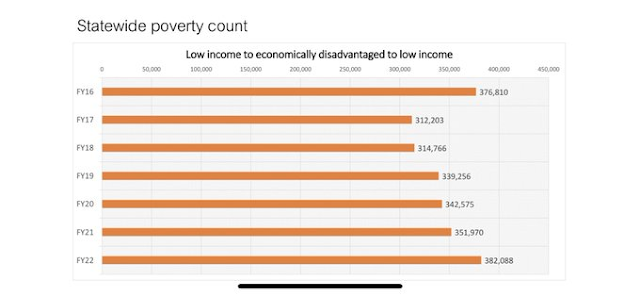
The Chapter 70 state aid recommendation is $5.9 billion, supporting a $12.8 billion foundation budget for K-12 education statewide. You'll note that this is less than half of it, which is by design; the foundation budget is designed to be funded 59% with local funds. The recommendation is a second one-sixth step towards the goal rates of the Student Opportunity Act, increased by inflation. That's in the rates for the health insurance, special education out-of-district, English learners, guidance, and low income students. This also increases the assumed in-district special education enrollment to 3.86% (4.86% for vocational), towards the goal of 4% (5% for vocational). It does again use 12 tiers for low income students. The October 1 (2021) count on which this budget is based increased the statewide low income enrollment count by 25,413 students; some of that probably is additional students who are poor, but some of that is better recognition of what already was, as I've been tracking here:
The calculation uses the 4.5% inflation rate cap of the Student Opportunity Act, as the actual inflation rate would be 5.9%, so, if that was your bet on what Baker would do, you won. The calculation uses 4.51% for inflation for health insurance, which is better than it has been. The budget holds districts harmless on funding—no district sees a drop in Chapter 70 aid alone--as well as a $30 per pupil minimum increase for districts, both of which are of course in the Student Opportunity Act.
My quick look at some districts shows some real impact on that poverty rate growth kicking in. Orange, for example, made its way out of hold harmless and into foundation aid. Mohawk Trail ate through $1M of their hold harmless this past year. We're getting there!
The circuit breaker reimbursement increases in this proposed budget from $393 million to $414 million; there's another round of the phase in of transportation reimbursement again this year as part of the implementation of the Student Opportunity Act.
Charter school reimbursement increases from $154 million to $219 million. There are three things going on here. The increases in charter school tuition stemming from the increases in the foundation budget must then be offset by reimbursement. The next step in the phase in to fully funding 100% of charter reimbursement is also in here. The state is funding the next step, which is 90%, though the actual text of the SOA says in FY23, it will be 100%. They're following the phase in by year. In outside section 40, the proposed budget adds a proposed increase to the charter school facilities per pupil increment to $1088, which then would be tied to inflation. As that funding flows through charter tuition coming from Chapter 70, it then also creates a need for reimbursement initially.
Regional transportation reimbursement, funded last year at $82 million, is proposed this year at $77 million. We sometimes forget, I think, that this is a reimbursement account; it's based on completed actual spending. Some of that drop here is reflecting the drop in transportation spending during remote learning in the year from which estimates are drawn.
Homeless student transportation funding is proposed for a substantive increase “to meet need,” from $14.4 million currently to $22.9 million for FY23, which seems wise.
METCO, funded last year at $28.5 million, is proposed in the Governor’s budget at $27.9 million.
Targeted intervention services, budgeted this current year for $17 million, is proposed to be cut this coming year to $10.3 million. Similarly, after and out of school grants, budgeted currently for $17 million, is proposed to be cut to $10.5 million. Extended learning grants, funded at $9.9 million this year, is cut to nothing. The regionalization grant to likewise cut to zero.
...all of which is rather depressing.
On the other hand, two of Baker's favorite projects, early college and vocational education, are proposed for grant increases. He proposes a substantial increase in the early college program, funded this year at $5 million, to $9.5 million. What had been the Innovation Pathways program, he renames “Career Technical Partnership Grants,” raising the funding from $600,000 to $4.8 million.
And for reasons I cannot decipher, the Executive Office of Education--that is, Secretary Peyser's office-- more than doubles from $2.3 million to $4.4 million, “to meet projected need and support new initiatives." I have no idea what that means, nor can I find anything further.

