Showing posts with label online. Show all posts

Sunday, August 9, 2026

As Massachusetts now has the lottery online...

 ...it might be good to remember that more teens are getting hooked on gambling:

A recent national survey from Common Sense Media found that 36% of boys age 11 to 17 in the U.S. have gambled in the past year.

"It's a lot of kids," says Michael Robb, the head of research at Common Sense Media, a nonprofit that promotes digital safety for kids. "A third of kids is a lot of kids."

Tuesday, October 28, 2025

Monday, November 11, 2024

🚩🚩🚩for schools now


Consider this the red flag for schools now: 

Girls in schools report being harassed in school, online, and elsewhere, part of a larger trend of misogyny exploding online since Tuesday. 

LGBTQ teen suicide hotlines have seen a spike since Tuesday.

Racist texts were sent to Black people nationally after Tuesday, including to children in Massachusetts.


For all of us in education, this is result of Tuesday. And it is now our problem. 

Thursday, August 1, 2024

KOSA is dead in the House

 Punchbowl News is reporting this morning that the House leadership won't bring it up.

While that may be for the wrong reasons, we'll take the win! 

Do note that there is still a House version of the bill, though time is limited and the Senate wouldn't pass what the House has.
If you haven't weighed in with your rep, it is still not a bad idea to do so, but take the win we got, too!

Wednesday, July 31, 2024

The Senate passed the Kids Online Safety Act, which is still bad

 I wouldn't read the mainstream press which is all "groundbreaking blah blah blah" but maybe look at The Verge. It's good to read the Electronic Frontier Foundation and Stop KOSA.
And as a reminder, here's my post on this from January. While the bill has changed a bit, the main issues with it remain.


..we can only hope that it tanks in the House.

If you're planning on contacting your rep (please do), you might find some of what is in this The 74 piece (in addition to the EFF and Stop KOSA links above) useful. 

Wednesday, May 29, 2024

Some things to read this last week of May

I tend to share most of my "here read this" stuff on Twitter* but for those who might find another location more congenial:


___________________________________________________

*it's Twitter. It will always be Twitter. Surrender already, dude.

Friday, January 5, 2024

Why the Kids Online Safety Act isn't

Here's one I have been intending to post about for awhile!

A bill called the "Kids Online Safety Act" sounds like motherhood and apple pie, right? Surely we all want kids to be safe online?

But much like housing developments that are named "Fox Run" or "Maple Grove" or otherwise after things that are not there, KOSA would in fact make kids--and a very particular kids about whom we already have reason to worry--much less safe online. 

This is Shadow.
Shadow is a sheep who lives in Worcester and is not a wolf pretending to be a sheep.

Wednesday, May 27, 2020

Creating the least bad option

The follow-up to last night's post
Let me preface this (again) by noting that I have next to no say over any of this, in any of my capacities.

And let me add (again) that I am speaking only for myself.

I fear that in the entirely legitimate concerns over what kids are losing by not being in school--food, mental health support, physical activity, along with education--we may have lost sight of the overarching concern of the time:
we are in a pandemic


As of today, more than 100,000 American people--that would be, for example, more than half the population of Worcester--have died of this disease, most of them in the past two months. That is almost certainly an undercount. And we are early in this outbreak in the U.S..

Internationally, more than 350,000 people have died. That's as if we lost all of Anaheim.
The highest risk category for coronavirus includes one-third of American teachers, as well as significant numbers of school staff.

Risks are also particularly high if you are Latinx, or Black, or Native American, or poor. 
Some people who don't die get very sick.
That includes children.
It also includes particular high risk categories, which also includes children.

Antibody testing, as yet, is unreliable, and we don't know yet if you can get it again.
To create herd immunity, 70-90% of a population needs to have immunity; we don't know for sure yet, but most estimates have us in the U.S. at below 10% exposure at this point.
And herd immunity alone isn't a solution. 

In short, we are putting the actual lives of children and school staff up against their education.
People who gather together share this disease, and then people die of this disease.
We need to not do that.

What then, are we do to?
I've heard several times lately that there is no good option: there are only bad options, and we should choose or create the least bad option possible.

To start: we need to stop and make an actual plan this time. We went flying out of schools in mid-March as if the buildings were on fire. We needed to do that, and some districts and schools managed better than others, but now we have a chance to take a breath.

We're also going to need resources, and thus, if you're reading this, here's your one ask from me: send an email to Congress and tell them we need funds for public education. Only the federal government has the resources to pull off what is needed here.

I've seen lots of citing of "Maslow before Bloom" over the course of the time we've been out: in essence, that people's basic needs of things like physical safety and enough to eat must be met before their learning needs are. It is what was recognized when the first order of business for schools was to feed kids.

And so, first: we feed kids. Right now, we're missing thousands of kids across the state: Multiply that across the country, and we have millions of kids who are missing meals.
First order of business then is do what it takes to make sure kids are fed. There are lots of models out there: deliveries are happening in some districts, some have added adult meals (without reimbursement), and the P-EBT benefit is also designed to help with that. Nationally, food insecurity is growing during the pandemic. The numbers we had for free and reduced lunch qualification in mid-March are bound to be wrong right now; we should update those numbers, as we can.
But above all: Get food to kids who need food, whoever they are, wherever they are, whatever their need.

Then, we make sure they're connected, so we can make sure they're well.
We need internet connections to every kid, no matter where they are. This is now a necessity. This isn't only about schools: it's about medicine, jobs, food...you need connection to do it. Some have made the parallel with rural electrification, in it being a matter of public interest and equity to get such access. Obviously, a federal effort on that would be ideal. Lacking that, state efforts, local efforts need to be organized such that families aren't without or dependent on making a cell phone data payment for access.
I would argue that if schools require it, districts should pay for it, but if it is used beyond that, then that could be broader.
This means, by the way, that we also need to have conversations around things like bandwidth, because some families, but also some communities, are maxed out.
Likewise, no more essays on cell phones or sharing devices. We're not sharing slates or spellers in colonial times: every student has a laptop or something of its ilk to do their work on.
We also need to recognize: kids are going to socialize on these, too. That's also part of school.
We find every kid, though, and we connect every kid.

That, of course, doesn't get us too much farther forward than we are now, save fixing some of what's broken. Next we try being actively constructive.
This takes first noting that the pandemic has hit kids inequitably. There are students right now who need more support than others. This is where our taking a breath comes in: What do those students need? How do we meet those needs?

Most of our students are going to need to feel connected. It's going to be hard to have that connection, starting off a new year with new teachers and classmates. Some have suggested looping classes, having students stay with the same teacher and classmates for another year; this gives the added benefit of perhaps having the teacher coming in with an idea of where students are at as the year begins. That won't work for everyone, though, but each student should have an adult (at least one!) who is their link to the school. Some schools have homeroom teachers for this; some have mentoring groups; with buildings closed, it is possible that this could extend beyond teachers. Students need a home base, though, from which to start. This means taking stock of each student before school starts to base the year off those connections.  For the adults: those are their kids. For the kids, this is their link to the school and district.

Some students need mental health supports. Much like everything else, this is harder to even figure out when we aren't seeing students in person. Persistence in who have we heard from and who haven't we heard from is one way, particularly through their connection with the school. Some of this can be over video, but sometimes the connection may be written. Some may be over the phone. In some cases--and this isn't the only time I am going to suggest this--maybe we are finding a way to get students someone in person, but through a glass door.
This is probably going to take more staff than we have now, too, and it's not the last time I am going to make that observation, either. Student mental health needs are higher than ever during the pandemic, and if we're going to get students through this as healthy as possible, then we need to meet that need.
As a note to this: we also know that some kids aren't safe where they are, making those connections with other adults crucial. 

The pandemic has been particularly difficult for students with special needs and their families. This has been a really hard one for schools, and there is no easy answer at all. It is another one, though, where the level of staffing, and the level of connection with families, makes a huge difference. Some of this can be done via video. Some students, though, don't respond to that. How do we get students their connections with staff members? And how to we actually PARTNER with families--who, after all, are doing much of the lifting on this--to meet student needs? Can we send people to porches and windows? I know of examples of aides moving in with families (and thus becoming part of their 'pandemic pod'). Can we somehow directly support families that are most strained by this? 

We have large numbers of students whose first language isn't English and whose families may not speak English at all. First, we've got to stop sending work home to these children in English; that makes no sense! Translation programs, with all due respect to Google, aren't that strong. Here's another staffing issue: we need more people who work for districts who speak the languages that students do at home, and that can connect with families where they're at. It is difficult to do that well if we don't have people working with them and for us who can speak and listen directly.

Not everything can be done on a computer, and families need to not be trying to scramble to get students what they need for school during a pandemic. Students need school supplies: they need paper and pencils and crayons and art supplies and science kits. If students are learning at home, they need those supplies at home. For little kids in particular, learning means hands-on materials. We need to not assume that families have blocks or markers or whatever else is needed for school. 
Note that for gym class and art class and music class, that may mean something different. Nerves would probably be strained unduly if we gave every student a recorder, but music and art should be made as well as studied (it's in the standards!) and keeping students active is essential. Worcester Hearts Connected has made a start on that last, if you're looking for examples.
That last means a renewed emphasis from the state, incidentally, that outdoor time and recess time and gym time are part of school time. School time doesn't mean you've spent hours in front of a Chromebook, home or no.

One of the disparities for students is a quiet space to work. Here is the one place that I would open buildings, but with strict scheduling for those who live together and limited access and lots of cleaning. Giving students and their families, if needed, space that is quiet to work through their math or read, if that isn't possible with limited space at home is part of attempting to make up for equity gaps. 

Little kids in particular struggle to learn remotely, and for them, we should bring our student/adult ratio WAY down, and flood early elementary with people. Unemployment is up; we have everything from students talking about taking gap years to college graduates looking for work to people sidelined by the economic downturn. CORI them all, get them some training, and create a teaching assistant corps.
Note here: assistant corps. I'm under absolutely no illusions about what it takes to teach elementary school, and that can't be replicated short term (regardless of what particular national programs may have done). But what would be stations in elementary school are not something one can replicate well online. Teachers teach; assistants ensure that students are connected to the learning by getting it to them.

For all students, we always start by finding out where we are. The level of online reaction (to put it mildly) to the not-revolutionary notion that we assess kids as they come back has been...something. Teachers have always need to figure out what kids know and can do before they move forward with teaching them. That is significantly more true than it ever was before this year, as some students will have continued moving forward (and may even have leapt well ahead of what would otherwise have been intended for them), and some have slid during their time away.
I have seen some suggestions, relatedly, that moving to a mastery based system, as Cleveland is considering doing, would be a timely switch. This means each student fully learns the skill or material before moving on. As students are coming in next year in radically different places from one another--always true, but more true now!--they need to start different places. They'll take different amounts of time to get to where they need to be--also always true!--so maybe it is time to make that how this works.

And speaking of teachers and of staff: first, let's get them a break, for sure, as this spring has been exhausting. Then, let's look at their needs, too. Some of them are working from home with their own kids; how do we as districts and as schools effectively work to help teachers and staff balance their home lives while teaching? What does that look like around time and scheduling and planning? If we are going to do this for an extended period of time, we need to actively be seeking solutions to that issue.
Next, what do staff need to be able to do this work well? I've seen a BIG push on tech training, which is understandable, and in many cases, was needed. But we are also talking about a societal trauma on a scale not seen in decades. We're trying to teach students in a way that hasn't been done on this scale ever. We're watching inequities grow vastly right in front of us. We are having to reach students in their homes with their families. What does that mean both for professional development and for staff support? What do staff and teachers need to connect with students, to keep and get students engaged, to actively work to overcome inequities, and to not burn out themselves? That's work that needs to start this summer and continue through the year.
This means that cultural competency has never been more important: knowing and appreciating the strengths of families is crucial to connection.

The above doesn't, of course, solve anywhere near anything. 
It won't, of course, make up for what we're missing by not having school in person. 
As best as I can tell, though, the real push to have school in person is coming less from educators, and more from those who see schools as a way of "restarting" the economy. I'd suggest we need to consider the health and well-being of people ahead of that. 

While the above doesn't fix education, it might, though, keep schools from killing people. 

Sunday, May 10, 2020

Chromebooks, Worcester, and civil rights

Regarding today's T&G article from Thursday's Worcester School Committee meeting, as I've noted on Twitter:

  • A. You are reading correctly that the Worcester Public Schools are starting Chromebook distribution this Friday, two months after we left school buildings.
  • B. During that time, a single packet of material was mailed to students early on. This was followed by a second one this past week. All other material was accessible only online.
  • C. I don’t think I need to run through our Worcester stats, but our information on where our kids are at on access has been...slow to create. Beyond individual teacher and school efforts, the district didn’t push til about three weeks ago. This despite a report on access in October of last year which noted that more than a quarter of our students lack access at home (and that report didn’t differentiate how much of that access was via data on a cell phone).
  • D. As I have mentioned here and elsewhere, the lag has much less to do with the city—who it seems simply were unhappy with whatever the plans were to distribute—and much more with it simply not happening at all for weeks and weeks. Thus my example on grass clippings—and yes, Worcester *has* opened our yard waste sites—isn’t a critique of public health but is expressing my disbelief that somehow no-contact device distribution is being barred. In short: I doubt that was what was barred.
  • E. Finally, yes, access to education is a civil rights issue. Providing that access is our job. If that couldn’t be done through technology, it needed to be done otherwise. But providing it only or largely via technology without providing that technology *creates* an equity issue.
  • And PS: while my district has just made itself the example of this, this is a much bigger issue than Worcester. Running our K-12 “public” education system on Mom and Dad paying Spectrum and anteing up for a laptop isn’t our Constitutional mandate.

Friday, May 8, 2020

At my OLD school, we...(Worcester School Committee, May 7 meeting notes)

It feels only right as we complete eight weeks of not going to school and instead...whatever it is we are doing, that we open with some acknowledgement:
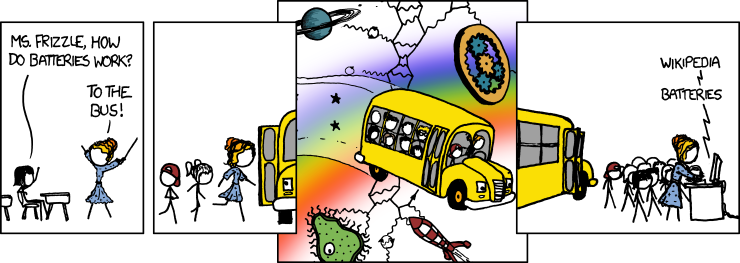
Magic School Bus
xkcd 911: Magic School Bus
Title text: At my OLD school, we used Microsoft Encarta 2005.

Last night's Worcester School Committee opened with an executive session that started at 5:30, went to public session around 6:45 which lasted until 9:45, and then continued in executive session until 11.
That's a five and a half hour meeting. 
At administrative request, we took the request to purchase new geography texts out of order (it was late on the agenda). I think it's important to note here that general process is that new texts are sent to Teaching, Learning, and Student Support for vetting before coming back to the full Committee for approval. Curricular approval remains with the Committee in Massachusetts. The administration argued that the item needed to go through now so teachers could receive training in the new texts (which, to be frank, doesn't make a lot of sense to me); I believe there probably also is a budgetary issue here with when things need to be ordered in order to clear the fiscal year. The issues I have with this, and thus why I voted against this, are two-fold: poor time management on the part of administration shouldn't be a regular reason to circumvent process (and it seems to be a habit); and second, why are we buying geography textbooks? Had this gone to subcommittee, processwise, I would have asked that there, but this didn't give time or space for such a discussion.
In any event, it passed 6-1.

We next moved into something we haven't done before, done at student request: we had our student reps and some of those on the Superintendent's student advisory council meet with us. I have put my notes from that section over here. Mayor Petty closed by saying we'll do this again soon; I personally hope they plan to attend our budget hearing (which should be at our next meeting?).

We then had a series of teachers and staff testify about their experiences with remote learning. Let me just note here that the School Committee has been receiving a constant stream of messages from teachers about their working conditions around remote learning, particularly when it comes to the tracking that is being required, the communication, and consistency across the district. The testimony offered last night was of a piece with that, as Scott O'Connell covered in the Telegram & Gazette today. We're actually in negotiations right now--thus the lengthy executive sessions--so I won't say more than that, other than to encourage those concerned to keep contacting us.

The response to Mrs. Clancey's item on special education meetings came in at about 1:25, so for families to which that is of interest, you might pick up there in the video. While there are IEP meetings being scheduled during the school shutdown, they're being triaged, with students in transition (particularly those aging out of the public schools) going first.

The response of administration to a request for clarification on the source of work gave as backup the state's April 24 guidance as well as both the elementary and secondary standards for what is needed for the next grade (I have that all saved here, if that's useful.) That, not surprisingly, led to a fairly lengthy discussion (starts about 1:27) around remote learning in the district at this time. A few things that were repeatedly brought up by more than one of us: 
  • There continues to be a massive gap around access. The district isn't, for example, giving out Chromebooks to any students beyond the handful that have gone to special education and homeless students for another week, despite our being eight weeks into this, and despite more districts that I can name coming up with little to no contact ways of having given out literally thousands of devices across the state. We also have done nothing on access beyond pointing students to Spectrum offers and free hotspots. At the same time, the district has mailed out one paper packet of work over the preceding seven weeks; the work has been pushed out online. . "We have failed our students...We could have found a way to get these Chromebooks into the hands of these kids much faster," is what Mr. Foley said, and I agree.
    As I noted, the response we repeatedly got from administration was that the city said no. However, the city has also provided for (these are my examples) me to be able to eat a hamburger from the Fix, a pizza from Blue Jeans, a McFlurry via a drive-thru, and buy a plant for my mother for Mother's day; plus this week we're opening up the yard waste site. It has to have to do with how administration was describing what was going to happen in pick-up or drop-off of Chromebooks, as otherwise, this doesn't make sense in terms of the health guidance the city has been given.
    To his credit, Mayor Petty said that he'd work with the city to come up with a way to get it done sooner.
    Superintendent Binienda then said it would not be possible for the district organize sooner.
  • Even for those with access, we aren't being thoughtful on use. We have been told that schools will be requiring (!) attendance for particular classes at particular times starting next week. As Ms. McCullough noted, this presents a very big problem for families with multiple children. If you have one device, who gets it if the times overlap (which they well might, if you have students at multiple schools)? And how much bandwidth does your family have? You aren't--I speak here from personal experience, as a parent who has had a college student home doing courses online--going to have enough. Both are why districts are specifically advised against having synchronous lessons online (check page 12 of the state guidance linked above). They create an equity issue.
As a side note, we still have an outstanding item to schedule a town hall, which I know we'll be following up on.

Miss Biancheria noted that the High School Voter Registration and Pre-Registration Grant that we were being asked to vote to accept need to have half of it used by June, which seems complicated with school not meeting. The administration plans to have this organized online.

Miss Biancheria also had filed an item requesting additional information about the acquisition of the property adjoining Roosevelt Elementary for traffic flow.

There were also a series of items that went to administration regarding, in essence, school being closed:

  • Request that the Administration provide a report with a breakdown by high school for seniors regarding reimbursements for all trips, events, graduations and any other costs. In addition, provide an additional report for all student events and trips that have been paid for and need to be reimbursed. This, because we've gotten some uneven reports over if seniors are getting funds paid to schools for senior activities that are not happening refunded to them. Ms. McCullough expanded this item to include all students in the report.
  • To forward a letter to Congressman McGovern to support the Emergency Education Connection Act of 2020 to ensure that K-12 students can be connected and continue online learning and instruction.
  • Request that the Administration provide a report on the district’s plan to enhance extended learning for the remainder of the school year that will ensure students are meeting the standards and are ready for the next grade level. 
  • Request that the Administration report on the number of seniors eligible for the modified competency determination as passed by the Massachusetts Board of Education on April 28 and the process through which their application for competency will be submitted. This is the MCAS thing.
  • Request that the Administration consider the number of Worcester Public Schools’ students in a family in the distribution of district Chromebooks. This is happening, but the second and third rounds of Chromebooks won't go out until the week of May 25 for elementary and middle and the week of June 8 for high school, with the ultimate goal of every district family being 2-1 on Chromebooks. That's at 2:14 on the video, if you'd like to hear that. The Mayor has also put together a group to be working on internet connections. 
  • To clarify the structure of the feedback rubric vis-à-vis district assigned work versus extended work. We have had students being told they can't get a 4 unless they do, in essence, extra work. This item led to the Superintendent clarifying that no points can have been earned toward final grades so far; that is only to be going forward. Students who do not have online access are to take photos with their phones and email them to teachers; failing that, teachers will be calling.
  • To create and administer a survey for students, families, and staff regarding current remote learning, to inform Phase III remote learning planning and work. We sent this to Governance, which meets this Wednesday.
  • To clarify the district’s directive requiring the recording of teacher-student interactions. This has come up a LOT in discussions with teachers. That starts about about 2:38, but takes a substantial sidetrack around recording online interactions, but the crux of documenting interactions starts more like 2:47. 
Our next meeting is May 21, which should include a public budget hearing. 

Tuesday, May 5, 2020

About the state's remote learning guidance

Yes, I'm way behind on things like this...sigh
I finally had a chance to review the state's new guidance on remote learning which came out on April 24. While the guidance is directed at school leadership, it isn't (I think) particularly removed, so it's worth a read if this is of interest.
From our home chalkboard after Governor Baker's announcement
As noted at the Board of Ed meeting last week, the Commissioner has been conceiving of this in four phases: Phase I was responding to the crisis of closing the buildings and getting students fed, Phase II was the response to being closed til May 4, and this guidance is for Phase III, being closed to the end of the school year. Phase IV will be work around reopening. The intent was for districts to be moving to Phase III in "early May," which would be...now?
The Commissioner's opening letter says that this third phase focuses on two areas:
  • further defining the recommended elements of a quality remote learning program, including focus on teaching the content standards most critical for student success in the next grade level
  • encouraging districts to move all students towards successful engagement in remote learning, with a focus on addressing fundamental needs
Okay, maybe some of this is a little lingo-y...the first is basically "what do you need to know and be able do to go on to the next grade?" and the second is "are kids actually being met and are their needs being met?" The "what do you need to know" lists are here for elementary and for secondary, if you're interested.

DESE plans to conduct surveys and interviews to "listen and learn" in the coming weeks, plus share best practices and professional development, issue updated family guidance, and build out their website with resources (That's a completely revamped front page).
They also (in a section puzzlingly called "continuing to address students' and families' technology needs" which I don't think has been done at all) will be working "to identify the most efficient and effective plan to make technology available" to families across the Commonwealth. This--and yes, as a member of the Worcester School Committee, I am well aware of my glass house on this one--isn't, as far as I know, something DESE has been particularly involved in, beyond, perhaps, having had something to do with the additional hot spots that went out to towns two weeks ago.

DESE notes that their initial guidance called for "meaningful and productive learning" for about half a school day, repeating that such time isn't going to be all direct instruction. They also further note that what it looks like will vary by age, individual and family need, access, and "critical wellness and readiness factors."
In terms of grading, the department continues to advocate to promote students, and says "[s]pecific high school guidance on grading and graduation will be forthcoming." Two things on this:

  1. Not actually under DESE's purview (like AT ALL)
  2. It's May. It's a little late. 

And so on to the guidance.
The state notes that this experience involves families to an unprecedented degree; I do wish that we were spending more of our attention on this. When the state issues guidance for education right now, and when a district sends out its plan, it has an impact on families far beyond what any K-12 decision usually does. My sense is that some districts are doing well on establishing a feedback loop on what's working and what's not, but thinking of families as to whatever degree possible co-workers in this would be, I think, valuable.

It's right there in bold:
Equity needs to be a top consideration in local planning efforts, especially as districts and schools make plans to manage an extended closure.
Something that I think is crucial to recognize in all of this is that the students who left our classrooms in mid-March are not the same students that are being reached now: we don't know who has lost relatives, whose parents have lost jobs, who is living with family tensions of new levels, and so on. What might have looked like equity--whether or not it was--in mid-March may not be equity now.

Someone, at some point, needs to write the piece that points out that our K-12 public education system right now is running largely on the ability of families to have spend a few hundred dollars on a Chromebook per child and to keep up with their internet bills.
No Chromebook? No wifi? No education.
Yes, there are exceptions (either through school provided devices and wifi or through paper packets), but they are very much exceptions.
I have yet to see this be written about, let alone managed around, in any real way. Access to public education depends now more than it has in some time on individual (not even local community) resources.
And that's just wrong.

Maintaining connections is what is most important "particularly for the most vulnerable members of our school communities." That brings me back to this post I shared earlier this week, because we must be incredibly mindful in our planning of check-ins that this is done in a way that communicates real concern, not in a way that is another checkbox, let alone one that puts people in further turmoil. Teachers who fear to express how difficult a time they are having, lest there be professional repercussions; parents who are concerned they'll be reported if they speak of their difficulties; students who are worried they'll get in trouble if they note how hard it is...all of these are things I've had shared with me these past weeks. As organizations, we are, to some degree, depending here on relationships already forged in past times. If those relationships lacked trust, these times of remoteness may well make them worse, and expressions of concern and inquiries about well-being can have the opposite effect.

In strengthening--which itself is interesting framing?--remote learning, DESE recommends districts:

  1. prioritize meaningful connections with educators and peers
    These should be "woven throughout core instruction and enrichment opportunities." In other words: BE IN TOUCH WITH YOUR KIDS. I note that all of the examples given involve online access.
  2. providing engaging (important word!) core instruction focused on the prerequisite standards that are most critical of student success for the next grade.
    This is the "are they going to be ready for next year?" bit. Engagement per the guidance is "more important than ever." Also, districts are to offer a "manageable number of lessons and assignments."
  3. offer opportunities for enrichment, exercise, and play.
    I have yet--and I may just not have seen it--seen "play" put forward anywhere as a priority. Can we embrace this chance?
  4. ensure programming is accessible and secure and communication streamlined for students and their families.Give weekly doses of assignments, send ONE email of the assignments and meeting times, provide a weekly checklist, be clear on what is required and what is optional, and align communication, and STREAMLINE. To which I would add "make it accessible and user-friendly."
    Also, it is recommended districts NOT have synchronous lessons, speaking of equity.

For students not engaged, DESE recommends that information be collected, and then that the district provide supports for meeting the student's needs to become engaged. Further along, they note that this isn't necessarily going to be easy, and that it may also be outside the ability of the district: students may lack devices, they may lack wifi, they may be watching younger siblings, they may lack a home...some of this is bigger than us.
There is also a LOT here about not replicating effort: evaluating who has relationships with students, and thinking of outreach beyond the classroom teacher, but NOT having every single (for example) secondary teacher tracking every single student: "split up responsibility" is how the guidance puts it.
And then: 
Collecting data is essential; however, the most important thing is how districts and schools respond to this information.
Considering, for example, WHY students are not engaging and then HOW the district meets that challenge is essential (rather than something to be dismissed). Later on, the guidance discusses this in terms of  tiered instructional support: tier 1, 2, and 3 needs. If a fifth of your students lack online access, that's a tier 1 need, and your district needs to be planning around that, and likewise with whatever the need is.

Note that there are appendices giving some back-up resources.
And so the baton is passed again to the districts, who should, we hope, be taking this chance to consider again what is working and what is not and who is not being reached and why. 


Tuesday, June 11, 2019

Access matters

Yesterday, MassLive noted the lack of home internet access among two groups of students: those in rural areas (still an issue) and those (of low income) in urban areas. MassLive notes how Springfield and Holyoke have worked with families on this:
At the beginning of every school year, Springfield and Holyoke families can purchase internet services through Comcast at a discount — $9.95 a month, with the option to purchase an internet-ready computer for less than $150. Households with school-age children eligible for free and reduced-price lunches, all households living in U.S. Department of Housing and Urban Development-assisted housing and low-income veterans are eligible for the Internet Essentials program.
That's in addition to Springfield having a one-to-one program from grade 3 up, with high school students able to bring them home, and Holyoke having free mobile devices in their middle schools.

As for Worcester? While the push to do work online at the secondary level is the same here, there has been no district effort to work with families on home access; it's been years since the district even surveyed internet access, let alone device access. While the student in this AP article is in Hartford, her experience is something some Worcester students experience as well:
With no computer or internet at home, Raegan Byrd's homework assignments present a nightly challenge: How much can she get done using just her smartphone?
On the tiny screen, she switches between web pages for research projects, losing track of tabs whenever friends send messages. She uses her thumbs to tap out school papers, but when glitches keep her from submitting assignments electronically, she writes them out by hand.
"At least I have something, instead of nothing, to explain the situation," said Raegan, a high school senior in Hartford.
 In Massachusetts, requiring students to depend on family access without providing such access is in violation of a free public education. Per DESE guidance of November 2016 (note that's a doc; page 10):
1. Are schools obligated to provide students with a device if one is required for learning and instruction? 
Yes. Under Chapter 71, Section 48 of the Massachusetts General Laws, schools must purchase at public expense textbooks and other instructional materials and supplies intended for use and re-use over a period of years. Schools then in turn "loan" those instructional materials free of charge to students, who must return them at the end of the school year.
Costly tools such as a tablet or other computer or graphing calculator fall in the category of instructional materials and supplies that, similar to textbooks, are intended for schools to purchase and use and re-use over a period of years. If such technology is required, schools may encourage each student to purchase these devices. Students are likely to do so because they may need those devices for future classes and other use outside of school. Schools are advised to be prepared to provide such devices free of charge to students whose families do not choose to buy them or cannot afford to do so. If students need such devices to complete out-of-school assignments, schools must provide that access.
Students need such devices to complete out-of-school assignments in Worcester.

Sunday, February 26, 2017

Worcester School Committee meets Thursday, March 2

Looks like a light agenda! 
There is no report of the superintendent.
There are no reports of subcommittees.
There are a number of congratulations.
There is a request from Miss McCullough for a report on bus tracking; note that this has been raised before.
There is a request that the committee accept $305.00 from the Tri State Truck Center, Inc. to the South High Community School’s Diesel Technician Training Program for the cost of a bus for a field trip.
Mayor Petty is asking about soccer for the Main South high schools.
Ms. Colorio is requesting a report on online learning.
She is also asking how many teachers were on administrative leave.

Administration is asking that the following courses be approved (note that this will go to TLSS for consideration; right now there's no information on the courses):
English Composition & Literature I
The Development of Early Civilizations
Science Engineering & Technology I
Advanced Seminar (in what?)

There is also an executive session on (you guessed it!) PCBs, negotiations with the teachers, and a grievance from an HVAC employee.


OH! And note that the WPS Facebook page has moved and is now here.

Tuesday, November 29, 2016

MCAS 2.0 standard setting

backup is here
download description here
Wulfson "staff has been creating a great deal of guidance"
"much of the effort over the past...has been around mode choice selection"
(that's who is using computers)
96-97% responded: test as much as possible in 4 and 8 on computers; low 90's
free choice on remaining; about 40% testing online
Stewart: what some of the priorities have been in developing the test?
Wulfson: around standards
tradeoffs on lengths of test and number of categories reported
testing time issue: minimize time while still making sure results are valid
"would have preferred to have an additional year...very aggressive timetable"
"will be a year or two as we fine tune the test"
discussions of the high school test; options for high school testing
next month, plus continuation in January with Board of Higher Ed
MCAS-Alt: as required by ESSA limits to having no more than 1% of students taking that version of test
"will create some logistical issues"
that decision is made by each individual IEP team
terminology when used to report results
circulating through the field and come back to Board in February for further discussion and a decision
Proposal is:
  • exceeding expectations
  • meeting expectations
  • partially meeting expectations
  • not yet meeting expectations
Intended for audience of parents and students; wanted to signal that there's additional work that needs to be done, additional supports to be provided by the school
Peyser: "partially meeting" and "not yet meeting" seems like it could be the same thing
Noyce: discussion around need for a big wakeup call versus need to be encouraging
Wulfson positive, but wanting to give a wake up call as needed


Friday, August 12, 2016

Familiarity with technology makes a difference in testing

See if you can spot the gap in this article from the Herald:
Over the next three years, all Massachusetts students will be taking standardized tests on computers — a transition some school leaders caution may put inner city kids and budgets at a disadvantage. 
“There is a bit of a problem in places like Worcester. Our population is not as economically advantaged as other parts of the state. Some districts have laptops for every kid,” said David Perda, chief research and accountability officer in Worcester Public Schools 
“We’re working very hard to provide the kind of technological support for our students,” said Dan Warwick, superintendent of Springfield Public Schools. “The problem is some of our kids haven’t had enough exposure.” 
But state education officials said the move is appropriate as more students use technology out of the classroom. “It also reflects the reality that students are increasingly using technology in and out of the classroom to learn and to produce written work,” Mitchell D. Chester, the state’s commissioner of elementary and secondary education, said in a letter to superintendents.
Some of them aren't, though. That's the point.

Friday, June 24, 2016

Massachusetts testing update

Two things:

  • The state has awarded the testing contract to Measured Progress, who currently hold the MCAS contract. This would not be noteworthy were it not that their subcontractor is Pearson.


  • The following update was sent out by DESE earlier today regarding computer assessment:

  • After consultation with the Test Administration Workgroup and other stakeholders, the Department has decided to implement a gradual transition plan to phase in computer-based testing. We hope this will make the transition more manageable for school and district staff. Here are the details: 
    · For next year’s tests (spring 2017), our expectation is that all schools will administer the computer-based versions of the ELA and math tests in grades 4 and 8.[1] · The Department’s Office of Digital Learning will provide consultation and support for schools that anticipate difficulty in meeting this requirement. In exceptional circumstances, we will waive the spring 2017 requirement if the school has made a good-faith effort to comply and has a plan for getting on track by spring 2018. 
    · For grades 3, 5, 6, and 7, schools may elect either the computer-based or the paper-based tests next spring. We strongly encourage districts to implement the computer-based version in as many additional grades as possible. The Board’s “hold harmless” policy with respect to school level determinations next year provides a good opportunity for students, teachers, and administrators to gain experience with computer-based testing. · Paper versions of all tests will always be available as an accommodation as required by a student’s individualized education program (IEP). We also anticipate setting up a process for principals to request a paper-based test accommodation for a small number of students who do not have IEPs but who are unable to take a computer-based test for other reasons. 
    · We are currently considering a transition in grades 5 and 7 to full computer-based testing in spring 2018, followed by grades 3 and 6 in spring 2019. We’ll finalize this schedule after the 2017 test administration and after plans for high school testing are finalized. 
    It is the Department’s intention to develop a test that is compatible with most of the devices in common use in schools, including tablets, Chromebooks, laptops, and desktop computers. In the coming weeks, we will be finalizing our selection of the next-generation MCAS testing contractor. After that is completed, we will provide additional details regarding the technical specifications for networks and devices. Additionally, we plan to announce funding opportunities for infrastructure upgrades later this summer.

    Tuesday, May 24, 2016

    Update on MCAS 2.0: May Board of Ed meeting

    The backup is here
    Sagan: will do as a review of the assessment committee meeting
    "very interesting time"
    coming to the end of statewide testing this year and we just got the deadline for the RFP for the next test
    on schedule, but it's a very aggressive one
    "fewer issues this year than last year" with online testing
    also had fewer schools taking it online this year than last year
    any change in test refusal? No change
    still appears to be a very small number
    70% PARCC 30% MCAS
    "won't be a state number" as a one time thing
    "nothing we can do about it"
    Two bids for next text: one from AIR, one from Measured Progress
    update of curriculum frameworks : 300 applicants to be on the committee
    seems to be going extremely well
    "how do we manage the level in the next generation test?"
    will hear what you're changing, what you're not changing
    district technology preparedness
    too early to be alarmed at responses to E-rate (MA districts have requested a total of $48.6M)
    Sagan: need to think of summer schedule

    Wulfson: would be remiss if didn't express appreciation to educators across the state in working through test and standards
    budget for assessment: Legislature level funded
    "is not going to be sufficient to do everything we want it to do in a high quality way"
    wait until after vendor selection and come up with a hard contract

    Sagan: parallel negotiation with PARCC regarding rights
    Stewart: intellectual property component (see here for why this is relevant)
    Commissioner has said it will allow us to retain control over material
    Wulfson passes to someone else...intellectual property
    exist right now collectively among the member states in the consortium
    has been established through the life of the consortium
    there are layers to it: materials that were developed through Race to the Top funding: those questions will be available and available publicly
    some questions developed with each state's contract with Pearson
    "it would be difficult for states to individually police questions"
    as we move out of consortium this will change
    need to develop a licensing agreement
    will be buying content from PARCC; want to be sure that we are developing questions
    "a little nuanced"
    Wulfson: use of intellectual property, and logistical use
    costs associated with all of that as well
    Stewart: I understood that it was phasing out
    Wulfson: PARCC consortium continues to exist, there are member states who want to be full-fledged members who want to offer full test
    separately, states are discussing what kind of governance they want to have going forward
    and how will they deal with affiliated members like us who may not want to take the full test
    PARCC, Inc: serves as project manager: each state has a contract with PARCC, Inc
    both contracts will be expiring the end of this testing cycle
    will have a direct relationship with the PARCC vendor contractor
    will be subsumed in the licensing agreement that all affiliated states will negotiate
    Stewart: state data privacy : anything changing?
    anything state can do to help districts with this?
    Chester: we insist on industry standards
    provide technical assistance and standards to districts
    districts ultimately house a lot of data
    Wulfson: section on student data privacy in last week's Commissioner's update
    Sagan: industry standard isn't always good enough in this day and age
    "let's come back to this"
    Sagan now polling Board on how they want to handle this over the summer
    Chester suggests an assessment subcommittee this summer
    Chester "confident" we'll be able to have test ready for next year


    Thursday, May 5, 2016

    The mixed messages we give kids on technology

    I read this great piece by Melinda Anderson in the Atlantic on how internet filtering hurts kids about the same time that I started putting together my latest presentation for MASC on social media. I started to work on this at a high school ...which has social media blocked on their wifi.
    Thus the media that is important enough that school committee members are going to special training sessions on using it themselves and figuring out how to use it for their districts is not important enough to allow our students access to.
    And we claim to be raising 21st century citizens.

    I see some who (still) think that the online universe is a passing fad, as if in twenty years, no one will be connecting electronically anymore. I hear this particularly in district discussions about cell phone use, when those who haven't seen a class full of high school students pull out phones when asked to look something up opine about what kids are doing online.

    If we want students to responsibly use media of all kinds, we need to TEACH them to do that! It does not happen spontaneously. And yes, this is something that we hope parents are doing. But many are not, and in many cases, schools are better equipped to instruct.

    If one of the skills kids need to get along is how to ignore Facebook at work, shouldn't they be learning that now?

    Just as we teach students to read articles with a critical eye, to check their math problems, to do science experiments safely, to work with each other respectfully, we need to teach them to read online with a critical eye, to check their online sources, to work online safely, and to teach them to interact with others online respectfully.

    We want kids to know what's going on in the world? Most of us aren't waiting for a daily paper or the nightly news for that.

    We want kids to be involved advocates? Most of that organizing is happening online.

    We want kids to active citizens? Much of that activity is taking place online.

    We are doing our kids a real disservice to block all such activity rather than to direct and interact with it.

    Thursday, February 4, 2016

    Better PARCC results on paper than on computer

    EdWeek now picked up the story around the significance (and I use the word advisedly) difference between the scores of students who took PARCC on a computer versus those who took it on paper. For example, in Baltimore:
    They found a strong "mode effect" in numerous grade-subject combinations: Baltimore County middle-grades students who took the paper-based version of the PARCC English/language arts exam, for example, scored almost 14 points higher than students who had equivalent demographic and academic backgrounds but took the computer-based test.

    This was mentioned here in Worcester more than once, and I've heard from other districts in Massachusetts that it was noted there, as well. As a result, many chose to conduct all PARCC assessments on paper this coming year, even if (as in Worcester) they have the capacity to do it online. I have yet to hear any remedy coming from the Department regarding last year's scores, however:
    Assessment experts consulted by Education Week said the remedy for a "mode effect" is typically to adjust the scores of all students who took the exam in a particular format, to ensure that no student is disadvantaged by the mode of administration.
    PARCC officials, however, said they are not considering such a solution. It will be up to district and state officials to determine the scope of any problem in their schools' test results, as well as what to do about it, Nellhaus said.
    Such uncertainty is bound to create headaches for education leaders, said Michael D. Casserly, the executive director of the Council of the Great City Schools, which represents 67 of the country's largest urban school systems.
    "The onus should be on PARCC to make people aware of what these effects are and what the guidelines are for state and local school districts to adjust their data," Casserly said.
    As I heard more than one person mention yesterday: it will be interesting to see what the Mass Board of Ed makes of this, particularly with the Department's push to conduct all assessments online by 2019.

    Tuesday, March 24, 2015

    PARCC update

    Wulfson: "in general, testing has been going smoothly...some small glitches"
    online testing started last week
    about 44,000 tested completed thus far
    "had the benefit of being one of the last states"
    paper and pencil version of PARCC and MCAS window opens this week
    small number of inquiries regarding "so-called opt out provision"
    advice we've given is that there is no opt out provision under state law
    "having said that, we advice districts to deal sensitively with students and parents"
    Sagan asks if students are given option
    Wulfson: all students given option, if decline, marked as absent
    hearing it is not too many
    studies coming: looking at content by college professions regarding level of work
    administer PARCC and MCAS to college freshmen
    upcoming dates of public forums
    "will be plenty of opportunties for various stakeholders to weigh in"
    controversy nationally about Pearson monitoring social media
    "something we have done for many years and have done with our own staff...considered good practice without MCAS"
    not going into personal information on Twitter or Facebook
    looking for student who sneaks a cell phone into a test and posts a photo of an exam question
    Pearson does not go to schools; Pearson goes to DESE, superintedent goes to student, get post taken down
    "longstanding practice"

    Wulfson (in response to Q from Roach); moving into that space (of online testing) regardless of vote for PARCC or MCAS
    McKenna asks number of states in: 12 states administering
    a lot of discussion nationally, particularly in states where commissioner is elected
    "can't predict to you what will happen"
    Bickerton: many states "taking wait and see"

    Stewart: parents who have expressed a concern about the PARCC, not sure why MA would give up test that has led us to be fourth in the world if we were a country
    Wulfson: MCAS set as minimum level of proficiency needed to graduate from high school
    'though test has been successful, part of feedback from college and business is students who passed MCAS were not necessarily succeeding at next level
    revisit to put students on path after high school
    "not a Massachusetts way" of doing English and math
    Chester: when testing contract rebid, anticipated doing more online components, could do due to state recession
    Stewart notes Rennie Center concerns about technology needs
    "found the interface to really get in the way...could not see the full problem" when doing math
    various dragging and dropping of texts for ELA
    "going forward I'll be looking" at technology
    Wulfson: Q we're very interested in answering
    students more comfortable in front of a keyboard than writing something out

    Willyard: "putting student first, the test second"...consequences for students who refuse
    Wulfson: "we're advising schools that we don't think any discipline is called for"
    students will get results, but districts held harmless
    Willyard cautioning ability on testing of critical thinking