Showing posts with label field trip. Show all posts

Wednesday, April 19, 2023

What happened at the first April Worcester School Committee meeting?

 with apologies for this taking until now; I got to enjoy a really lovely weekend in Chicago, and am playing catch-up. As always, this is from me as a member of the Committee. 

The agenda is here; the video of the meeting can be viewed here.

I should note that the meeting started with two hours of executive session, including deliberations on the contracts with our bus drivers, our paraprofessionals, and units A & B, which are teachers and assistant principals. It's against the ground rules agreed to by both the EAW and the Worcester School Committee at the beginning of negotiations for me to say any more than that.

The Grafton Street chorus not only sang the National Anthem, but "This Land is Your Land."

Note that among the items on the consent agenda were several relating to recent athletic successes, and some generosity that has gotten the Burncoat High orchestra to Washington, D.C. this week.
(The consent agenda puts a group of items of which approve is reasonably expected, and has us take them with a single vote. Any member can pull an item off the consent agenda for separate approval with a 2/3rd approval.)

I was swamped enough that I didn't get a chance to put up a blog post to explain reconsideration, but if you search the blog, you can find earlier explanations. Both Laura Clancey and I filed for reconsideration on the Governance report, she to send the dress code back to standing committee for further discussion, me to take up the process of the strategic plan now with the report from Hanover Research (contracted to support the work) in hand. 
Reconsideration cannot be deliberated, but the member filing is required to file an explanation as to why with the request for reconsideration. In this case, both reconsiderations passed unanimously, so the dress code is not yet amended  (this is why nothing is done until it passes full committee!) and goes back to standing committee, and the process described by Dr. Monárrez for the strategic plan (let me give you a separate post on that) goes forward. 

We had also held two items (which also get to go first): the Human Resources position description, which, with a few additional edits, we approved; and Sue Mailman withdrew the bill she'd requested endorsement of on vocational school buildings.

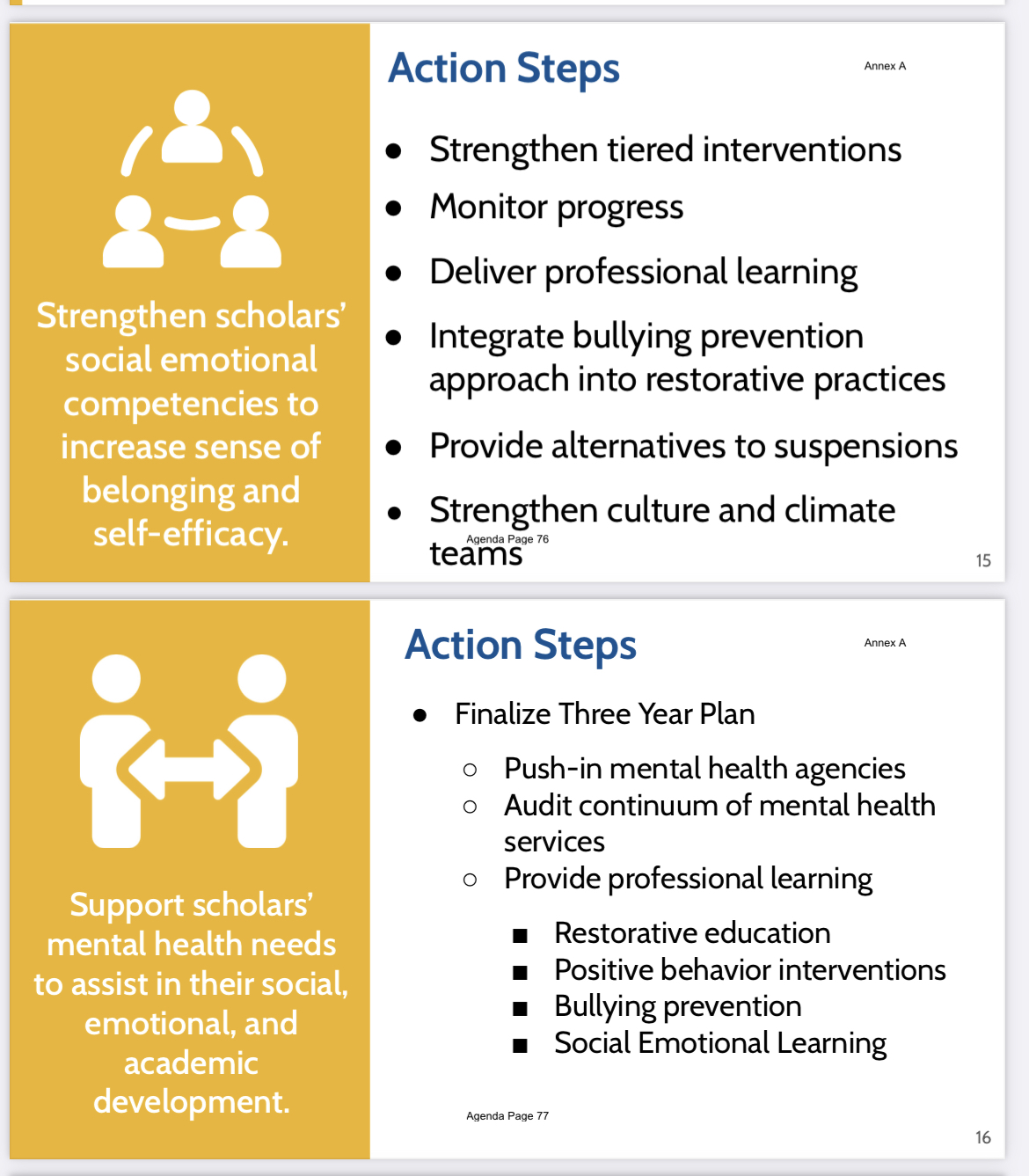
The report of the superintendent was on social emotional learning and student mental health supports. Let me note here that we on the Committee have received emails from a number of staff members about planned reorganization of the social emotional learning department; we did hear a bit about that on Thursday in response to questions, and I am confident that we'll hear more.

The report came about 20 minutes into the meeting (if you'd like to review on the video), and included a substantial number of statistics, some of our students specifically, some national, regarding their mental health and resiliency. 


The presentation was about twenty minutes, and it was followed by at least that of questions, so I'd say there's a significant amount of Committee attention to what is being done here and what is still to come.

We approved one prior year payment and three grants, including one for a new meat slicer at Claremont Academy; one for summer work with English learners; and one to fund work with refugee families from Brazil, Central America, and Haiti (the area from which we get the largest number of people currently) in ensuring they are well connected to the school district.


We sent items on the use of AirPods to administration; on vaping detectors to F&O; on signs for North High basketball to the City Council; on suspension of the voluntary uniform policy until there's a way out to Governance; on moving dance teams under athletics to administration.

Administration will be bringing forward a recommendation for a new reading curriculum to Teaching, Learning, and Student Supports subcommittee this coming week after a pilot this year. They've been collating the feedback that they have received from staff; that will go through subcommittee to the full committee. You can find what we know so far here.

We passed a description for the Physical Security Systems Technician (this was in the FY23 budget; it had just never been brought forward); this is the person who runs the "stuff" (like cameras) of our security systems. 

We did some updating on policies, something which you'll see in a number of upcoming meetings; I had noticed a few worrying things in our policies, so over February break, I did a full review of our current WPS policies compared to the state model policies. I'll be putting them on the agenda in batches. The first batch we updated ensured that we are following federal and civil rights legislation in our list of protected classes. This is a substantial list, and it also includes the note on the Crown Act, passed last year. 
We also updated the policy on school calendar (which I thought was a little bit funny); in spring of 2020, the Commissioner dropped 10 school days for the calendar for professional development (due to the pandemic). Worcester changed our policy...and never changed it back. It still said we were going 170 school days. We cannot, of course--our policy doesn't change state regulation!--so we changed it back to 180 days.

Dr. Monárrez will bring back the descriptions of the Director of Nursing and the Director of Climate and Culture positions with the budget, so we can see how they fit. 

We sent a proposed revised Wellness Policy to Governance for consideration.

We sent a proposed Unifed PE to TLSS for consideration.

A proposal from Jermoh Kamara that we endorse S.340/H.583 “An Act enabling all students to thrive: protecting a high quality, diverse educator workforce” which would remove seniority as considered in layoffs, was withdrawn.

A proposal that we endorse H.1367 "An Act to facilitate additional financial student assistance," which would require students to complete the FAFSA in order to graduate (unless they had a signed waiver), was voted down, as was the item accompanying it, to request financial assistance for implementation. 


And that was the meeting! Note that our next regular meeting is Thursday, April 27. 

on the OSV boycott


Since last Thursday's vote of the Worcester School Committee to no longer send our students on field trips to Old Sturbridge has caught some attention, I thought it might be wise to refocus our attention on why this was both proposed and passed. 

I've set the below video to my comments--for the item was mine--last week:


The Worcester School Committee has very carefully laid our our concerns with the relationship between Old Sturbridge Village, Inc, and its charter schools in this letter dated March 10 to the State Auditor, the Attorney General, the Office of the Inspector General, and the Ethics Commission. If this is of interest, I recommend reading the letter itself, but in sum: 

  • OSV Executive Director Jim Donahue has, both in public letters to membership and in employee meetings at the Village, made it clear that the schools are a source of revenue for the Village. As we have cited several times, in the FY22 Annual Report of the Village, Donahue wrote: 

    The Academies will provide reliable, contractual revenue to the museum, safeguarding us against fluctuations in uncontrollable factors that impact admission revenue such as weather and public health.
     

    Providing reliable revenue to a private organization is not the purpose of public education funds. The Massachusetts Department of Revenue clearly states: 

    Public funds cannot be used for private purposes.  

    If there is both a private and a public purpose, the private purpose cannot be the primary one; that would invalidate the spending. Donahue's own words would appear to indicate that this is intended as a revenue stream primarily. 


  • The Department very carefully guides charter school boards in their selection of a management organization, should they choose to have one. They are directed to follow the same public bid process they would for any major purpose. They also are directed not to have overlap between the charter board and the management organization, as that would clearly constitute a conflict of interest. 
    Of the 17 founding members of the new Worcester charter school, 11 have ties to OSV itself or the OSV charter school, and one more to the company that will provide the charter school's curriculum.
    The Board is not independent, and the ethical conflict is clear.
    Since the letter, the Board has had its first meeting, and it did not spend any time deliberating, let alone follow the public bid process, before appointing OSV as the management organization.


  •  OSV currently holds a lease with the Roman Catholic Diocese of Worcester for the former St. Joseph's School on Hamilton Street. The lease has the following clause: 

    Neither Lessee nor any of its employees, servants, agents or invitees shall make any use of the [building] which would be inconsistent with the doctrines or teachings of the Roman Catholic Church, as determined by the Roman Catholic Bishop of Worcester in his ecclesiastical capacity of Ordinary of the Diocese of Worcester in his sole discretion

    There are of course significant conflicts, not only in what may or should taught in the building with what the Bishop of Worcester may feel appropriate, but even the basic civil rights protections a public entity like a public charter school must hold for staff and students are brought into question with such an agreement. As noted in the letter, this is not simply about Catholic teaching, but the particular bishop, who has a history locally regarding his perspective on these issues. 
    As yet, we have no evidence any successor lease has been negotiated. 


As of us who direct money, whether publicly or privately, must do so according to our best judgment. Massachusetts elected officials also much follow the state public finance laws and guidance; the state ethics laws; and both state and federal civil rights laws. If, in our estimation, those are not being followed by an organization to which we would direct funds, we are, as Mayor Petty notes above, being consistent to discontinue such spending. 

Wednesday, April 12, 2023

Boycott

It felt as if the website editors were having some fun this morning...

On tomorrow night's Worcester School Committee agenda, I have placed the following item: 

To request that the Administration arrange for an alternative LEAP trip in lieu of the current trip to Old Sturbridge Village; further, request that the Administration ensures that no Worcester Public Schools funds voluntarily are allocated to Old Sturbridge Village, Inc. or its affiliates.

I am not going to say too much about this here now, lest I predeliberate ahead of the meeting, but I'll note news here, here ('though that is a little confusing), and here.  

And if you haven't reviewed the request for an investigation filed by the Worcester School Committee, you can find that here. 

Thursday, March 31, 2016

RISE and shine!

This morning the Senate committee released the RISE Act (S.2203). The acronym (and nice job on this) is for An Act Enhancing Reform, Innovation, and Success in Education" per the Senate press release (which is a good bulleted summary). You can find MASC's response here.
So what's in it?
A lot, to be perfectly honest.

First (to focus on essentials) there is a charter cap lift in the bill. The lowest 10% performing communities (same as now) have a lift in the amount of spending on charters of up to 0.5% of net school spending per fiscal year, starting in 2019, up to a maximum of 23%.
HOWEVER (and this is a BIG however), that only happens if the state, in 2019-2025 fully funds the recommendations of the Foundation Budget Review Commission, and, in 2026 and thereafter, fully funds what they're now calling "district mitigation" (charter reimbursement). If that doesn't happen, the cap can only go up by the percentage funded.
The bill also puts no cap on Horace Mann and innovation schools (both of which are district-run) BUT those may be counted towards the percentage of spending of the cap lift (so a district could exceed 23% or lesser percentages in previous years IF the spending was on Horace Mann and/or innovation schools).
The bill also puts no cap on schools that primarily serves at risk populations (75% of enrollment).

District mitigation payments are reformulated at 100%, 50%, 25% (right now it's 100%, 25%, 25%, 25%, 25%, though the last few tend to be irrelevant as they generally aren't actually funded).

What else?

The Board of Ed is reformulated to have one of the Governor's appointees be required to be a retired teacher, jointly recommended by AFT and MTA; currently, teachers are barred from serving on the Board of Ed. It also drops the phrase barring a Board member from serving "as a member of any school committee," thus reversing that ban ('though they can't be paid by a district and serve on the Board of Ed). Those currently in office are to complete their terms.

It requires the Secretary of Administration and Finance to jointly with the Joint Ways and Means Committee create an implementation schedule for the Foundation Budget Review Commission recommendations. It specifically calls out:
...tuitioned-out special education rate, assumed in-school special education enrollment, low-income increment, low-income enrollment, foundation benefits, retired employee health insurance and English language learner increment...
...as the categories to be covered (note: those were the recommendations, but not everything mentioned; early childhood ed, inflation, as well as the question over if "assumed" was right for special ed aren't in here). It sets in place a seven year implementation schedule, to be equally implemented each year; in determining the schedule:
the secretary of administration and finance and house and senate committees on ways and means shall hold a public hearing and receive testimony from the commissioner of elementary and secondary education and other interested parties. The schedule may be amended by agreement of the senate and house ways and means committees in any of the 7 fiscal years to reflect changes in enrollment, inflation, student populations, or other factors that would affect the remaining costs in the schedule; provided, however, that the final year of the schedule shall not surpass fiscal year 2025, but the schedule may be fully implemented prior to fiscal year 2025.
In other words, yes, you get some wiggle room, but you don't get to kick the can down the road forever, and we're not taking excuses.

It is, however, as all such things are, "subject to appropriation."

The definition of "foundation benefits" is updated to include retiree benefits (which it hasn't).

In terms of implementation of the Foundation Budget Review Commission:
  • The benefits rate is set by "average group insurance commission premium for all plans for the 3 previous fiscal years" (so the three year GIC rate);
  • Health insurance now includes retirees in the calculation.
  • The ELL rate is set at $2,361 for 2019 and is expanded to include vocational students.
  • The low income rate is for students whose families are at or below 185% of the federal poverty level. Districts are divided into septiles (there's a new word to me!); the starting rate is set at $3,474 "and each subsequent septile shall increase by equal amounts up to the highest percentage septile rate of $8,179" which is to be annually adjusted for inflation.
  • The in-district special ed rate is raised to 4% overall and 5% of vocational students.
  • The out-of-district special ed rate is set at "4 times the statewide foundation budget per-pupil 434 amount less the sum of the statewide foundation budget per-pupil amount and out-of-district special education cost rate" (which is what the FBRC recommended).
DESE is required to "develop target percentages and standards for administrative costs."

If a student transfers into a different school during the school year, or has had substantial interruption in their schooling in the previous three years, their test scores don't count towards the school.

The bill expands those things required of Level 4 schools to Commissioner-designated Level 3 schools (the lowest performing 20%); the Board of Ed is charged with creating regulations regarding such a declaration of a "priority" school, taking:
...into account multiple indicators of school quality in making such designations, including, but not limited to: student attendance rates, dismissal rates and exclusion rates, promotion rates, graduation rates or the lack of demonstrated significant improvement for at least 2 consecutive years in core academic subjects, either in the aggregate or among subgroups of students, including designations based on special education, low-income, English language proficiency, and racial or ethnic classifications.
The teachers' union and school committee must then negotiate a waiver agreement (subject to approval of 2/3rds of those working at least 50% of their time at the school; if they can't come to agreement, the Commissioner can simply declare the school underperforming (Level 4)). The superintendent then convenes a turnaround stakeholder group. The turnaround plan then goes to the school committee for approval, as well as to the teachers' union for approval. If it doesn't get approved, the Commissioner can declare the school underperforming (Level 4). The plan goes to the Commissioner but is not subject to his approval. The "priority" designation is for two years, at which point it is reviewed by the Commissioner. (There's also a bunch of language which makes ch. 69 include "priority" schools, as well as "underperforming" (Level 4) and "chronically underperforming" (Level 5).)
It provides for regional school district planning boards and specifically allows for cities to be part of them. And there's a lot of language on this and I don't know why, so if anyone wants to clue me in, I'd appreciate it.

For the purposes of school discipline regulations, "a commonwealth charter school shall be considered a school district." They thus are held accountable for all portions of the law, including the revisions to chapter 222. They must post their policies pertaining to conduct on their websites. Charter schools thus must provide for alternative education for students suspended or expelled. Charter schools specifically must: 
...establish a panel consisting of 3 members of the board of trustees to hear appeals of disciplinary actions taken by the charter school, 1 of whom shall be the representative of the district school committee and 2 other members who shall be appointed by the chairperson of the board of trustees. Unless otherwise provided in this section, the panel shall have the same rights and responsibilities as a superintendent in hearing appeals and issuing final decisions.
...which brings us to the changes for charter schools. Their board of trustees are required to have at least one full-time teacher at the school, at least one representative of the sending district's school committee, at least two (or 25%, whichever is greater) parent or guardian of current students at the school, and high schools must have a current student member, all of whom are to be voting members of the board. Members of the Board of Trustees and their families may not materially benefit from the school (save the teacher may be paid). The same change is made for Horace Mann charters.

Charter school teachers must be evaluated as public school teachers are. They also shall if unionized acrue seniority and receive compensation equal to with that received by district teachers. Charter school teachers are to be certified by July 1, 2019, and charters must file plans about their progress towards making that happen.

Charter schools may not expand or create new schools if their suspension rate overall or for subgroups exceeds that of sending districts for the previous three years. This does not, however, apply to the alternative charters (we're getting there) and it may be waived for a subgroup if the gap is small and the Board of Ed feels they're making an effort.

Applicants for new charter schools have to meet with the superintendent of the district before applying, and they must explain how their program will compliment the district. They also must hold a joint hearing with the district school committee. Not doing so automatically disqualifies them from applying.

As part of the application process, the "superintendent may submit an analysis to the department that describes how approval of the proposed charter school may affect the district’s students," AND the Commissioner is REQUIRED to:
...explain in writing to the board that the commissioner’s decision is responsive to the district superintendent’s submission and provide an assessment of the accuracy of the analysis of the impact on the programs and services of the sending school district or districts...
Further, the Board of Ed is required to "substantially consider" materials submitted by the district in their decision on charters and:
When making a decision on an application, the board shall explain in writing how the decision takes into account the district superintendent’s submission under subsection (h) regarding how the school’s approval is expected to impact the district’s students.
It appears that the Senate believes that falls under the Board's purview.

Charter schools can only be created, renewed, expanded, or amended if they have an opt-out lottery system of some kind. This may (Bostonians, please note both the verb and the stress on it) be a unified enrollment system with the district, 'though if that is the case, the charter may only enroll students from the single district, may not displace district options in choices, and students cannot be compelled to attend a charter school. Charters that already exist may phase it in. All students eligible for enrollment are entered in the lottery ('though parents and guardians may opt their children out); those pulled may also choose not to enter the school. The charter will also create a waitlist through the lottery, from which it will backfill students into seats that open during the year for all grade levels; if the waitlist is exhausted, the charter is to conduct a new lottery.
Charter schools may offer priority enrollment to  at-risk students, students who are homeless, students who are pregnant or parenting or students who have dropped out of school.
Districts that rent space to charters can require that students in that district be given preferential enrollment, though (here and throughout) the low income percentages must be at least those of the sending district.
Charters may also preferentially enroll the children of their employees.

Charter schools are to update their waitlists monthly. They must include names and addresses, and they must include those taken off the list (either through enrollment or by request). Waitlists annually expire on July 1. Waitlists will be maintained separately for Horace Mann and Commonwealth charters; they will be available publicly (without student identifying information) on the DESE website.

Contracts and leases, partnerships, grants, and gifts must be posted on the charter school website.
No charter management organization may "exercise a proprietary claim" on practices at a charter school.
Charter schools may not charge tuition or fees. They may not require a contract be signed by parents or guardians.
DESE is charged with creating a charter and district exchange program, including the exchange of employees to share best practices.
Districts continue to provide transportation IF they and the charter agree on start times. If not, the charter school has to cover 50% of the cost. What if the district is just given a bill?
Limitations that districts put on busing also cover district charter schools; if there's transportation for specialized district programming, the charters are covered.
Districts also must provide charters with field trip transportation equal to the average field trip transportation for the prior three years provided by the district to their schools (easy in districts where we've long since stopped providing field trip transportation).

Attrition, stability, and suspensions, including those of subgroups, must reflect those of the sending district for the previous three years; there is again a provision for a waiver if it's a small gap and "the charter school has made a rigorous effort to maintain all of its students."

Charter schools are to publish an annual report, including a financial report. The department is to create regulations regarding the net asset balance of charter schools. That is all to be on the charter school's website as well.

The Commissioner is charged with collecting attrition and stability data annually and making it publicly available.

DESE has until January 1, 2017 to revise its regulations.

DESE is to make recommendations regarding the revision of definition of low income by January 1, 2017.

There is to be a charter school funding commission with a report due January 1, 2017.

There is to be a commission on school start times with a report due December 31, 2016.

The State Auditor is required to issue a report on the first five years of the changes in chapter 222. It's to be filed with the Civil Rights division of the AG's office, among others, and is due December 31, 2019. 

Friday, December 19, 2014

Who volunteers and what that means for kids

The New York Times Motherlode post "When Elite Parents Dominate Volunteers, Children Lose" hits precisely what I've been feeling a great deal this season (as can be attested by more than one patient administrator who has heard my rant on it). I am relieved to see it being expressed this way in a public forum, and I hope that this will be making its way to more PTO and site council meetings.
I am enormously grateful for parents who volunteer: in Worcester, we wouldn't have had (or still have) elementary school libraries, field trips, playgrounds, and a host of other necessities that aren't funded as if they are. I also appreciate those who push to get things done when many don't have the time.
Often, very often, it is those with the luxury--and it is the luxury--of time and money to spare who do so. And having those parents make the decisions around activities and fundraisers leads to exactly the dispartity put forward by the column.
We need to be acutely conscious, most particularly if it is we who are the volunteers, of this disparity. In Worcester, for example, 74.3% of our public school students are free or reduced lunch eligible. Out of every four kids, three of them have a family that is struggling to keep that kid in sneakers. That's the silent majority that may well not be at the meeting where the decisions are made. Their voices need to be heard, nonetheless.

Monday, December 2, 2013

Worcester School Committee meets this Thursday!

two more meetings this year!
The Worcester School Committee has its regularly scheduled meeting at 7 pm on Thursday at City Hall. You can find...hmmm, no, you can't. Let me get back to you on that. UPDATE: agenda is here. 
You might remember that we had a super-short meeting last time, and many items were held, as both Mr. Foley and Mr. O'Connell were not there. Those have all carried over to this meeting.
We have several recognitions, including the Quinsigamond Land Task Force for cafeteria tables, Worcester Tech for the PRIME Manufacturing award, Team BEMANY for the solar decathlon, the Alden Foundation for their funding of field trips, and Mr. Allen for the Professional Eagle award.
We're getting the Finance and Operations report back from November 12.
We have some retirements and appointments.
We have more than one PARCC item: one on delaying implementation until student accommodations are done, and another recognizing it as an unfunded mandate. To that end, incidentally, you might take a look at this letter that Commissioner Chester sent out to superintendents (no, not to School Committees) regarding the state's authority regarding field testing. As this will be coming up on Thursday, no comment from me on this.
We're inviting members of the Model United Nations team at South to come make a presentation to us about possible expansion.
We're setting some dates and doing some recognitions, including one for the great work of the teachers and students involved in the "Night at the Oscars" program (which is now up online...I'll post it in a bit!).
Mr. O'Connell is concerned about cursive.
We have an item coming in regarding bumping teaching assistant principals to full assistant principals.
Miss Biancheria is asking for an update on the finances around our recent enrollment increases.
She is also asking for an update on 504 plans.
We will also have an executive session (as per usual) at six. 

By the way: you'll see that the agenda has a somewhat irregular profile when it comes to co-sponsorship. About halfway through the time since the last agenda, we started using the system the Attorney General has required in order for us to be in compliance with the Open Meeting Law. Thus the later items are sponsored only by a single member; all co-sponsorship must be done from the floor during the meeting.

Thursday, October 18, 2012

generous donation to Union Hill

Patricia Lanza is coming through for Union Hill again: $25,000 to Union Hill for class trips and school improvements.
THANK YOU!

Tuesday, February 14, 2012

Yes, you can learn in a parking garage

I would just like to point out that this teacher--and every other teacher who "gets it" that kids need actual background knowledge to do more than decode and then DOES something about that--is awesome.
Reading isn't only about what's on the page.

Thursday, February 2, 2012

US Tennis Association in Worcester

The T&G caught some fun photos* from yesterday's USTA Kids Day down at the DCU Center. There were over 300 kids from three city schools down there for the afternoon, learning racquet skills and meeting players, who also seemed to be enjoying themselves.**It was very well run, and entirely covered by USTA (including at least six buses, which don't come cheap!).
Many thanks!

*including Governor Patrick returning a volley to Venus Williams. Alas, it appears no one caught Superintendent Boone, who was also there, wielding a racquet!
**I personally intend to start cheering for Sloane Stephens, who was incredibly patient and fun with the kids. She's an up-and-comer: watch for her!

Monday, January 30, 2012

Worcester School Committee meeting Thursday

The Worcester School Committee meets Thursday at 7 pm at Worcester Technical High School. You can find the agenda here.

The report of the superintendent this week is on the curriculum review process. The idea here is that each subject will periodically have a curriculum review; we'll be starting with math. We are in very early days, as yet on this (they're looking at data right now in math), so much more to come. This is partly pushed by Massachusetts moving to the Common Core, but it is also is a chance to look at what we're teaching, why, and how that's going. If you have any interest in curriculum and how it's working, Thursday's report is a place to start.
There's a series of requests for information and reports that are going to administration and various subcommittees, including a request on working windows, third grade reading, information on school profiles, the ever-popular Read Across America day, and secondary report card comments.Also, guidance counselor course load, ninth grade course selections, and career and technical education month.
We're also being asked to accept a grant from the Greater Worcester Community Foundation for ESL classes around the city (particularly for parents); the plan is for ten more classes. Also, a grant from Target for pre-schoolers and kindergarteners from Canterbury Street to go to Heifer Project at Overlook Farm for a field trip (how cool is that?).

I know there was great angst about the meeting not being broadcast live last time (no, I am not kidding). I know that they've been working on it.

Thursday, November 18, 2010

Field trips

Currently field trip policy says students cannot travel outside the state, says the Mayor. Students do travel out of the state on field trips...revisiting the policy.
Mullaney reminds us that we've had discussions within the recent past, and that legal counsel has recommended that we not allow foreign field trips.
Mullaney asserts that it has nothing to do with September 2001.
Monfredo and O'Connell rise to defend the notion of foreign travel for students, as surrounding districts do.
(note that the policy is not in the handbook; you can get a copy through the Quadrant Managers' office, apparently)
Biancheria gets up to question that we have teachers taking kids on trips outside of school coverage.
Luster speaks of teachers asking that the policy be reconsidered.
It's being sent to TLSS for consideration.