Showing posts with label health. Show all posts

Thursday, July 23, 2026

Things I am reading this week

  •  Not specific to education, but this lengthy piece on "AI mania" in the workplace is a very "the Emperor has no clothes" description, where no one can say the Emperor has no clothes because no one else in business leadership will.
    The reality is thus: the people in charge either have no plan, or see no path forwards other than keeping their heads down. Not at banks, not at hospitals, not in our government institutions. The world’s organisations have been captured by people in the throes of frothing excitement, and saner people who now live in a state of constant commingled fear and frustration.
    I again reiterate: for education to put any eggs in this basket is badly thought-out.

  • My main takeaway from Chad Aldeman's look at K-12 education spending hitting a trillion dollars is what a huge difference single payer health care would make: 
     In 2023-24, schools spent $197 billion on employee benefits. As another way to look at it, for every $1,000 that a school spent on salaries, it also paid $438 in benefit costs. These trends may help explain why districts with rising personnel costs are not boosting take-home pay for their workers. 
    Imagine if we had all that money to spend on any aspect of education, because employees all already had health care. 

  • It's worth reading Matt Barnum's interview with Ary Amerikaner, who co-founded Brown's Promise (and I say that not only because it echoes some of what I question about the lawsuit). 

  • Not sure if it's because the seniors involved have graduated or just coincidences of timing, but there are good pieces covering two separate episodes of attempted throttling of student reporting that came out this week. Wired covers Redwood High in California, where a student journalist turned up a connection to the Epstein files to his local community. In that case, the decision making was in the hands of the students, though this quote from their advisor deserves mention: 
    “With all due respect,” Schneider remembers Bishop replying, “under California’s student press law, being afraid of a lawsuit or backlash is not a valid reason to call for the takedown of content.”
    Colorado Newsline covers Grand Junction High, where the advisor was reassigned apparently due to a single complaint by another staff member over a student editorial on the Gaza conflict most recently; the student paper itself published a piece about student press freedom being under threat from their administration in June. 

  • One would really like to think something like the national civics competition would be outside of meddling from this federal administration. It appears that is not the case.
It is July and so my daisies are in bloom.


Tuesday, June 27, 2023

June Board of Ed: State Student Advisory Council

 report of the State Student Advisory Council so this one is over to Eric Plankey
And I don't have this report, so I have no links as yet
state council of 50 members, then 5 regional councils which produce reports for the larger council
changes in student advocacy this year, too
first year of meeting back in person: moved the meetings from Malden to Worcester to increase access

student reps: opportunities for youth involvement in every district
should have two students from every high school in Massachusetts
how do student voices get represented across the state
student government; affinity groups; advocacy groups
handbook for student government, focused on policy change

financial literacy: bundle of resources for districts
life after graduation, paying for college
documented past work to build off of
lesson plans series
presentations from guidance departments on paying for college


health and wellness: youth risk behavior survey
consistent feeling of sadness/hopelessness: 50.1% of girls; 26.6% of boys
only 20.4% of students getting more than 8 hours of sleep
40-50% of LGBTQ+ students had seriously considered suicide
bullying down; alcohol use down
peer on peer support groups
up to date occupational advisors
make sure students aren't overloaded with work; stay balanced

now reviewing regional work: 
Greater Boston: list of recommendations for updating health curriculum; building codes and sustainability
Northeast: guidance on religious holidays
Central Mass: wellness week
Southeast: brochure for school spirit; initiatives on BIPOC history
Western: outreach for representation


Stewart: where can see report? need space on website

"got students thinking about what was happening in their districts"

Mass Association of Student Representatives:
student reps to school committees: every district required to have student rep, have student advisory to school committee
"there isn't a lot of compliance with it"
help spread best practices of students getting involved in their local districts
proposed amendment for student reps voting rights


Student Union of Massachusetts:
coalition of local youth groups from across the state 
local reform efforts to improve student voice
facilitate student gov reform
create template policies for local implementation

three levels of decision making now has a dedicated student advocacy to that level
"creating something special in MA"

Lombos: sees parallels between student organizing and work organizing
excited to see if can bake in continuity

Plankey plans to connect incoming student rep with Board and Department members
"state should be prepared to engage with students as partners"
suggests DESE solidify of SSAC as a partner with the Department: "one stop spot as student voice" for Department

Ella Gardner, Wellesley High School will be incoming rep for next year

Wednesday, December 29, 2021

It's a staffing issue

 You may have caught in passing the mention from today's Boston Globe that the Department is providing six million KN95 masks to school districts for staff when they come back to school next week:

To help protect school employees, the Massachusetts Department of Elementary and Secondary Education has supplied 6 million KN95 masks. That’s enough for one mask per day for each employee, including teachers and bus drivers, said a department spokeswoman.

Below, this appears to be predicated on there being about 100,000 staff in Massachusetts, so that's 60 days of masks, assuming one per day, which gets us (with February break off) to mid-March or so. 

This afternoon, the Department announced that they were sending out 200,000 tests to districts, allowing two tests per staff member: 

...strongly encourages all school personnel take one of the at-home antigen tests no more than 24 hours before they return to work 

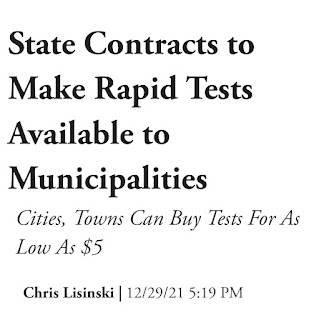
It has been noted by others that the Department said they're spending $5.6M on this last, which would be $25 per test, and then the next email in my inbox had this headline:

I assume DESE paid what was being asked for what could be had now.
The above is occurring during a school vacation week and without warning. Masks are coming to central distribution points, from which districts need to retrieve them. I assume tests are likewise being sent out the same way, at which point districts will have to find a way to get them to staff, who are also on vacation.
As has been noted, we have been warned for weeks that this week's vacation is of concern. It's why districts that could manage it sent tests home with students before vacation for their use. Districts largely didn't have access to enough tests, and thus we have what it is difficult to describe as anything other than a very late effort. 

Students, of course, are not mentioned in any of the above--we have nearly a million of them in public schools in Massachusetts--and they're also going to be coming back into buildings on Monday morning. There are districts in Massachusetts that were among those to get tests in students' hands before vacation; some of the higher risk communities that had received the state distribution focused on schools. Not all did, and that would leave many districts out, regardless. Lines at testing centers have been long in the places where those tests are available; at home tests are difficult to find.

And the COVID rates in the state have never been this high before. As of last week's data, 41% of 5-11 year olds, 77% of 12-15 year olds, and 78% of 16-18 year olds had at least one dose, which doesn't appear to be enough to blunt the force of the virus.

There was a good deal of online (and elsewhere) outrage this week when the CDC rolled back quarantine recommendations, following staffing concerns expressed by an airline executive, after a weekend in which thousands of flights were cancelled. 

The above, on the other side, is based on protecting staff. But it is still focused on staff.

I have two concerns as we head into this holiday weekend, which has school on the other side.
The first is for students, most of whom were not sent home with tests, most of whom don't have access to free testing (as we even do in Worcester, if you can get there and can stand in line in the cold), most of whom simply, I'd guess, are not going to be tested before Monday morning.
And many of whom are not going to be walking in the door on Monday with masks equivalent to the above.

The second is actually a staff concern. The state positivity rate right now is over 13%, and that is only of those tested at medical centers; it does not count at home tests.
If anything like that many of the tests the state is sending out to districts to get to staff come back positive between Sunday night and Monday morning, what's our plan for Monday? 


UPDATE: the above was posted prior to DESE's email to superintendents Thursday night that the tests would not, in fact, be in on Friday as scheduled.

Saturday, July 31, 2021

What I want from the Department of Elementary and Secondary Education

 At Monday's Joint Committee on Public Health hearing, Rep. Mindy Domb asked the school committee panelists what they could use from DESE this year. I asked on Twitter if she'd take that input from others, and she said yes. Here, slightly edited from Monday, is what I sent in. 

train platform at Union Station, Worcester

In my capacity as a member of the Worcester School Committee and a parent of a high school sophomore, I am leaping at Rep. Domb’s request to send in what we could use from DESE this year. As I write this on my train homebound to Worcester, fully masked and looking at a smoky Massachusetts from western fires, I am wondering, I have to say, about what sort of world we’re arranging for our children.

I do want to start, however, by thanking you with all my heart for today’s hearing. It was the very first—and I am not exaggerating—time I have felt that any organized state level public body or group of officials in Massachusetts has acknowledged just how local districts have been profoundly misserved the past eighteen months. In all the reading I have done of the various types of challenges schools have faced for centuries, never did I imagine that when the challenge came for Massachusetts public education that the state leadership would abandon its responsibilities. And yet they did, and they have continued to do right up through their non-appearance today. Thank you for hearing and acknowledging that; thank you even more for working to change that.

Rep. Domb asked what we would want of the Department in our capacities at the local level, month by month. Let me start by saying that I want the Department to center my kids—and those of Boston, and Chelsea, and Lynn, and Fall River, and Springfield, and Pittsfield—in their decisions. It has been exhaustingly clear that the Governor lives in Swampscott and the Secretary in Milton and (more to the point) they never leave. We cannot and will not have equity in this state unless and until we first acknowledge the profound segregation of school districts and what impact that then in turn has on absolutely everything we do. The community health leadership who testified today are entirely correct: we have had our response to this pandemic backwards from nearly the beginning. The question should never be “is it okay for the kids in Swampscott?”; it should always be “is it okay for the kids in Springfield?”

Those children—my kids in Worcester—have parents who have been working front line jobs throughout the pandemic. Those are literally the people that Worcester has depended on to keep our hospitals open, crucially, as they are the custodians, the food service, the CNAs and more of our hospitals on which the central Mass health system depends. They have worked long hours and have been worried about COVID throughout. Some of our families ran small businesses, and some of them have closed. The hunger, the concerns about homelessness, and all of the cascading impacts of the pandemic have hit our families.

This hasn’t been a “shift to take out and Amazon” pandemic for most Worcester Public Schools kids.

So first, yes, as soon as the shots were widely available to school staff (and what a mess that was!), the state should have mandated for them. If it meant quite that much to them to have our kids in schools, then they should make it as safe as absolutely possible. 

Likewise, as soon as the vaccines were available for our students, we should have seen a profound push first for city kids to get them vaccinated, with the expectation that all would be required, down to age 12 for fall.

And then the state should have spent the entire summer at every single possible space at which people have gathered in cities—farmers markets, outdoor church services, festivals of every kind—having vaccinations there. They should have rolled out PSAs with any and everyone who has any kind of following—sports, music, and more—having them use their social media to magnify that anyone who was anyone was getting vaccines. They should have worked with the Statewide Student Advisory Council, first, to make sure they’re vaccinated, and then to have them use their social media reach, and those of their student government peers, to reach out further to their peers. Make teen vaccination a constantly trending topic on Instagram.

As you note, Rep. Decker, we’re now five weeks out. How much of this can be done now? I don’t know. But we shouldn’t give up the weeks we have. DESE should absolutely be using its reach and messaging to push as many as possible to be vaccinated as soon as possible.

And then, yes, it should be mandated at the state level in partnership with DPH. I don’t want to be the test case for a district mandating vaccinations of students, but if I have to (and if I can get the votes), I absolutely will. This is not my job as a school committee member. It wasn’t my superintendent’s job to cancel school in a pandemic, either, though, and she had to do that. 

It also, as it long since should have been, should be mandated for all school employees. We’ve been told that this is something we’ll need to negotiate with our collective bargaining units. If DESE wanted to be useful, they could make it embarrassing for the unions to fight this; as a former member of the MTA, I will find it horrifying if my former union argues that this isn’t in their members’ interest. 

The state should also absolutely mandate masks for all in school buildings for the coming year. This is, I agree, a no brainer. And there should be no exceptions for wealthier white communities that don’t have front line workers and have managed early high rates of vaccinations, either. Lines between communities are invisible; so is the virus. 

I would like the state to give solid research on just want kinds of realistic improvements we can make to ventilation in the buildings we actually have with the time and money we actually have. Stop sending us pie in the sky idealized and expensive options when our floor plans and our building ages are available to the state. What should we spend time and money on and what is a waste? This, again, would have been more useful months ago, but I’ll take it now. Give it to us in phases: what can we do now, what could we do if there are two weeks off in December, what can we plan for next summer?

I would like the state to do what they should have done this summer (but again, here we are): create a statewide mobilization of after school programs. Yes, let’s run some in schools, but we also have plenty of community resources. How do we make sure that any student who needs a place to be after school has a safe place to be? Cross reference those with the school districts to ensure those students also have what schoolwork support those students specifically need as part of their after school hours. That should, though, only be part of that. 

(This isn’t what you asked, but I’d further extend that to making sure every student of a particular age—fourth grade?—also got swimming lessons.)

The state should create and staff statewide affinity groups for anyone who will be dealing with students emotional and social impacts of this year. I am very worried of how much we’re pushing onto our adjustment and guidance counselors this year, and I’m certain that some of that is going to end up on teachers, too. Yes, we at the district level should be supporting them, too, but the state has capacity to create common support groups. They often can better point to resources.

There also should be common catalogues of resources: online, easy to access, well organized, for any school staff to access as they have need to for their students. 

Heading into teachers going back to school, the Department should use every channel they have to emphasize that the first job of schools is not reading scores or math scores; it’s supporting students. There should be no question in anyone’s mind who walks into a school building this fall as to what we’re about. That will need repeating over the course of the year, particularly once we get into spring and what traditionally is test prep season. In general, the messaging on academics has been less than stellar. Students are in very very different places right now, and that is to be expected. That should be the first message from the state.

As we head further into fall, the danger of students showing up sick to school will grow. First, we certainly need a flu vaccine mandate this winter (and one that sticks this time). We also, though, need a clear message that showing up for school sick (whether you’re staff or student!) is a bad idea. We need flexibility with DESE on outreach to students who stay home (as there’s no easy switch to remote this year), and we need a hard discussion on accountability accordingly. We can, if we are smart about it, emphasize the importance of school without encouraging “presenteeism” as your speaker today had it. 

We also need the state for the holidays—first the long weekend in October, then Thanksgiving and forward—to create real mandates on testing after traveling, even discouraging traveling as needed depending on what things look like around the country. We have to be consistent that we are endangering unvaccinated children when we aren’t strong on these standards. 

Should we have under 12 year old students eligible for vaccinations by the turn of the calendar year, then, yes, we must be more than ready to go. It must be mandated but in concert with vaccinations being in schools. This should be, as you noted (and as we already should have) Rep. Domb, multi-lingual resources for families that respond to frequent questions and misinformation about vaccines in children. Again, that should be anywhere there are families, should be culturally responsive, should be easy to find, should be above all accessible. We will know this is a success if the rates in Chelsea exceed those of Brookline. 

I am certain that as soon as I send this, I will think of much more. This is the first time that someone has asked, though, and I want to send this right in so you understand how much it means to be asked. Contrary to what the Board of Elementary and Secondary Education said in their evaluation of the Commissioner, this was not, has not, been well handled for any of us at the local level. 

I would be more than glad to speak with any of you regarding this at any time.

Thank you again for asking the question. 

Monday, January 18, 2021

...regarding in school transmission

 Early last week, I received a lengthy, footnoted letter from a Worcester Public School student, pressing for a return to school buildings.
Let me note first: I do so love getting emails from students! or any contact at all from students! Keep those coming! 
It repeated--not surprisingly, as this has been the main push in much of the press--the idea that schools were safe from COVID transmission. As I haven't done a blog post on that--I just keep tweeting out links to things--I am excerpting here that section of my response to the student letter, for both myself and others who might find it useful. 


...And none of that is to speak of the fear that surrounds transmission, because there is certainly transmission in schools. Multiple Massachusetts superintendents have publicly noted that they have, through their contract tracing, found transmission within their buildings; here, for example, is Framingham from the beginning of December, and Hudson from about the same time. This is in line with what was found by a study published in the Lancet back in early December: there is in fact school transmission. 

The science of transmission of COVID-19 in schools is something that I've been reviewing with care since last spring.
It has been apparent from fairly early on that children more often get coronavirus asymptomatically; the CDC, for example, notes that
 as many as half of COVID-19 cases in children may be asymptomatic. On the same page, they note the main issue that has plagued us from the beginning: 

The true incidence of SARS-CoV-2 infection in children is not known due to lack of widespread testing and the prioritization of testing for adults and those with severe illness.
Without widespread testing of all--including asymptomatic!--individuals, we simply do not know the rates of coronavirus among us. 

We do, though, have research from places that have been doing testing. The models, which like those you cited, are from Europe, give us troubling perspective on the reality of COVID-19 in schools. In mid-December, the German magazine Der Spiegel had what has been one of the better reviews of this research as of that date. As you'll see in the piece, Austrian researchers have been, since late summer, been conducting research in 240 schools in Austria in which students and teachers are being regularly tested. This weekend, the Wall Street Journal included an update of that research in an extensive article they did on schools across Europe now closing; they've found: 
In Austria, a nationwide survey by universities and medical institutes found that children under 10 showed a similar rate of infection to those between 11 and 14, and that the children in general were getting infected as often as teachers, said Michael Wagner, a microbiologist at the University of Vienna who oversees the study.
“That is very different to what has been claimed for months, that younger children are less frequently infected,” said Mr. Wagner. The study, funded by the government, regularly analyzes samples from up to 15,000 children between the age of 6 and 15, as well as teachers who show no symptoms.

(The WSJ  piece is paywalled; let me know if you'd like me to send it to you.)
The United Kingdom has been widely held up for keeping schools open even during their fall lockdown. The U.K. also is regularly testing 2% of their population. During that fall lockdown, when just about everything but schools were closed, (to quote from the WSJ again):


Scientists also point to data from the U.K.’s Office for National Statistics, which conducts a weekly random survey of the population. Just before the Christmas break, when schools were still open, the positivity rate among children was higher than in most adult groups, especially in those older than 11.

You can find the details of that in this study from December. As you may know, the U.K. has, in this most recent surge, now closed their schools. This is in part due to the new more contagious variant--now in Massachusetts--but it also is because community rates across the U.K. are now so high; as noted of open schools in Utah in the AAMC piece you cited:
That stuns Benjamin Linas, MD, MPH, an associate professor of medicine and epidemiology at Boston University School of Medicine who has advocated for opening schools under strict safety measures. “You can only open your school safely if you have COVID under control in your community,” Linas says.
This is in line with two recent pieces of research done in the United States, summarized well in this Chalkbeat piece. Having schools open where there are higher caseloads of hospitalization for coronavirus, or (in the other study) simply high rates of daily cases further contributes further to community spread. We in Worcester, and across Massachusetts, exceed the rates found to be of danger in the studies; the REACH study on hospitalization links to a spreadsheet that updates county hospitalization rates across the country. It was the CALDER study on daily rates of positive cases that I found particularly alarming, as we've exceeded those rates for some time. You might find this Intercept piece looking at recent research also of interest.

The relative safety of schools thus is not that which has too often been cited in the press; On the Media had a useful review of how we got to a place so misleading in their show late last week.
Schools can and do contribute to community transmission, and we must, above all, hold the lives of those in our district at high enough value to appropriately manage that.

...

While appreciating the concerns regarding remote learning, I also want to be realistic about them. The Christakis study, which I reviewed when it came out, was flawed in a number of significant ways, which led (after much online scholarly discussion) to a letter to JAMA criticizing its publication. Most notably from my own perspective, the loss of learning was based on a single study of an Argentinian teachers strike during which students received no instruction, which is of course not at all the case for students now; the study itself warned against using it to draw these sorts of conclusions. The assumption as well that those lost "years" of learning translate into lost years of life also simply does not follow. 

Saturday, December 12, 2020

Things I have been reading this week

 As always, most of this has probably made its way out to the universe through my other social media postings, but I like having things where I can find them again. 


  • Just out this week in Der Spiegel is a piece on a long term study going on in Austria, which is regularly testing children. They've found: 
    But Wagner's study doesn't just demonstrate that the number of unreported cases among children and their teachers is relatively high. The mass tests also show that younger children are by no means exempt from infection by SARS-CoV-2. Indeed, there was no significant difference to infection rates among adults. Furthermore, schools in poorer areas were found to have 3.5 times as many positive results as elsewhere, which is consistent with generally higher infection rates in lower income neighborhoods. 

    Further: 

    All of these findings have cast doubt on the idea that children are less affected than teenagers. And they have shown that almost half of infected children show no symptoms. Meanwhile, an analysis by the Centers for Disease Control and Prevention in the United States found that asymptomatic cases are potentially responsible for more than half of all infections.

  • This is actually from the beginning of last month, but every time I hear Governor Baker or someone else reference "longitudinal studies," I am reminded that this is so far the largest one I have seen that includes schools, and its conclusion was this: 
    Children’s return to classrooms was followed by an average 24-per-cent rise in the R transmission number, University of Edinburgh researchers found after analysing data from 131 countries.

     The only measure that was associated with a higher increase was lifting the ban on small gatherings.

  • This thread from Dr. Zoe Hyde, an epidemiologist in Australia, further illustrates how (to use her word) "wonky" trying to suss out children and coronavirus is. Kids don't necessarily consistently test positive even when they have it. 

  • This report on a recent study from Korea regarding cases from a restaurant has us all looking at our measurements and air flow again.

  • Given that Imperial College study from about two weeks ago that I referenced here, I've been keeping an eye on the U.K. and here's the latest of what their teachers think of the plans.

  • I've been neglecting the ways in which school buildings being opened and closed around the country is going and being received, but of note from this week was Governor Raimondo of Rhode Island--the state with highest per capita rate of coronavirus in the country--pretty extensively going after superintendents who are (or have been) going remote, which was not well received, which she later apologized to some for. Also, this whole mess in Arizona (there's some reporting from elsewhere there, too), leading to a superintendent resigning after his family was threatened by those who wanted schools open. 

Wednesday, October 28, 2020

Three to read on school reopening

 I am finding this year that I rarely have time to sit down and write. Here are three to read on school reopening:

  • "Why reopening schools has become the most fraught debate of the pandemic" by Rachel Cohen in The American Prospect walks through what we do and don't know, walking through the studies that keep being oversimplied and some of what isn't being discussed. One of the best things I've read on this.
  • A note from Chalkbeat New York City by Reema Amin on parents of color by majority choosing not to send their children back to school buildings, even as they are more dissatisfied than white parents with remote schooling, and some thinking on why that's applicable far beyond NYC
  • An opinion piece by Melinda Anderson in The New York Times on the racism that Black and brown students are not having to deal with by not being in school buildings. It opens: 
    “You’re out of your mind if you think I’m ever going back to school.” 
    Awo Okaikor Aryee-Price, a Black mother of two who lives in Florham Park, N.J., initially laughed off the pronouncement her 13-year-old made in March after the Covid-19 pandemic closed the state’s schools. But it became clear that her daughter, Saige, was serious. So Ms. Aryee-Price started to revisit the things she’d heard her daughter say in response to her daily “How was school?” queries. 
    “Whether it was other students saying that she’s too loud, or people saying she has anger-management issues, it was always something,” Ms. Aryee-Price said, describing the subtle bigotry that Saige experienced but was unable to articulate and name.
You can, of course, contrast the above with the remarks of the Commissioner, the Secretary, and Governor Baker yesterday, as covered here, here, here, and here. 

Saturday, July 4, 2020

DESE room diagrams

Each week, the Commissioner sends to all of the superintendents in Massachusetts and all of the Department's staff an "On The Desktop" memo, which later gets posted over here. By virtue of the Commissioner's position and those with whom he communicates, these messages are public documents.
I was sent this week's message, which went out Thursday evening ahead of the holiday weekend. The accompanying presentation is shared ahead of a session this coming week on arranging classrooms. I have posted this presentation here; I shared it as a Twitter thread here, and as a Facebook album here, those all shared without commentary (intentionally). Below are screenshots of the slides.
The opening slides are as follows:
Add caption


I want to take a step back here and talk about what this is: we're in the middle of a pandemic, one that is not only killing people, but is leaving others with lifetimes of aliments; we have the worst economic crisis (consequently) that the country (the world?) has seen since 1930; we are scrambling to figure out how to best educate children while protecting not only their health but their teachers and other staff's health and their families' health...
...and the Department thinks that the most crucial contribution that they can make at this point is telling us how to arrange desks?
REALLY?

Let's call this what it is: it has been widely noted that DESE's reopening guidance is poorly supported, the first several districts (led by Lexington) have pushed back--let's note that Amherst Pelham wins best headline--

...and now the response from the state is "you just don't know how to arrange your desks correctly."
Condescending much?

I've started a thread over here of things DESE could be doing that would be useful rather than creating PowerPoints and having presentations on seating charts. I'm happy to take further suggestions, as I think there is a real role for the state here.

On to the diagrams:
Let's remember the ground rules under which DESE guidance is playing:
  1. Six feet apart "if feasible" thus all of the below plans are three feet apart (from edge of seat to edge of seat)
  2. Students will be moving minimally, if at all, over the course of the day, and will be facing the same direction
And here are the diagrams they have shared: 


I would urge you to consider these from several perspectives:

First, given what we know of COVID, does these feel safe to you?
Here is why that matters: it's hard to learn if you don't feel safe. If this doesn't feel safe, then it is not going to make nearly as much difference to have kids back in schools.

Second, consider the logistics of this: the students don't simply appear in these seats: they must walk there. How does each student get to that seat without crossing paths with others? And where is the teacher during that time? 

Third, once there, what happens? If the student in the back needs to use the restroom, does that whole line and the one next to it empty into the hall? Or is the space only "feasible" if no one needs to use the restroom or visit the nurse?

Fourth, how does this work as a learning environment? Every student spaced, facing frontwards, and cannot move or turn....

...which of course reminds me: have you met children? Or even people? I don't think adults could stay in these seats, facing entirely frontwards, for hours at a time.
Where is the teacher instructing? How does that teacher check student work? They can't pass papers up; they can't hand things from one to another. The teacher can't go to the back of the room. How does that work?
And of course, there's no group work, no pairing up, no talking to the person next to you...much of the good work of learning is gone.

Fifth, all of this furniture you're moving out is going...where, exactly, since we're using our libraries, gyms, cafeterias, and more as classrooms, and we need our hallways as wide as possible for passing safely? 

Sixth, where do these classrooms of students eat lunch? The guidance is clear that if the masks are off, as they must be to eat (of course), they must be spaced six feet apart. These desks are three feet apart. Are half the students going elsewhere for lunch? Where, if their cafeteria is now classroom space? 

Seventh, look back up at those diagrams.
Now talk to me about kindergarten.
Or computer science.
Or lab sciences.
Or art class.
Or music class. 

I could go on (and on and on) at length about how impractical and poorly focused this is, but I won't, because I think that would be repeating DESE's error here.
Halve each of those classrooms--that would be six feet again--and we're getting somewhere. That's that many fewer bodies, that much less to manage, that much greater ability to work with students with compassion and understanding, that much greater ability for teachers to do the good work that is missed when students aren't with their teachers. 
Spend some of that energy then figuring out how you align staff with students such that someone else (not the same teacher) is working with the students who are at home, rotationally.
Doing all of this while balancing family schedules, teacher and staff health needs and schedules, the ongoing tech and training gaps, the cleaning and nursing needs, and how we're going to pay for all of this is going to take a LOT of logistical work over the next several weeks.

We don't have time to be pushing desks around. 

Thursday, June 25, 2020

COVID doesn't care

COVID-19 doesn't care about your politics.
It doesn't care about the economy or small businesses or the GDP.
COVID-19 doesn't care about learning loss.
It doesn't care about language acquisition or student growth or meeting state standards.
COVID-19 doesn't care about socio-emotional learning.
It doesn't care about your mental health or your social connections or student support.
COVID doesn't care.

We can want, desperately, to have things back to normal, to have children back in classrooms, to have families back to work, to begin to repair what we've lost by schools being closed.

But COVID doesn't care.

So no matter how many times DESE writes in bold and underline that their goal is to bring back as many students as possible in-person

...COVID doesn't care.

Ever in my mind as we go through this pandemic are the accounts of how leaders have dealt in the past with similar situations. In Worcester, for example, in 1918, the city leaders were extremely reluctant to respond, and continue to wait for the state to take action:
Saddled by an indecisive Board of Health with no clear leader and with a mayor who seemed equally unwilling to take charge, the city opted to take its cues from Massachusetts officials rather than plot its own course. It waited for state health officials to make influenza a reportable disease, leaving it with no good source of information on the severity of the epidemic during those critical early days. Likewise, the Board only moved to close public places after the state board of health strongly urged local communities to do so. As a result, Worcester’s public health response time (the period between the time when the city’s epidemic became severe enough for health officials to take notice and the time when the first control measures were adopted) was 15 days, the longest of Massachusetts’ major cities.
Because they waited for state guidance and then only followed that, significantly more people died of influenza in Worcester than in other cities in Massachusetts.
Influenza didn't care, either.

This is thus the lens I bring to reading the initial state guidance released earlier today. You can read coverage of the release of the guidance here, here, here, here, and here.

I'll start with the points to know, and follow with some critique:
  • The Department really, really, really wants as many kids as possible back in buildings.
  • Really, really. I'm saying this twice because it is repeated and bolded and underlined throughout.
  • Districts are required to submit four plans by sometime in August (date not yet announced): 
    • a back in the buildings plan, 
    • a hybrid plan, 
    • a remote plan, 
    • a plan for special populations.
  • Because the Department is so heavily pushing being back in buildings, much of the guidance is about that, though it doesn't go into details on some pieces--cleaning, transportation, athletics, and more--for which guidance will be coming later. 
  • For planning this, districts need to name a "COVID-19 response leader" and establish planning and implementation teams, establish a process to work with the local Board of Health, and plan "for communicating more intensively with students, families, staff, and the community."
  • The state is offering grants for school reopening of $225/pupil ($182M for formula grants plus $20M for Commissioner's discretion statewide), plus $25M in 100% matching grants (the state will match what the district puts up) for technology.
  • Regarding being back in buildings:
    • districts need to have a remote learning plan for students whose families opt to keep them home.
    • face masks will be required to be worn by all from grade 2 and up in buildings, and by all on buses; masks should be provided by student families and be washed daily (though districts are encouraged to use, yes, the grant funds to have disposable ones available for those whose families cannot provide them); there's a medical exception in here, too
    • students are to be distanced by "a minimum of three feet" though districts should "aim for six feet" which the Department argues is "[b]ecause of the reduced susceptibility in children and lower apparent rates of transmission, establishing a minimum physical distance of three feet is informed by evidence and balances the lower risk of COVID-19 transmission and the overarching benefits of in-person school."
    • "To the extent possible," desks should be "spaced six feet apart (but no fewer than three feet apart" meaning that other spaces in the schools "should be repurposed to increase the amount of available space" like libraries, cafeterias, and auditoriums. Also, districts should "consider engaging with community partners to find spaces outside the school" for additional room.
    • Students should stay in the same group in elementary and "to the extent feasible" in middle and high school. Schools thus should "divide students into smaller groups that remain with each other throughout the day."
    • Use of the cafeteria (thus) is discouraged, so students should eat in their rooms. Because they will be taking off their masks to do so, they will need to be six feet apart to eat.
    • Students and staff are required to "exercise hand hygiene" when they get to school, before eating, when putting on and taking off masks, and before dismissal. "While hand washing with soap and water is the best option," the guidance is quick to defer to sanitizer if handwashing "is not feasible."
    • Schools are required to have an "isolation space" for students who are displaying COVID-19 symptoms.
    • "At this time, in-school testing is not recommended" and temperatures will not be taken, either.
    • Vaccines for the flu will be strongly encouraged.
    • Families should keep children home if they are ill, should support the use of masks, arrange "alternative transportation whenever possible," communicate and follow state guidance for health and safety.
    • Regarding hybrid learning:
      • Priority on being in buildings during hybrid learning is to be for students with special education needs and for English learners; others would switch between remote and in person learning. 
    And...that's kind of it. So what's the rest of the 27 pages?
    As Shakespeare had it: "The lady doth protest too much, methinks."

    Because much of the above guidance is contrary to much of what we have been told, repeatedly, from multiple trusted sources, they spent a significant amount of time arguing that, yes, it is fine for students to come back together again, that students don't get as sick as frequently or as much nor do they spread the disease that much as adults or as they do other things. 
    And then they spend a significant amount more time arguing that three feet is just fine when combined with other measures, no, really.

    I'll be upfront: I have not gone through all of the research they're citing (they do seem to have a bit of a fondness for New South Wales?), but betting the health of not just students, but of school staff and of families of both students and staff on "kids don't get it as often and as badly and they don't spread it that much" is...betting a lot.
    Plus, every country cited is a country with a functioning public health system that does not, as a country, have the nightmare that is both how we care for health and how we are managing the pandemic (or not).
    The rate of Massachusetts adults is three times that of children in getting the disease, as is noted, perhaps because...all of Massachusetts children are home because school has been cancelled since mid-March?
    And the health of staff, beyond a sentence or two regarding medical conditions, is barely mentioned.
    It does not mention the number of children we have who are medically fragile.
    It does not mention the, yes, rare, but frightening inflammatory syndrome that has more recently been presenting itself.
    And there is no mention, in a document which presents itself as centered on getting students back in schools in part due to concerns regarding racial equity, of the vast racial and ethnic disparities among our population here in Massachusetts. The coronavirus rate is THREE TIMES HIGHER among Black and Latino people as it is among the white population. And it looks like Black and Latino parents are well aware of that, as well as of the limitations of the districts to which they (largely) send their children.

    And there is evidence that even six feet isn't enough.

    Do I think there are schools that can possibly pull all of the above off?
    Yes, I do. I think there are airy elementary schools with lots of outdoor space, some of it covered, with library and cafeteria space that can be converted, where someone at home can drive each child in, where someone can stay home if there is even a hint that a child is sick, and where there is staff enough to cover the split classes. It won't be easy, it will take a lot of calculation, but some of those schools are already figuring out how to rework their bathrooms so no one has to touch anything, so they'll probably get there.

    And then there are the rest of us.
    It isn't only the Gateways that concern me, though of course how we find three or six or more feet of space per student in already crowded and overcrowded buildings in which we're already using basement space as classrooms with limited if any outdoor space for a student population that's at high risk, has to ride the bus, have parents who can't stay home if they're sick, with a staff that is by state calculation, well under what it should be is obviously a nightmare, even if we were going to be funded at what we should be.
    The Governor demurred today on what is happening with Chapter 70 funding, by the way.
    But it's a nightmare for any school district that is concerned about staff that are older or have medical complications or who have family members that do. It's a nightmare for any district that has barely been able to keep the facilities maintenance up. It's a nightmare for any district that has run into busing issues, or staffing issues, or crowding issues, or just has parents who, if the norm is "things must be okay because schools are open" have put hand to forehead, given a dose of Tylenol, and kept their fingers crossed their kid could make it through the day.
    "To the extent feasible" is no way to respond to a public health crisis.

    It is clear, as others have noted, that the guidance started from a place of "how do we get school buildings open" rather than "how do we do right by kids and families and staff." We, yes, have an educational responsibility to our students. We also have a societal responsibility to Massachusetts. That is, it seems to me, being frantically brushed aside in the race to get children back in the buildings.

    For what it is worth: I dissent. 

    Sunday, June 21, 2020

    Two to read

    The first is this Politico piece describing the impossible position school districts are in right now:
    School superintendents and principals are staring at an impossible equation. 
    Governors are promising to put kids back in classrooms in a matter of weeks, but it’s mostly school officials stuck navigating the messy details of how to keep students and teachers safe and win over skeptical parents, while dealing with a budget crisis that is forcing layoffs and other cuts.
    I genuinely don't know what more one can say than that: the situation is impossible. And state level leadership almost everywhere is making it harder rather than easier.

    The second is this excellent Fresh Air (no pun intended) interview with epidemiologist Michael Osterholm, who stresses this:
    “Over and over again, it's the air that we share with each other that is critical.”
    Stay outside, stay apart, be sure you've got masks on when you're closer.

    Sunday, May 31, 2020

    Plans only work if they're funded

    Okay, look: I appreciate--truly!--having the thoughtful opinions of health professionals, especially epidemiologists about what we should be doing about schools, so I read the above linked piece in today's Washington Post with interest. Daniel Halpern, who wrote the piece, is an epidemiologist and teaches UNC on global health. And he urges that schools be reopened in the fall, concluding with this:
    Although some covid-19 cases regrettably may result from reopening schools, the existing evidence does not warrant inflicting potentially long-term academic, social and vocational disadvantages on millions of children.
    Here's the problem: the sentence before, which is the ONLY sentence in which he comments on this, reads:
    Adequate testing and evidence-based safety precautions are essential for protecting teachers and other staff.
    THERE IS NO PLAN FOR THAT AND THERE IS NO ONE PUTTING FUNDING TOGETHER FOR THAT!

    I'm not particularly going after Halpern for that; he's opining from his place of expertise, as he should. To put into operation what he recommends, however, requires that those of us with expertise on the other end note that as yet, what he recommends isn't being organized or funded. I tweeted this out last week:
    I'm not saying this frivolously: let's just run Worcester numbers for a minute:
    25,000 students plus
    4500 staff
    times two (masks work for four hours)
    is 59,000 masks a day. Plus, these are kids, so some are going to get torn or tossed or otherwise ruined.
    A DAY. For ONE school system.

    And no one is paying for this, as yet, which is what is being noted by two of the superintendents of larger districts in California this week:

    "Operating our schools will not be as easy as separating desks or placing pieces of tape on the floor," Beutner and Marten said in their statement. "A robust system of COVID-19 testing and contact tracing will need to be in place before we can consider reopening schools. Local health authorities, not school districts, have to lead the way on testing, contact tracing, and a clear set of protocols on how to respond to any occurrence of the virus."
    The CEO of California School Boards Association has called California's state budget plan "not realistic."

    Schools start their 2020-21 school year the first week of August. We need better from leaders then giving us a list, a cut budget, and sending us on our way.

    And (Massachusetts note) everything I am seeing coming out of state planning on this--which also note, is only DESE--has been "all systems go! We're going to give you a plan and we'll be set!" WITHOUT ANY PLAN ON HOW TO MAKE THE FUNDING WORK.

    We need not to do that. It's irresponsible.

    Monday, May 25, 2020

    What I'm reading about what comes next

    I feel as though I behind in posting on here about what I'm reading; I'm doing better on keeping Twitter and Facebook updated on that. Here are the latest round of links I've been reading on what comes next for schools during the pandemic:
    • First, a blog post from Oakland teacher Harley Litzelman has rightfully gone viral for walking through what a school day looks like in an urban high school, and what the pandemic means for it. His conclusion is his title: "We Cannot Return to Campus This Fall"
      I’ve often heard teachers respond to suggestions on how to reopen with a common phrase: Have you ever met children? I hope this article leads you to ask the same question in response to politicians’ claims that schools could safely reopen this fall if they implement physical distancing and adequate sanitation. As a high school history teacher, let me show you what it would look like for a school to reopen in the middle (yes, in the middle) of a global pandemic.
      In particular, let me note that I know of many teachers pleading with those in authority to read it.

    • Next, I've backed off linking to EdWeek because their paywalls are rough, but the headline does a lot of the work on this one: "Too Expensive to Reopen Schools? Some Superintendents Say It Is." Note also this piece from Brookings calling for "unprecedented federal aid" for schools.
    • This coming week's edition of The New Yorker has a piece "The Complex Equation of Reopening Schools" which also looks at the challenges of reopening, and adds the equation of the inequities of the system:
      There is a risk that the reopening process will only amplify those divisions, with wealthier districts (and private schools) raising money for infrared thermometers and contract tracers, and poorer ones left to scrounge for bandannas and disinfectant wipes. Before the pandemic, public school teachers spent hundreds of dollars a year of their own money on classroom supplies; they can't just be handed a new, longer shopping list.
    • There are of course countries that run on a different calendar than ours that are sending kids back now. This Learning Policy Institute brief reviews what is being done in China, Denmark, Norway, Singapore, and Taiwan as they reopen their schools. It looks at attendance, social distancing, and hygiene and cleaning. Note that the U.K., where Prime Minister Johnson had announced that schools would reopen on June 1, is now instead having a staggered opening, with only primary schools (more or less our elementary schools) opening then in England, with Scotland and Northern Ireland not opening until August and Wales announcing no date as yet, much of that as a result of a pushback by parents and teachers. Closing note of that article from the Guardian:
      Sir Michael Wilshaw, the former chief inspector of schools in England, told Sky News that implementing social distancing for children as young as five “is going to be like herding cats, it’s going to be really difficult. But other schools are doing it abroad and we should be doing the same.”
    • Finally, there have started to be some attempts to model what is being lost during the pandemic of student learning; see here for one example. 
    More as I have it, and if there are things you'd share, please send them along.

    Friday, March 13, 2020

    Announcement from the Worcester Public Schools

    from Superintendent Binienda's call this evening:

    This is Maureen Binienda, Superintendent of the Worcester Public Schools with this very important message.
    The Worcester Public Schools announce that all schools and programs, including the Parent Information Center, will be closed until at least Monday, April 6, 2020. The Durkin Administration Building will be open to employees and closed to the public but available by telephone. The district is taking proactive steps to protect our students and staff during this current pandemic to prevent community spread of the virus. The district will closely monitor the current situation and determine if the planned opening date needs to be extended.
    The district will be updating students and families on the dates and times of access to schools to retrieve personal items. We are working with city and community partners to develop plans to provide meals and other essential services to students during this shutdown period.
    All staff should check their employee email that will be sent by 5pm on Sunday for details about work assignments, accessing personal items from the school, payroll, and other information.
    I will continue to update you on this evolving national emergency as it pertains to the Worcester Public Schools.

    how does social distancing work?

    Learn from stats teacher (and Barnstable School Committee member) Joe Nystrom:

    If you're looking for Massachusetts K-12 COVID-19 updates

    ...let me just note that this news section at MASC is updating every weekday:

    Wednesday, March 11, 2020

    Governor Baker, the state of emergency, the K-12 education (with updates)

    Yesterday afternoon, Governor Baker held a press conference on the ongoing COVID-19 situation. He has declared a state of emergency--see here for what that means--and, among other things, issued new information about public schools. Essentially, these are suspensions of current regulations:
    • For this school year, the chronic absenteeism calculation in school and district accountability will run through days completed by March 2.
    • Schools will only need to complete days scheduled to their 185th day of school (all school calendars are required to have 185 days scheduled, of which students are by regulation required to attend 180).
    UPDATE: The following clarification has come this morning from DESE:
    1. Data reporting – districts should not be changing the way they report student attendance to DESE. Student absences should be coded as they have in the past. The announcement yesterday was in regard to the use of that data (see below) and not about how the data should be reported. If schools are open, students should be reported as either being in attendance or not. If schools are closed, then student attendance is not reported for that day (just as student attendance is not reported to DESE if a district closes because of snow day).
     2. March SIMS reporting – the certification deadline for the March SIMS collection is next Thursday, March 18. This reporting should cover all 2019-20 school days as of March 2nd (March 1st was a Sunday) and is no different than any past collection of SIMS in March.
     3. Chronic absenteeism in accountability – this is where there will be some changes as a result of the health situation. For accountability purposes we will calculate the percent of students that were considered to be chronically absent as of March 2nd. Specifically, DESE will calculate the percentage of students that missed 10% or more of their days in membership based on the data provided in the March SIMS collection. To be clear, student attendance data from March 3rd to the end of the school year should be reported to DESE (see #1), but will not be used in the accountability chronic absenteeism calculation. DESE will also calculate a comparable rate from the March SIMS in the 2018-19 school year to serve as a baseline for accountability results this year. Our accountability team will begin this work and get the revised 2018-19 baselines and targets out to you in the coming weeks.
    UPDATE: Here is the specific language on make up days per DESE:
    180 School Day Requirement: In light of concerns about possible school closings for public health reasons, I have updated DESE’s guidance about the requirement for 180 days of school to provide relief to districts. (Note: The Department will continue to revisit this guidance if the situation warrants it.): 
    All days lost to health, weather, or safety emergencies between the first day of the school year and March 15 must be made up by rescheduling full school days to ensure a 180-day school year. 
    All days lost to health, weather, or safety emergencies between March 16 and June 1 must be made up to ensure a 180-day school year or until the district has reached its previously-scheduled 185th day, whichever comes first. If all five snow days have been used prior to this point, the district is not required to scheduled additional school days. 
    Districts will not be expected to make up any days lost to health, weather, or safety emergencies that occur after June 1. 
    This change means that if you have already canceled school for five days before March 15, you do not need to schedule additional make-up days for any days that school is closed after March 15. 
    The longest that any school district will be required to go is its scheduled 185th day. No schools will be required to be in session after June 30. This policy applies to the current (2019-20) school year only. 


    There are also new rules issued for executive branch workers, which does include the Department of Elementary and Secondary Education:
    • All work-related travel, both foreign and domestic, is to be discontinued until further notice. Executive Branch employees are also strongly encouraged to avoid any personal international travel. 
    • Conferences, seminars and other discretionary gatherings, scheduled and hosted by Executive Branch agencies involving external parties, are to be held virtually or cancelled. 
    • Regular internal business shall continue, including but not limited to mandated public hearings and board meetings. Meeting organizers are strongly encouraged to utilize alternatives like conference calls, WebEx and other group communication tools. 
    • Additionally, Executive Branch employees should not attend external work-related conferences, seminars or events. Alternatively, Executive Branch employees are encouraged to participate remotely.