With the school year now fully underway, I’ve been dismayed to see how the default position on generative AI throughout the educational landscape has been to ask how we might use it ethically, without considering that the answer to the question might be: “We can’t.”
I’m seeing this at my kid’s high school and at the University of Minnesota (where I work), from my professional organization and from the Minnesota Department of Education. It seems to be the norm pretty much everywhere. But what if we just didn’t accept that these programs must infiltrate every part of our lives? Or at least not the products currently being sold to us, literally sold to us so megacorporations can make more money, but also metaphorically sold to us as inevitable.
We can stop. We can pause. We can demand something better. And we must. Because there is a body count.
Monday, October 27, 2025
to read on so-called ethical AI use


Monday, April 28, 2025
to read today on American technofascism
I've really been appreciating (as you may have been able to tell) Benjamin Riley's work on generative AI and technology in education. I'd urge you to read today's post from him on Cognitive Resonance:
The bedrock principle of cognitive science is that we understand new ideas based on those we already know. Fascism isn’t new, but American technofascism lacks historical precedent, and perhaps we simply lack the collective background knowledge we need to see what’s in front of our face.
Or maybe we pretend we don’t see, so we turn our head.
Tuesday, January 14, 2025
It clearly cannot be said enough
“Generative AI is an unethical technology in any way it is sliced.”
Because I tend to approach this from my own framing in English and history, this part particularly struck me:
It occurs to me that there are a lot of us in STEM fields who need to be thinking about our fields not as technical disciplines where problems need to be solved by any means at the students’ disposal, but as liberal arts where the path the student takes to the solution is as important as the solution itself. If only the answer matters, then absolutely we should be employing technology in any way we can. We need to take the attitude that it isn’t just the answer that matters.And the very nature of the technology itself is the evidence that the answer isn’t the important thing. How the answer is obtained, how much damage is done by the technology doing the answering, how much does the student lose by not exercising the tools they have to do the answering?When everything is said and done, what are we telling our students about their humanity? What messages do we send about how they are developing their minds to engage the world around them?
He also has a really good set of links for the mess of massive problems--environmental, intellectual property, human rights--that are part and parcel the use of generative AI.
Monday, April 8, 2024
April 4 meeting of the Worcester School Committee
 |
| Please enjoy these daffodils from my walk from work in Boston. |
While school in Worcester was cancelled, the meeting was not; my meeting was, so I got to this one in person to find that the balcony now has some who are interested in good governance of the district attending in person to keep an eye on things. Excellent. Let me know if you're coming; I'm bringing snacks.
The agenda is here. The video of the meeting is here.
Tuesday, March 14, 2023
Two important Worcester Public Schools updates
no, not school weather related!
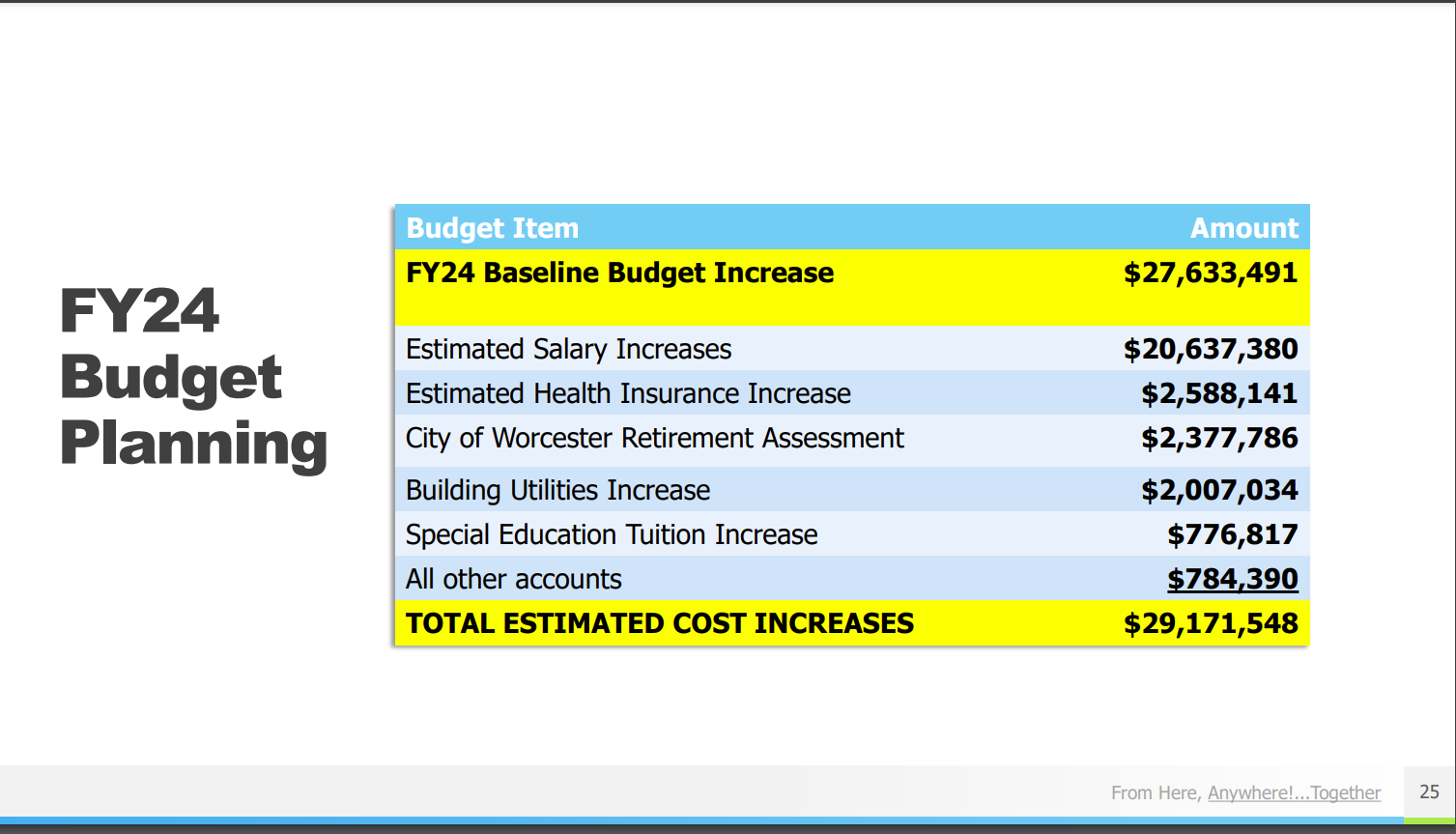
- The agenda for Thursday night's meeting of the Worcester School Committee, including the preliminary presentation on FY24, is now available online here. This does include the annual "where are we actually at" calculation:

- This afternoon, the Worcester School Committee sent a letter, per our vote on February 27, outlining our concerns with the Worcester Cultural Academy Charter School's financial relationship to Old Sturbridge Village, the proposed management fee under the public purpose limitation, conflict of interest issues with their trustees, and the civil rights concerns given their lease with the Roman Catholic diocese of Worcester. It is accompanied by 184 pages of documentation.
Now over to the state officials to respond.
Friday, May 20, 2022
What happened at last night's Worcester School Committee meeting: May 19, 2022 edition
What happened at last night's Worcester School Committee meeting (agenda; video)? Here are the highlights:
First, the headline news:

signed by us Thursday night, in the mail to California Friday morning.
We also voted a three year contract renewal with Kay Seale, who is our director of special education.
We're in contract negotiations, so I don't want to say too much, but we did have some of our WPS bus drivers speak to us.
 |
| ...which gives me a good excuse to share this photo! Yesterday, I got to ride a morning set of bus routes on S-29, with driver Tina Mansfield (left) and monitor Justa Fernandez as part of the EAW's Walk a Day in Our Shoes initiative. |
We also had--and, honestly, I can't tell you how proud I am of this--a strong showing of school psychologists and school adjustment counselors, who spoke on their petition regarding student mental health, in response to the report of the superintendent at the last meeting of the School Committee (also covered behind the paywall here). It takes courage to show up at a meeting and say, "No, it's really this way," when the dominant narrative has been otherwise. As covered in the WGBH piece linked above, our staff strongly argued, and gave data supporting, the need for additional resources and connections in our schools. Staff also used the public comment portion of our meeting--which is new this year!!--to make additional remarks on this issue.
Also Mayor Petty had an item on this agenda to set up a meeting between our mental health staff and the Mayor's Task Force on Mental Health.
In reporting out on two subcommittees, I do want to note that there are ongoing discussions in TLSS on elementary libraries, and Governance is continuing to chug through our student handbook, as well as do some preliminary work on our revision of our strategic plan.
The COVID update was not good. The latest meeting of the medical advisors, as transmission remains high and the local hospitals are becoming concerned, yielded a "strong recommendation" that those in schools (and elsewhere inside) wear masks. The district's student vaccination rate is 35.5% double vaxxed, with another 6.74% with the third shot. That's lousy.
This week's positives: 252 students, 84 staff.
We got a report back on principal succession planning, which didn't include which principals are leaving and being replaced--we aren't being given this information at all--but did have a bit of an outline on school-level involvement, described as follows:
Candidates are screened by Human Resources for the appropriate DESE license. Licensed candidates are reviewed by an administrative team which selects candidates for the school-based committees to meet. The Site Council and the principal at each school identifies family and/or community members for the interview panel. Each committee consists of representatives from schools, central office administrators, the Chief Diversity Officer, members of the Superintendent's Advisory Committee, and school leaders. The committee meets the candidates, reviews resumes, asks questions and discusses the candidates responses. The Superintendent receives the interview committee's recommendations, meets with the candidates and makes the hiring decision.
After asking, we're going to receive a list of which principals are being hired.
We also filed some new items, to wit:
- a request for a report on CORI reports on student volunteers. My colleague Sue Mailman put this one on, and, as CORIs effectively bar some parents and family members from volunteering, asking the grounds is super important.
- a request for a report on teacher shortages and substitute coverage this year (also Mailman)
- a request for a report on specialized programs by quadrant and student access to those (these from Jermoh Kamala)
- a request from me that we get a report prior to the end of the fiscal year next month on district adherence to MGL Ch. 32, sec. 90 and 91, as operational under the waiver passed during the FY22 budget process. This is hiring former employees who are now retired; there are caps on hours and pay.
- a request from me that we look at our sexual harassment policy and its alignment with federal requirements (which are in a weird state of flux, as the rules from the Trump administration largely remain in force, but the Biden administration has said they're revising, plus Attorney General Healey has reminded us that Massachusetts has a higher standard). This one stemmed from some considerable concerns that have arisen among students on how the district handles sexual assault and harassment cases, in some cases. At the meeting, Superintendent Binienda passed out to us paper copies of a proposed revised policy in light of some of the issues that have been raised locally (which I'll share on here once we have it electronically). That goes to Governance for revision.
- A request from me that the Superintendent and her staff and the other employees of the district follow policy GBEBC and the state ethics law in refraining from using district resources, including district emails, from private fundraising, however good the cause. Enough said.
- And I'm really proud that my colleagues unanimously passed a proposed resolution for the MASC Delegate Assembly in November. If five committees across the state pass the same resolution by June 1, it automatically goes to the Delegate Assembly for consideration as part of MASC's state priorities. The resolution asks that the Legislature pass sanctuary laws like those proposed in other states for those who are trans and their relatives. It reads as follows:
WHEREAS The Commonwealth of Massachusetts has a long history of standing for civil rights, including advocacy for a bill of rights in the U.S. Constitution, and
WHEREAS Massachusetts codified gender identity as a protected class in the 2011 Act Relative to Gender Identity, and
WHEREAS All children deserve a safe environment in which to grow up, and
WHEREAS Some state governments are now criminalizing supportive medical care for trans individuals; moving to bar families from traveling to access such care; and otherwise violating the civil rights of trans children and their families, and
WHEREAS The defense of the civil rights of the historically marginalized is contained within the first article of the Massachusetts Constitution right of “seeking and obtaining their safety and happiness,”
THEREFORE the Massachusetts Association of School Committees call on the Great and General Court to join with other states in the passage of so-called “sanctuary” laws to ensure such children and their families have “the power of enjoying, in safety and tranquility, their natural rights and the blessings of life,” as guaranteed by the Constitution of the Commonwealth.
Saturday, December 28, 2019
First Worcester School Committee meetings of the new term (and a few notes from me)
- The Committee meets before the meeting to draw seats and to take a straw poll on the position of vice chair (the Worcester School Committee elects their own vice chair each year). The seats, for those not familiar with Worcester's arrangement, are assigned for the two year term in the Esther Howland Chamber at City Hall, where the City Council also meets: Because the Council has eleven members including the mayor, there are ten desks (the Mayor chairs all meetings from the dais), of which the School Committee uses six.

The straw poll for vice chair is a dry run for the actual vote which takes place during the ceremony.
- During the Inauguration, the Committee votes for vice chair for the year. The rules of the Committee say:
A Vice-Chairperson shall be chosen for the year ensuing from the members of the School Committee by a vive voca vote, each member present answering to his name when called by the Clerk or other proper officer, stating the name of the person for whom he votes, or that he declines to vote. The Clerk or other proper such official shall record every vote.
In Worcester, the School Committee vice chair has no independent authority; they simply run the meeting when the Mayor isn't there (which, to his credit, isn't often under Joe Petty's mayoralty). - After the Inauguration, the Committee votes to accept "the policies and by-laws of the previous School Committee to be in force until changes are accepted," so they have something under which to continue to meet.

While I do plan to continue to post a gloss of at least the full Committee meetings here, as I have for...years, at this point, there may be a bit of a change, as I began to note over here, and I want to talk a little bit about why.
The code of ethics under which school committee members in Massachusetts operate, found in full here, has two pieces that, in my mind, particularly are relevant around social media and serving as a member:
- under "relations with administration," one is to "[r]efer all complaints to the administrative staff for solution and only discuss them at Committee meetings if such solutions fail." I frame this as "don't stick it on an agenda if you can do it with a phone call," but it also means that complaints, as a member, go to those who can fix them, not to the larger universe, unless that becomes necessary. Frankly, I'd always rather have things fixed than make it a point that I had anything to do with the fixing, so you may see fewer public Worcester concerns here and elsewhere online. Please know that doesn't mean they aren't being voiced, which may well include from the floor as needed.
- under "relations with fellow members," one is to "[r]ealize that they should not make statements or promises of how they will vote on matters that will come before the Committee." This can be a tough one to hear and a tough one to do. What it does, however, is respects the role deliberation during a meeting is to have in the public process of making decisions. New members are told--and thoughtful long-serving members know well--that there will come a time or more when you come in thinking you'll vote one way, but the discussion or information presented shifts your perspective. That's how public deliberation is supposed to work!
That is going to mean, however, somewhat less opining on matters on upcoming agenda items, as my discussion of them and deciding on them as a member should be happening during the public meeting.
I'm going to do my best.
Tuesday, September 26, 2017
September Board of Education: opening remarks and new members
Prior to the meeting, two new members were sworn in: Martin West, associate professor of education at Harvard Graduate School of Education, who also has an association with the Brookings Institute; and Amanda Fernandez, CEO of Latinos for Education, who previously worked with Teach for America, and had an association with the Bridgespan Group. James Morton has been reappointed for a second term.
Thursday, October 27, 2016
In Massachusetts, "pay to play" happens via donations
Their funding the charter question isn't the biggest concern of the piece, though. It's that, though we have a laws that basically say, no, you can't donate to someone's election campaign and get pension business that way from the government:
The cash flowing to the Massachusetts school initiative spotlights more than just a fight over education policy: It exemplifies one of the ways in which the securities and investment industry can get around a federal rule that was designed to restrict financial executives from giving campaign cash to governors with the power to influence state pension business.
In the case of Massachusetts, since the federal rule does not cover money donated to governors’ policy initiatives, executives banned from donating directly to Gov. Baker are able to give to a constellation of groups that are pushing his pet cause — and that in some cases are advised by Baker’s political associates. Meanwhile, Baker’s appointees at the state pension board are permitted to continue delivering investment deals and fees to those same donors’ firms.So basically, they're funding what we now know from the Globe's report is very much Baker's pet initiative and are getting the business of the state pension system (whose board is appointed by the Governor).
Not pretty.
Wednesday, September 23, 2015
Committee meeting on vision, goals, and policy
Backup on policy is here
Reviewing the changes
HELD until the next meeting in October
Kootcher: aligning goals of committee with goals of superintendent
superintendent goals need to be considered in light of this
integration of policy and budget in practice
topical heading related to the goal may be selected
SC needs to decide which kind of goals they want to pursue
goals for the committee and/ or goals for meetings
many committees deal with their dealings with the public
many look at their role in improving student achievement
time for the School Committee to think about what its individual goals should be
Superintendent's goals related to district improvement and student learning
professional development for School Committee members, both as a body and for the community
district engagement: how their work may effect the social and emotional well being of students
fiduciary responsibilities of School Committee
most prudent School Committees take three or four goals
given that the Superintendent has been extremely specific in establishing student learning goals
"how what you do affects student achievement, public credibility, and moves the district forward"
get three or four priority areas on the board; identify the roles of the School Committee, then figure out how the role of the School Committee translate into those goals
"standards to which School Committtees are held are higher than about any other role in this country"
School Committees are held to a higher standard, to focus policy and to focus on direction; leave the management to the Superintendent (and City Manager)
in a plan E charter, it makes it a crime for the City Council to interfere (or try to) in the management of the city
"of course there are disagreements about what that intervention is"
"we fight very hard to get our members policies orientated on policy...and stay out of the weeds"
keeps the bad guys off our back
areas:
community outreach (suggestion was public hearings)
students (at risk,
student achievement (reading, student learning, district achievement, students at risk, absenteeism)
safety/ environment (community use, facilities,
professional development (annual self evaluation, training, code of ethics,
policy review
community outreach (forums, conducting meetings)
culture of visibility, transparency
"as a school committee member, there are many things you may do that you shouldn't do"
maintaining your own role,"that creates a very clear link between your role and the ethics law and the code of ethics"
Foley: "it's high level rather than operational"
using policy, budget, public discussion of student achievement...how can we advance the goal of student achievement
school committees have driven the focus on socio-emotional growth for students
"the board regulates itself"
"pay very close attention to policy, as you're binding yourself"
safety/environment
student achievement
professional development
education leadership/ community outreach
poicy review
putting those priorities into words and saying 'here's how we're going to do it'
not hard to put words to this
suggestion that the Mayor appoint a subcommittee to wordsmith policy
Mayor appoints O'Connell, Ramirez, and Novick to wordsmith goal language: Novick appointed chair
Thursday, November 7, 2013
MASC 13: School Law 101
with apologies for the part missed in the middle; I had to take a phone call