Showing posts with label inequity. Show all posts

Sunday, December 12, 2021

How much has Massachusetts really been trying on school funding?

This year's Shanker Institute report on the adequacy and fairness of school funding, which uses 2019 data, gives a stark picture of where we have been in Massachusetts. 
2019, of course, is when, in November, we FINALLY got a revision to the state formula, one-sixth (mostly) of which was FINALLY implemented this current fiscal year.
The work of Bruce D. Baker of Rutgers University), Matthew Di Carlo and Kayla Reist of the Shanker Institute, and Mark Weber, also at Rutgers University, the report looks at effort, progressivity, and adequacy; that is: how much are states actually trying in using the fiscal resources they have for schools, and do they make sure poor kids are getting more resources, and are districts getting enough money to get to outcomes needed.

And we don't look so hot, Massachusetts. 

First of all, given what we have in Massachusetts, we really aren't trying all that hard on funding schools. Check where we are on the map: 
 

If you take a look at the state level detail, it's honestly kind of even worse: our effort level ranks #43 in the nation (out of 49). There's a headline you're probably not going to see in the Globe
A few other stats from that state profile on effort: 
  • In FY 2019, total direct state and local K-12 spending in MA was equivalent to 2.84% of the state’s economic capacity (GSP).
  • This was 0.61 percentage points lower than the unweighted national average of 3.45%.
In other words, most other states try harder than we do to fund public education. 

While the state effort had increased prior to the recession, there was a decrease of 0.42 percentage points in MA's effort during the “K-12 recovery” period of 2012-2019.
In other words, recently, we've been going backwards.

Okay, but what about adequacy? Surely we are giving enough?
(That sound you hear is the hollow laughter of Gateway cities, among others.)
I'd argue that we already know the answer to this: 2019, which is the same year being compared here, is also when the statewide average spending over foundation--over what the Mass General Law itself calls an "adequate minimum"--was 31%. In other words, towns and cities (because remember, that addition is always local funds!) decided on their own that a third more money was called for than was required.
On this one, Massachusetts does better: a actual per-pupil (PP) spending in each state to cost model
estimates of the amount required to achieve U.S. average test scores shows Massachusetts as $997 above that amount, which places us tenth.
...I think that most of us think that we should be doing more than aiming for average U.S. test scores.

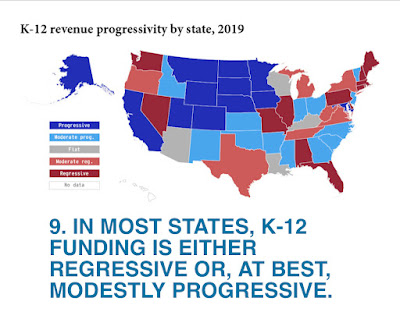
On progressivity, the news again is grim: 
Oh look: Massachusetts is a red state.

This measures "the degree to which states provide greater resources to districts serving higher-need students." This, remember, is the entire point of the foundation budget. And how have we been doing at the state level? 
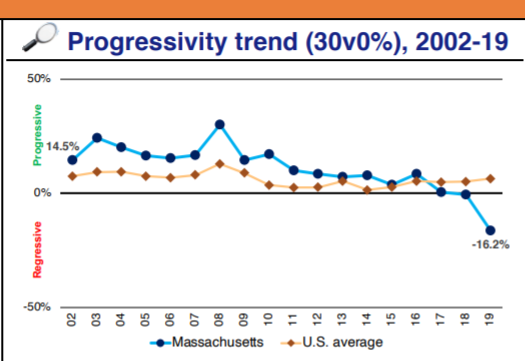
  • School funding in MA is regressive.
  • Higher-poverty (30%) districts receive 16.2% less revenue than zero-poverty districts.
  • This level of progressivity ranks #42 in the nation (out of 49).
42 and 43...leading the nation, indeed. Check out the chart: 
We've been falling since 2010, dropped below the nation in 2017, and plunged straight into regressive territory in 2019.

Now again, let me note: this is 2019 numbers. This is pre-Student Opportunity Act, and much of this is what the SOA is intended to deal with.
It should, however, be a statewide scandal that Massachusetts, which claims education as what we do and what we're about, has been doing so very very poorly on these measures. It should be in headlines, it should be active discussion in the Legislature, and the Board of Ed should be outraged that the state has let it fall so far. 
This also absolutely should be part of the story we tell about our districts: this is a Constitutional responsibility of the state, that the state has not fulfilled and has let fall to towns and cities, that the Supreme Judicial Court said in 1993 was not their issue alone. And yet it has been left to them, some of which we know, again by the SJC decision, are unable to fulfill it. 
No discussion of Lawrence or of Holyoke or of Southbridge, for certain, but also no discussion of Worcester or Fall River or Pittsfield should ever be conducted without reference to this. The state has failed students in those districts, make no mistake. 

Tuesday, June 15, 2021

Three longer reads (that are worth it)

 I've not been doing a great job of pushing shares over here (they're mostly living on Twitter or Facebook, sorry), but here are three that have recently crossed my desk that are worth a read: 

Climate change is here and it's hitting our schools

 With schools closing across Massachusetts last week due to the heat wave, we're now getting the periodic realization: lots of Massachusetts schools don't have air conditioning. And those that do, as Haverhill illustrated, often have incomplete and outdated systems.

This isn't, as this column from Andrew Ahern of Sunrise Worcester noted last week, a problem that is going to go away:

Ninety degree Junes. A year's worth of extreme heat in the matter of two spring months. Individual day records and annual average temperatures smashed. People staying indoors to avoid the heat, with businesses, community, and the liberating feeling of summer suffering as a result. More air conditioning, using more energy, making it harder for us to transition to a clean and renewable economy in time to stay within safe levels of warming and avoid days like these.

This piece in Grist connects climate change explicitly back to school buildings and--not a shock--inequitable impact: 

In looking at the schools that need the most work to prepare for climate change, Schifter saw a familiar pattern. “The need is greatest in low-income communities and communities of color,” she said. These school districts have a harder time getting the money to pay for upgrades, she told Grist, and so instead they end up frittering away dollars on the maintenance of long-outdated systems.

...see that A/C system in Haverhill. 

Lest this all seem hopeless (though do read the Grist piece for a bit of hope), I have been taking some hope as well from this Rethinking Schools editorial on the New Green Deal.

Wednesday, May 27, 2020

Creating the least bad option

The follow-up to last night's post
Let me preface this (again) by noting that I have next to no say over any of this, in any of my capacities.

And let me add (again) that I am speaking only for myself.

I fear that in the entirely legitimate concerns over what kids are losing by not being in school--food, mental health support, physical activity, along with education--we may have lost sight of the overarching concern of the time:
we are in a pandemic


As of today, more than 100,000 American people--that would be, for example, more than half the population of Worcester--have died of this disease, most of them in the past two months. That is almost certainly an undercount. And we are early in this outbreak in the U.S..

Internationally, more than 350,000 people have died. That's as if we lost all of Anaheim.
The highest risk category for coronavirus includes one-third of American teachers, as well as significant numbers of school staff.

Risks are also particularly high if you are Latinx, or Black, or Native American, or poor
Some people who don't die get very sick.
That includes children.
It also includes particular high risk categories, which also includes children.

Antibody testing, as yet, is unreliable, and we don't know yet if you can get it again.
To create herd immunity, 70-90% of a population needs to have immunity; we don't know for sure yet, but most estimates have us in the U.S. at below 10% exposure at this point.
And herd immunity alone isn't a solution

In short, we are putting the actual lives of children and school staff up against their education.
People who gather together share this disease, and then people die of this disease.
We need to not do that.

What then, are we do to?
I've heard several times lately that there is no good option: there are only bad options, and we should choose or create the least bad option possible.

To start: we need to stop and make an actual plan this time. We went flying out of schools in mid-March as if the buildings were on fire. We needed to do that, and some districts and schools managed better than others, but now we have a chance to take a breath.

We're also going to need resources, and thus, if you're reading this, here's your one ask from me: send an email to Congress and tell them we need funds for public education. Only the federal government has the resources to pull off what is needed here.

I've seen lots of citing of "Maslow before Bloom" over the course of the time we've been out: in essence, that people's basic needs of things like physical safety and enough to eat must be met before their learning needs are. It is what was recognized when the first order of business for schools was to feed kids.

And so, first: we feed kids. Right now, we're missing thousands of kids across the state: Multiply that across the country, and we have millions of kids who are missing meals.
First order of business then is do what it takes to make sure kids are fed. There are lots of models out there: deliveries are happening in some districts, some have added adult meals (without reimbursement), and the P-EBT benefit is also designed to help with that. Nationally, food insecurity is growing during the pandemic. The numbers we had for free and reduced lunch qualification in mid-March are bound to be wrong right now; we should update those numbers, as we can.
But above all: Get food to kids who need food, whoever they are, wherever they are, whatever their need.

Then, we make sure they're connected, so we can make sure they're well.
We need internet connections to every kid, no matter where they are. This is now a necessity. This isn't only about schools: it's about medicine, jobs, food...you need connection to do it. Some have made the parallel with rural electrification, in it being a matter of public interest and equity to get such access. Obviously, a federal effort on that would be ideal. Lacking that, state efforts, local efforts need to be organized such that families aren't without or dependent on making a cell phone data payment for access.
I would argue that if schools require it, districts should pay for it, but if it is used beyond that, then that could be broader.
This means, by the way, that we also need to have conversations around things like bandwidth, because some families, but also some communities, are maxed out.
Likewise, no more essays on cell phones or sharing devices. We're not sharing slates or spellers in colonial times: every student has a laptop or something of its ilk to do their work on.
We also need to recognize: kids are going to socialize on these, too. That's also part of school.
We find every kid, though, and we connect every kid.

That, of course, doesn't get us too much farther forward than we are now, save fixing some of what's broken. Next we try being actively constructive.
This takes first noting that the pandemic has hit kids inequitably. There are students right now who need more support than others. This is where our taking a breath comes in: What do those students need? How do we meet those needs?

Most of our students are going to need to feel connected. It's going to be hard to have that connection, starting off a new year with new teachers and classmates. Some have suggested looping classes, having students stay with the same teacher and classmates for another year; this gives the added benefit of perhaps having the teacher coming in with an idea of where students are at as the year begins. That won't work for everyone, though, but each student should have an adult (at least one!) who is their link to the school. Some schools have homeroom teachers for this; some have mentoring groups; with buildings closed, it is possible that this could extend beyond teachers. Students need a home base, though, from which to start. This means taking stock of each student before school starts to base the year off those connections.  For the adults: those are their kids. For the kids, this is their link to the school and district.

Some students need mental health supports. Much like everything else, this is harder to even figure out when we aren't seeing students in person. Persistence in who have we heard from and who haven't we heard from is one way, particularly through their connection with the school. Some of this can be over video, but sometimes the connection may be written. Some may be over the phone. In some cases--and this isn't the only time I am going to suggest this--maybe we are finding a way to get students someone in person, but through a glass door.
This is probably going to take more staff than we have now, too, and it's not the last time I am going to make that observation, either. Student mental health needs are higher than ever during the pandemic, and if we're going to get students through this as healthy as possible, then we need to meet that need.
As a note to this: we also know that some kids aren't safe where they are, making those connections with other adults crucial. 

The pandemic has been particularly difficult for students with special needs and their families. This has been a really hard one for schools, and there is no easy answer at all. It is another one, though, where the level of staffing, and the level of connection with families, makes a huge difference. Some of this can be done via video. Some students, though, don't respond to that. How do we get students their connections with staff members? And how to we actually PARTNER with families--who, after all, are doing much of the lifting on this--to meet student needs? Can we send people to porches and windows? I know of examples of aides moving in with families (and thus becoming part of their 'pandemic pod'). Can we somehow directly support families that are most strained by this? 

We have large numbers of students whose first language isn't English and whose families may not speak English at all. First, we've got to stop sending work home to these children in English; that makes no sense! Translation programs, with all due respect to Google, aren't that strong. Here's another staffing issue: we need more people who work for districts who speak the languages that students do at home, and that can connect with families where they're at. It is difficult to do that well if we don't have people working with them and for us who can speak and listen directly.

Not everything can be done on a computer, and families need to not be trying to scramble to get students what they need for school during a pandemic. Students need school supplies: they need paper and pencils and crayons and art supplies and science kits. If students are learning at home, they need those supplies at home. For little kids in particular, learning means hands-on materials. We need to not assume that families have blocks or markers or whatever else is needed for school. 
Note that for gym class and art class and music class, that may mean something different. Nerves would probably be strained unduly if we gave every student a recorder, but music and art should be made as well as studied (it's in the standards!) and keeping students active is essential. Worcester Hearts Connected has made a start on that last, if you're looking for examples.
That last means a renewed emphasis from the state, incidentally, that outdoor time and recess time and gym time are part of school time. School time doesn't mean you've spent hours in front of a Chromebook, home or no.

One of the disparities for students is a quiet space to work. Here is the one place that I would open buildings, but with strict scheduling for those who live together and limited access and lots of cleaning. Giving students and their families, if needed, space that is quiet to work through their math or read, if that isn't possible with limited space at home is part of attempting to make up for equity gaps. 

Little kids in particular struggle to learn remotely, and for them, we should bring our student/adult ratio WAY down, and flood early elementary with people. Unemployment is up; we have everything from students talking about taking gap years to college graduates looking for work to people sidelined by the economic downturn. CORI them all, get them some training, and create a teaching assistant corps.
Note here: assistant corps. I'm under absolutely no illusions about what it takes to teach elementary school, and that can't be replicated short term (regardless of what particular national programs may have done). But what would be stations in elementary school are not something one can replicate well online. Teachers teach; assistants ensure that students are connected to the learning by getting it to them.

For all students, we always start by finding out where we are. The level of online reaction (to put it mildly) to the not-revolutionary notion that we assess kids as they come back has been...something. Teachers have always need to figure out what kids know and can do before they move forward with teaching them. That is significantly more true than it ever was before this year, as some students will have continued moving forward (and may even have leapt well ahead of what would otherwise have been intended for them), and some have slid during their time away.
I have seen some suggestions, relatedly, that moving to a mastery based system, as Cleveland is considering doing, would be a timely switch. This means each student fully learns the skill or material before moving on. As students are coming in next year in radically different places from one another--always true, but more true now!--they need to start different places. They'll take different amounts of time to get to where they need to be--also always true!--so maybe it is time to make that how this works.

And speaking of teachers and of staff: first, let's get them a break, for sure, as this spring has been exhausting. Then, let's look at their needs, too. Some of them are working from home with their own kids; how do we as districts and as schools effectively work to help teachers and staff balance their home lives while teaching? What does that look like around time and scheduling and planning? If we are going to do this for an extended period of time, we need to actively be seeking solutions to that issue.
Next, what do staff need to be able to do this work well? I've seen a BIG push on tech training, which is understandable, and in many cases, was needed. But we are also talking about a societal trauma on a scale not seen in decades. We're trying to teach students in a way that hasn't been done on this scale ever. We're watching inequities grow vastly right in front of us. We are having to reach students in their homes with their families. What does that mean both for professional development and for staff support? What do staff and teachers need to connect with students, to keep and get students engaged, to actively work to overcome inequities, and to not burn out themselves? That's work that needs to start this summer and continue through the year.
This means that cultural competency has never been more important: knowing and appreciating the strengths of families is crucial to connection.

The above doesn't, of course, solve anywhere near anything. 
It won't, of course, make up for what we're missing by not having school in person. 
As best as I can tell, though, the real push to have school in person is coming less from educators, and more from those who see schools as a way of "restarting" the economy. I'd suggest we need to consider the health and well-being of people ahead of that. 

While the above doesn't fix education, it might, though, keep schools from killing people. 

Sunday, February 2, 2020

Sunday reading

Here's some things I've been reading that I'd recommend:
  • I struggle to choose what passage to quote in this interview with Paul Gorski, which I really just want you all to read all of:
    All these practices are alluring because they avoid the harder work of equity—because they don’t require that we identify inequities, how they are operating in schools, and how we’re complicit in them. I want to clarify: I do think that—in the context of a robust systemic approach to equity—some of these practices can play an important role. I wish my own teachers had access to trauma-informed classroom practices, for example, because I grew up with a lot of trauma and generally felt like I was repeatedly punished for the impact of that trauma. But what none of these approaches help us do is identify and eliminate inequities that are deeply embedded in our educational systems. When we’re not eliminating inequities, we’re instead trying to help students adjust to inequity-laden institutions—we’re feeding that classic deficit ideology.
    We challenge deficit ideologies by learning how to spot them in all their forms. Educational leaders have a big role to play here: they simply cannot allow deficit narratives and assumptions to live in their school or district cultures. On a more interpersonal level, when I hear somebody make a deficit-oriented statement, I like to ask a question that invites that person to look through a more structural lens. Somebody might say, “These low-income families just don’t value education. They never show up for anything.” In this case, I might ask, “I wonder if there are any other possible explanations for why those families are less likely than wealthier families to attend family-engagement events? Could there be an explanation other than they don’t care or they’re irresponsible?” In this way, I’m inviting somebody to try on a different lens.
    Ultimately, we challenge deficit narratives by making an intentional choice: equity efforts should never be about fixing anything about students who are marginalized in schools. They should always—always—be about fixing whatever is marginalizing students in schools. 
  • Similarly, this piece on the trap of hiring a woman of color as a diversity officer without ensuring she has full leadership support to change the culture of the organization is a challenging but necessary read:
  • I asked how that was going.
    “Not great,” she said. “The trouble is that they don’t actually want me to do my job.”
    This is a complaint I heard time and again from the six women of color CDOs I spoke to for this essay, and it is a complaint I have made myself.

  • If you have some time, try out this tool that tracks school by school demographics back over the past several decades. Worcester, try out the high schools!
  • I learned a lot from this New Yorker piece on historic preservation and Black history, including of the existence of the Rosenwald schools, which says a lot, really, that someone who reads about education history as much as I have still hadn't come across them.

Saturday, April 20, 2019

What we owe each other

Inspired this weekend by the various observances of justice, of proclamations of good news, and also by this 2012 piece from Charlie Pierce, which includes the following:
It is the doctrine of the oligarchy that there is nothing that we hold in common, that the commonwealth is a myth, that it is even a sign of softheadedness and weakness. The oligarchical power feeds on the sense that we are all individuals, struggling on our own, and enobled by the effort... A basic philosophy of selfishness is being inculcated into our politics. It will render us incapable of reacting when our democratic patrimony is swindled out from under us. There are thieves abroad in the land, making off with the blessings of the political commonwealth, and their most basic alibi is that it never existed in the first place. Once we accept that as our true history, the future is pretty much lost.
I was at an event last weekend about education policy and the question came, as it often does: how are we to fund what is needed in education in Massachusetts?

Part of the answer is that we already do. We just don't do it everywhere.

There's been a lot of talk online (publicly and otherwise) around fairness and a lot of sharp elbows around keeping what is perceived to be "mine" this spring. What I'm not seeing nearly enough of is concern for first recognizing and then meeting greatest needs.
This may mean recognizing where there are not the same needs.

Among the various workbooks posted by the Department of Elementary and Secondary Education for our perusal, as usual, is one that gives town-by-town calculations:

If you head right, over in column L, we find a column that is of great interest:

"CEY % found" is what the header says, which is "Combined Effort Yield as a percentage of foundation."
What's that?
The combined effort yield is the calculation, based on property taxes and income taxes, of what each town and city could afford (by a uniform calculation that applies to every town and city across the state) to contribute to their local district's budget. Bluntly, it's a measure of community wealth.
The "% foundation" calculates what percentage of the local foundation budget is covered by the local municipality's combined effort yield. How much of that local "adequate" (scare quotes intentional) school budget could be funded by local property wealth if that was all that was being used?

Important note: Massachusetts has districts that are funky outliers in many ways! Before we go any further with this, it is crucial to remember that we have, for example, whole towns in which single digit numbers of kids are going to school. Apply that sort of foundation budget against ANY town's community wealth, and it's going to be overwhelming in the ability of the town to fund. Those are not the ones to latch on to.

Keeping that in mind, if you sort by column L (largest to smallest), you get a list for which the first 25 is this: 


We start right off with two outliers: Mount Washington and Gosnold, which come close to framing the state's southern border, as Mount Washington (population 167 at the 2010 census) is the community that is the southwest corner of the state, and Gosnold (population 75 at the 2010 census) is the town of the Elizabeth Islands that trail off the southern end of Falmouth, so only Martha's Vineyard and Nantucket are farther southeast. Check those foundation budgets! It appears that Mount Washington has a single (middle school?) student and Gosnold has two elementary and one middle school students. Yes, those districts have significantly more ability to fund than that. 

You'll see then that, not surprisingly, we bounce back and forth a bit between the Berkshires and the Cape, both regions with, often, significant property wealth and small (and shrinking) school enrollments. Outside of Alford (part of Southern Berkshire Regional), however, the foundation budgets aren't necessarily outliers. This does, though, give perspective on why the Cape and the Berkshires fought to get income (something which many of those towns don't have as much of) included in the revamped calculation of combined effort yield, rather than straight property wealth.

As we skim down, we start to get into more of what are (if you're using the more facile sites) considered "good schools": Weston, Cambridge, Lincoln, Wellesley. And look at how much of the foundation budget those local districts can cover of their foundation budgets by the combined effort yield: 
  • Weston at 340.6% 
  • Cambridge at 278.5%
  • Lincoln at 249.8%
  • Wellesley at 228.1%. 

They can, in other words, afford to pay two or three times the foundation budget of their schools!
Off the bottom of what I've clipped above, we also get: 
  • Newton at 188.9%
  • Brookline at 180.3%
  • Concord at 174.6%
  • Watertown at 159.7%
  • Wayland at 159.4%
  • Carlisle at 147.3%
  • Somerville at 143.7%
...you'll note that we're dropping pretty rapidly here, though, even if you keep in mind I'm dropping the Cape and Berkshire towns. I could continue here, but remember that the statewide average last year was 130%! 

I note this first because the above towns are actually funding their schools at levels that otherwise elude us. In FY18: 
  • Weston funded their schools at 221.3% of foundation
  • Cambridge at 234.6%
  • Lincoln at 206%
  • Wellesley at 177.7%
  • Newton at 169.8%
  • Brookline at 182.2%
  • Concord at 219.3%
  • Watertown at 181.8%
  • Wayland at 179.5%
  • Carlisle at 215.4%
  • Somerville at 132.2%

These are towns that are, at the very least, covering their foundation gaps in health insurance and special education, ensuring that underfunding doesn't impact other parts of the budget.

I also point this out because one of the choices the state legislature is making, even as it chooses not to move ahead with the funding needed in the foundation budget for kids who are learning English and kids who have low income, is to continue to fund 17.5% of the foundation budgets of districts like those above; moreover, the Legislature continues to increase the state aid of these districts at $30/pupil, again. This is done, one presumes, from some notion of "equality."
Here's what the other end of column L looks like, however: 
  • Worcester CEY 27.9% of foundation
  • Orange CEY 27.8% of foundation
  • Lowell CEY 26.2% of foundation
  • Southbridge CEY 26% of foundation
  • Fitchburg CEY 25.2% of foundation
  • Lynn CEY 23.8% of foundation
  • Fall River CEY 23.3% of foundation
  • Brockton CEY 22.5% of foundation
  • Chelsea CEY 21.8% of foundation
  • New Bedford CEY 20.9% of foundation
  • Holyoke CEY 19.9% of foundation
  • Springfield CEY 15.9% of foundation
  • Lawrence CEY 14.1% of foundation

The state notion of "equality" pushing those increases per pupil doesn't extend so far as to ensure that all, including those above lacking local resources, districts are funding at the levels above foundation the top districts are. It doesn't extend so far as to ensure that all districts don't have the health insurance and special education gaps hit the classroom. 

There has been a notion advanced this spring that somehow the latter districts don't "deserve" to have local representation; that because they are poor, and thus majority state-funded, their districts should be state controlled. This is predicated on the false premise that the wealth within a municipality--a municipality made of particular kinds of historical decisions about whom could live there and whom could not, among other things--belongs solely to that municipality. This is of course an extension of the dispute over to what degree what we as individuals earn belongs to us an individuals.

The Constitution of Commonwealth, however--and, reaching even farther back, the history of Massachusetts even as a colony--states straightforwardly that the distinctions of family or town wealth are not what is to determine the type of education a child receives in Massachusetts "for the preservation of their rights and liberties." To use such determinants is simply unconstitutional. We as individuals, children as individuals, are not "left to struggle on our own" as Pierce states above; we are a commonwealth. 

We should act, and budget, as one. 


Sunday, October 22, 2017

On economic inequity and educational impact: TO READ

I highly recommend this piece from WGBH working with MassLive on Springfield's High School of Commerce and what poverty and inequity look like from there.
Longmeadow spends 144% of net school spending, Springfield just hits 100%, to compound the hardship. 

Thursday, August 24, 2017

How ESSA's requirement on school level finance reporting may miss the point

I just read a new paper out from Bruce Baker and Mark Weber entitled "State School Finance Inequities and the Limits of Pursuing Teacher Equity through Departmental Regulation" and if you're a funding wonk type, I'd recommend it.
The upshot--and I'm oversimplying here--is that the requirement that ESSA has that school by school level finance reporting be done misses the real problem of funding inequity, which continues to be one of district by district. The district by district funding inequities are the issue we see driving the Foundation Budget Reform Commission in Massachusetts, the hangup over the state budget in Connecticut and in Illinois, insecurity as the new school year begins in Wisconsin...and I could continue. As Baker and Weber point out in the paper, equity in funding lies with the states, not the fed, and until district by district inequities are dealt with, we're missing the crux of the problem.